aftermarket replacement parts · 2026-06-16

Used Auto Parts Online: B2B Buying Guide

Buying used auto parts online can cut the invoice price for older vehicles, discontinued references, and low-value repairs. That is the easy part. The harder question for a B2B buyer is whether the part can be identified correctly, installed without rework, supported under warranty, and sourced again when the next branch asks for the same SKU.

A used component may be sensible for a one-off, customer-approved repair with limited warranty exposure. The same component can be a poor fit for a distributor, importer, fleet programme, or multi-location repair chain that needs repeatable availability, barcode control, consistent packaging, export documents, and predictable claim handling. An USD 18–35 used water pump is not cheap if a repeat failure adds labour, coolant, towing, diagnostics, and customer compensation. New aftermarket parts carry a different cost structure, but they can also offer controlled materials, dimensional checks, production records, batch traceability, and clearer commercial terms.

This guide gives procurement teams a practical way to decide when used online supply is acceptable, when to move a reference into a new aftermarket programme, and what evidence to request before volume purchasing. Driventus is an independent aftermarket manufacturer; brand names and OE references are used for fitment identification only.

Start with the repair risk, not the listing price

The first sourcing decision is not “used or new.” It is: what happens if this part is wrong, late, or fails after installation?

Used parts can work where cosmetic condition is acceptable, mileage is known, the part is non-critical, and the labour exposure is low. Engine and powertrain components need tighter control because removal, installation, fluids, calibration, retesting, and complaint handling can cost 3–10 times more than the unit itself.

Classify the requirement before asking for quotes:

</tr></thead><tbody> </tbody></table>When comparing used auto parts online, capture the part number quoted, OE reference, donor vehicle year, engine code, transmission type, mileage band, visible casting number, connector count, bolt pattern, sensor ports, and supersession notes. Do not rely on a generic cross-reference alone. Formats such as OE 06A107065 or OE 11251… can help align cataloguing, but they do not prove interchangeability. Regional variants, emissions packages, cooling layouts, production dates, and supersessions can all change fitment.

Set a threshold before the buyer starts browsing. For example, allow online used supply only when annual demand is below 10–20 units, the part is non-critical, the customer accepts used condition in writing, and the seller offers at least 14 days of return rights. Move the SKU into aftermarket review when demand exceeds 30–50 units per year, branch mis-picks occur more than twice per quarter, or likely warranty exposure is greater than the unit saving.

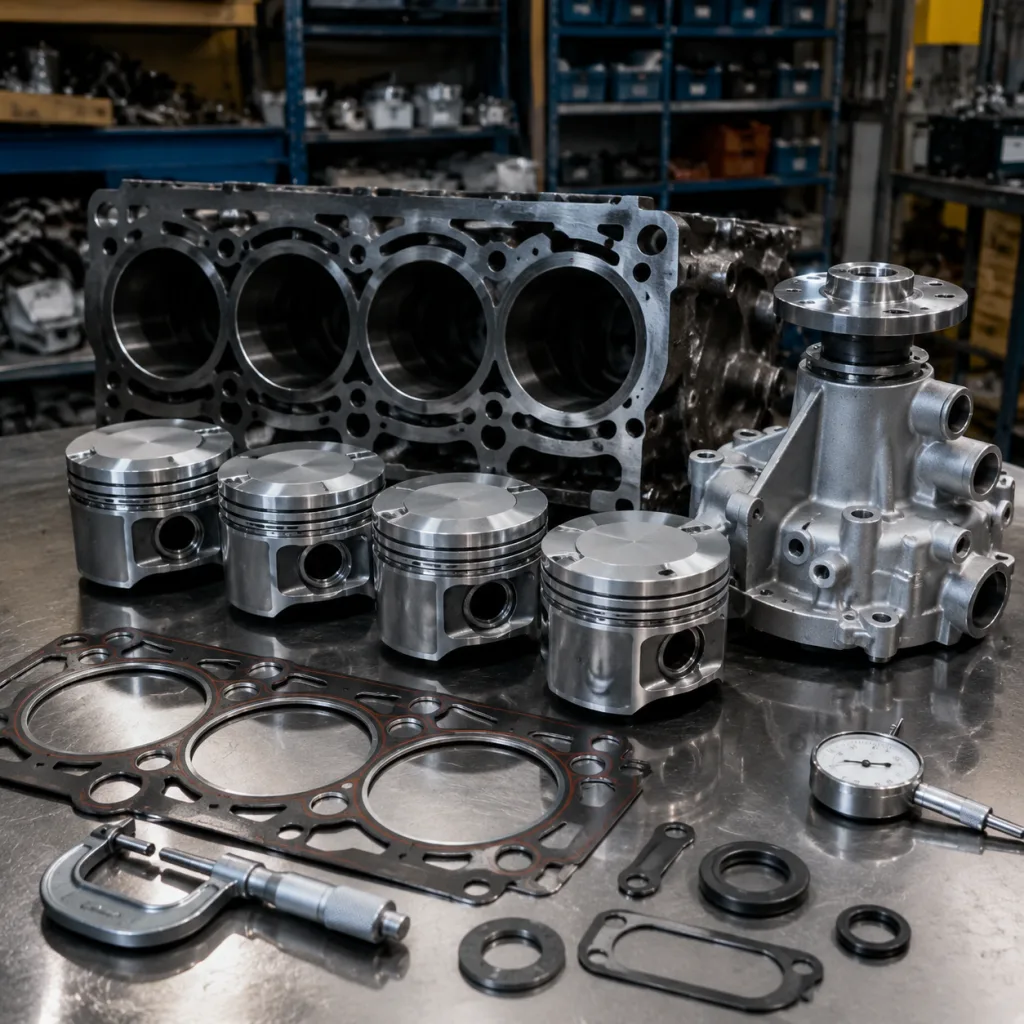
For repeatable replacement supply, buyers can review our catalog for engine and powertrain categories including pistons, crankshafts, gaskets, water pumps, turbochargers, bearings, and valve train components.

Used online supply vs. new aftermarket: the real trade-off

Used supply wins in one situation: a specific reference is needed quickly, and no repeatability is required. It is often useful for discontinued, slow-moving, or hard-to-find parts. Its weakness is variation. The same listing title can cover different production years, operating environments, mileage bands, storage conditions, and repair histories.

New aftermarket supply is not automatically better. It still has to be verified. The difference is that new production can be specified, measured, packaged, repeated, and traced. Buyers can request material grade, heat treatment records, dimensional reports, surface finish targets, batch codes, and packing standards. For quality-sensitive markets, documents linked to IATF 16949:2016 and ISO 9001:2015 help assess process control instead of relying on catalogue claims.

Requirement type Typical use case Procurement priority Common sourcing route
One-off service repairOlder vehicle, customer-paid repair, urgent replacementLow purchase price, 24–72 hour delivery, acceptable condition evidenceSalvage, used, remanufactured, or aftermarket
Stocking programmeRepeat demand across branches or distributor customersSKU continuity, packaging control, warranty consistency, fill rate above 90–95%New aftermarket or remanufactured
Technical or OEM projectEngine build, Tier-1 supply, private label, special applicationDrawing control, material specification, PPAP-style records, audit accessNew production or custom tooling

</tr></thead><tbody> </tbody></table>Use expected cost, not listing price:

`expected cost = unit price + inbound freight + handling + probability of failure × claim cost + probability of misfit × return cost`

If a used turbocharger is USD 120 cheaper but carries a 10% chance of a USD 250 labour dispute, USD 25 of the saving has already disappeared. That calculation still excludes branch administration, customer downtime, and the risk of losing the repair account.

For new aftermarket supply, price must be tied to specification. A piston quotation without alloy grade, pin-bore tolerance, ring-groove measurement, weight group, and coating detail is not comparable to a controlled production offer. A water pump quotation should state housing material, bearing specification, seal type, impeller material, leak-test method, and packaging.

Failure modes to catch before a purchase order is released

Most used-part problems are predictable. The listing looked close enough. The photo hid the damaged surface. The seller refunded the unit but not labour. The branch could not return it across the border. The part fitted one production year but not the next.

A verification routine prevents those failures from becoming normal operating cost. Save the checklist with the PO and shipment record so warranty, customs, and branch teams can see what was approved.

Minimum checks for used online listings:

  • Confirm OE cross-reference format and application notes, including engine code, displacement, fuel type, emissions variant, transmission type where relevant, and production date.
  • Request at least 6–10 clear photos: front, rear, side, casting marks, connector positions, bolt holes, sealing faces, impeller or turbine condition, threaded areas, and machined surfaces.
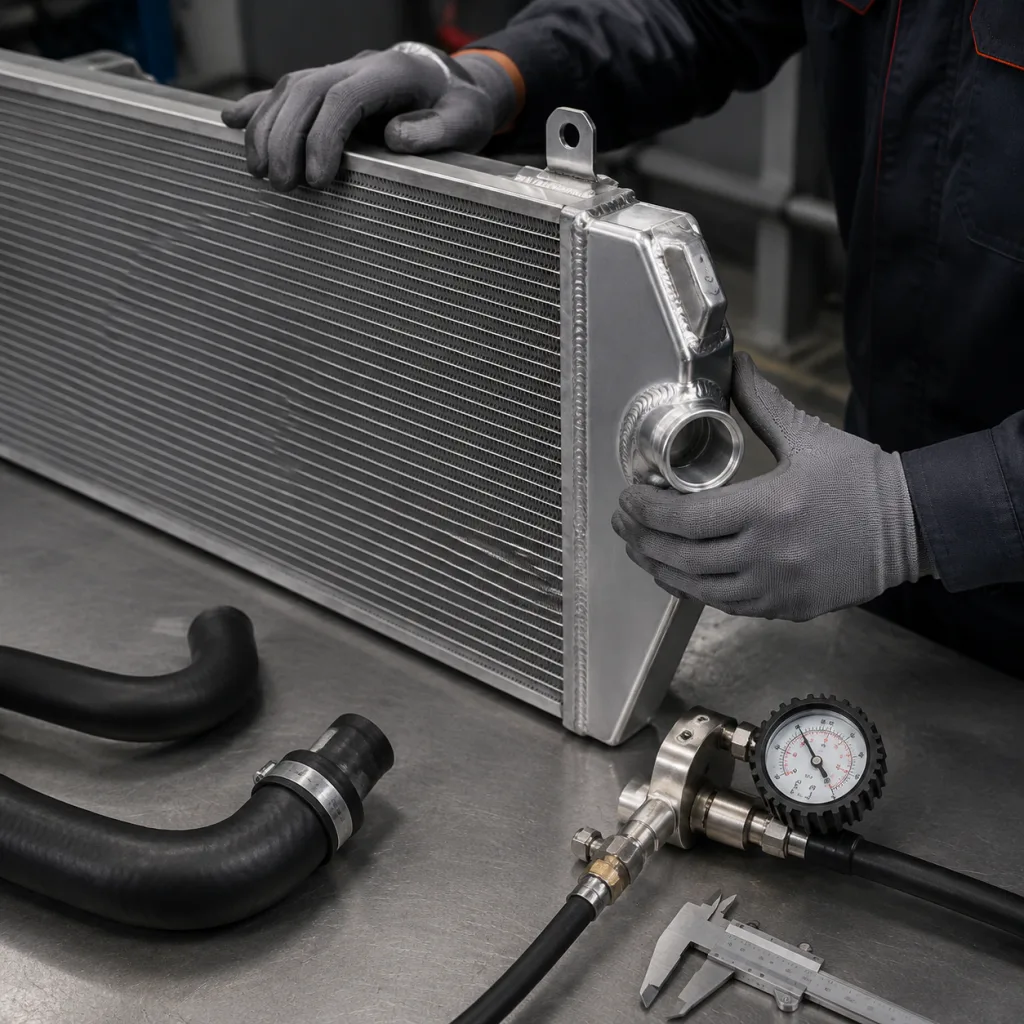
  • Ask for mileage, donor vehicle condition, storage history, and whether the part was tested under operating temperature and pressure. For cooling parts, request a pressure-test value; for electrical or actuator parts, ask for a video or test report where practical.
  • Confirm whether the seller covers only the part price or also diagnostic, removal, installation, fluids, towing, and labour costs.
  • Check the return window, restocking fees, export documentation, customs invoice details, and packaging method. Cross-border returns can take 2–6 weeks and may cost more than the part.
  • Avoid listings with cleaned, blasted, or painted surfaces that may hide cracks, corrosion, overheating, impact damage, or prior repairs.
  • Record screenshots or copies of the listing because marketplace descriptions can change after purchase.
  • Require protective packaging for machined faces, threaded ports, connectors, and shafts. Loose packing inside a carton is not acceptable for rotating or sealing components.

Additional checks for new aftermarket supply:

  • Dimensional report for critical features such as bore diameter, journal size, gasket thickness, gear profile, shaft diameter, pump impeller clearance, mounting flatness, and bolt-hole position.
  • Material declaration and, where relevant, RoHS or REACH (EC) No 1907/2006 status.
  • Process evidence aligned with IATF 16949:2016 and ISO 9001:2015.
  • Batch traceability code on product, label, or packaging, with retention of production and inspection records for an agreed period, commonly 2–5 years depending on customer policy.
  • Agreed AQL, defect reporting route, sample approval process, and corrective action timeline. Typical commercial inspections may use AQL 1.0 or 1.5 for major defects and AQL 2.5 or 4.0 for minor appearance defects, while functional dimensions should follow drawing limits rather than visual AQL.
  • Packaging specification for inner box, export carton, palletisation, barcode label, and private-label requirements. Confirm carton drop protection, moisture protection, anti-rust treatment, and maximum gross weight per carton.

For dimensional control, ask which features are checked 100% and which are sampled. Critical sealing, rotation, and pressure features may need 100% inspection or automated test records. Non-critical cosmetic points can often be sampled by lot. Inspect a first-article sample before mass production, then keep the approved sample sealed or fully photographed as a reference.

Driventus operates a documented quality system covering incoming material checks, machining control, in-process inspection, final inspection, packaging review, and export documentation. For high-volume programmes, this allows buyers to compare part quality on evidence rather than description.

Spec deep-dive: engine and powertrain parts that punish loose sourcing

Body trim may tolerate small condition differences. Engine and powertrain parts usually do not. A small mismatch can cause oil consumption, coolant leakage, bearing wear, combustion gas escape, turbocharger failure, or repeat labour claims.

That is why many professional buyers limit used sourcing to lower-risk categories and use new aftermarket parts for core engine repair programmes.

Critical inspection points by product family

Factor Used part from online marketplace New aftermarket replacement part
Purchase costOften lower per unit; quote is usually one-off and non-repeatableHigher than used, usually lower than many OE channels; price may reduce with 300, 500, or 1,000+ piece lots
ConditionVariable; mileage and service history may be unclearNew production with defined inspection criteria and acceptance limits
TraceabilityOften limited to donor vehicle, seller record, or lotBatch, material, inspection, and production records may be available
Fitment riskDepends on listing accuracy, photos, and supersession knowledgeManaged through cataloguing, OE cross-reference control, sample confirmation, and first-article checks
Warranty riskShort return window; labour usually excludedNegotiable B2B terms, defect analysis, sample retention, and corrective action process
Repeat availabilityUnstable for multi-branch demandForecastable with MOQ, lead-time planning, and repeat production
Compliance documentationLimited or unavailableCan support REACH (EC) No 1907/2006 and customer declarations where applicable

</tr></thead><tbody> </tbody></table>Useful control examples include piston weight grouping within a few grams per engine set, pin-bore and skirt dimensions checked against drawing tolerance, crankshaft runout controlled in hundredths of a millimetre, machined sealing-face flatness verified with a gauge or CMM, and water-pump leak testing at a defined pressure and duration. Exact limits must come from the drawing, OE reference, or approved sample. If a supplier cannot state its measurement method, gauge resolution, or sampling plan, treat the offer as higher risk.

Turbochargers need particular discipline. A used complete unit, a rebuilt unit, and a new aftermarket unit are not equivalent. Used online photos may show a clean housing while the real faults are shaft wear, oil coking, compressor wheel contact, actuator calibration error, or contaminated oil passages. New turbocharger programmes should document balancing, actuator setting, housing clearance, wastegate movement, and cleanliness protection before packing.

For emissions-related components, consider the destination market. ECE R-83 applies to vehicle emissions in relevant type-approval contexts, while replacement parts may need to support vehicle compliance when installed correctly. Brake friction buyers may reference SAE J2527 for dynamometer test procedures, although it is not an engine component standard.

Used auto parts online may be acceptable for non-critical assemblies. Rotating, sealing, pressure-bearing, and heat-loaded parts need stricter control because the expensive failure is rarely the part refund. It is the labour, towing, diagnostics, customer downtime, and branch administration that follow.

Build the landed-cost model before negotiating MOQ

Online used-part pricing is usually unit-based and transactional. That works for occasional purchases. It does not work well for importers and wholesalers managing container plans, SKU fill rate, warehouse receiving, and branch replenishment.

New aftermarket sourcing is planned around MOQ, forecast, tooling availability, production lead time, and shipment consolidation. So the commercial comparison has to include the full landed cost.

Product family Risk in used sourcing Key new-part control points
PistonsRing groove wear, skirt scuffing, detonation marks, heat damageAlloy grade, skirt profile, pin bore tolerance, coating, weight grouping
CrankshaftsJournal scoring, hidden cracks, incorrect grinding, prior straighteningNodular iron or forged steel grade, hardness, runout, journal size, oil-hole finish
Cylinder head gasketsNot reusable; counterfeit or aged surplus riskLayer structure, coating, bore size, compressed thickness, embossing control
Water pumpsSeal fatigue, bearing noise, cavitation damage, impeller corrosionImpeller geometry, shaft runout, leak test, bearing specification, housing flatness
TurbochargersShaft play, oil coking, compressor wheel damage, actuator mismatchCHRA balancing, housing fit, actuator setting, oil passage cleanliness, wastegate control

</tr></thead><tbody> </tbody></table>For standard aftermarket items, compare annual demand against MOQ instead of buying case by case. As a working rule, fast-moving small parts may justify 300–1,000 pieces per SKU, medium-value parts may justify 100–300 pieces, and heavy or high-value assemblies may be planned at 30–100 pieces depending on tooling, testing, and carton volume. Exact MOQ depends on raw material batch size, casting or forging minimums, machining setup time, packaging print quantity, and whether parts can share components across related applications.

Lead time also needs a line-by-line view. Existing catalogue items may need 2–4 weeks for production or final packing after deposit and artwork approval. Private-label cartons, special surface treatment, or added inspection can add 1–3 weeks. New tooling, drawing development, or sample validation may require 45–90 days before mass production. Ocean freight commonly adds 25–45 days depending on route and port congestion. Air freight can reduce transit time, but for heavy parts it may remove the unit-cost advantage.

A simple landed-cost model should include EXW or FOB unit price, inland freight, export packing, inspection fees if any, sea or air freight, insurance, duty, customs broker fee, destination handling, warehouse receiving labour, warranty reserve, and financing cost during transit. For example, a USD 6.00 gasket kit with USD 0.45 packaging, USD 0.35 allocated ocean freight, 5% duty, and 2% warranty reserve may land near USD 7.15 before branch handling. A used item with a USD 4.50 purchase price but USD 9.00 parcel freight and uncertain return rights may not be cheaper in real terms.

For slower references, mixed-SKU consolidation, scheduled releases, or shared tooling across related applications may be more practical than forcing a full MOQ immediately. Ask whether the supplier can combine 20–50 SKUs in one shipment, hold approved packaging artwork, and repeat the same batch label format across orders.

Driventus supports B2B programmes for distributors, importers, repair chains, and OEM/Tier-1 customers. Where catalogue parts are not sufficient, our custom manufacturing service can review drawings, samples, target materials, surface treatments, inspection requirements, and packaging standards before quotation.

Transition scenario: from emergency buying to a controlled aftermarket programme

The trigger to move away from ad hoc used sourcing is usually not one bad purchase. It is a pattern: branch complaints, inconsistent packaging, missing invoices, high return rates, long dispute cycles, or the inability to source the same reference twice.

A structured aftermarket programme becomes more practical when:

  • Monthly demand is stable across multiple locations, repair bays, or distributor customers, especially when combined demand reaches 30–50 units per month across related SKUs.
  • The part requires dimensional accuracy, sealing performance, pressure retention, heat resistance, or rotational balance.
  • Buyers need private-label packaging, barcode control, export cartons, and consistent pallet configuration.
  • The market requires material or chemical compliance declarations, including REACH (EC) No 1907/2006.
  • Technical teams need root-cause feedback, sample retention, and corrective action rather than simple refund approval.
  • The part family is strategic for margin, service level, fleet uptime, or customer retention.
  • Branch teams spend too much time checking listings, reconfirming fitment, or managing returns.
  • Return or misfit rates exceed an internal threshold, such as 3–5% for non-critical parts or any repeated failure for labour-intensive engine components.

Keep used auto parts online as a tactical channel for rare references, discontinued applications, and urgent customer-paid repairs. Do not let that emergency workflow become the inventory strategy for SKUs that affect revenue, warranty consistency, or service reliability.

A practical transition plan:

1. Rank SKUs by annual spend, claim cost, and branch search time. 2. Select the top 20–50 problem references. 3. Request samples, drawings if available, and dimensional reports. 4. Approve packaging, barcode format, carton strength, and label fields. 5. Place a pilot order rather than converting the whole range at once. 6. Track claims, returns, fitment notes, and branch feedback for 90–180 days. 7. Convert successful SKUs into forecasted replenishment.

This staged approach prevents procurement from replacing one uncontrolled sourcing channel with another. It also gives finance, warehouse, and warranty teams measurable evidence before the programme scales.

Driventus is based in Taizhou, Zhejiang, and manufactures engine and powertrain components for export to more than 60 countries. We do not claim approval or endorsement by any vehicle manufacturer. Brand names and OE references are used only to identify fitment and cross-reference requirements.

Frequently asked questions

They can be suitable for one-off repairs, discontinued references, or customer-paid jobs where risk is understood. The listing should include clear fitment data, condition evidence, testing information, photos, packaging details, and return terms. For warranty-backed repair chains, new aftermarket parts often provide better repeatability, documentation, packaging control, and stock planning.

Typical requests include business licence, IATF 16949:2016 or ISO 9001:2015 certificate, inspection reports, material declarations, packaging specifications, batch traceability method, sample approval records, AQL or inspection plan, and corrective action procedure. For regulated markets, buyers may also request REACH (EC) No 1907/2006 declarations where applicable.

Yes. Buyers can provide OE references, samples, drawings, photos, measurements, or application data for review. Cross-references are used for fitment identification only and do not imply vehicle manufacturer approval, authorisation, or endorsement.

If your team is comparing used supply with repeatable new aftermarket sourcing, Driventus can review part references, MOQ, target price, drawings, samples, tolerances, quality requirements, packaging needs, lead time, and export documentation. To discuss a programme, [request a quote](/contact.html).

Request a Quote
Cost item Why it matters
Unit priceStarting point only; does not include failure exposure or administrative cost
Freight and consolidationUsed parts often ship individually; new parts can be palletised, cartonised, or containerised
Customs documentationImporters need consistent HS codes, origin data, and invoice descriptions
Return handlingCross-border returns can exceed the value of the part
Warranty reserveHigher uncertainty requires a larger reserve and more branch support
Stockout costUnstable availability affects service levels and customer retention
Technical supportDimensional data and defect analysis reduce dispute time
Packaging and labellingConsistent packaging supports warehouse handling, barcode control, and private-label programmes