Used Auto Parts On Line: A Smarter B2B Sourcing Decision
Buying used auto parts on line can cut invoice cost sharply, often by 20% to 70% against OE list pricing. That headline saving is real. So is the extra verification work that comes with it.
For distributors, repair networks, wholesalers, and importers, the issue is not whether a seller has stock and a low price. The issue is whether the part can be identified correctly, graded consistently, shipped compliantly, and installed without creating avoidable claims. Risk climbs fast in safety-critical, wear-sensitive, and performance-dependent categories such as pistons, gaskets, crankshafts, water pumps, and turbochargers, where hidden damage, unknown service life, or poor storage conditions can undermine reliability.
That is why the real sourcing choice is rarely just used versus new. It is a commercial decision shaped by traceability, OE-equivalence, inventory continuity, quality consistency, MOQ, lead-time stability, and total landed cost. A used part that looks 35% cheaper on the invoice can end up 10% to 25% more expensive once sorting, rejects, return freight, and warranty reserve are included. This guide explains where used auto parts on line still make sense, where new aftermarket replacement parts are usually the safer buy, and which controls matter before you commit to repeat orders. Driventus is an independent aftermarket manufacturer; brand names are referenced for fitment only.
Start with the decision, not the discount
Used stock works best in narrow, predictable situations: older applications, intermittent supply, or vehicle populations too small to justify fresh tooling. Think discontinued housings, brackets, non-wear castings, and cosmetic trim. In those cases, buyers can often accept broader cosmetic tolerance as long as mounting geometry stays within spec and fill rate is usable.
The mistake is treating every used category the same. A cast housing and a crankshaft do not carry the same failure profile. Procurement teams should split part families by commercial risk first, then decide whether used sourcing is still defendable.
Fatigue, wear, deformation, loss of sealing integrity
Usually reject unless fully measured and reconditioned to spec
Cooling and forced-induction parts
Low to moderate
Impeller wear, shaft play, internal contamination
End play/radial play check, pressure or leak test, contamination flush
</tr></thead><tbody> </tbody></table>A useful working rule: used sourcing is strongest when four conditions are all true. Annual demand sits below roughly 50 to 100 pieces per SKU. The part is non-safety-critical. New-supply coverage is weak. Incoming inspection takes less than 10 to 15 minutes per unit. Once volume rises beyond that range, grading labour and stock inconsistency often eat away the apparent price advantage.
If your business sells into workshop channels and carries warranty exposure, the bar gets higher. Used stock then needs tighter intake inspection, written grading standards, and firmer seller terms. In many multi-depot operations, a new aftermarket replacement part with controlled production data is simply easier to standardise and defend.
What buyers should ask before placing any order
Good buying decisions begin with identification and documentation, not photos alone. Images help. They do not replace application data, dimensional evidence, or a usable condition grade.
Minimum verification checklist
Original application details: vehicle make, model, engine code, model year range
Part identification: casting number, stamped reference, or OE cross-reference where available
Condition grade and inspection method used by the seller
Clear images of all sealing faces, mounting points, threads and connector areas
Quantity available by grade, not only total stock count
Return policy, warranty scope and failure classification rules
Export packing method and corrosion protection
Evidence of handling controls for fluids, oils and contaminated residues
Lead time from order confirmation to dispatch, stated in working days
MOQ by SKU, by mixed lot, or by pallet if export consolidation is required
For regulated markets, compliance does not disappear because the part is used. Depending on category and destination, buyers may still need declarations aligned with REACH (EC) No 1907/2006 and related substance-control requirements.
Where fitment depends on original dimensions, ask for real inspection records on critical features such as bore size, flange flatness, shaft journal diameter, or bolt-hole position. Practical thresholds many buyers use include flange flatness within 0.05 to 0.10 mm on small sealing faces, bolt-hole positional deviation within ±0.20 mm, shaft journal readings to 0.01 mm resolution, and thread confirmation with GO/NO-GO gauges. If that evidence is missing, the order is being placed on appearance rather than engineering data.
For used auto parts on line sold in lots, grading definitions matter just as much as price. A workable structure is simple: Grade A for ready-to-install units with no repair and no structural damage, Grade B for functional units with cosmetic wear or minor serviceable defects, and Grade C for rebuildable cores only. Without written grade definitions, stock counts from different suppliers are not truly comparable.
Where used stock loses to new replacement parts
In engine and powertrain categories, the comparison usually turns on consistency, not headline cost. New replacement parts are not always cheaper to buy, but they are often cheaper to manage.
Buying factor
Used stock
New aftermarket replacement
Unit acquisition cost
Usually 20% to 60% lower than new equivalent
Usually higher on invoice
Traceability
Often limited to seller records
Batch and production traceability usually available
Dimensional consistency
Variable by individual part
Stable when produced to controlled tolerances
Warranty predictability
Lower
Higher
Inventory repeatability
Irregular
Better for planned replenishment
MOQ
Often low per piece, but availability is inconsistent
Commonly 50 to 300 pcs per SKU depending on category
Lead time
Immediate if in stock, but non-repeatable
Often 30 to 60 days for repeat orders, more predictable
Cosmetic condition
Variable
Consistent
Fitment validation
Often visual only
Can include drawing checks and validation testing
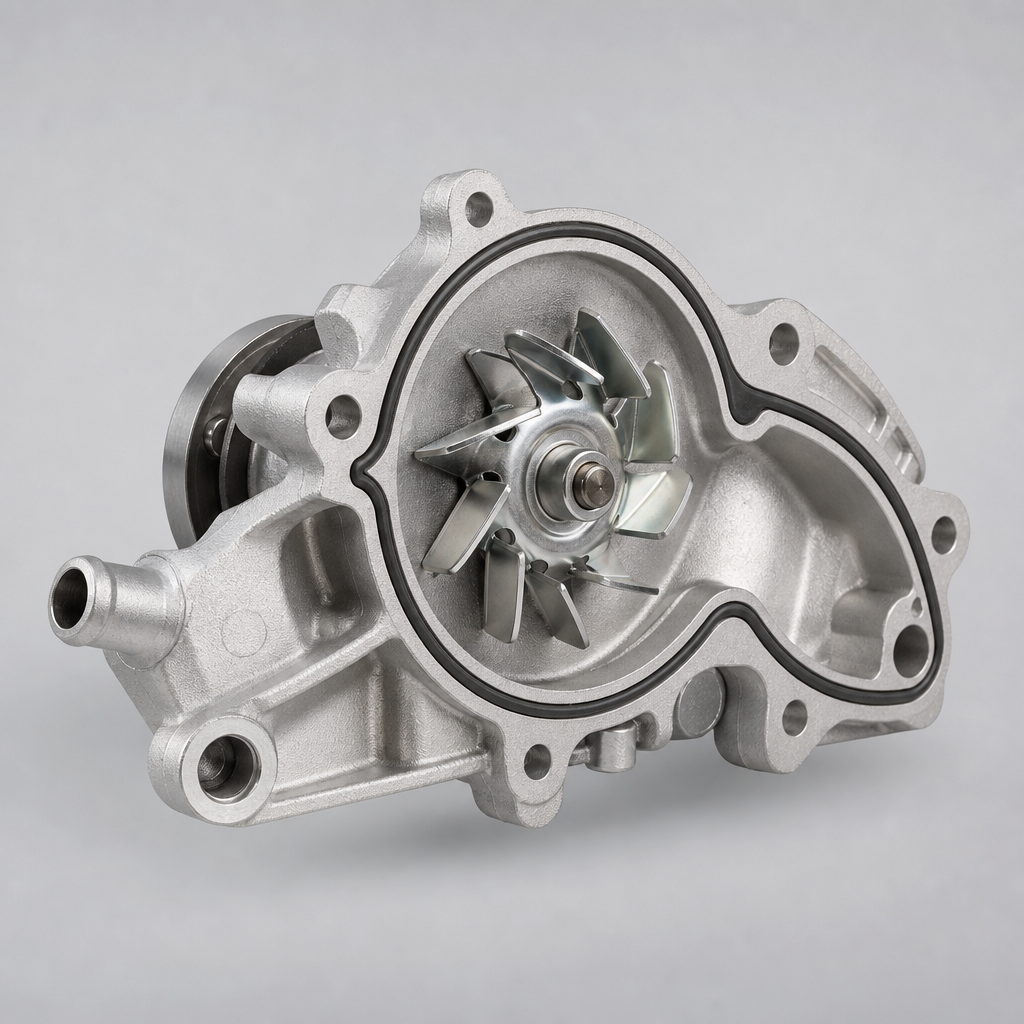
</tr></thead><tbody> </tbody></table>Take a water pump. A used unit may look clean, but the buyer still does not know bearing life, seal history, or storage exposure. A new unit can be checked against defined dimensions and endurance expectations. The same commercial logic applies to pistons, crankshafts, gasket sets, and turbochargers, where small deviations create expensive downstream failures.
This is why professional buyers compare total cost, not invoice price:
Incoming inspection labour, often 5 to 15 minutes per unit for used parts versus 1 to 3 minutes for controlled new stock
Sorting and grading time
Return freight risk
Warranty reserve rate, which may run 3% to 8% for inconsistent used categories versus below 1% to 2% for stable new programmes
Workshop rework cost
Stockout risk on repeat orders
In practice, buyers may accept used housings at 1 to 5 pieces per order while moving pumps, gaskets, or similar references to new production once demand becomes repeatable. Where replenishment planning matters, a manufacturer with documented controls is usually easier to integrate into long-term sourcing. You can review our catalog and related programmes before deciding which SKUs should remain in used supply and which should move to new replacement sourcing.
Failure modes that matter most in powertrain sourcing
If you are buying replacement parts instead of pure salvage stock, broad quality claims are not enough. Ask for controls tied directly to failure prevention.
Relevant controls may include:
Incoming material verification and supplier approval processes
In-process dimensional inspection on critical characteristics
Leak testing for cooling-system components where applicable
Balance checks for rotating assemblies
Surface finish and flatness inspection for sealing faces
Batch traceability from raw material to packed goods
Nonconformance handling and corrective action records
For used or reman-adjacent sourcing, the inspection method needs to be explicit. A crankshaft should typically be checked for journal diameter, taper, out-of-round, runout, visible scoring, and crack indication. A water pump should be checked for shaft play, impeller damage, seal leakage, and housing corrosion. A turbocharger should be checked for radial and axial shaft play, wheel contact marks, thread condition, oil contamination, and actuator status where fitted. If the seller cannot state the measurement point, tool type, and acceptance limit, the process is not robust enough for a repeat programme.
As a working benchmark, many buyers specify dial-indicator runout checks to 0.01 mm resolution, surface-finish verification where sealing is critical, and pressure or leak tests held for 30 to 60 seconds on cooling-related housings. For reusable cast housings, visual inspection alone is rarely enough; thread integrity, flatness, and crack detection at stressed locations matter more than a cleaned surface.
For export buyers, management-system certification is a useful filter. IATF 16949:2016 supports automotive process discipline, while ISO 9001:2015 provides a broader framework for document control, corrective action, and repeatability. Neither standard guarantees zero defects. Both improve visibility and supplier accountability.
When a supplier claims validation, ask for the named method. For friction and brake products, recognised methods may include SAE J2522 or SAE J2527 where relevant. For emissions-related applications, buyers may also need to consider vehicle-system compliance contexts such as ECE R-83. The point is simple: validation should be linked to a method and a record, not a marketing phrase.
You can review Driventus' quality system to see how controlled manufacturing differs from ad hoc used-part grading.
A step-by-step sourcing model importers actually use
Most experienced importers do not rely on one sourcing model. They split the portfolio. Used stock serves low-volume legacy fitments; new aftermarket parts cover higher-rotation references where claims, inconsistency, and stock gaps are harder to absorb.
A disciplined sourcing process usually looks like this:
1. Classify SKUs by failure consequence and return cost. 2. Keep used sourcing for non-critical or obsolete items only. 3. Move repeat-demand engine and cooling references to controlled new production. 4. Build an OE cross-reference file for each item family. 5. Audit packing, labelling and traceability before placing larger orders. 6. Measure supplier performance by claim rate, fill rate and lead-time stability.
The cutoff should be defined before buying begins. A common rule is to keep used procurement only for SKUs with demand below 5 to 10 units per month, claim cost below the gross margin earned on three units, and no realistic new-production MOQ. Above that point, new supply is usually easier to plan and scale. Importers often track four numbers closely: fill rate above 95%, on-time dispatch above 90%, incoming defect rate below 2%, and claim closure within 30 days.
Packing discipline matters more than many buyers expect. Used parts should be drained where applicable, bagged or wrapped to isolate residues, protected with VCI paper or light anti-corrosion oil on exposed ferrous surfaces, separated to prevent metal-to-metal impact, and labelled by grade and part number at carton level. For mixed export pallets, buyers should request a packing list showing SKU, OE reference, grade, quantity, net weight, and carton count. Weak packing control is a frequent cause of transit damage and receiving delays.
For private-label or market-specific programmes, controlled new supply also makes barcode, language, carton, and compliance planning easier. That level of standardisation is difficult to maintain with mixed-origin salvage inventory.
Where volume justifies it, buyers may also combine standard catalogue supply with custom manufacturing for tailored packaging, dimensional adjustment within design scope, or application-specific kit composition. For distributors covering multiple regions, that is often the more scalable route.
A four-question rule for deciding what to source used
If a part's condition cannot be confirmed through reliable inspection data, and if failure would create labour-heavy warranty claims, a new aftermarket replacement part is usually the safer commercial choice.
A practical rule for procurement teams is straightforward:
Use used stock for low-risk, low-rotation, non-wear items with clear grading
Use new production for sealing, rotating, pressure, heat-cycle or fatigue-sensitive parts
Require traceability and documented inspection for any part entering a repeat programme
To make the call, ask four questions. Is the part subject to wear, heat, sealing load, or high rotational speed? Can the supplier show measurable acceptance criteria such as flatness, runout, journal size, or pressure retention? Is demand high enough that you need repeatable lead times rather than opportunistic stock? Would one field failure cost more than the margin on the order after labour and freight are included?
If the answer is yes to two or more, buyers usually move the SKU to new supply.
This framework is especially relevant for engine components, where small deviations create disproportionate downstream cost. Buyers sourcing pistons, crankshafts, gaskets, pumps, or turbo-related parts should usually prioritise repeatable production control over short-term price advantage. As a guide, new-production MOQ may start around 50 to 100 pieces for selected references and rise to 300 pieces or more for stable export programmes, but the tradeoff is forecastable replenishment, consistent packing, and clearer warranty accountability. If you are reviewing options across these categories, start with our catalog or, for engine-focused ranges, `/products/engine-components.html`.
The goal is not to avoid used auto parts on line entirely. It is to use them selectively, with clear commercial boundaries, documented controls, and a lower-risk alternative ready when volumes grow.
Frequently asked questions
Usually only in limited cases. For engine internals, sealing parts, and rotating components, hidden wear and inconsistent grading raise warranty risk. Many distributors restrict used engine parts to cores, obsolete references, or very low-volume applications unless the seller can provide measurable inspection data such as journal size, runout, flatness, or pressure-test results.
Ask for application data, cross-reference details, inspection and grading criteria, images of critical areas, quantity by condition grade, packing details, MOQ, dispatch lead time, return terms, and any available compliance declarations such as REACH-related statements for the destination market. For critical categories, also request sample inspection records with actual measured values and acceptance limits.
Compare total landed cost, not just unit price. Include incoming inspection time, sorting, reject percentage, return freight, claim rate, workshop labour exposure, stock continuity, MOQ, and lead-time stability. In many powertrain categories, a used part that is 30% cheaper upfront can still cost more overall if defect rates and replenishment gaps are not controlled.
If you are reviewing which references should stay in salvage supply and which should move to controlled new production, Driventus can support the assessment with fitment, inspection, MOQ, and manufacturing data. To discuss your programme, please [request a quote](/contact.html).