Turbocharger Salt Spray Test Standard: Buyer Guide
Procurement teams often use the turbocharger salt spray test standard to compare corrosion resistance, coating quality, and assembly robustness before placing volume orders. The test does not prove field life on its own, but it is a useful screening method for housings, brackets, fasteners, actuators, and external hardware exposed to road salt, humidity, and coastal air. For turbocharger sourcing, the key is to define the test method, exposure duration, acceptance criteria, and the exact component condition being tested. Driventus is an independent aftermarket manufacturer; brand names are referenced for fitment only. We manufacture turbocharger-related parts in Taizhou, Zhejiang, and supply B2B customers under IATF 16949:2016 and ISO 9001:2015 controls. This article explains what to ask for, how to read a test report, and how to align salt spray data with your purchasing specification.
Where the turbocharger salt spray test standard helps—and where it doesn’t
The turbocharger salt spray test standard is best used as a screening tool for chloride corrosion resistance. It is useful when you need to compare suppliers, validate a coating stack, or check whether external hardware can survive a controlled corrosive environment.
It is not a full life test. A part can pass a chamber exposure and still fail in service because of vibration, thermal cycling, mixed chemicals, or poor assembly control. That is why buyers should use salt spray data as one input, not the final decision.
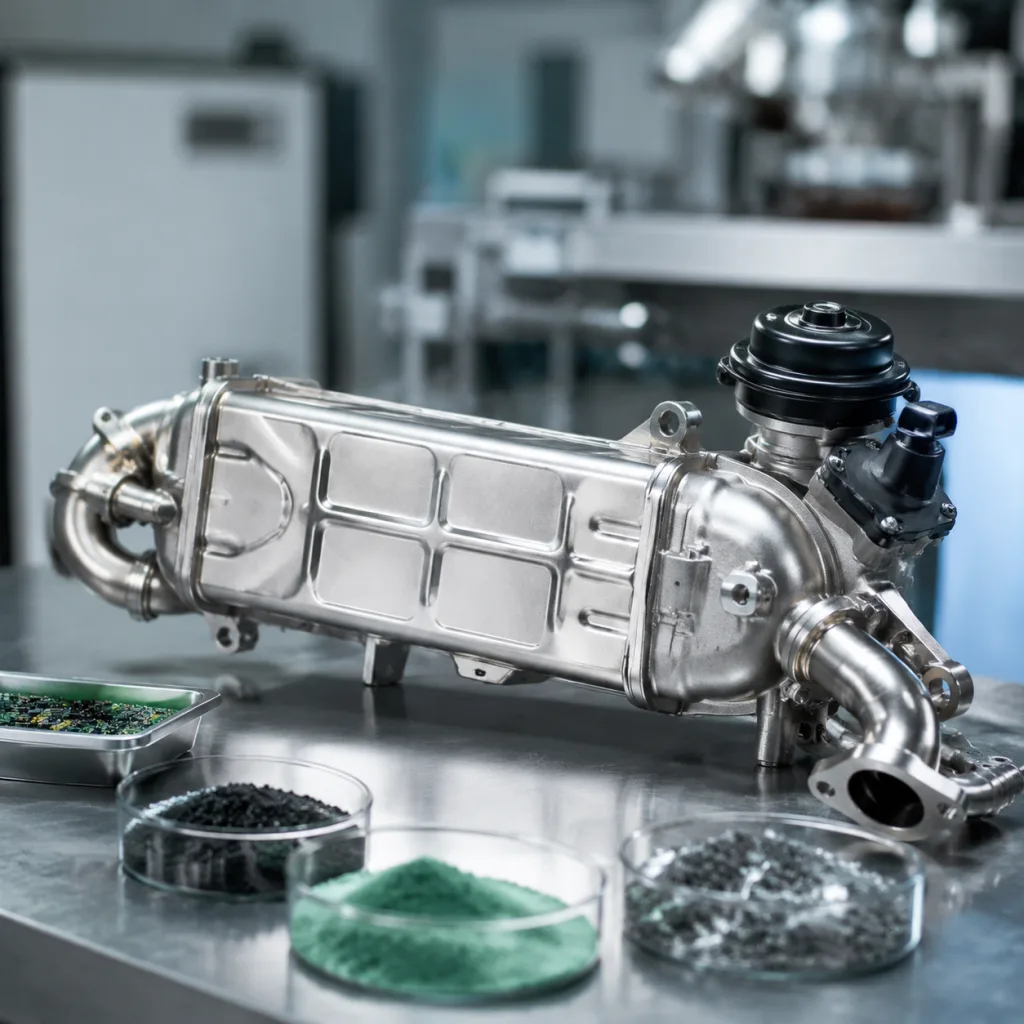
In turbocharger sourcing, the test is usually applied to external surfaces rather than rotating core components. Typical targets include:
Compressor and turbine housings
Clamps, brackets, studs, and fasteners
Actuators, heat shields, and mounting hardware
Packaged parts that may sit in storage or transit before installation
The most common published references are `ASTM B117` and `ISO 9227`. `ASTM B117` is typically run at `35 ± 2 °C` with a `5 ± 1 %` sodium chloride solution and a collected spray rate of about `1.0–2.0 mL/80 cm²/h`. `ISO 9227` is similar, but the test variant must be stated because NSS, AASS, and CASS are not interchangeable. The standard defines chamber conditions. Your purchase spec defines what success means.
What to lock into the spec before you send an RFQ
A strong specification removes guesswork. If you only write “salt spray tested,” suppliers will fill in the blanks differently and the results will not compare cleanly.
State these points in the RFQ, drawing note, or control plan:
Bare part, coated part, assembled part, or packaged part
Acceptance criteria
No red rust, no blistering, no coating lift, no functional seizure
Inspection point
Before test, during exposure, and after cleaning/drying
Report content
Chamber calibration, salt concentration, temperature, photos, and lot code
</tr></thead><tbody> </tbody></table>Add measurable tolerances where the finish matters. For example, you might require coating thickness of `15–25 μm` on zinc-nickel hardware, zinc plating thickness of `8–12 μm` on fasteners, and torque retention within `±10 %` after exposure if the component is reassembled.
If the turbocharger uses coated housings or plated fasteners, ask for coating thickness records, adhesion results, and surface-preparation controls such as blast profile, phosphate weight, or degreasing method. For Europe or the UK, also confirm REACH declarations where applicable, especially for surface treatments, sealants, and packaging materials.
How to set pass/fail rules without making them vague
Acceptance criteria should match the function of the part. A housing can show light staining and still be acceptable, while a bracket with heavy rust may no longer support the assembly safely.
Typical acceptance rules include:
No functional binding of the actuator or VNT mechanism
No corrosion penetration on critical sealing surfaces
No flaking that exposes base metal on coated parts
No thread seizure on fasteners after exposure
No loss of assembly torque beyond the agreed limit
A practical buyer target is often written this way: no red rust on any critical surface after `48 h` for light-duty exterior hardware, `96 h` for coated brackets and fasteners, and `240 h` or more for upgraded corrosion systems, depending on coating stack and market exposure.
If you need a measurable rejection rule, specify surface coverage. Example: less than `5 %` cosmetic white corrosion on noncritical areas and `0 %` red rust on sealing, thread, or bearing-adjacent surfaces.
For OE cross-reference programmes, some buyers compare the tested sample to OE `06A107065`-type reference numbers where the part family is already established. That helps define geometry and fitment, but it does not replace corrosion validation.
For severe-duty applications, ask for extra checks such as salt mist exposure after thermal cycling or post-test torque retention. And if a supplier claims customer-specific validation, request the report number, test date, and sample traceability—not a summary sentence.
How to read a report without missing the red flags
A useful report should let you trace the sample, the method, and the result. Read it in this order:
1. Match the sample ID to the purchased part number and revision. 2. Check the chamber standard, exposure time, and test temperature record. 3. Confirm whether the sample was coated, plated, painted, or bare. 4. Look for photographs before and after exposure. 5. Check whether the report records any cleaning or neutralisation step. 6. Compare the acceptance statement with your written requirement.
If any of those items are missing, the report is weak for procurement use.
A stronger report also includes chamber calibration date, salt solution concentration, pH log, spray collection rate, rack orientation, and the number of test pieces per lot, usually `3–5 pcs` for qualification and more if you are confirming process stability across multiple batches.
If the supplier cannot show traceability from report to lot code, ask for raw inspection photos and the incoming/outgoing record chain. Driventus aligns production and verification under IATF 16949:2016 and ISO 9001:2015 processes, which helps buyers trace test data back to lot control, inspection records, and corrective action history.
A sourcing checklist for real procurement decisions
Use this checklist when qualifying a turbocharger or related assembly for corrosive environments:
Confirm the test method and duration in writing.
Ask whether the sample was tested assembled or as individual components.
Verify coating or plating type, thickness range, and cure process.
Request chamber calibration records and photo evidence.
Define the allowable corrosion level by surface and function.
Require lot traceability for any production release.
Include packaging and storage conditions in the shipment spec.
For RFQs, add rules that reduce back-and-forth. Require first-article approval before production. Set a supplier response window of `48 h` for sample documentation and `5–10 working days` for a standard corrosion report if records already exist. Ask for lead time by tool status and finish type.
A typical MOQ framework may be `100–300 pcs` for standard catalog hardware, `300–500 pcs` for coated or plated variants, and higher if the finish requires a dedicated bath or oven cycle. Quote the base part, surface treatment, packaging, and test report separately so you can compare suppliers on the same basis.
If a supplier cannot hold the quoted finish tolerance, ask them to quote alternate plating thickness, topcoat, or sealing options rather than accepting an unverified equivalent. If your programme needs a different coating stack, sealant selection, or hardware package, use custom manufacturing instead of trying to force a standard catalogue item to fit every market. You can review our catalog for current turbocharger-related coverage, or go directly to request a quote when you need part-specific validation support.
Frequently asked questions
No. It is one validation tool, not a full durability programme. Use it with dimensional inspection, functional checks, material review, and application-specific cycling where needed.
`ASTM B117` and `ISO 9227` are the most common published standards. The buyer must still define duration, sample state, chamber condition, and pass/fail criteria.
Usually both, depending on the risk. External hardware and housings are the main corrosion targets, while the CHRA needs other validation methods focused on function and cleanliness.
If you need a turbocharger corrosion test requirement aligned to your part drawing or RFQ, send us your target spec and we will review it with you. Start here: /contact.html