brake pad · 2026-06-16

Trailer Brake Pads: Buyer's Guide to Fit, Friction and QA

Buying trailer brake pads is not a catalogue exercise. Two pads can share a cross-reference and still differ at the ears, shim stack, friction curve, corrosion protection, or hardware pack. That is where returns, noise claims, drag, short service life, and field comebacks usually start.

For distributors, fleets, repair chains, and OEM suppliers, the safe sourcing logic is simple: prove fit first, prove friction second, then lock the process that keeps both stable. Price matters, but only after the part matches the axle family, load profile, route conditions, packaging system, and compliance market.

Driventus is an independent aftermarket manufacturer; brand names are referenced for fitment only. This guide shows what to put into an RFQ, where trailer brake pad programs fail, how to compare organic, semi-metallic, and low-metal compounds, which inspection data to request, and how MOQ, tooling, packaging, and validation timing affect landed cost. It also covers quality evidence linked to IATF 16949:2016, ISO 9001:2015, REACH (EC) No 1907/2006, and replacement-part rules such as ECE R90 where applicable.

Start with the decision file, not the part number

A purchase order for trailer brake pads should define the fitment envelope, performance target, and commercial rules. A vehicle name or cross-reference is not enough. Build the buying file around these inputs:

  • Axle make and model, plus drum or disc brake family and caliper type
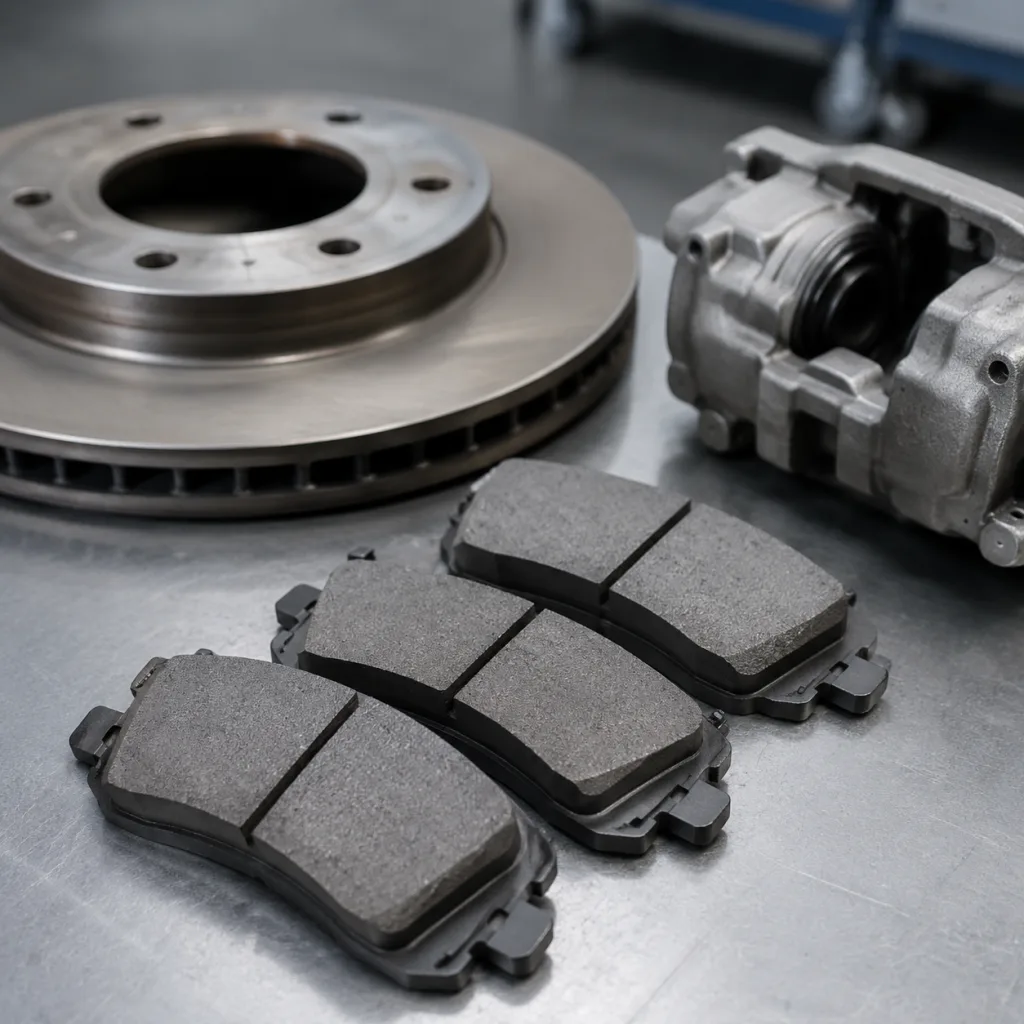
  • Pad length, width, total thickness, lining thickness, and backing plate profile
  • Backing plate steel grade, plate thickness, coating type, and corrosion target
  • Friction material family and target normal/hot coefficient range, for example 0.35–0.45 for general-duty programs
  • Operating temperature window, such as -30°C to 450°C continuous with short peaks above 500°C where validated
  • Load duty cycle: GVW/GCW, stop frequency, route grade, region, and expected service interval
  • Required hardware: shims, springs, pins, wear indicators, anti-rattle clips, grease sachets, and instruction leaflets
  • Packaging format, private label artwork, EAN/UPC barcode, carton quantity, pallet pattern, and country-of-origin marking
  • Inspection level, AQL target, sample approval process, and retention-sample requirement

If the buying team is working from a fleet list, pause before releasing volume. Check the pad against the hub, carrier, or caliper drawing. For critical dimensions, buyers often hold overall length and width to about ±0.20–0.30 mm, backing plate thickness to ±0.05–0.10 mm, and lining thickness to ±0.20 mm. The drawing still controls. A few millimetres at the ears, abutment points, or spring pockets can be enough to create drag, rattle, uneven wear, or an installer rejection.

The supplier file should include photos, 2D drawings, 3D data where available, compound code, batch traceability back to mix and cure lot, and a signed golden sample. For new tooling, set realistic timing before the RFQ becomes urgent. Prototype or sample runs may take 15–25 days after drawing approval. First production often takes 35–60 days, depending on tooling and compound validation. Repeat orders are commonly 25–45 days if backing plates and friction raw materials are in stock.

MOQ follows the same logic. Standard trailer brake pads using existing tooling and neutral packaging may be practical from a few hundred sets. Custom backing plates, private-label cartons, special coatings, custom shims, or dedicated compounds usually need higher batch quantities to absorb press setup, printing, and testing costs.

Choose the compound by failure risk, not by material label

Organic, semi-metallic, and low-metal compounds do not fail in the same way. The right choice depends on what the buyer is trying to avoid: noise complaints, dust, disc wear, fade, short pad life, or warranty labour.

</tr></thead><tbody> </tbody></table>Ask suppliers to quote the compound code and test history. A generic material name is too vague. Useful RFQ targets include cold friction, hot friction after fade, wear rate, compressibility, shear strength, noise tendency, and recovery after water or salt exposure. As a working specification, many buyers expect a stable friction band within roughly ±0.05–0.08 across normal operating conditions, shear strength above the relevant internal or regulatory threshold, and no separation, cracking, or excessive glazing after dynamometer and road simulation cycles.

Duty cycle is the filter. A pad that works on a short urban route can underperform on long descents, frequent stop-start work, refrigerated trailer duty, or trailers running close to maximum gross combination weight. If the part is intended for ECE R90-controlled markets, confirm that the approval covers the exact pad set and axle application. A generic certificate should not be accepted as proof.

Compare price per usable service interval, not only price per set. A trailer brake pad that costs 8–15% more but extends replacement intervals by 20–30%, reduces disc damage, or cuts comeback labour can be the lower-cost option for fleets and service chains.

Trace most fit problems back to these inspection points

Fitment failures usually begin at the interface between the pad, caliper, carrier, and hardware. The friction block may look correct while the steel plate, ears, shim stack, or kit content causes the problem. Use this checklist for first articles, incoming inspection, and repeat orders:

Compound type Main strengths Main trade-offs Best-fit buying scenario
Organic / NAOLow noise, lower rotor or disc wear, smooth engagementShorter life under heavy loads, more heat sensitivity, possible fade on long descentsLight-duty trailers, urban delivery, mixed fleets with low annual mileage
Semi-metallicStable friction, better fade resistance, good value, strong high-temperature behaviourMore dust, higher rotor wear risk, potential noise if chamfer/shim package is weakGeneral distribution fleets, higher load cycles, regional freight
Low-metal ceramic blendCleaner operation, steady friction, good heat control, reduced noise when tuned correctlyHigher cost, compound must match exact disc and hardware, longer validation timePremium service contracts, low-dust requirements, fleets tracking total cost per kilometre

</tr></thead><tbody> </tbody></table>### What a useful validation pack should contain Request the dimensional report, material certificate for backing plates, compound batch record, cure-lot traceability, and batch retention samples. A practical approval package for trailer brake pads normally includes first-article inspection, dynamometer performance summary, wear and fade data, shear/bond test, compressibility result, noise evaluation, corrosion check, and packaging drop or transport test.

For high-volume programs, ask for control plans and process capability on critical dimensions. Cp/Cpk targets of 1.33 or higher are commonly used for stable production dimensions, while safety-critical or customer-designated dimensions may require stronger evidence.

Process detail matters because small production changes can alter field behaviour. Backing plates are blanked or fine-blanked, deburred, cleaned, coated or treated, then bonded with adhesive and friction material. Friction ingredients are weighed to batch formula, mixed for a controlled cycle, preformed if required, hot-pressed under defined temperature, pressure, and time, then post-cured to stabilise resins. Final operations usually include grinding to thickness, chamfering, slotting, scorching where specified, shim assembly, marking, 100% visual inspection, and packing.

Ask which steps are automated, which are operator-dependent, and where mistake-proofing is used. For Europe, confirm whether the application needs ECE R90 replacement-part conformity. For plant controls, ask how the factory maintains IATF 16949:2016 and ISO 9001:2015 across raw material receipt, mixing, pressing, curing, grinding, final inspection, and packing. For chemical compliance, request REACH (EC) No 1907/2006 declarations on friction ingredients, coatings, adhesives, labels, inks, and packaging materials.

Scenario planning: distributor range, OEM program, or fleet trial

The same trailer brake pads can move through different channels, but the sourcing controls should change with the business model.

Aftermarket distributors need broad SKU coverage, consistent labels, strong cartons, barcode accuracy, and manageable minimum order quantities. OEM and Tier-1 buyers usually need stricter PPAP-style documentation, controlled change management, engineering sign-off, and part-to-print approval. Fleet operators care about service interval, downtime, predictable replacement labour, and fewer noise or vibration complaints.

A practical range plan separates SKUs into four groups:

1. Core SKUs with stable annual demand and repeat production every 1–3 months 2. Fast movers that need higher safety stock and shorter replenishment lead times 3. Application-specific items with lower volume, tighter validation, and controlled MOQ 4. Trial SKUs for fleet testing before catalogue launch

This keeps inventory from being trapped in slow movers while protecting fill rate on high-volume trailer platforms. A distributor may hold 8–12 weeks of stock for fast movers, 12–16 weeks for imported core SKUs, and buy low-volume items only against forecast or customer commitment. If production lead time is 30–45 days and sea freight adds 25–40 days, the reorder point must cover demand during lead time, safety stock, customs clearance, and seasonality.

Negotiate MOQ and price as one system. Existing-tooling trailer brake pads in neutral packing may support lower MOQs. Private-label packaging, custom shims, special coatings, or exclusive compounds increase setup time and may require full press or mixing batches. Compare ex-works price, tooling amortisation, packaging cost, testing cost, freight cube, pallet efficiency, defect allowance, and payment terms. A low unit price can disappear if cartons crush in transit, revisions are mixed, barcodes fail at receiving, or every claim requires field labour.

For fleet validation, do not jump from desk approval to full rollout. Fit pads on a defined group of trailers. Record odometer or operating hours, axle position, load profile, disc condition, bedding procedure, noise events, remaining thickness at inspection, and replacement reason. A 60–90 day pilot or 10,000–30,000 km route trial is often enough to reveal fitment, noise, glazing, or abnormal wear before annual volume is committed.

Questions that separate a brake-pad supplier from a quote machine

A weak supplier sells a price. A useful supplier protects the drawing, compound, process, packaging, and change history behind that price. For trailer brake pads, the difference shows up when batches repeat, raw material prices move, or a field complaint arrives.

Ask these questions before awarding volume:

  • Can the compound formula, backing plate thickness, shim material, coating, and packaging structure be locked for the contract period?
  • Which dimensions are controlled by gauges, CMM, SPC, or operator inspection?
  • How are friction material lots, backing plates, coatings, adhesives, and packed cartons traced?
  • What does the first-article package include, and who signs the golden sample?
  • Are barcode grade and scan checks part of packing inspection?
  • How are cross-reference reviews, axle-code matching, and fitment questions handled?
  • What buyer approval is required before a material, tooling, coating, shim, or packaging change?
  • How are claims handled: retained samples, 8D response, corrective-action timing, and replacement policy?
  • What lead-time windows apply to standard SKUs, custom SKUs, and repeat production?

Process transparency becomes more important when price pressure rises. Ask what happens if steel, copper, resin, or logistics costs change. Some suppliers quote a quarterly review tied to cost indexes. Others hold price only for a defined quantity or validity period. The cleaner the price-adjustment rule, the easier it is to protect margin and avoid quiet substitutions.

Use our catalog for standard coverage, review the quality system for traceability and process controls, and choose custom manufacturing when the pad shape, hardware, compound, carton, or validation plan must be built around a specific program. For an accurate quotation, send drawings, cross-references, annual volume by SKU, packaging requirements, target market, and compliance requirements. That lets the supplier quote the correct trailer brake pads instead of a generic substitute.

Frequently asked questions

Match the pad dimensions, backing plate profile, ear geometry, lining thickness, and hardware against the axle or caliper drawing. If possible, approve a sample set or first article before placing a production order. Photos alone are not enough because small geometry differences of 1–3 mm can change clearance, sliding movement, and wear.

Semi-metallic and low-metal blends usually suit higher loads because they hold friction better under heat. The right choice still depends on duty cycle, route grade, service interval target, disc material, and whether the buyer prioritises low dust, low noise, longer pad life, or lower total cost per kilometre.

Ask for dimensional drawings, first-article inspection, batch traceability, compliance declarations, compound or performance test summaries, and packaging specifications tied to the exact SKU. For European programs, check whether ECE R90 applies to the specific application. For factory controls, IATF 16949:2016 and ISO 9001:2015 evidence is useful.

Send your axle code, pad dimensions, target annual volume, packaging format, and required delivery window through [request a quote](/contact.html).

Request a Quote
Check point Why it matters Typical control method
Backing plate thicknessAffects caliper clearance, retention, and pad knock-backMicrometer or caliper gauge, drawing match, SPC trend
Overall pad envelopePrevents drag, incomplete contact, and assembly rejectionLength, width, height, and diagonal measurement
Ear and abutment geometryControls sliding movement and wear patternGo/no-go gauge, CMM check for first article
Lining thickness and parallelismAffects brake balance, bedding time, and service lifeThickness gauge at multiple points; parallelism target commonly within 0.10–0.20 mm
Chamfer and slot geometryReduces noise, edge loading, and cracking riskVisual, template, and cut-depth inspection
Shim stack-upControls vibration, heat transfer, and pedal feelPart-by-part build check and adhesion test
Hardware inclusionPrevents field shortages and installation delaysPacking audit, weight check, and kit verification
Coating and corrosion protectionProtects backing plate in road-salt regionsSalt-spray target, coating thickness, adhesion check