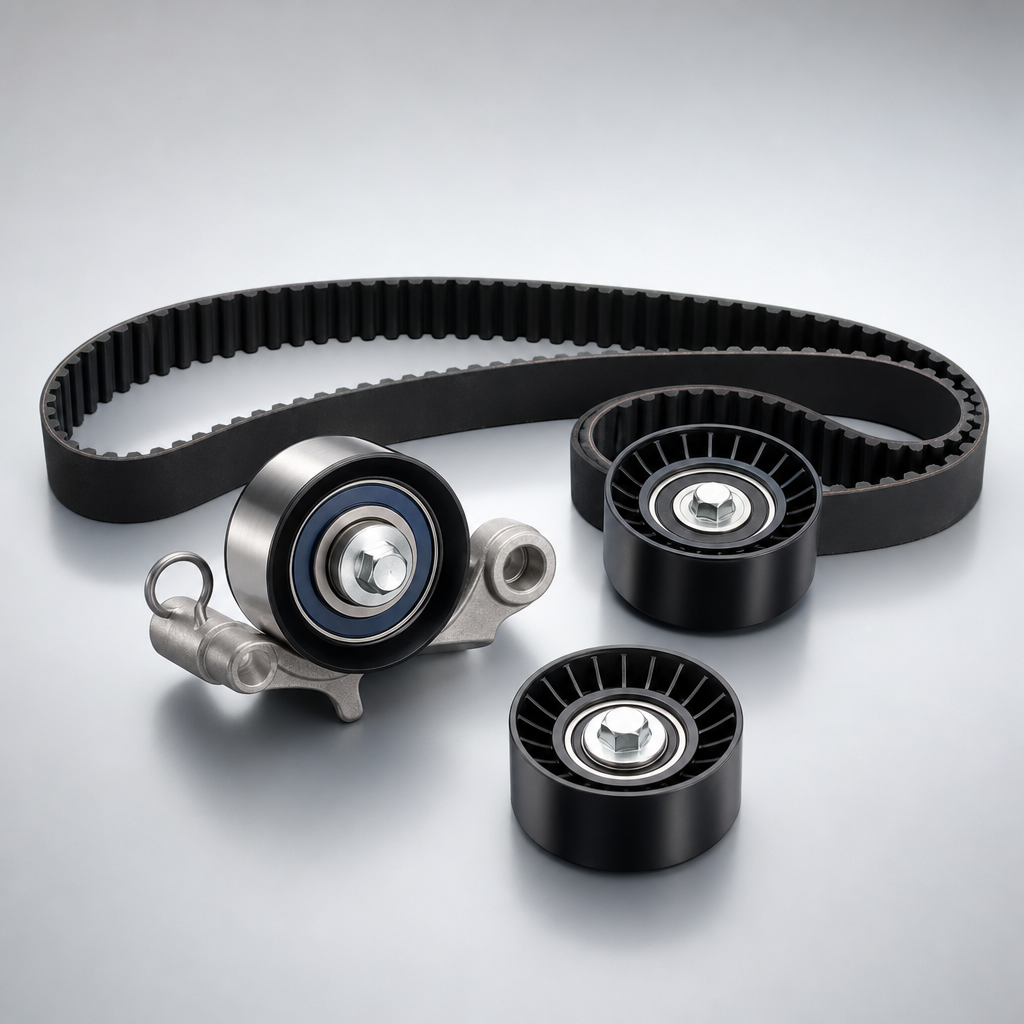
A reliable **timing belt kit material grade comparison** starts with a harder question than “Which belt compound is better?” Buyers need to know how the full kit will behave at the end of the service interval, not how it looks on arrival. Material choices affect heat resistance, pitch stability, bearing life, noise, corrosion performance and, ultimately, warranty cost. The belt, tensioner, idlers, seals and fasteners have to work as one system.
That is where low-price sourcing often goes wrong. A kit can pass incoming visual inspection and still fail early because cure control drifts, cord adhesion is weak, bearing grease is not suited to engine-bay temperatures, or pulley finish changes between lots. Those compromises usually surface later as tooth wear, bearing noise, tension loss or storage corrosion.
This article is built for procurement teams rather than catalogue browsing. It links material grade to measurable limits: temperature capability, hardness tolerance, pitch control, pulley runout, bearing life, coating performance, MOQ, tooling cost and lead time. The aim is to help distributors, OEM supply teams and repair-chain buyers compare offers on evidence instead of generic “premium quality” claims. Driventus is an independent aftermarket manufacturer; brand names are referenced for fitment only.
Start with a decision framework, not the belt alone
A useful timing belt kit material grade comparison should answer one question first: what exactly is being graded? If the answer is only “the belt,” the comparison is incomplete.
A typical kit includes:
Timing belt
Tensioner assembly
Idler pulley or pulleys
Mounting hardware
In some applications, oil seals or water pump
Instead of reviewing parts one by one without context, use a four-part decision framework:
1. Base material — rubber compound, cord type, bearing steel, pulley material, seal elastomer and fastener grade 2. Functional property — heat resistance, fatigue life, wear resistance, noise behaviour, corrosion resistance and dimensional stability 3. Process consistency — curing window, mould control, grease fill accuracy, hardness range, runout control and torque verification 4. Validation evidence — dimensional inspection, endurance testing, material reports, traceability and batch records
This changes the buying conversation. It moves the review away from brochure language and toward evidence that the assembled kit is fit for the intended service interval.
In practice, buyers should ask for numbers, not adjectives. Control points often include belt width tolerance around ±0.2 mm to ±0.3 mm, pitch accuracy to drawing, elastomer hardness within ±5 Shore A, pulley radial runout within the supplier’s defined limit, grease fill by weight, and tensioner load within a specified force window. If a supplier cannot show a control plan around those checkpoints, the grade claim is weak.
For B2B sourcing, the supplier’s quality system matters because it shows whether incoming materials, process monitoring, nonconformance handling and lot traceability are documented. Certification to IATF 16949:2016 and ISO 9001:2015 does not prove product performance by itself, but it does reduce the chance that a kit is assembled from mixed-control processes.
Commercial terms belong in the same comparison. A lower ex-works price may reflect larger MOQ, lighter incoming inspection, shared packaging, outsourced bearings or longer replenishment cycles. Compare the quality-adjusted landed cost per kit, not the opening quote.
Component-by-component: where grade differences actually show up
The table below gives a practical view of where material grade changes usually appear during a timing belt kit material grade comparison.
Component
Entry-grade material
Mid-grade material
Higher-grade material
What to verify
Belt body
CR or basic neoprene compound
HNBR blend
High-stability HNBR with controlled cure
Tooth wear, crack resistance, heat ageing
Tensile cord
Polyester
Fibreglass
Aramid or high-spec glass cord
Tensile retention, elongation stability
Tooth fabric
Standard nylon
Treated nylon
Wear-optimised polyamide fabric
Abrasion resistance, oil contamination behaviour
Idler pulley
Stamped steel
Machined steel or formed steel with tighter balance
Precision-machined steel or engineered alloy design
Runout, coating adhesion, noise
Bearings
General-purpose bearing steel
Controlled-grade bearing steel with improved grease
Premium bearing set with high-temp grease and seal design
Radial play, grease leakage, endurance
Tensioner spring/damper
Basic carbon spring steel
Heat-treated spring steel
Tight-load-controlled spring/damper system
Load retention, hysteresis, fatigue
Fasteners
Standard carbon steel
Higher tensile class with plating
Application-specific high-strength fasteners
Torque class, coating, thread quality
</tr></thead><tbody> </tbody></table>## Belt compound
For hotter engine bays, HNBR is often preferred to lower-grade chloroprene-based compounds because it handles heat, oxidation and oil vapour better. In sourcing terms, CR-based belts are more common in lower thermal-load applications, while HNBR-based belts are usually chosen where sustained under-hood exposure may reach roughly 120°C to 140°C, with short peaks higher depending on design.
But the label alone proves little. Two HNBR belts can perform very differently if cure control, filler selection, crosslink consistency or fabric bonding differ. Ask for heat-ageing performance, crack resistance and adhesion stability data. Useful indicators include hardness change after ageing, tensile retention after oven exposure, tooth shear resistance and dimensional change after thermal cycling.
Cord reinforcement
Cord grade directly affects pitch stability. Too much elongation changes valve timing accuracy, increases tooth loading and shortens system life. Polyester may be acceptable in lighter-duty applications. Glass fibre and aramid solutions are more often linked to tighter dimensional stability.
Ask for tensile and elongation data before and after heat ageing, not just the cord label. In a serious timing belt kit material grade comparison, retention values matter more than sales wording. Buyers should request the allowable elongation range under defined load and the belt length or pitch tolerance used at final inspection.
Bearings and pulleys
Many field complaints start here, not in the belt. Entry-grade assemblies may use general-purpose grease and broader radial play windows. Better-grade units usually show tighter runout control, cleaner assembly conditions and grease selected for continuous exposure in the -30°C to 150°C range or the equivalent application target.
For pulleys, ask whether parts are stamped, turned or precision machined; whether dynamic balance is checked where needed; and whether anti-corrosion coating thickness is controlled. For bearings, request internal clearance class, grease type, seal design and endurance test conditions.
Fasteners and seals
Fasteners should match installation load and service conditions, not be added as a low-cost filler item. Buyers should request tensile class, coating type and torque specification for every included bolt, stud or nut. Where seals are included, confirm whether the elastomer is NBR, FKM or another grade, especially in applications with oil splash and elevated temperature.
At the component level, upgraded grades may add only a small percentage to piece cost. At programme level, they can change warranty exposure materially. If a factory quotes far below market, ask exactly where the downgrade sits: belt compound, cord, bearing source, grease, spring steel, coating or packaging.
How to read supplier test data without being misled
A supplier approval file is only useful if it helps you separate repeatable production performance from one good sample. That is the real test of a timing belt kit material grade comparison.
Useful checks include:
Dimensional inspection of belt width, pitch, tooth profile and overall length
Hardness testing of elastomer components with defined tolerance bands
Heat ageing comparison of tensile strength and elongation retention
Adhesion testing between cord, rubber and fabric layers
Bearing endurance testing for idlers and tensioners under temperature and load
Salt spray or corrosion testing for coated metal components where relevant
Rotational noise and runout checks on pulley assemblies
When reading reports, ask four things immediately:
1. What standard or internal method was used? 2. How many samples were tested? 3. What was the acceptance limit? 4. Did the data come from PPAP, pilot run or mass production?
A strong report does not just say “pass.” It shows the result against the target. A bearing endurance report should state running hours, load, speed and test temperature. A corrosion report should state salt spray duration such as 48 h, 72 h or 96 h. A hardness report should show actual readings and tolerance, not only a nominal material callout.
For belts, practical approval questions are straightforward:
What are the final inspection tolerances for width, pitch and length?
What is the hardness target and allowable spread?
What tensile or elongation retention is required after heat ageing?
What adhesion method is used between tooth fabric and rubber body?
How many pieces are tested per lot or per shift?
For rotating parts, go deeper. Ask how assembly cleanliness is controlled, how grease is metered and how torque is verified. A capable factory should be able to explain whether grease fill is checked by weight, whether runout is measured 100% or by sampling, and how spring force or damping load is verified on tensioners.
If kits include seals or other elastomer-coated parts, destination-market compliance may also matter, including REACH (EC) No 1907/2006 where applicable. And if a supplier claims low noise, long life or low wear, ask for the exact method, sample size and pass criteria.
For importers serving repair networks, batch consistency usually matters more than one impressive report. Request control-plan evidence, sample-retention policy and whether PPAP-style documentation can be supported for programme business through custom manufacturing.
A good approval decision confirms three things: the test is relevant, the report matches the quoted kit configuration and the supplier can reproduce the result at production scale. If the report cannot be tied to lot number, mould cavity, bearing batch or production date, treat it as limited evidence.
Buyer workflow: compare two kit offers step by step
When two quotations look similar on paper, structure matters. Use the sequence below to make a timing belt kit material grade comparison easier to defend internally.
1. Confirm application scope
Check engine code coverage, tooth count, belt width, pulley geometry and included hardware. If a supplier cites an OE cross-reference such as OE 06A109119 or a gasket-style reference such as OE 11251..., verify that it truly matches the target application and is not being stretched across multiple variants.
Also confirm the exact BOM. Water pump inclusion, seals, washers or one-time-use bolts can shift the real comparison by several percentage points.
2. Force component-level disclosure
Do not accept “premium quality” as a specification. Request the declared belt compound, cord type, tooth fabric type, bearing grease temperature range, pulley material, coating type and fastener class.
Written terms such as HNBR, glass fibre cord, polyamide tooth fabric, 8.8/10.9 fastener class or NBR/FKM seal material reduce ambiguity and lower dispute risk later.
3. Match reports to the sold kit
A belt report alone is incomplete if the commercial kit includes idlers and tensioners from another source. The reports should match the actual production configuration, including bundled seals, pump or hardware where applicable.
If the factory uses multiple sub-suppliers, ask which parts are made in-house and which are outsourced. You need to know whether the approved sample and the shipped production lot come from the same chain.
4. Review process controls
Ask about incoming rubber batch checks, bearing supplier qualification, curing parameters, spring load verification, torque verification and final inspection sampling. These details often tell you more about future consistency than the sample itself.
A practical process-control checklist is:
Incoming elastomer identity and hardness check
Cord batch verification and storage control
Cure time and temperature recording for each press batch
Bearing lot approval and grease specification lock
Spring force test or damper load test frequency
Pulley runout and noise inspection method
Final kit completeness and label verification
5. Compare corrosion protection and packaging
For sea freight or long stock cycles, packaging is part of the technical specification. Weak moisture protection can damage acceptable parts before installation, especially bearings, plated fasteners and untreated metal surfaces.
Ask whether pulleys use oil film, VCI paper, sealed polybagging, desiccant, tray separation or carton burst-strength controls. If goods will move by ocean freight and sit in stock for 6 to 12 months, do not treat packaging as a minor detail.
6. Verify traceability
Every carton or inner label should link back to production date, component batch and inspection record. If a field issue appears, traceability determines how quickly affected stock can be isolated.
At minimum, labels should show kit part number, lot number, production date and inspector or line code. Better programmes also trace bearing lot, belt cure batch and packaging date.
7. Compare MOQ, tooling and lead-time logic
Quote gaps often come from supply model choices rather than material cost alone. Ask for:
Standard MOQ per kit number
MOQ for custom box or private label
Tooling charge for mould, sleeve or carton
Sample lead time
First-order lead time
Repeat-order lead time
Capacity per month at the quoted grade
As a working pattern, stock-style aftermarket kits may be quoted at lower MOQs, while private-label or low-volume applications often carry higher carton MOQs or print setup charges. A very short lead time can also signal use of shared materials or stock bearings, so confirm that the fast offer uses the same grade.
This method is more useful than comparing list price alone. Buyers consolidating sourcing across powertrain categories can also review adjacent engine component ranges in our catalog.
Failure modes: what lower-grade materials tend to cause in the field
This is where sourcing decisions become visible. A kit may look acceptable at receipt and still fail once it sees heat cycling, contamination, storage humidity or a long service interval.
Common risks include:
Heat cracking in the belt body from insufficient compound stability
Tooth shear or delamination from weak adhesion between fabric, rubber and cord
Premature bearing noise from grease breakdown, low seal quality or poor internal cleanliness
Tension loss from spring fatigue or unstable damping characteristics
Corrosion at pulleys or fasteners during long storage or humid transport
Pitch instability from reinforcement cord variation
These failures often appear even when incoming dimensions are correct. For distributors and service chains, the cost goes well beyond the part itself. Labour claims, vehicle downtime, repeat workshop visits and installer dissatisfaction add up quickly.
From a procurement standpoint, the main warning sign is a quote that sits materially below market without a clear explanation. In many programmes, a 5% to 12% gap can be explained by scale, packaging or freight terms. A bigger difference often points to a hidden downgrade in elastomer grade, cord specification, bearing source, grease type, coating thickness or inspection frequency.
Typical outcomes are predictable:
Lower belt compound stability shortens crack-free life over long intervals
Lower cord stability weakens pitch control under temperature cycling
Lower-grade grease increases noise risk after storage or repeated hot-cold cycles
Thinner coating or weaker packaging increases corrosion complaints before installation
Broader spring-force variation creates installation inconsistency across workshops
For private-label buyers, even a small increase in claim rate can erase the apparent savings from the cheaper kit. That is why warranty-adjusted cost should carry more weight than invoice price.
Pre-order Q&A: what to lock down before production release
Before nomination or first import order, ask the supplier for one concise technical package that closes both commercial and quality risk.
The package should cover:
Product drawing or key dimensional sheet
Material declaration by component
Validation summary and sample size
Routine inspection plan
Packaging specification
Nonconformance response process
Lead time, MOQ and lot traceability format
To make that package usable internally, request these points in the same approval file:
Final quoted Incoterm and price validity period
MOQ by standard pack, master carton and private-label version
Sample cost, tooling cost and artwork cost if applicable
First article timing and mass-production lead time
Monthly available capacity for the specific kit number
Standard warranty policy and claim response timeline
Lot coding format on belt, pulley, box and outer carton
If the programme is private label, clarify whether the supplier controls belt production, bearing sourcing and final kitting internally or through subcontractors. Vertical integration can simplify root-cause analysis, but only if responsibility and control points are documented clearly.
It is also worth confirming escalation timelines, warranty claim handling and whether reserve samples are retained for each production lot. These details matter more once volumes rise or multiple markets are involved.
A practical workflow is:
1. Approve drawing, BOM and material declaration 2. Review sample and validation data 3. Confirm packaging, labels and traceability 4. Lock MOQ, lead time and claim terms in writing 5. Release pilot order before full-container or annual programme volume
For many buyers, the safest route is to begin with a pilot lot sized to test receiving, storage and early market feedback, then scale once consistency is proven. This matters even more when the price is well below benchmark or the quoted lead time is unusually short.
Driventus supplies engine and powertrain components for aftermarket and industrial customers, with timing-system related products supported under a documented IATF 16949:2016 and ISO 9001:2015 framework. Buyers assessing programme fit can review our catalog and use request a quote for application and specification review.
Frequently asked questions
Not automatically. HNBR usually offers better heat and ageing resistance, but kit performance still depends on cure control, cord adhesion, tooth fabric quality and the matching quality of tensioners and idlers. Buyers should ask for actual ageing, hardness-retention and adhesion data, plus the operating temperature target for the quoted belt grade.
Both. Component tests help isolate weak points, while system-level review confirms that the sold kit works as one assembly. A belt report alone is not enough when bearings, pulleys and springs are included. At minimum, request belt material and dimensional data plus rotating-part endurance, runout and noise results for the assembled kit BOM.
Start with material declarations, dimensional reports, endurance or ageing tests, traceability format, packaging specification and certification status under IATF 16949:2016 and ISO 9001:2015. Then confirm that the reports match the exact supplied configuration. For sourcing decisions, also request MOQ, lead-time breakdown, tooling or artwork charges, and lot-level inspection or control-plan evidence.
If you are comparing timing-system suppliers or preparing a private-label programme, Driventus can review your target specification, MOQ structure, validation requirements and lead-time expectations. Contact our team to discuss fitment, materials and commercial terms at /contact.html