Rod knock is not just an engine noise. For workshops, rebuilders, and parts buyers, it is usually the audible result of a lubrication failure that has already started damaging bearings, journals, rods, or related oiling components. That is why the real job is not merely to identify the sound. It is to decide, with measurements, whether the engine needs a bearing-only repair, crank machining, a wider rebuild, or a complete change in sourcing scope.
This article approaches rod knock causes and fixes as a decision problem rather than a generic symptom list. The critical checkpoints are numerical: hot versus cold oil pressure, crankpin diameter, taper and out-of-round, rod big-end bore condition, bearing clearance, debris evidence, and the true health of the lubrication system. Those numbers determine whether buyers should order a fast local bearing set or move into a larger crankshaft, rod, pump, gasket, and traceability conversation.
For procurement teams, that distinction matters. Ordering too early can lock a repair into the wrong parts list, trigger avoidable warranty claims, and miss the root cause entirely. Buyers should always work from the engine maker's service manual and machine-shop data, but in practice the process is simple: verify the failure mode first, then align the parts package to the measured repair path. Driventus is an independent aftermarket manufacturer; any brand names or OE-style references are used for fitment identification only.
Decision framework: what rod knock is really telling you
Rod knock usually means the clearance between the connecting rod bearing and the crankshaft journal has grown beyond what the oil film can safely manage. In a healthy engine, pressurised oil keeps those surfaces separated. Once that film thins or collapses, the bearing starts touching the journal, heat rises, the overlay wears, and the sound becomes audible.
In the workshop, the pattern often looks like this:
Deep metallic knock rather than light valvetrain tick
Stronger during throttle blips, load changes, or acceleration
Louder with hot oil, when viscosity has fallen
Often paired with low oil pressure, metallic debris, or a detonation or misfire history
The important point is that the noise is rarely the whole failure. A single knocking rod bearing may be the final symptom of oil starvation, contamination, overheating, crank geometry problems, poor assembly practice, or abnormal combustion load.
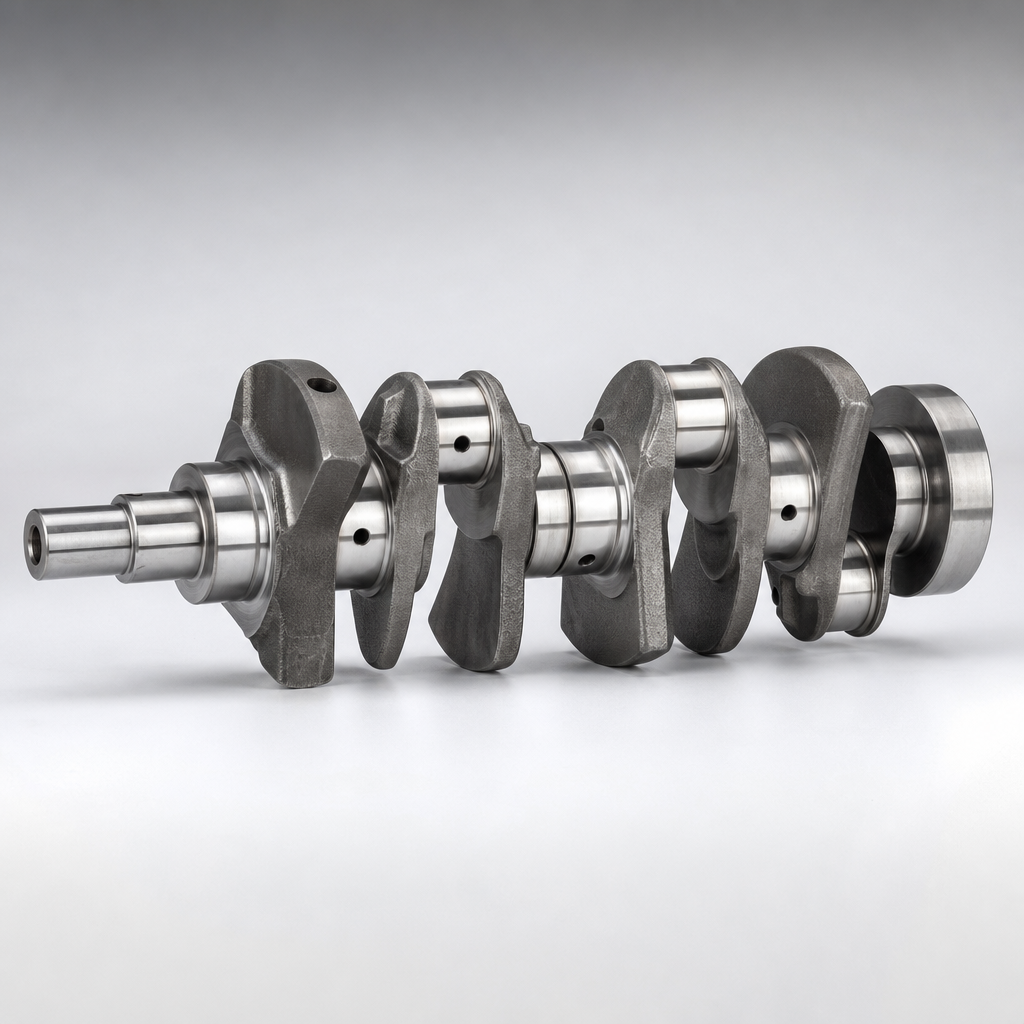
For buyers, rod knock causes and fixes should be treated as a clearance-and-system problem. On many light-duty engines, assembled rod-bearing oil clearance may sit roughly in the 0.0010-0.0030 in (0.025-0.076 mm) range, while heavy-duty and performance applications may differ. Once clearance moves beyond the OEM service limit, hot oil pressure tends to fall and knock becomes easier to hear around 1,500-3,000 rpm. Likewise, journal taper or out-of-round beyond roughly 0.0004-0.0010 in (0.010-0.025 mm), depending on design, often shifts the job from a bearing replacement to crank machining or crank replacement.
That is the commercial fork in the road. Replacing shells without checking journal finish, crank dimensions, rod big-end geometry, oil pump condition, and gallery cleanliness is one of the fastest ways to buy the same failure twice.
Failure modes compared: which root cause changes the parts list
Rod knock usually develops through a chain of damage, not a single event. Oil control weakens, temperature rises, clearance increases, and the bearing eventually loses its film. The right repair depends on which link in that chain failed first.
Failure mode
What usually happens
What to inspect next
Likely replacement scope
Low oil level or pressure
Oil film collapses under load and the journal starts contacting the bearing
</tr></thead><tbody> </tbody></table>The bearing itself often tells the story. Copper exposure on a tri-metal shell suggests the overlay is already gone. Blue or black heat marks on the journal point to temperature distress. Embedded particles indicate contamination. A spun bearing is more serious: it usually means the rod housing bore, crush, tang area, or thermal condition also needs inspection, because a new shell in a distorted rod is rarely a durable fix.
This is where quote logic changes. Common aftermarket bearing steps are standard, 0.25 mm undersize, 0.50 mm undersize, and in some families 0.75 mm or 1.00 mm. If a polish keeps the crank within standard service dimensions, standard bearings may still work. If the crank is reground, bearing size must match the finished journal exactly, and the quote should state the final journal size, fillet condition, and finish target. A common finish target after grinding is roughly Ra 0.2-0.4 um, though the machine shop should follow the crankshaft and bearing manufacturer's guidance.
Standards such as IATF 16949:2016 and ISO 9001:2015 do not diagnose rod knock, but they matter when sourcing the repair parts. Consistent process control and traceability reduce variation in bearings, rods, crankshafts, seals, and gaskets.
If combustion problems helped trigger the failure, the diagnosis should also include the platform's engine-management and emissions hardware. In some older passenger vehicle applications, frameworks such as ECE R-83 may be relevant where emissions faults affect combustion quality and long-term durability.
Step-by-step: the checks to finish before you order anything
The most expensive rod knock mistake is ordering visible parts before confirming the actual failure path. A disciplined inspection sequence keeps the parts list aligned with the measurements.
1. Separate rod knock from other noises
Use a mechanic's stethoscope or chassis ears to distinguish bottom-end knock from valvetrain noise, piston slap, wrist-pin noise, flywheel issues, torque converter noise, or accessory drive faults. On suitable systems, disabling one injector at a time may help identify a cylinder-specific issue by reducing combustion load, but only under safe workshop procedures and the vehicle maker's guidance.
A rod knock is often most obvious during a short throttle blip from idle or when the engine moves from decel to light load. Piston slap is usually louder cold and may fade with temperature. Wrist-pin noise tends to sound sharper and lighter than a big-end knock.
2. Check the lubrication history first
Review oil grade, service interval, filter type, any low-pressure warnings, and signs of fuel or coolant contamination. Cutting open the oil filter often reveals copper-coloured or silvery debris that supports a bearing-failure diagnosis.
If possible, capture the contamination numerically. Fuel dilution above roughly 2-3% can materially weaken oil film strength in some applications. Glycol contamination is especially destructive because it attacks bearing material and builds sludge. A filter packed with non-ferrous glitter usually means the issue extends beyond one journal.
3. Measure oil pressure hot and cold
Compare actual readings against the engine maker's service data. Low hot idle pressure is a common clue for excessive bearing clearance, internal leakage, or pump wear. But low pressure alone does not prove the pump is at fault; worn clearances elsewhere may be the real cause.
As a rough guide only, many engines show something like 10-20 psi (0.7-1.4 bar) at hot idle and 40-70 psi (2.8-4.8 bar) at moderate rpm. Do not build an order from generic numbers. The order file should record pressure alongside oil temperature, oil grade, and engine speed.
4. Measure the crankshaft and rods after teardown
At minimum, verify:
Journal diameter against specification
Out-of-round and taper
Surface scoring, pitting, or heat discolouration
Connecting rod big-end bore geometry
Rod twist or bend if over-rev, detonation, or hydrolock is suspected
Fastener condition and whether the design requires bolt replacement
Method matters. Use a calibrated outside micrometer for journal diameter, then a dial bore gauge for installed bearing bore or rod big-end bore. Plastigage can be useful as a quick screen, but it is weaker than recorded micrometer and bore-gauge data when a buyer must decide what to order. Many rebuilders measure each journal in at least four positions to capture both taper and out-of-round. If housing-bore distortion exceeds the manual limit, often only hundredths of a millimetre, the rod should be rejected or resized.
5. Expand the inspection to adjacent systems
Bottom-end debris rarely stays local. Inspect:
Oil pump housing and gears
Pickup screen restriction
Turbocharger bearings if fitted
Camshaft bearings where applicable
Piston skirts and pin bores
Block oil galleries
On turbo engines, assume debris may have reached the turbo bearing circuit unless proven otherwise. Pickup screens partly blocked by RTV, gasket debris, or carbon can repeat the failure even after new bearings and a repaired crank.
6. Match the evidence to the repair scope
Before ordering, decide which of these jobs you are actually buying:
Bearing-only scope: standard-size bearings, bolts if torque-to-yield, pan set, filter, oil; usually MOQ 1 set and the shortest lead time
Machine-and-build scope: undersize bearings matched to the finished crank, gasket set, pump, bolts, cleaning consumables; often 2-7 days if machining is local
Full rebuild scope: crankshaft, rods, pistons or rings as needed, pump, gasket set, seals, filters; often MOQ 1 engine set for service parts or higher MOQ for distributor or private-label supply
Repair-path comparison: when a bearing change is enough and when it is not
Not every rod knock ends in a full engine replacement. But many do require more than a fresh set of shells. The correct repair depends on measured journal condition, rod bore accuracy, oil-system health, and whether overheating or combustion damage joined the failure.
Typical repair paths
Light damage If the knock is caught early and the crank journal remains within service limits with acceptable finish, the repair may be limited to new rod bearings, new rod bolts where required, fresh oil and filter, and correction of the root cause. The journal, housing bore, and clearance still need to be measured. Assumptions are what turn a light repair into a repeat claim.
Commercially, this is the cheapest path. In many markets, bearing sets for common 4-cylinder passenger engines may sit in the low-to-mid two-digit USD range, while bolts, seals, oil, and filter add predictable cost. Lead time is often same day to 72 hours if standard sizes are in stock.
Moderate damage If the journals are scored, tapered, or out of spec, the crankshaft may need polishing, regrinding to an approved undersize, or replacement. At this point, rod knock causes and fixes stop being a simple parts order and become a machining-plus-parts decision.
Typical regrind steps are 0.25 mm or 0.50 mm undersize, depending on engine family and crankshaft hardness. Buyers should ask the machine shop or supplier to state the finished journal diameter, corner radius or fillet condition, surface finish, and whether oil holes were chamfered and cleaned after grinding. A moderate-damage job often lands in the 3-10 working day range once machining, cleaning, and parts availability are combined.
Severe damage If the bearing has spun, welded, fractured, or heavily overheated, expect additional problems: rod bore distortion, cap damage, heat-checked journals, contaminated oil passages, piston distress, and debris spread across the engine. The bill of materials often expands to include:
Crankshaft
Connecting rod
Bearing set
Thrust washers where applicable
Oil pump
Full gasket set
Pistons or rings if detonation, seizure, or skirt damage occurred
This is where repair economics shift sharply. A spun-bearing event can convert a low-cost bearing job into a four-figure rebuild, especially if one damaged journal forces crank replacement, rod matching, balancing checks, full cleaning, and wider sealing replacement. For sourcing teams, it is often more efficient to request two quote levels: repair-to-inspection result and full overhaul option.
For sealing materials and chemical compliance in destination markets, it is also sensible to confirm supplier conformity with REACH (EC) No 1907/2006 where applicable.
A durable repair restores geometry, lubrication, and cleanliness together. Leave one out, and the knock often comes back.
Spec deep-dive: what sourcing teams should verify before approving a rebuild supplier
For fleets, rebuilders, distributors, and multi-site repair groups, bottom-end parts should be sourced as a matched system rather than as isolated SKUs. Fitment matters, but dimensional consistency, material control, and traceability matter just as much.
Key sourcing checkpoints include:
Bearing material and sizing control: confirm standard and undersize availability, wall-thickness consistency, crush characteristics, and batch traceability
Crankshaft journal accuracy: request inspection data for diameter, roundness, taper, and finish
Rod machining quality: verify big-end bore accuracy, cap alignment, and whether rods are supplied finished or need final sizing
Metallurgical control: ask about forging or casting route, heat treatment, and hardness verification where relevant
Cleanliness and packaging: critical for bearing shells, finished journals, and oil-wetted components
Documentation: PPAP-style records may be necessary in some OEM- or Tier-1-influenced aftermarket programmes
Push for numbers, not claims. Useful checkpoints include bearing wall-thickness tolerance, housing-bore tolerance, journal tolerance band, hardness range, and runout limit. A serious crankshaft supplier should be able to explain material grade, nitriding or induction-hardening route where applicable, and batch inspection records. A serious bearing supplier should be able to confirm the material stack, overlay system, and size coding for both standard and undersize shells.
Standard service parts: MOQ 1-5 sets, short lead time, limited custom packaging
Distributor replenishment: MOQ by carton or mixed application list, with price breaks at 20, 50, or 100 sets
Private label or drawing-based supply: higher MOQ, often 100-500 sets depending on part complexity, plus tooling or sample lead time before production
Crankshafts and rods: lower piece-count MOQ may be possible, but sea freight economics often favour larger consolidated orders
For quote comparison, ask each supplier to state ex-works price basis, tooling cost if any, sample lead time, production lead time, carton quantity, pallet quantity, and warranty-handling process. The lowest unit price is not always the lowest risk if the supplier cannot hold size mix, provide undersize variants, or trace lots during a field claim.
At Driventus, buyers can review our quality system and discuss custom manufacturing for private label, drawing-based development, or application-specific kits.
When cross-referencing fitment, use OE-style references only where they already exist in your approved data set, for example a format such as OE 06A107065. Sound alone should never decide the part number. Final ordering should follow teardown findings, measured dimensions, and the confirmed repair path.
Repeat-failure prevention: what changes after the new parts go in
The costliest rod knock repair is usually the one that comes back. Repeat failures nearly always trace to one of three problems: the root cause was never corrected, contamination stayed in the system, or key clearances were assumed instead of measured.
Post-repair controls should include:
Verified crankshaft and rod measurements recorded before assembly
Correct bearing clearance checked with proper measuring instruments
Oil passage cleaning and a documented final flushing procedure
New filter and correct oil viscosity for the application
Priming of the lubrication system before first start
Review of injector condition and combustion faults if detonation was present
Cooling system inspection to control oil temperature
Early oil and filter inspection after run-in where the engine design and service plan permit
A useful assembly control sheet typically records rod-bolt torque and angle, housing bore, journal diameter, calculated oil clearance, side clearance, bearing size and part number, and assembler sign-off. If torque-to-yield bolts are used, they should not be reused unless the engine maker explicitly allows it. Lubrication system priming should continue until pressure is verified or oil is visibly reaching the required points, depending on engine design.
Cleanliness deserves extra attention. After a spun or wiped bearing, galleries should be brushed and flushed, not simply sprayed. Oil coolers and lines may need replacement if they cannot be reliably decontaminated. Some rebuilders also cut open the first post-repair filter after 30-100 minutes of running, or after an early service interval, to verify that debris is limited and non-progressive.
For friction and wear validation in brake or chassis categories, standards such as SAE J2527 may apply elsewhere in the aftermarket. For engine bottom-end parts, however, the more relevant controls are dimensional inspection, material verification, cleanliness, and production traceability under IATF 16949:2016 and ISO 9001:2015.
If your team is planning recurring purchases for rebuild kits, crankshafts, rods, pistons, pumps, or gasket sets, disciplined supplier approval and post-installation controls will do more to reduce claims than any single low-cost parts decision.
Frequently asked questions
Sometimes. If the crank journal surface and dimensions remain within service limits, the repair may only require new bearings and correction of the root cause. If there is scoring, taper, out-of-round, or heat damage, the crankshaft usually needs regrinding or replacement.
Start by measuring hot oil pressure, inspecting the oil filter for metallic debris, and completing a teardown inspection of the affected journal, rod bore, and oiling system. Ordering parts before measurement is one of the main reasons rod knock repairs become incomplete.
Bearings, gaskets, oil pump-related parts, filters, and lubricants should typically be evaluated together. Depending on the damage, the order may also need to include a crankshaft, connecting rod, pistons, rings, and fasteners to reduce the risk of repeat failure.
If you are reviewing suppliers for engine rebuild components or need application-specific support, you can [request a quote](/contact.html). We can discuss standard supply or tailored kits based on your inspection findings.