Rear Main Seal Leak or Front Crankshaft Seal? Diagnosis
An engine oil leak can be misdiagnosed quickly, especially when the drip pattern is not obvious. A rear main seal leak and a front crankshaft seal leak can both leave oil on the bellhousing, undertray, or front cover area, but the source, repair access, and risk profile are different. For procurement teams supporting workshops, distributors, or rebuild programmes, the priority is to identify the actual sealing point before ordering parts. A front crankshaft seal sits at the timing cover or front cover and is often affected by shaft wear, crankcase pressure, or installation damage. A rear main seal is deeper in the engine and usually requires transmission removal. Driventus is an independent aftermarket manufacturer; brand names are referenced for fitment only. Our seals are produced under IATF 16949:2016 and ISO 9001:2015 controls, with material compliance aligned to REACH (EC) No 1907/2006 where applicable.
How to separate front and rear leak symptoms
The first step is to identify where the oil starts, not where it ends up. Airflow, vehicle movement, and underbody shielding can move oil several hundred millimetres from the source.
Observation
More consistent with front crankshaft seal
More consistent with rear main seal
Oil at crank pulley, timing cover, or belt area
Yes
No
Oil inside bellhousing or between engine and transmission
No
Yes
Oil on accessory belts or lower radiator support
Yes
Rare
Oil dripping from transmission inspection cover
No
Yes
Wetness around harmonic balancer hub
Yes
No
</tr></thead><tbody> </tbody></table>If the engine has a rear main seal leak front crankshaft seal confusion, inspect both areas before quoting labour. A front seal failure can throw oil onto the undertray and create a false impression of a rear leak. Use a UV dye trace or clean-and-observe method after a short road test.
Common causes of front crankshaft seal failure
A front crankshaft seal rarely fails in isolation. The root cause is often mechanical rather than material.
Crankshaft nose wear or scoring at the seal lip track
Incorrect installation depth or lip damage during assembly
Excess crankcase pressure from blocked ventilation
Timing cover distortion or poor housing concentricity
Contamination from dust, coolant, or degraded engine oil
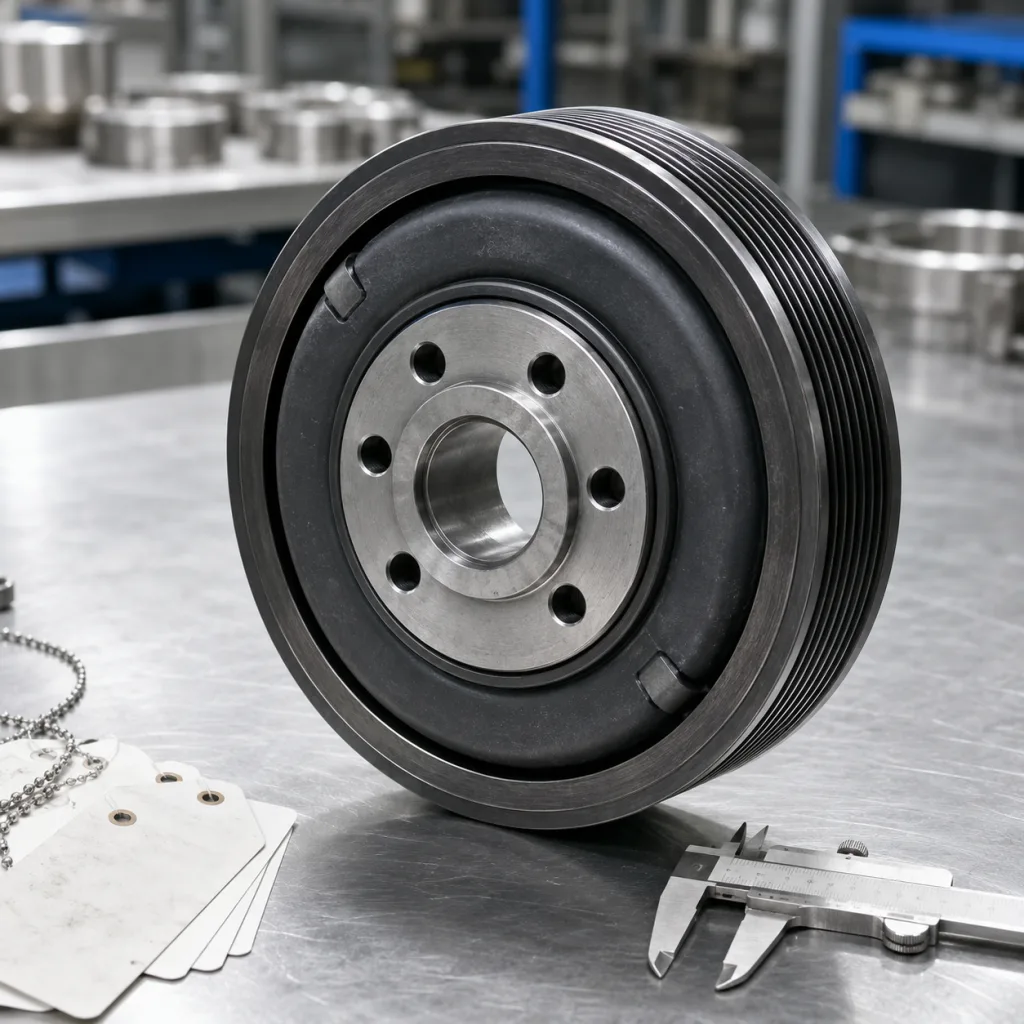
Excessive shaft runout or worn crank pulley/harmonic balancer
For procurement teams, the seal specification matters only if the shaft and housing are within tolerance. A well-made seal will not compensate for a damaged crank journal. When evaluating supply for fleet rebuilds, require dimensional checks against the OE envelope and confirm lip material selection for the operating oil temperature range.
Inspection checklist before replacement
Use a controlled inspection sequence before approving any repair order.
1. Clean the front cover, crank pulley area, and lower engine face. 2. Inspect the oil pan rail, timing cover seam, and crank nose for wetness. 3. Check the PCV system or crankcase breather for restriction. 4. Examine the belt path for oil contamination. 5. If the leak is at the bellhousing, inspect the rear main area and transmission join. 6. Verify whether the oil is engine oil, transmission fluid, or another fluid. 7. Measure crankshaft journal wear where the seal lip runs.
If the leakage is only visible at the front and the crank pulley area is wet, the front crankshaft seal is the likely source. If oil accumulates at the bottom of the bellhousing, the rear main seal becomes the primary suspect. Document findings with photos and mileage before ordering parts through our catalog.
Replacement criteria and part matching
Front seal replacement should be based on measured fitment, not visual similarity. For professional buyers, the minimum data set should include housing OD, shaft ID, seal width, lip design, and elastomer type.
What to verify
Shaft diameter and surface finish
Seal outer diameter and interference fit
Case material: metal case, rubber-coated case, or PTFE design
Lip material compatibility with engine oil and temperature
Spring tension and garter spring retention
Axial installation depth
For OE cross-reference work, use the exact engine application and seal envelope. Do not assume that a rear main seal leak front crankshaft seal job uses interchangeable dimensions; the two parts normally differ in diameter, section, and installation access. For applications requiring special packaging or private label supply, review custom manufacturing.
Validation testing and quality control for sourced seals
A supplier should be able to show process control and test data, especially when selling into export markets.
Driventus products are produced under IATF 16949:2016 and ISO 9001:2015 systems. Depending on the programme, validation may include:
Dimensional inspection to drawing or sample master
Elastomer hardness and compression set checks
Oil immersion resistance screening
Runout and concentricity inspection
Salt spray or corrosion resistance for case hardware where relevant
High-temperature endurance testing for lip stability
For duty-cycle verification, some customers request bench testing aligned to published methods such as SAE J2527 or related durability protocols when evaluating sealing materials and assemblies. Where emissions-related fitment applies, vehicle programme requirements may also reference ECE R-83 or local homologation rules, but seal supply itself still depends on the exact engine build. Review our quality system before approving a new source.
Buying guidance for distributors and repair networks
For multi-location repair groups and wholesalers, stock risk is driven by identification error. The same customer complaint can lead to two different parts and two very different labour times.
A front crankshaft seal is usually a lower labour operation than a rear main seal.
Rear seal jobs often require transmission removal, clutch handling, or subframe access.
Front seal claims may involve repeat leaks if pulley wear or crankcase pressure is not corrected.
A mixed fleet needs OE-number mapping, engine-code mapping, and clear packaging labelling.
If you are building a programme for engine overhaul or fast-moving service parts, confirm whether you need standard catalogue supply or a private specification. Driventus supports buyers across aftermarket and OEM-facing programmes, including our catalog, engine components, and request a quote for sample approval or volume planning. Driventus is an independent aftermarket manufacturer; brand names are referenced for fitment only.
Frequently asked questions
Usually no. Oil at the bellhousing more often points to the rear main seal, but front-end leaks can migrate along the sump and undertray. Clean the engine and confirm the true origin before ordering parts.
Check crankshaft journal wear, pulley condition, crankcase ventilation, and housing alignment. If the shaft is scored or the breather is blocked, a new seal may leak again.
Yes. We support OE-equivalent replacement, sample-based matching, and custom programmes. Send the application, dimensions, and target annual volume through the contact page.
If you need help matching a front crankshaft seal to an OE application or diagnosing a leak source, send the engine details and photos through /contact.html.