Radiator Hoses Replacement: Fitment and Validation Guide
Radiator hoses replacement looks straightforward until the part is matched against a real cooling system. For procurement teams, most problems come from small dimensional misses: bend radius, connector depth, wall stiffness, clamp land length, or a compound that softens too early after heat soak. A correct replacement should follow OE geometry, maintain seal under pressure, and withstand coolant, oil mist, ozone, and repeated thermal cycling. Driventus is an independent aftermarket manufacturer; brand names are referenced for fitment only. We build to IATF 16949:2016 and ISO 9001:2015 controls, and material selection should be checked against SAE J20 and REACH (EC) No 1907/2006 where applicable. This article focuses on the checks buyers should complete before approving a hose as a replacement part, whether the order is for distribution, repair chains, or OEM-adjacent programmes.
What Has to Match for OE-Equivalent Fit
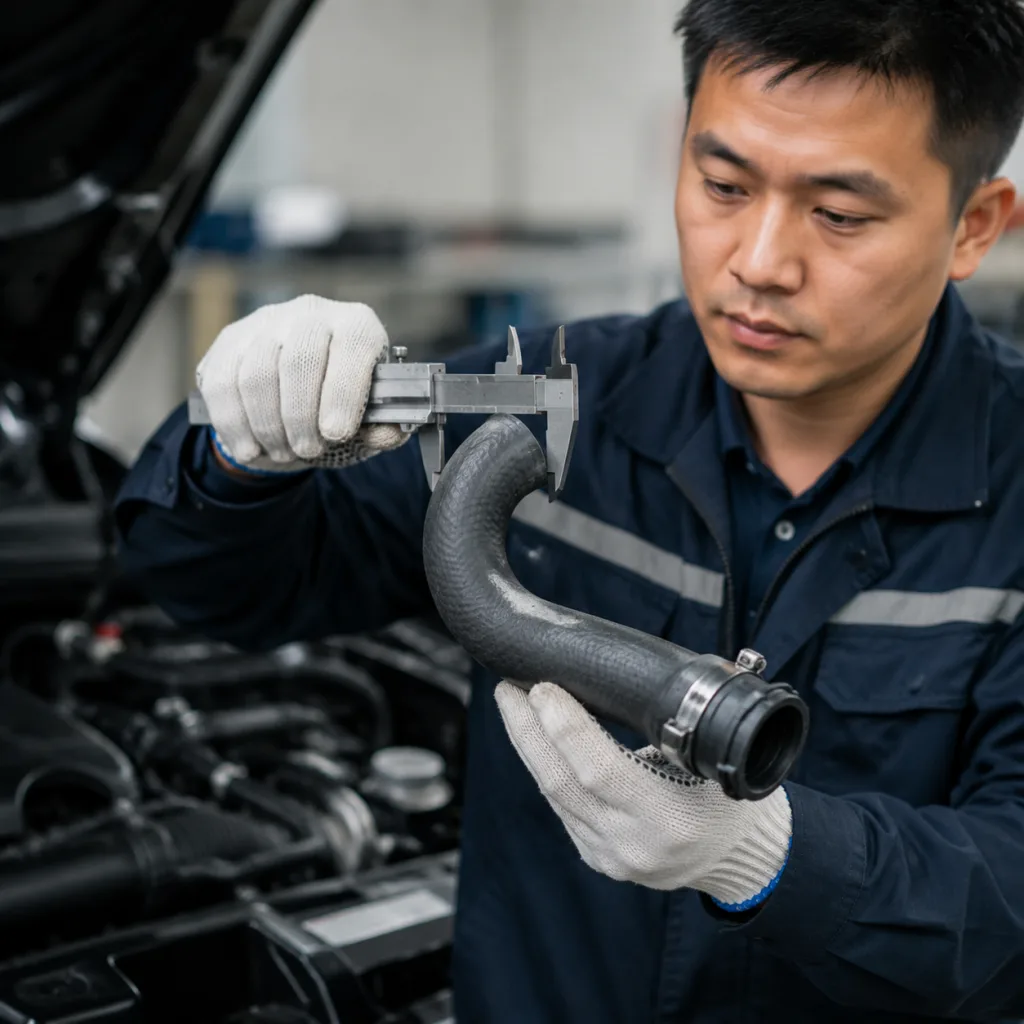
Replacement parts are judged by geometry first. A hose that appears correct on the bench can still fail at the radiator neck if the bend radius, bead shape, or wall stiffness is off by a small amount. Buyers should compare the sample or drawing against the vehicle stack-up, not just the nominal diameter.
Check these points before approval:
- Inside diameter, outside diameter, and wall thickness
- Centreline length and formed bend angles
- Bead form, reducer steps, and insertion depth
- Clamp zone length and surface finish
- Clearance to fans, belts, and brackets through full engine movement
- Vacuum resistance on the suction side, if applicable
If the hose is sold as an OE-equivalent part, the supplier should be able to show how the profile, material, and reinforcement are matched to the target application. For formed parts, the fit call is rarely about one dimension alone; it is the combined result of geometry, stiffness, and how the hose seats under clamp load.
Common Failure Signs Before You Replace
Field replacement is usually triggered by visible ageing or a leak at the joint, but the root cause is often broader. A hose can fail because it has softened, hardened, or taken a permanent set after repeated heat cycles.
Typical signs include:
- Coolant wetting around the clamp band or bead
- Surface cracking near the ends or along the bend
- Swelling, blistering, or oil contamination
- Collapse on the suction side during warm-up
- Hardening that makes the hose brittle during removal
- Local abrasion from nearby hardware
For fleets and repair chains, one failed hose is often a signal to inspect the entire route, including clamps, thermostat housing, radiator necks, and overflow lines. Replacing the hose without checking the attachment surfaces can leave the same leak path in place, especially when the mating neck is pitted, distorted, or contaminated with old residue.
Material Options and Trade-Offs
The right material depends on coolant chemistry, temperature headroom, cost target, and available packaging space. For most passenger-car and light-truck applications, EPDM remains the default choice. Silicone is used in hotter or more customised systems, but it is not automatically a better replacement.
| Material | Main advantage | Main limitation | Typical use case |
|---|---|---|---|
| EPDM rubber | Good heat, coolant, and ozone resistance at controlled cost | Poor resistance to oil and fuel contamination | Mainstream radiator and heater hose replacement |
| EPDM with textile reinforcement | Better shape retention and pressure stability | More complex tooling and QA | Formed hoses with tight routing |
| Silicone | Higher thermal margin and good flexibility | Higher cost and weaker oil resistance unless specially formulated | Performance builds or high-temperature systems |
| Test or document | Why it matters | Typical reference |
|---|---|---|
| Dimensional inspection | Confirms bend geometry, ID, OD, and clamp land lengths | Drawing control and sample report |
| Pressure retention or leak test | Checks seal integrity at the joint and through the wall | Supplier test method aligned to application |
| Thermal cycling | Shows whether the hose keeps shape after repeated heat soak | SAE J20 where applicable |
| Coolant and ozone exposure | Helps predict ageing in real service | SAE J20 and material specification |
| Material declaration | Supports EU and UK compliance review | REACH (EC) No 1907/2006 |