Price to Fix a Wheel Bearing: Cost Factors for Buyers
The price to fix a wheel bearing is shaped by labour time, hub architecture, vehicle platform, bearing quality, and whether the job uses an integrated hub assembly or a press-in bearing. For procurement teams, the workshop invoice is only part of the calculation. The larger cost picture includes comeback risk, fitment errors, warranty handling, vehicle downtime, and stock fragmentation across the vehicle parc. Wheel bearings work under radial and axial load, road impact, water exposure, brake heat, and continuous rotational fatigue. Differences in seal design, grease fill, raceway finish, flange control, and ABS encoder accuracy can materially change service life. This article explains the repair cost structure, the technical variables that affect replacement time, and the sourcing checks B2B buyers should use when selecting aftermarket wheel bearings for repair chains, wholesalers, and regional distributors.
Typical Cost Structure for Wheel Bearing Repair
For a repair chain or fleet workshop, the price to fix a wheel bearing usually combines the part, labour, consumables, diagnostic time, and any related alignment or brake work. Retail invoices vary by region and vehicle class, but the underlying cost drivers are consistent.
Repair cost element
Typical influence on invoice
Procurement relevance
Bearing or hub assembly
Medium to high
SKU cost, warranty rate, availability
Labour time
High
Design-dependent, affects service bay throughput
Press tooling or hub puller use
Medium
Increases time for press-in designs
ABS sensor or encoder issue
Medium
Can cause warning lights after installation
Corrosion, seized bolts, damaged knuckle
Medium to high
Raises labour variation in older vehicle parc
Alignment or brake inspection
Low to medium
Often added when suspension parts are disturbed
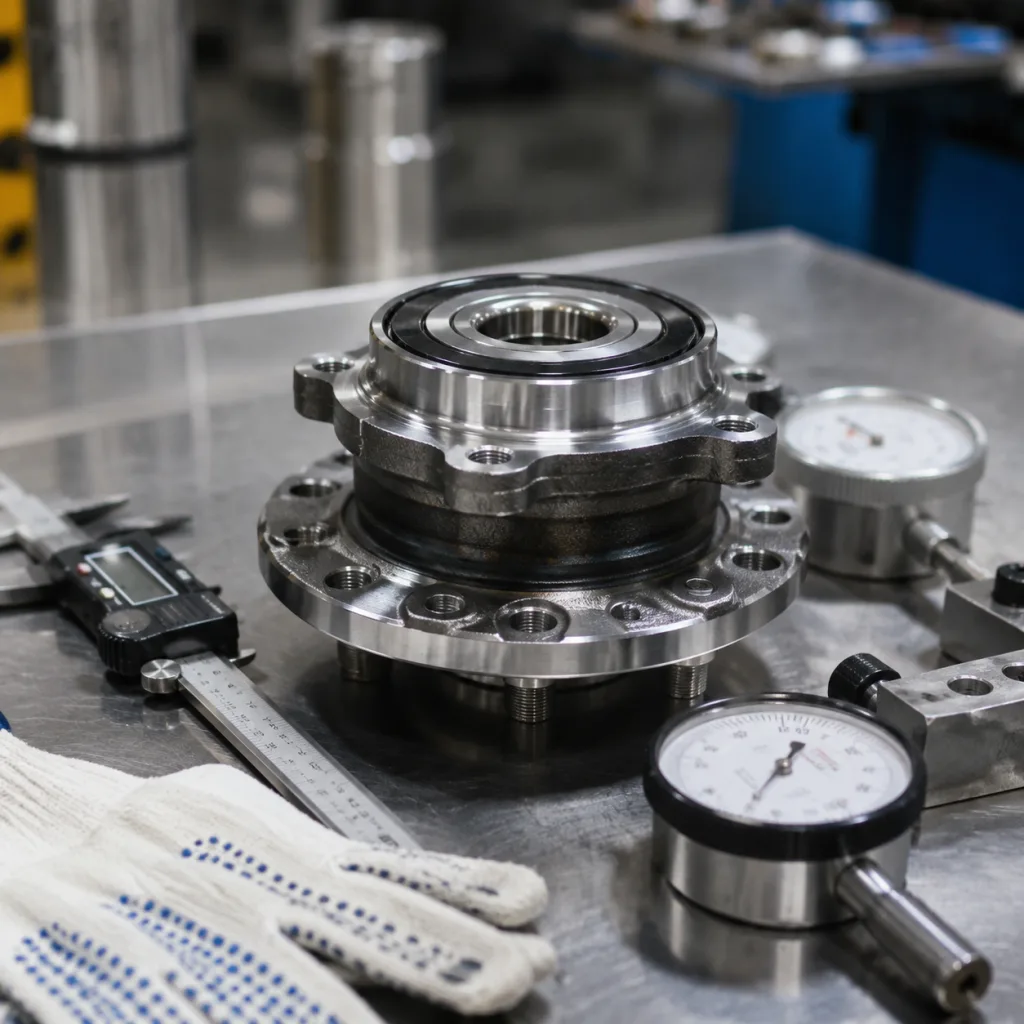
</tr></thead><tbody> </tbody></table>A bolt-on hub assembly normally shortens installation time because the bearing, hub flange, and often the ABS encoder are supplied as one unit. A press-in bearing can have a lower part price, but labour time is higher and installation quality depends on correct pressing force, support location, circlip seating, and protection of the seal and raceways.
For import managers and category buyers, landed part cost should not be judged on its own. A bearing that saves 8% at purchase can still raise programme cost if it creates claims, noise complaints, ABS signal faults, or catalogue disputes. Repair chains value predictable fitment, accurate cross-reference data, stable packaging, and batch traceability because these reduce counter time and warranty administration.
Why Vehicle Design Changes the Labour Cost
Wheel bearing replacement time is controlled mainly by vehicle architecture. Front-wheel-drive vehicles often place the bearing inside a steering knuckle, while many rear applications use a bolt-on hub unit. All-wheel-drive layouts may add axle removal steps, high-torque fasteners, tighter access, or corrosion around splines and mounting faces.
</tr></thead><tbody> </tbody></table>A procurement specification should identify bearing generation, flange pattern, ABS type, encoder pole count where applicable, wheel stud details, and axle nut compatibility. Dimensional matching is critical: bore diameter, outside diameter, width, flange offset, bolt circle, wheel pilot diameter, and sensor cable routing must align with the target application.
Repair chains also need technical documentation that prevents avoidable installation errors. Impact tools used on axle nuts can overload raceways before the vehicle leaves the bay. Pressing through the wrong race can brinell the bearing. A hub unit dropped on the flange can create runout or damage the encoder. Without installation guidance, these failures may be treated as supplier defects even when the root cause is handling or fitting procedure.
Part Quality Variables Behind the Repair Price
The visible part price is only one input in the price to fix a wheel bearing. Bearing construction and process control determine whether the repair remains quiet, stable, and durable under real road conditions.
Key technical variables to specify include:
Steel and heat treatment: High-carbon chromium bearing steel or equivalent grades with controlled hardness and case depth where applicable.
Raceway finishing: Low roughness and controlled geometry to reduce noise, vibration, and early fatigue.
Grease selection: Temperature resistance, oxidation stability, water washout resistance, and compatibility with seal material.
Seal design: Multi-lip or cassette seals for water, salt, and dust exclusion.
Hub flange control: Axial runout, radial runout, wheel pilot concentricity, and stud seating integrity.
ABS encoder quality: Correct magnetic signal strength, pole spacing, and protection during packaging.
Traceability: Batch number, production date, inspection records, and claim analysis data.
Relevant quality and vehicle-sector frameworks include IATF 16949:2016 and ISO 9001:2015 for manufacturing quality management. Material compliance may also be relevant for EU importers under REACH (EC) No 1907/2006. These standards do not replace application validation, but they provide a baseline for process discipline, corrective action, and supplier audit planning.
Driventus validates wheel bearing and hub assembly production through dimensional inspection, hardness checks, seal and grease controls, rotational noise checks, and sampling plans aligned with customer requirements. Buyers can review our quality system and compare available wheel bearing lines in our catalog.
Cost Control for Distributors and Repair Chains
A distributor selling into garages or multi-site repair networks needs a cost model that includes failure exposure. Wheel bearing claims are expensive because they can require repeat labour, vehicle downtime, replacement stock, and customer handling. Many buyers therefore segment wheel bearing sourcing by vehicle parc, claim sensitivity, and repair complexity rather than using one price target across the whole range.
Practical purchasing controls include:
Define top-moving SKUs by application count, not only by annual sales history.
Separate press-in bearings from hub assemblies when measuring return rates.
Require production batch traceability on carton and product where feasible.
Specify packaging protection for encoder rings, studs, flanges, and sensor cables.
Confirm whether axle nuts, circlips, bolts, or seals are included in the kit.
Use dimensional first-article approval for new references before bulk release.
MOQ and lead time should be planned around SKU breadth. A wheel bearing programme may require many references with uneven demand. Consolidated production planning can reduce unit cost, but excessive consolidation can create stock gaps in fast-moving hub assemblies. For repair chains, availability at the right branch or warehouse often has more commercial value than a small reduction in purchase price.
Driventus supports aftermarket distributors, wholesalers, and repair chains with standard wheel bearing references and custom manufacturing for private-label, packaging, kit content, and application-specific validation requirements. Driventus is an independent aftermarket manufacturer; brand names are referenced for fitment only.
How to Compare Supplier Quotes Beyond Unit Price
When comparing supplier offers, buyers should request the same technical and commercial data from each source. Otherwise, a low quoted price may reflect missing accessories, limited validation, lighter packaging, or incomplete fitment coverage.
</tr></thead><tbody> </tbody></table>Ask for samples from production tooling, not only prototype parts. For hub assemblies, measure flange runout, stud perpendicularity, pilot diameter, bolt hole position, and ABS output where relevant. For press-in bearings, inspect chamfers, seal seating, cage condition, and rotation smoothness.
The price to fix a wheel bearing at workshop level is directly linked to these procurement decisions. A repair becomes expensive when the bearing fits poorly, triggers an ABS fault, arrives damaged, or fails early under load. A structured RFQ makes quote comparison objective and reduces disputes after launch.
When Replacement Is Usually Justified
A wheel bearing is normally replaced when inspection confirms noise, roughness, excessive play, overheating, or sensor-related faults connected to the bearing or hub unit. Diagnosis should separate bearing noise from tyre cupping, brake drag, CV joint noise, suspension looseness, and wheel or tyre imbalance.
Common inspection points include road-test noise change under load, wheel lift play check, hub rotation feel, ABS live data, visible seal damage, grease leakage, and flange runout. In commercial repair environments, technicians should also inspect mating surfaces and fasteners. A new hub fitted to a corroded, contaminated, or distorted knuckle may not solve noise or vibration complaints.
Replacement should follow the vehicle service procedure for torque sequence, axle nut replacement where specified, and press support points. Procurement teams can reduce field problems by supplying kits with clear component content, consistent hardware policy, and technical bulletins for repair customers.
For programme planning, treat wheel bearings as safety-relevant rotating components. They are not regulated as brake friction parts under standards such as SAE J2527, but they still require controlled manufacturing, material verification, and fatigue-aware design. Cost reduction should not remove validation steps that protect bearing life and workshop confidence.
Frequently asked questions
Labour time is usually the largest variable. A bolt-on hub assembly can be faster to install, while a press-in bearing requires removal, correct support, pressing, and reassembly. Corrosion, axle design, ABS components, and damaged mating parts can also increase repair time.
Not without comparing validation, dimensions, sealing, grease, packaging, fitment data, and claim history. A lower unit price can increase total cost if the part causes noise complaints, ABS faults, installation delays, or repeat labour claims across a repair network.
Request dimensional drawings, application data, material and hardness information, inspection criteria, packaging specifications, traceability format, and current quality certificates such as IATF 16949:2016 or ISO 9001:2015 where applicable.
If you are reviewing the price to fix a wheel bearing across a sourcing programme, Driventus can support SKU matching, samples, packaging options, and technical RFQ data. To discuss requirements or request a quote, contact us at /contact.html