Replacing a piston is a precision job, not a parts swap. The final result depends on bore condition, ring end gap, skirt clearance, pin fit, rod alignment and clean assembly practice. If any one of those is off, the engine may start but fail early through noise, blow-by, oil consumption or scuffing. This guide sets out the workshop steps used by rebuilders and procurement teams that need to specify the right replacement component before ordering. It is written for four-stroke engine applications in passenger car, light commercial and industrial use, where dimensional match matters more than brand labels. Driventus is an independent aftermarket manufacturer; brand names are referenced for fitment only. For sourcing and technical confirmation, see [our catalog](/products.html), [our quality system](/quality.html) and [custom manufacturing](/oem-services.html).
When a piston should be replaced
A piston is usually replaced when inspection shows one or more of the following conditions:
Crown cracking, melted edges or heavy impact marks
Skirt scuffing, transfer, or abnormal polishing on one side
Pin boss wear, pin seizure marks, or ovality beyond service limits
Excessive ring land wear, broken lands, or ring groove collapse
Out-of-spec piston-to-bore clearance after reboring or honing
Before ordering, confirm the failure mode. If the cylinder has severe scoring, the cylinder head or fuel issue may be the root cause, and the new piston will only fail again unless the cause is corrected. For procurement teams, replacement decisions should be based on measured data, not appearance alone.
What to measure before ordering
Use the engine service data first, then verify the actual cylinder block and connecting rod. The minimum checks are:
Check
What to confirm
Why it matters
Bore diameter
Standard size, oversize, or sleeve condition
Determines piston diameter and clearance
Compression height
Distance from pin centre to crown
Controls deck height and compression ratio
Pin diameter
Full floating or pressed fit
Affects rod compatibility
Ring pack
Number of rings, groove width, ring thickness
Prevents wrong groove loading
Skirt profile
Cam ground, coated or non-coated
Affects noise, scuff resistance and break-in
Crown shape
Flat, dish, valve reliefs
Changes compression and valve clearance
</tr></thead><tbody> </tbody></table>If you are cross-checking a stock line against OE data, verify the part family by application and dimensions rather than by a single catalogue number. For commercial sourcing, a dimensional mismatch is a quality non-conformance, even if the part looks similar.
Step-by-step replacement sequence
1. Strip and clean the engine carefully. Remove carbon, gasket residue and metallic debris from the cylinder, oil gallery and sump. 2. Inspect the cylinder bore with a dial bore gauge. Record taper, out-of-round and surface condition. 3. Measure the new piston at the gauge point specified by the manufacturer, then calculate clearance with the actual bore. 4. Check ring end gap in the cylinder. Adjust only if the service data permits filing, and keep every ring matched to its cylinder. 5. Install rings with the correct orientation and stagger the gaps according to the engine manual. 6. Fit the piston to the rod with the correct pin type, circlip position or interference fit method. 7. Lubricate the skirt, pin and rings with clean engine oil or the assembly lubricant specified for the build. 8. Compress the rings, insert the piston in the correct orientation and torque the rod bolts to the published specification. 9. Turn the crankshaft by hand before start-up. Any tight spot should be investigated before the engine is run.
This sequence is standard across most workshop rebuilds, but the exact torque, ring orientation and clearance limits must always follow the engine data sheet.
Checks that prevent repeat failure
A replacement piston should not be treated as a stand-alone part. The surrounding system must be verified before first start.
Confirm injector pattern, ignition timing or fuel delivery if the old piston shows thermal damage
Check the oil pump, oil jet function and lubrication passages
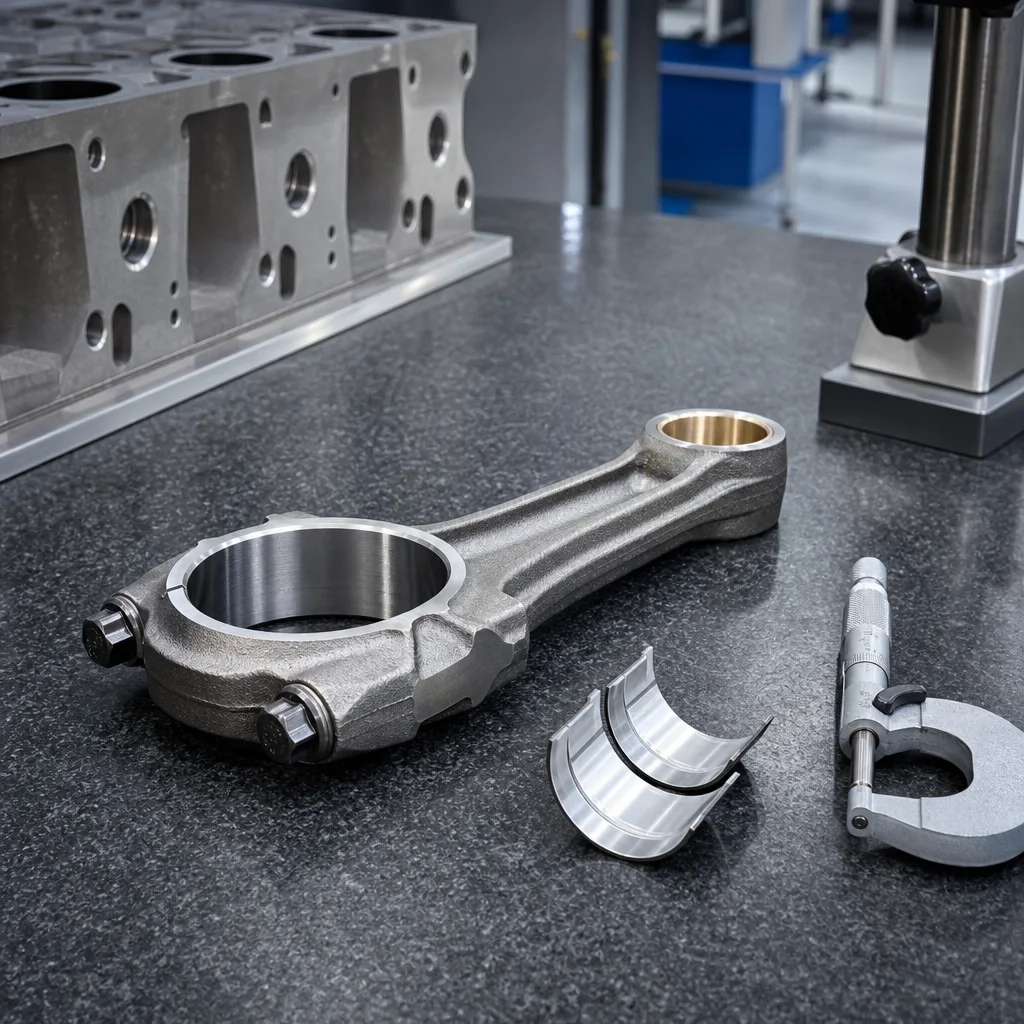
Verify rod straightness, big-end clearance and bearing condition
Inspect the cooling system for overheating history
Confirm crankshaft end float and piston deck height after assembly
For validation work, suppliers often reference IATF 16949:2016 and ISO 9001:2015 for process control, while material compliance may involve REACH (EC) No 1907/2006 for regulated substances. Where durability testing is required, SAE J2527 is commonly cited for environmental exposure comparison on coated parts and related components. The standard set must be matched to the application and market, not copied from another engine family.
How buyers should specify a replacement piston
Procurement teams reduce returns when the purchase request includes a complete technical description. A useful RFQ should state:
Engine code, displacement and fuel type
Bore size, oversize status and repair history
Piston diameter, compression height and pin size
Ring pack configuration and coating requirement
Quantity, packaging and traceability needs
Target market compliance, including any chemical or documentation requirements
If the application needs a non-standard skirt, crown, pin or ring package, use custom manufacturing rather than forcing a near-match part into service. For standard catalogue items, see our catalog. If you need supplier documentation, inspection data or export terms, use request a quote.
Frequently asked questions
Only if the piston crown, ring lands, pin bosses and skirt are within service limits and the root cause has been corrected. If there is any heat damage, scuffing or land wear, replace it.
It is critical. Too little clearance causes scuffing and seizure. Too much clearance causes noise, blow-by and oil consumption. Use the measured bore and piston data, not a nominal size alone.
OE references help with fitment, but they are not enough by themselves. Confirm bore size, compression height, pin diameter and ring pack before placing the order.
If you need a replacement piston matched to a specific engine family, send the application details, dimensions and target quantity. We will confirm fitment, documentation and production options at /contact.html