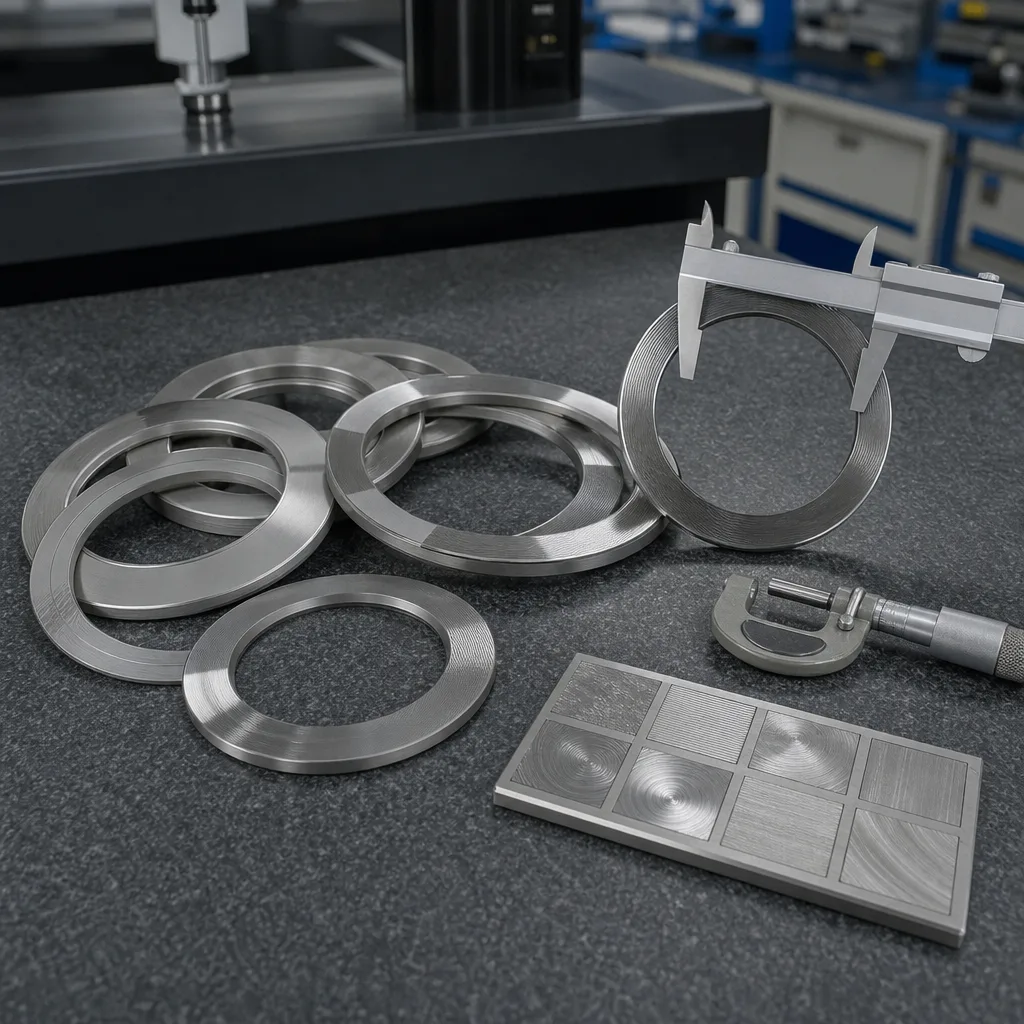
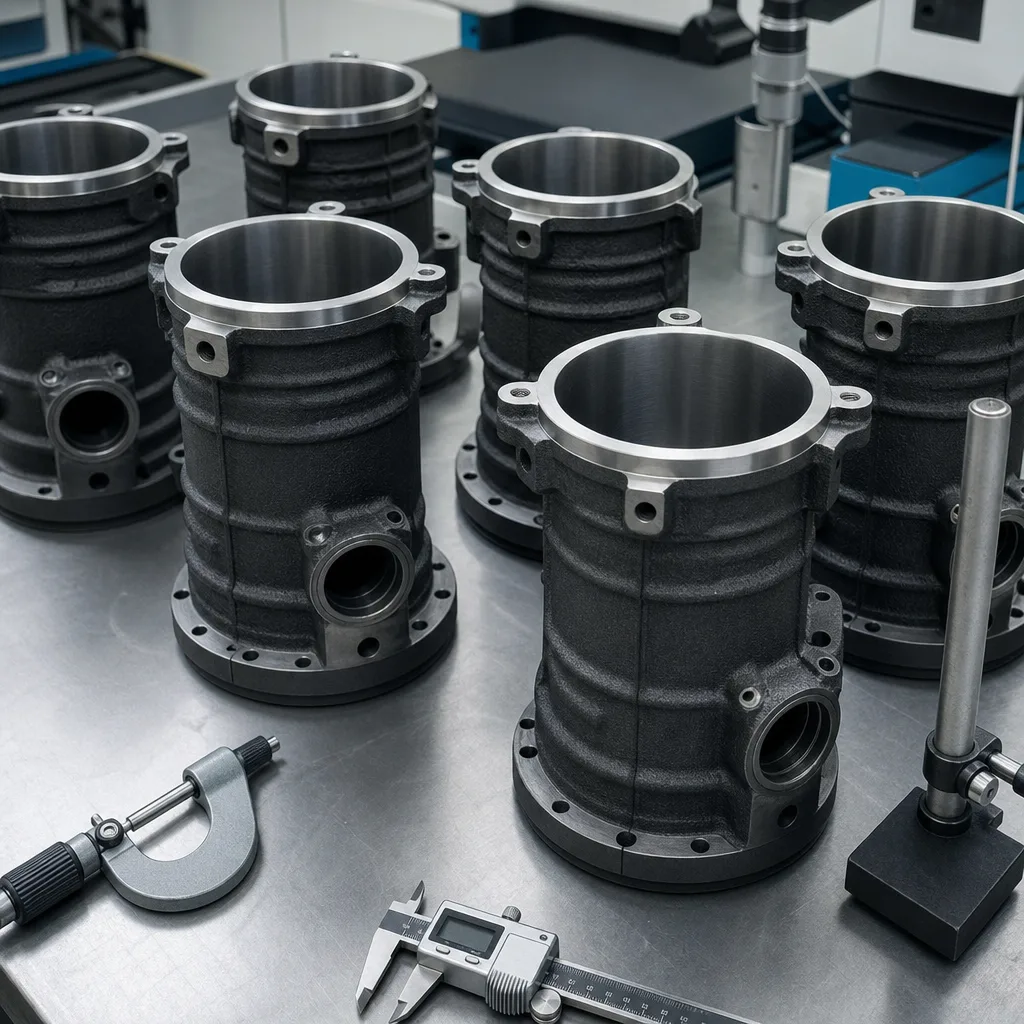
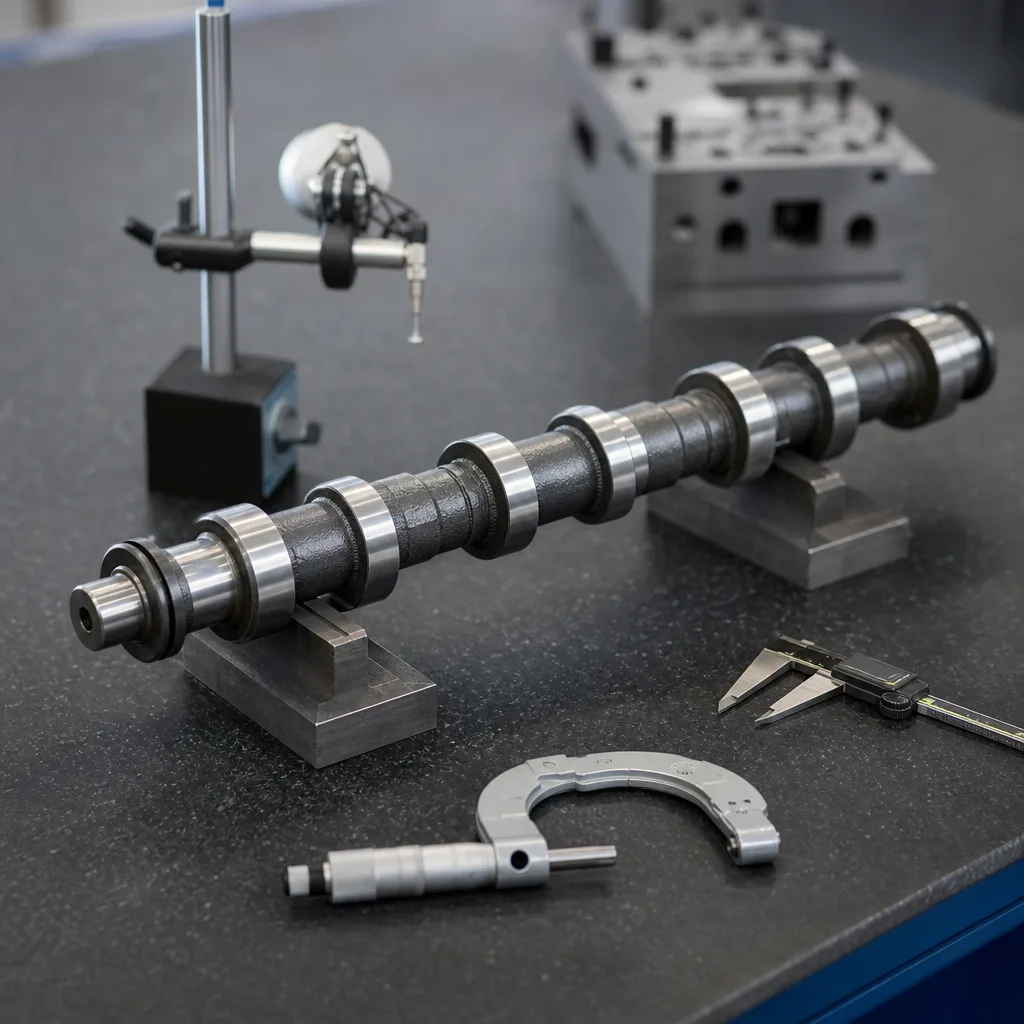
Oil pump assembly dimensions are a primary control point in engine sourcing because the pump must fit the housing, align with the drive, and maintain oil pressure at the designed flow rate. For procurement teams, the key issue is not only overall length and gear size, but also mounting face flatness, shaft concentricity, port locations, and the relationship between the pump body and pickup interface. Small deviations can change clearances, create cavitation risk, or increase parasitic loss. Driventus supplies oil pump assemblies for aftermarket and B2B programmes with dimensional verification against customer drawings, OE 06A107065-type cross references where applicable, and production controls aligned with IATF 16949:2016 and ISO 9001:2015. Driventus is an independent aftermarket manufacturer; brand names are referenced for fitment only.
What dimensions matter on an oil pump assembly
For sourcing, the critical dimensions are the ones that affect fit, drive engagement, and pressure performance. A complete review should include:
Overall body length, width, and height
Mounting bolt hole centre distance and hole diameter
Drive shaft diameter, spline or hex profile, and engagement length
Rotor or gear outside diameter and thickness
Housing bore diameter and radial clearance
Inlet and outlet port position, thread form, and sealing land width
Mounting face flatness and parallelism
Oil pickup spacing when the pump and pickup are supplied as a set
If a customer drawing is available, these should be checked against the critical-to-fit list before samples are approved. For replacement programmes, dimensional equivalence to the OE reference is usually more important than cosmetic similarity.
Typical dimensional controls and inspection methods
Oil pump assemblies are usually inspected with calibrated gauges, micrometers, height gauges, CMM reports, and functional flow testing. The control plan normally covers both component-level and assembled-pump checks.
Control item
Typical method
Why it matters
Mounting face flatness
Surface plate + gauge
Prevents leakage and distortion
Drive shaft runout
Dial indicator
Reduces vibration and wear
Gear or rotor clearance
Feeler gauge / metrology
Affects pressure and efficiency
Port position
CMM / fixture check
Ensures correct oil routing
Thread specification
Go/no-go gauge
Confirms sealing and assembly fit
Assembly torque
Torque tool audit
Prevents loosening or housing damage
</tr></thead><tbody> </tbody></table>For export programmes, traceable inspection records support incoming QA at the buyer’s warehouse and help reduce line-side rejection.
Material and build details buyers should verify
Dimensions alone are not enough. Buyers should confirm material grade, surface treatment, and assembly method because they affect wear life and dimensional stability.
Common checks include:
Pump body: aluminium alloy or cast iron, depending on design and oil temperature profile
Gears or rotors: sintered steel, powdered metal, or machined steel
Cover plate: wear resistance and surface finish
Relief valve spring: free length, load at compressed height, and repeatability
Seal faces: gasket compatibility and surface roughness
If the application is emission-sensitive or sold into regulated markets, material declarations should support REACH (EC) No 1907/2006 compliance and customer chemical-content requests. For durability validation, buyers often ask for bench test data aligned with SAE J2527-style endurance or equivalent internal validation methods, depending on the programme specification.
Comparison table: OEM reference, aftermarket replacement, and custom build
Procurement teams often need to decide whether to buy a direct replacement, a catalogue part, or a custom-built variant. The table below summarises the trade-offs.
Option
Dimensional control
Lead time
Validation effort
Best for
OE-equivalent replacement
High, matched to reference dimensions
Usually shortest
Moderate
Repair chains, distributors
Catalogue aftermarket part
High, but limited to listed applications
Short to medium
Moderate
Multi-SKU stocking
Custom manufacturing
Defined by buyer drawing
Medium to longer
Higher
OEM / Tier-1 programmes
</tr></thead><tbody> </tbody></table>If the pump must match a specific engine family, cross-reference data can be built around OE 06A107065-style identifiers where the programme calls for it. Driventus supports drawing-based development through custom manufacturing when catalogue geometry is not sufficient.
How Driventus verifies fit for export programmes
Driventus works from dimensional data, sample parts, and customer target prices to define the production route. The review normally includes first article inspection, batch traceability, and process capability checks where volume justifies it.
Key controls include:
1. Incoming material verification 2. In-process dimensional checks at critical stations 3. Final assembly verification against the approved sample 4. Functional pressure and flow testing 5. Packaging verification for export handling
Our quality system is built around IATF 16949:2016 and ISO 9001:2015. For buyers managing multiple platforms, the catalog and engine components pages can be used to narrow the part family before sample approval.
What procurement teams should request before PO release
Before placing an order, ask the supplier for the documents that prove the pump will fit and perform as intended:
Dimensional drawing with tolerances
Sample inspection report
Material declaration
Function test report
Packaging specification
OE cross-reference, if applicable
Warranty and claim procedure
If your programme needs a non-standard bracket, port position, or relief-valve setting, request written confirmation before tooling release. This is the point to confirm MOQ, lead time, and revision control. For drawings, sample review, or plant-level discussion, request a quote.
Frequently asked questions
The most important dimensions are mounting-hole spacing, drive engagement, overall envelope, rotor or gear clearance, and port position. Flatness and runout also matter because they affect leakage and pressure stability.
Yes, if the supplier works from a verified sample or drawing and controls the critical dimensions. Buyers should still confirm inspection data, because fit and function depend on the full tolerance stack.
Request a dimensional drawing, sample report, material declaration, and function test result. If the part is for a regulated market or a fleet programme, also ask for traceability and revision control details.
If you need a verified dimensional match or a drawing-based quotation, contact Driventus to discuss your programme and delivery schedule at /contact.html