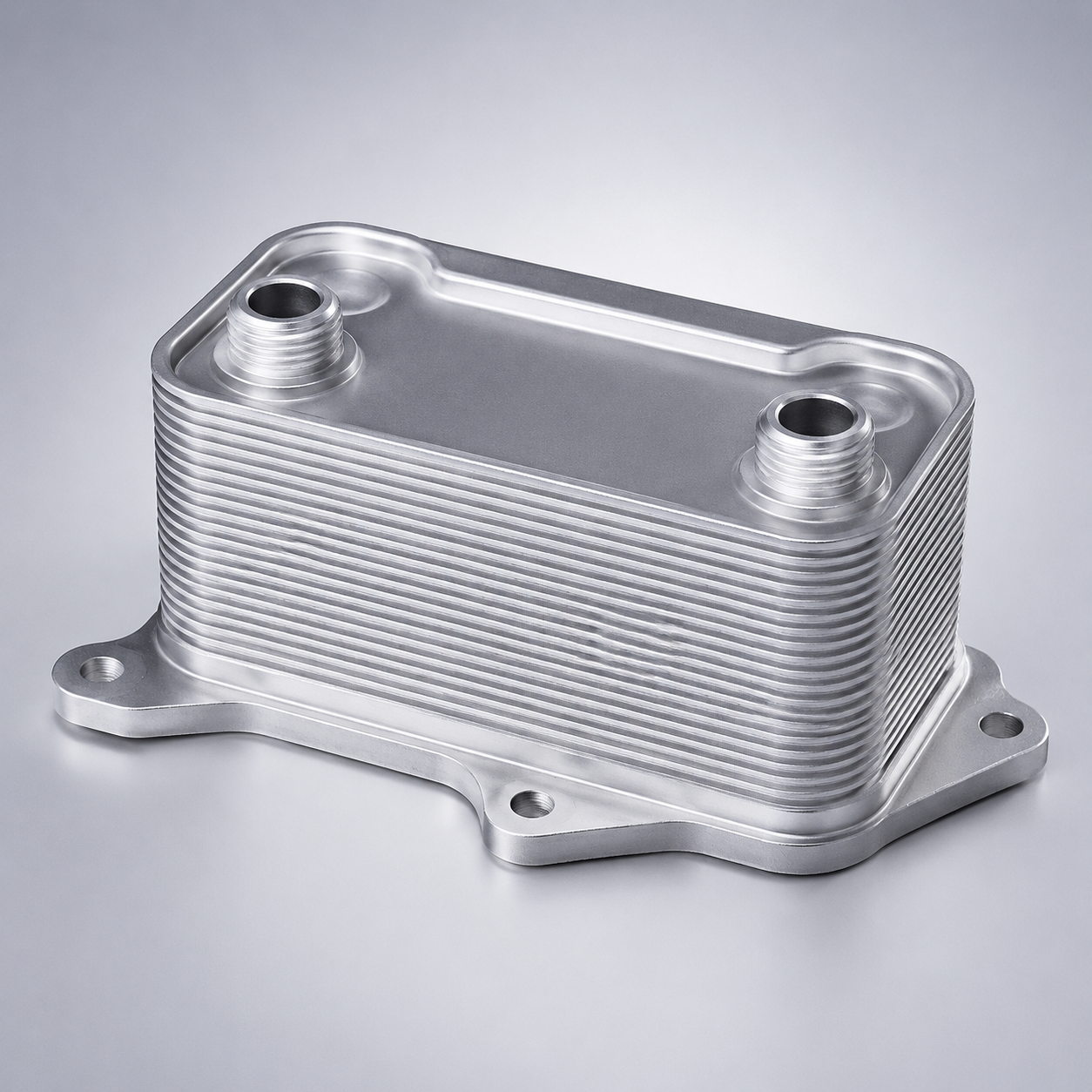
An oil filter housing is not a trim part. The material grade affects burst strength, hot-oil stability, thread life, seal compression, corrosion behaviour, and warranty risk. It also changes tooling cost, machining content, freight weight, and the shape of the supplier quote.
This article approaches oil filter housing material grade comparison from a buyer’s point of view rather than a generic materials overview. The useful questions are straightforward: which grade fits the real service environment, where do aluminium and reinforced polymer fail differently, what evidence should a supplier show, and when does a custom grade actually pay back? Driventus is an independent aftermarket manufacturer; brand names are referenced for fitment only.
Start with the decision tree: which housing grade fits the application?
Most programs narrow down to three families: cast aluminium alloys, glass-fibre reinforced engineering polymers, and, in older heavy-duty designs, cast iron. The mistake is choosing from labels. "Aluminium" and "plastic" are too vague to quote against, too vague to validate, and too vague to defend later if claims appear.
A better starting point is the application itself:
High local heat, repeated service torque, or integrated cooler passages usually push the choice toward cast aluminium
Weight-sensitive, stable high-volume programs with proven thermal margins may suit PA66 GF30 or PA66 GF35
Legacy platforms or heavy-duty layouts may still justify cast iron where mass is secondary to stiffness
Grades buyers actually see on drawings
Cast aluminium alloys
- ADC12 or equivalent for pressure die-cast housings - A380 or similar die-cast grades for thin-wall, more complex geometry - AlSi-based casting alloys where fluidity and machinability matter - Typical wall thickness: 3.0-5.0 mm with local reinforcement at bosses and ports
Glass-fibre reinforced polyamide
- PA66 GF30 - PA66 GF35 - PA6 GF30 in lower-heat environments - Typical wall thickness: 3.5-6.0 mm, usually with ribs added for stiffness
Cast iron or ductile iron
- Seen mainly on older or heavier-duty applications - Chosen when durability outweighs weight and packaging concerns
One more filter matters: is the housing standalone, or part of an integrated module with a cooler, bypass valve, sensor ports, and brackets? Integrated modules tighten the requirement for creep resistance, flange flatness, leak control, and thread durability.
Commercially, the grade changes the quote structure too. Aluminium may carry lower tooling exposure but more machining cost per part. Polymer may look cheaper only after the mould cost is spread over stable annual demand.
Typical checkpoints in sourcing are:
Prototype / sampling MOQ: often 30-100 pcs for machined or pilot-cast aluminium, and 100-300 pcs for pilot-moulded polymer
Mass production MOQ: commonly 300-1,000 pcs for aftermarket aluminium housings and 1,000-3,000 pcs for polymer housings
Tooling lead time: about 25-45 days for simple die-cast changes, 45-70 days for new die-cast tools, and 55-90 days for new injection tools with sliders, inserts, or hot runners
If you are screening several vehicle platforms at once, it helps to group comparable part families in our catalog before requesting quotes.
Aluminium vs reinforced polymer: where the trade-off is real
Property
Cast aluminium alloy
PA66 GF30 / GF35 reinforced polymer
Cast iron
Typical density
~2.7 g/cm³
~1.35-1.5 g/cm³
~7.0 g/cm³
Weight impact
Moderate
Lowest
Highest
Heat resistance
High, suitable for sustained high oil temperatures of 120-150°C with short peaks above this depending on design
Good, but long-term thermal ageing must be verified; many applications target 120-135°C continuous with higher short peaks
High
Burst / structural stiffness
High
Good when ribbing and wall thickness are well designed
Very high
Typical proof / burst expectation
Proof test often 8-12 bar; burst targets frequently 20-30+ bar depending on OE family
Proof and burst targets can be similar at room temperature, but hot-condition retention is the key check
High, usually above passenger-car requirement
Thread retention
Strong, especially with machined metal threads
Lower than metal unless inserts or careful thread design are used
Strong
Corrosion behaviour
Needs control of galvanic effects and salt exposure
No red rust, but can degrade from heat and chemical exposure
Requires coating or oil film protection
Dimensional stability
Good after machining
Sensitive to moisture uptake and moulding control
Good
Typical flange flatness capability
Machined faces commonly controlled to 0.05-0.10 mm
Moulded sealing faces often require design compensation; practical controlled flatness may be 0.10-0.20 mm depending on size and tool quality
Good after machining
Tooling cost
Moderate to high
High initial mould cost, lower cycle cost at volume
Weight-sensitive designs at validated service temperatures
Legacy heavy-duty designs
</tr></thead><tbody> </tbody></table>The headline is simple: aluminium usually gives a wider safety margin; polymer can give better economics, but only under the right conditions.
For many current engine programs, aluminium wins when buyers worry about thread life, local stiffness, sealing consistency, and long-term heat exposure. Reinforced polymer becomes attractive when annual volume is high, the moulding process is tightly controlled, and validation is strong enough to prove hot-condition performance rather than just room-temperature strength.
A commercial comparison should include more than piece price:
Low to medium annual volume such as 3,000-10,000 pcs/year often favours aluminium because tooling risk is lower and engineering changes are easier to absorb
Higher annual volume such as 20,000+ pcs/year may favour reinforced polymer if cycle time, scrap control, and freight savings offset mould investment
Aftermarket price spread depends heavily on geometry; polymer does not automatically beat aluminium on cost
Lead time after SOP is often 25-40 days for repeat aluminium production and 30-45 days for polymer, depending on insert supply, machining, and testing scope
Mixed-material designs deserve extra caution. An aluminium cooler body with a polymer cap can work well, but only if joint stiffness, thermal expansion, cap torque, and O-ring compression have been validated together.
Supplier approval in five checks, not fifty
A long checklist is not always a good checklist. For sourcing review, five disciplined checks usually expose the real risk faster than a stack of unconnected documents.
1. Confirm the exact grade
Ask for the full designation on the drawing, control plan, and material certificate: PA66 GF30 instead of "nylon"; ADC12 or A380 instead of "aluminium". If the supplier cites an equivalent grade, ask how equivalence is controlled and documented.
2. Check heat capability at real service points
Suppliers should define both continuous and peak temperature expectations. A housing near a turbocharger or exhaust route needs more margin than a remote-mounted design. Ask what happens at 125°C, 135°C, and 150°C where relevant. Ambient test data is not enough.
3. Review pressure, leak, and cycling evidence
A usable validation package normally includes:
100% leak test in production, often by air decay or a comparable method
Proof pressure hold for 30-60 seconds
Burst test to failure on sampled parts
Pressure pulse testing such as 50,000-200,000 cycles where the design includes cooler passages or repeated pressure fluctuation
4. Inspect the weak points, not just the body
Most field issues start at features, not at the main wall section. Check:
Cap and sensor thread design
Torque retention after thermal cycling
Number of validated service removals, such as 3, 5, or 10 reinstall cycles
Flange flatness
O-ring groove width and depth
Surface roughness on machined faces, often in the Ra 1.6-3.2 µm range where applicable
Concentricity between thread seat and sealing groove
5. Ask for process traceability and capability
Material lot traceability, cavity traceability for moulded parts, and casting or melt records make claim investigation possible. For die-cast parts, ask how porosity is controlled: vacuum assist, impregnation, X-ray sampling, or pressure-tight casting controls. For critical dimensions, request initial capability evidence such as Cp/Cpk ≥ 1.33 where feasible.
Suppliers operating under IATF 16949:2016 and ISO 9001:2015 should be able to support these checks with control plans, FMEA logic, and traceable records. You can review our quality system for the type of controls commonly used on engine and powertrain components.
From a release standpoint, the practical rule is: no nomination without a confirmed grade, no PO release without approved samples, and no volume approval without production-intent leak, pressure, and dimensional data.
Where grade selection goes wrong in the field
Poor material choice rarely announces itself on day one. It usually returns as a seepage complaint, a stripped cap thread, a warped flange, or a crack near a boss after months of heat cycling.
Common failure modes include:
Thermal ageing cracks in reinforced polymer around bolt bosses or hose outlets after exposure above the validated window
Creep deformation at sealing faces, causing slow oil leakage after repeated hot-cold cycles
Thread stripping at cap or sensor locations after repeated service or over-torque
Casting porosity leaks in poorly controlled die-cast bodies, including hot-condition micro-leakage
Corrosion at interfaces in integrated cooler modules exposed to salt, coolant, and dissimilar metals
Warpage that prevents proper sealing to the block or cooler plate
Insert pull-out or spin in polymer housings with weak insert anchoring
This is why buyers should ask how the part was tested, not just whether it "passed." A realistic validation review should cover:
Test temperature during pressure cycling
Number of thermal cycles, for example -40°C to 140°C where application-relevant
Vibration duration and fixture orientation
Whether the part was tested dry, oil-filled, or in a full module stack
If the part is sold into regulated markets, chemical compliance documents should also be available where applicable, including REACH (EC) No 1907/2006 substance communication for supplied articles.
Cross-references help with fitment, but they do not remove engineering risk. A number such as OE 06A107065 should be checked against dimensions, port geometry, and seal groove profile. It is not proof of equivalent material grade or validation scope.
There is also a commercial failure mode: false savings. A housing that is $0.40-1.20 cheaper on the quote can become the expensive option once sorting, returns, expedited freight, distributor credits, and warranty administration are counted.
When a custom grade pays back—and when it does not
Custom material selection makes sense in narrower circumstances than many buyers assume. If the standard part already meets the application, changing the grade adds cost and validation work without improving the program.
It usually becomes worth considering when one or more of these conditions apply:
Annual volume supports dedicated tooling or insert changes, often from about 10,000-20,000 pcs/year upward depending on complexity
Field returns repeatedly point to the same weak feature
The housing needs non-standard ports, sensors, or bracket geometry
The customer wants tighter flatness, torque, or cleanliness targets
A private-label program needs a controlled specification and differentiated packaging
The key is to change the whole logic, not one variable in isolation. Review CAD, ribbing, material grade, test scope, and process capability together.
Typical commercial scenarios are:
Tool modification instead of full redesign: lower investment and faster release where only ribs, inserts, or port machining need revision
Grade upgrade without geometry change: sometimes possible, but still needs validation because shrinkage, warpage, and machining behaviour may shift
Private-label exclusivity: viable when the buyer wants specification control, packaging differentiation, and a protected aftermarket line
Before approving customisation, buyers usually compare:
Tooling budget: from insert changes to complete new mould or die sets
Recovery period: how many months or units are needed to recover the spend through margin or lower claims
Lead time impact: whether the program can absorb 6-12 weeks for engineering and sample release
MOQ after customisation: often higher than catalogue supply because dedicated tooling or packaging must be reserved
Driventus supports custom manufacturing for selected engine component programs, including material and process review tied to the application. For broader family sourcing, buyers can also review our catalog.
Buyer’s wrap-up: the shortest useful comparison framework
If the application runs hot, sees repeated service torque, or relies on stable sealing over time, cast aluminium is usually the safer choice. If the program is high volume, weight-sensitive, and backed by strong hot-ageing and torque-retention data, glass-fibre reinforced polyamide can be the right commercial answer. Cast iron remains mostly a legacy or heavy-duty option.
That is the practical core of oil filter housing material grade comparison: do not rank materials in the abstract. Match the grade to the real duty cycle, then confirm the supplier can hold that performance in production.
For buyers comparing offers, the fastest decision matrix is:
Material grade and standard equivalence confirmed on both quote and drawing
Critical tolerances confirmed for flange flatness, groove dimensions, threads, and machined ports
Validation scope confirmed for leak, proof, burst, hot-oil ageing, and torque-cycle performance
Commercial terms confirmed for MOQ, tooling, sample or PPAP charges, production price breaks, and replenishment lead time
A complete sourcing file should also state:
Prototype or first-sample lead time
Mass production lead time, commonly 25-45 days after deposit or schedule release
MOQ by package level
Unit price by quantity break, for example 300 / 1,000 / 3,000 pcs
Warranty or claim handling method for leakage, cracking, or thread failure
If that information is missing, the buyer is not comparing complete offers. Driventus is an independent aftermarket manufacturer; brand names are referenced for fitment only. If you need support comparing material options across drawings, private-label programs, or cross-reference lists, you can request a quote with your technical file, target market, annual volume, and required validation level.
Frequently asked questions
No. Aluminium usually provides better thread strength, stiffness, and thermal margin, but reinforced polymer can be a valid option where weight and high-volume cost are priorities. The correct choice depends on temperature exposure, service torque, sealing design, validation results, and whether annual volume is high enough to justify polymer tooling and process control.
At minimum, ask for material grade identification, drawing dimensions, tolerance requirements, test reports for leak, pressure and thermal performance, and production traceability records. For managed automotive supply, evidence of control under IATF 16949:2016 and ISO 9001:2015 is also valuable. Buyers should also request MOQ, lead time, tooling status and quantity-based pricing so the technical and commercial review stay aligned.
No. An OE cross-reference helps confirm fitment, but it does not verify alloy grade, polymer specification, wall thickness, tolerance capability, or test performance. Material and validation data still need to be reviewed before approval.
If you are comparing oil filter housing specifications or planning a private-label programme, send us your drawing, cross-reference list, annual volume and target requirements. Our team can review material options, MOQ, tooling, validation scope and manufacturing feasibility—start here: /contact.html