Minimum Order Quantity for Oil Filter Housing: Buyer Guide
For procurement teams, the **minimum order quantity for oil filter housing** usually comes down to process cost, tooling status, machining cycle time, validation scope, and packaging minimums. A cast aluminium housing with machined gasket faces, threaded ports, and 100% air leak testing can often be supplied in smaller runs when the casting tool, machining fixtures, and test nest already exist. The picture changes quickly when a new die, new core box, dedicated machining fixture, or custom retail packaging is involved, because each one raises the commercial floor. Volume also depends on whether you are buying the housing only, a housing with thermostat or cooler interface, or a complete module with sensors, seals, and brackets. Driventus is an independent aftermarket manufacturer; brand names are referenced for fitment only. This guide explains how MOQ is set, what to include in an RFQ, and which quality and compliance documents buying teams should expect before placing a first order for EU, UK, US, Canada, Australia, or Brazil programs.
What Sets the MOQ
MOQ is not a fixed industry number. It is simply the point at which a supplier can recover setup and validation cost across a production lot without losing money on the first order. In other words, the minimum order quantity for oil filter housing is shaped by casting, machining, inspection, assembly, and packaging economics rather than by any universal benchmark.
For an oil filter housing, the main cost drivers are:
Casting route: gravity die casting, high-pressure die casting, or an existing shared casting platform
Alloy and heat condition: commonly ADC12, A380, or AlSi alloys depending on process and application
Casting route usually comes first. If the supplier already produces the housing family on an existing mold, much of the tool depreciation has often been absorbed by earlier orders, which helps keep MOQ lower. If the job needs a new die, new core box, trim tooling, or runner redesign, those non-recurring costs have to be recovered somehow, either through a tooling charge or through a larger opening order. For gravity-cast or sand-core variants, the core package and trimming method can also push the minimum viable batch size upward.
Machining content often decides whether the part can be treated as a low-MOQ service part or a higher-MOQ custom program. A housing with one or two machined sealing faces and standard tapped ports is much simpler than one with intersecting oil galleries, precision gasket lands, sensor ports, and tight positional tolerances. Typical controls may include flatness on gasket faces, thread go/no-go checks, and positional checks on bolt holes and bosses. More machining means more spindle time, more tool wear, and more first-article approval effort.
Assembly content is another big variable. A bare housing is one sourcing model; a complete unit with integrated thermostat, cooler, bypass valve, seals, sensors, and brackets is another. As the bill of materials grows, the supplier has more incoming parts to coordinate, more traceability points to manage, and more inventory to hold. That usually pushes MOQ up, especially when purchased subcomponents come with their own supplier minimums.
Inspection and validation can be significant because oil filter housings are pressure-bearing engine components exposed to hot oil, vibration, and repeated thermal cycling. If the buyer requires 100% leak testing, dimensional reporting on critical characteristics, thread inspection, alloy certification, or lot traceability, the supplier needs more labor and equipment time per batch. Leak testing is commonly performed by dry air decay at a defined pressure and hold time, with the exact test window agreed during PPAP-style approval or first article review.
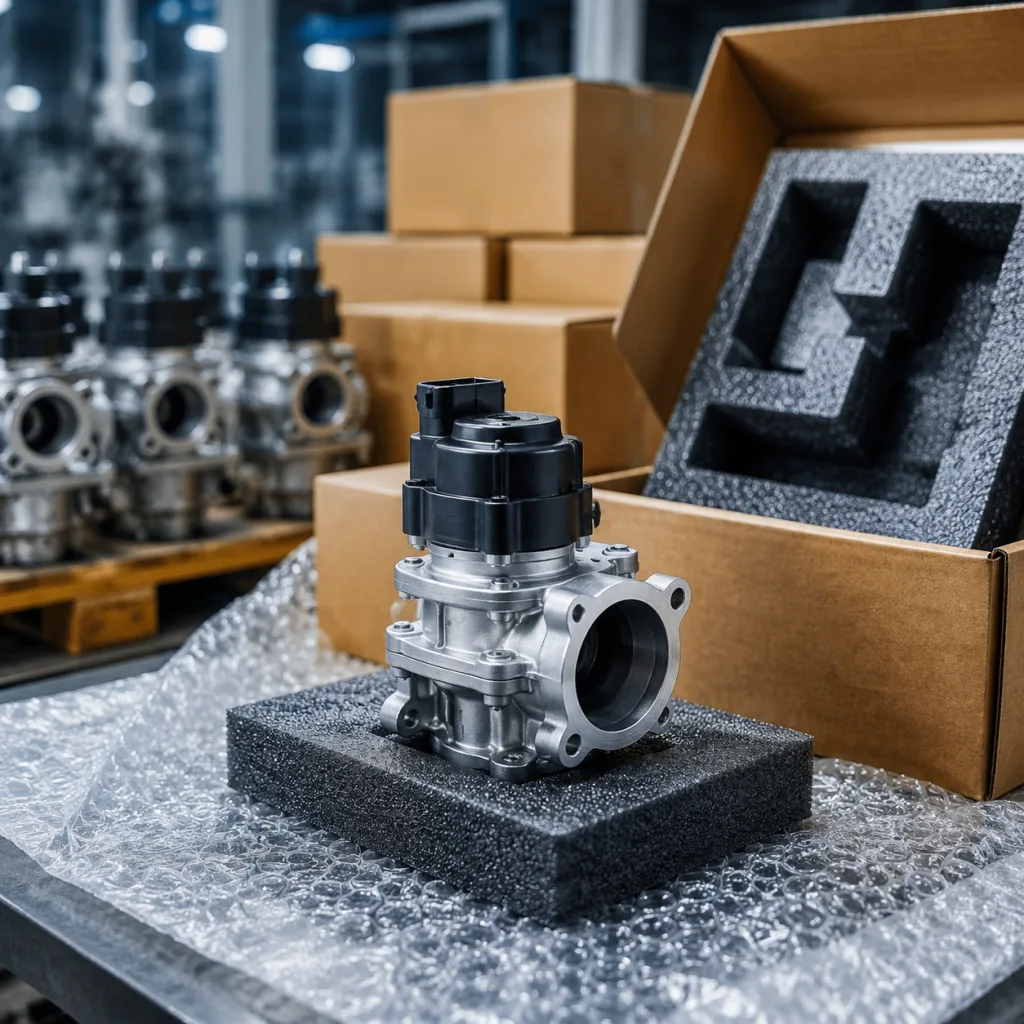
Packaging influences MOQ more than many buyers expect. Standard export cartons with dividers or trays are usually manageable at smaller volumes. Custom litho cartons, molded trays, private-label sleeves, barcode labels, or market-specific compliance markings often come with packaging-material minimums that can exceed the part MOQ itself.
If the part is a straightforward replacement on an existing platform, MOQ can be far lower than for a new casting that needs fresh tooling, gauges, and validation. Buyers should also remember that MOQ is often tied to the supplier's production schedule. A factory may accept a smaller quantity if your order can be grouped with another run using the same alloy melt, machining fixture family, or assembly cell.
The right order band depends on where you are in the buying cycle: sampling, launching a new SKU, or replenishing an established line. The table below is a practical guide, not a guaranteed supply rule.
Highest unit cost; usually viable only with existing tooling and standard packaging
300-1,000 pcs
Pilot commercial lot or first release
Common aftermarket opening range; setup and inspection cost spread more realistically
1,000-3,000 pcs
Repeatable production SKU
Lower unit cost; easier to amortise machining setup, leak-test time, and export packing
3,000+ pcs
Mature program, private label, or multi-market rollout
Best cost leverage; supports custom cartons, tray packs, and expanded validation
</tr></thead><tbody> </tbody></table>These ranges are useful because they mirror how suppliers typically spread fixed cost across a batch.
100-300 pcs is usually a trial quantity. Buyers use this range for fitment checks, workshop trials, bench pressure testing, fleet evaluation, or controlled pre-launch sales. It works best when the casting, machining route, and leak-test fixture already exist. At this level, unit cost is highest because setup, line clearance, first-piece inspection, and export administration are shared across very few parts.
300-1,000 pcs is often the most practical first commercial band for the independent aftermarket. It gives buyers enough stock to test real sell-through without taking on too much inventory risk. For many repeatable oil filter housing programs with existing tooling, this is where MOQ discussions tend to land.
1,000-3,000 pcs usually signals a committed SKU with a clearer demand pattern. At that point, the supplier can run casting, machining, testing, and packaging more efficiently, with lower labor burden and lower scrap exposure per shipped piece. Buyers may also see better price stability if repeat orders are planned on a consistent cadence.
3,000+ pcs is common for stable distributor programs, private-label launches, or multi-country rollouts. This volume can justify dedicated packaging artwork, customer-specific labels, tray tooling, and better component pricing on thermostats, seals, and fasteners.
These bands are not hard rules. If the part includes an oil cooler core, extra sensor ports, a proprietary cover, or country-specific retail packaging, the commercial floor usually moves up. If the project uses a shared housing family and only minor machining or label changes are needed, MOQ may move down.
It also helps to tie volume to inventory strategy:
Importers entering a new channel often start at 300-1,000 pcs to limit stock exposure
Distributors extending an established line may move directly to 1,000+ pcs for better landed cost per unit
Private-label buyers with custom boxes and inserts often need higher volume because packaging vendors have separate minimums
Multi-SKU buyers can sometimes negotiate lower per-SKU MOQ if several related housings are released in one sourcing package
The lowest MOQ is not always the best commercial choice. A very small lot can look attractive on paper, but once unit price, freight per piece, and inspection overhead rise sharply, the total program cost may be worse than ordering one band higher.
What to Send in an RFQ
A clean RFQ cuts down engineering back-and-forth and makes the quoted MOQ much easier to trust. At minimum, send:
Part drawing, clear photos, and exact vehicle application
Housing type: bare casting, machined housing, or complete assembly
Fitment-critical dimensions: port orientation, bolt pattern, gasket face geometry, and thread specification
Target annual volume, opening order quantity, and reorder cadence
Material, coating, and surface finish requirements
Packaging requirements for cartons, pallets, trays, and labels
Test requirements such as pressure decay, leak check, burst test, or thermal cycling
Those basics matter, but a stronger RFQ goes further. For the minimum order quantity for oil filter housing, the supplier is really deciding whether your project fits an existing process route or needs dedicated work. The more clearly you define that, the more reliable the MOQ, unit price, and lead time will be.
A strong RFQ should clearly state the following:
1. Exact application scope List engine code, displacement, model years, market region, and transmission variation if relevant. State whether the housing must match a specific OE configuration. Oil filter housings often vary by cooler interface, sensor count, port clocking, bracket geometry, and bypass or thermostat calibration even within the same vehicle family.
2. Product configuration Specify whether you are buying:
Bare casting only
Fully machined housing
Housing with cover
Housing with thermostat
Housing with integrated oil cooler
Full module with seals, sensors, and brackets
This distinction matters because a supplier that can support a low MOQ on a bare housing may need a higher MOQ for a complete assembled module.
3. Technical documents Send 2D drawings, 3D data if available, photos of the removed part, and any known field-failure modes. If the problem is cracking at a mounting ear, stripped threads in a sensor boss, warpage on the gasket face, or porosity-related leakage, say so directly. It helps the supplier review process controls against the actual failure mode.
4. Critical dimensions and tolerances Flag the dimensions that directly affect installation and sealing, such as:
Gasket face flatness
Port thread type and class
Centre-to-centre distance of mounting holes
Position of sensor bosses relative to bracket faces
Cooler sealing land width and perpendicularity
Where possible, provide the required tolerance band rather than simply saying "match OE." That tells the factory whether standard gauging is enough or whether a dedicated fixture or CMM program is needed.
5. Performance and validation requirements State the inspection and test level expected for the first order. Typical requirements include:
100% air leak test at agreed pressure and hold time
Burst or pressure endurance test on validation samples
Dimensional report on critical characteristics
Metallurgical or material certification for casting alloy
Hardness, coating, or corrosion test where specified
Thermal cycling or functional thermostat verification for assembled modules
6. Commercial forecast Even if the first release is small, provide realistic annual demand and reorder cadence. A supplier may accept a lower first MOQ if the forecast shows a repeat program rather than a one-off purchase.
7. Packaging and labeling Define inner-box quantity, export carton count, pallet pattern, label format, barcode symbology, country-of-origin marking, and any customer-specific data fields. Packaging changes are a common reason the final MOQ ends up higher than the first informal quote.
8. Market compliance needs If the parts are intended for EU, UK, US, Canada, Australia, or Brazil distribution, mention any material declaration, labeling, or importer-data requirements at RFQ stage rather than after sample approval.
If the part belongs to a larger sourcing family, keep the file aligned with our catalog so engineering, purchasing, and quality teams work to the same revision. A clear RFQ helps the supplier separate a one-time sample request from a long-term replenishment program. It also makes it easier to distinguish truly fitment-critical requirements from optional preferences that add cost without improving function.
How Custom Manufacturing Changes Volume
Custom work changes MOQ because it changes non-recurring engineering effort, tooling load, process validation, and scrap risk. A new port angle, added sensor boss, revised bracket, or changed gasket seat can trigger new tooling, modified machining programs, and extra first-off checks.
Custom manufacturing is usually most economical when the buyer keeps the base casting platform stable and changes only the machining program, final assembly content, or branding. That approach reduces validation risk and often makes a smaller launch quantity possible.
If the design needs to be fully unique, the supplier will often ask for either a larger commitment or a phased release plan:
1. Prototype or pilot lot for dimensional and leak validation 2. First production lot after sample approval 3. Repeat schedule tied to agreed forecast consumption
This structure is common because it separates engineering risk from full-volume production.
The key point is that not all customization affects MOQ in the same way.
Low-impact customization usually includes:
Laser marking or private-label branding
Outer-carton artwork changes
Minor machining edits on an existing casting family
Alternative O-ring compound such as NBR to FKM/Viton where compatible
Simple hardware kit additions
These changes may raise unit cost, but they do not always require a major MOQ increase if the base housing and process route stay the same.
Medium-impact customization often includes:
New fixture datum points or revised clamping strategy
Additional tapped ports or machined bosses
Revised cover geometry using the same casting family
Different cooler or thermostat pairing
Customer-specific dimensional or leak-test reports
Here, MOQ often rises moderately because the supplier has to validate more process steps and manage more purchased parts.
High-impact customization generally includes:
Completely new casting geometry
New die, core package, trimming tool, and machining fixture set
New leak-test nest or sealing adapters
New CNC programs across multiple sealing faces and ports
New bracket interfaces or vehicle-specific mounting architecture
At this level, the first order may need to absorb sample development, fixture proving, capability checks, trial scrap, and documentation similar to first article inspection or PPAP-lite submissions. That is why a fully bespoke oil filter housing program usually carries the highest MOQ or a separate tooling charge.
Buyers can often keep MOQ under better control by using one or more of these strategies:
Base the design on an existing casting family where possible
Freeze fitment-critical dimensions before quoting and sampling
Separate packaging customization from part customization during launch
Approve a pilot lot in standard packaging, then move to branded retail packs on the second order
Bundle multiple related part numbers into one sourcing agreement
A phased approach is especially useful when engineering wants custom features but purchasing wants to keep opening stock under control. The supplier can validate the design in a smaller pilot quantity, then move to a larger production release once leakage, gasket-face flatness, thermal behavior, and installation feedback are approved.
Quality, Compliance, and Reorder Terms
Commercial MOQ is only part of the sourcing decision. In automotive supply, buyers also need confidence that the supplier can repeat the approved specification on the next batch with controlled variation.
Ask for process control under our quality system aligned with IATF 16949:2016 and ISO 9001:2015. For export programs into the EU or UK, material declarations may need to address REACH (EC) No 1907/2006. Depending on material content and customer channel, suppliers may also be asked for IMDS-style material data or restricted-substance statements. Corrosion requirements should be tied to the actual finish and test method specified by the buyer rather than assumed.
A solid reorder file should include:
Lot traceability and inspection records
Approved drawing revision and control plan reference
Approved artwork or label format
Packing specification and carton quantity
Agreed lead time for repeat orders
Deviation and engineering change control procedure
These controls matter as much as first-order price, because a low MOQ has little value if the second shipment cannot match the approved sample.
For oil filter housings, quality control deserves close attention because the part combines machined sealing surfaces, internal oil passages, threaded features, and often assembled subcomponents. Small deviations can lead to leaks, stripped-thread complaints, sensor fit issues, or field returns. Buyers should confirm how the supplier controls each stage:
Incoming material control The supplier should be able to identify casting alloy, seal compounds, thermostat elements, fasteners, and any purchased cooler or sensor components used in the assembly. Material certificates should link back to lot or heat where applicable.
Casting quality control Confirm how porosity risk, flash, and dimensional stability are managed. For pressure-bearing housings, buyers commonly ask how the supplier controls wall-thickness consistency, core shift, and leak-prone zones before machining and assembly.
In-process machining control Critical characteristics usually include flatness of gasket faces, thread quality, hole position, perpendicularity of mounting points, surface finish on sealing lands, and burr control in oil passages. Ask whether checks are carried out by in-process gauging, first-off and last-off inspection, or scheduled SPC on critical dimensions.
Leak and function testing If the housing contains internal galleries, a thermostat, or an assembled cooler interface, confirm whether testing is sample-based or 100% per piece. For many buyers, 100% leak testing is a release requirement on finished housings or modules. If a thermostat is included, define whether functional opening-temperature verification is required on validation samples or on each production lot.
Final inspection and traceability Each lot should be traceable to a production batch, with records for dimensional checks, leak tests where applicable, and packaging verification. Traceability is especially important when one housing family is supplied in multiple configurations with different ports, covers, or bracket sets.
Compliance expectations should also be defined before the first order ships. Depending on destination market and customer channel, buyers may need:
Material declarations
Country-of-origin marking
REACH-related statements for EU or UK distribution
Packaging conformity details
Label data fields for importer, warehouse, or distributor systems
Reorder terms are equally important. A first order may go smoothly, but repeat supply can become unstable if there is no agreed framework for lead time, revision control, or forecast visibility. Buyers should align on:
Standard production lead time after PO release
Forecast window and flexibility band
Safety-stock or finished-goods policy if any
Procedure for engineering change notification
Handling of approved deviations or temporary substitutions
When these controls are documented, the buyer is not just purchasing a batch of parts. They are establishing a repeatable supply condition. That is what turns the quoted minimum order quantity for oil filter housing into a workable long-term sourcing plan rather than a one-time transaction.
Frequently asked questions
For a repeatable oil filter housing using existing casting tooling, standard machining fixtures, and non-custom packaging, 300-1,000 pcs is a common commercial starting band. If the project needs a new die, extra machining operations, 100% leak testing with dedicated fixtures, or integrated components such as a thermostat or cooler, the MOQ usually moves higher unless tooling cost is charged separately.
Yes. A pilot lot is often possible when the part is based on existing tooling or a shared casting family. Typical sample or validation quantities are 100-300 pcs, but unit price is higher because setup, first-article inspection, and test cost are spread across fewer pieces. Many suppliers will only support this for standard packaging and standard process routing.
Send the latest drawing, clear photos of the removed part, application and engine-code data, target annual volume, required opening quantity, packaging specification, and any compliance requirements. Include OE reference numbers for fitment screening where available, plus critical tolerances, thread specifications, and any required leak-test or validation standard so the supplier can quote MOQ and process scope accurately.
For pricing, sample planning, and MOQ confirmation, use [request a quote](/contact.html)