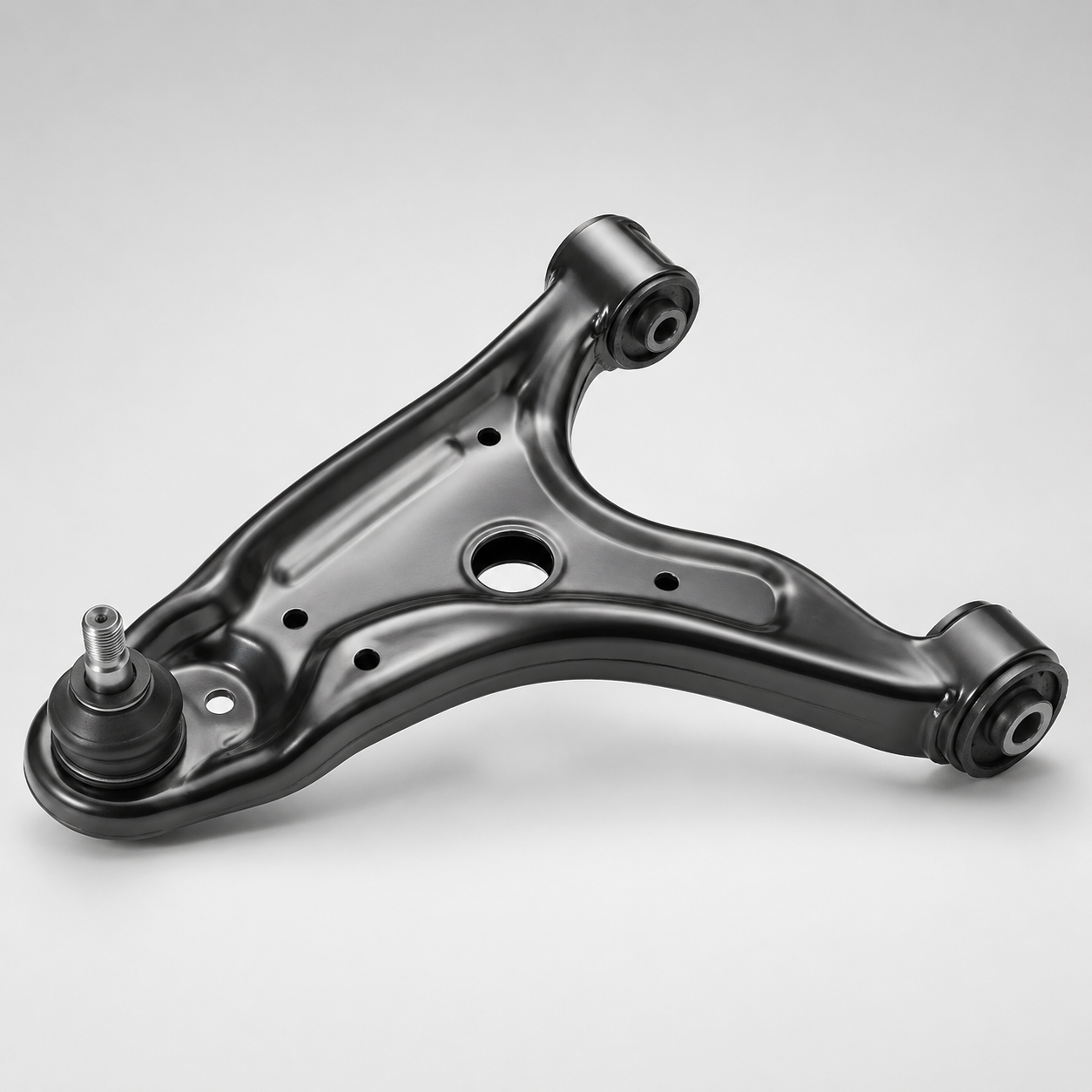
A catalog photo does not tell you whether a **lower ball joint and control arm** assembly will hold alignment, keep preload, and survive repeated road shock. Buyers in this category are not really buying a shape. They are buying geometry control, joint retention, bushing behavior, and corrosion resistance over time.
That is why two assemblies that look interchangeable can perform very differently in service. If the stud taper is slightly off, the bushing compound drifts, the weld pulls the arm out of position, or the boot sealing is weak, the part may install but still come back with noise, steering pull, tire wear, or early looseness.
For distributors, repair chains, and private-label programs, the practical job is to compare suppliers with evidence, not claims. Useful checkpoints include taper dimensions, center-to-center tolerances, articulation torque, housing retention force, coating performance, MOQ by reference, sample timing, and production lead time. This guide approaches the category from a sourcing angle: how to decide fast, what usually goes wrong, and which data separates a reliable supplier from a risky one. Driventus is an independent aftermarket manufacturer; any brand names mentioned are for fitment reference only.
Start with the buying decision, not the unit price
For a lower ball joint and control arm program, the first screen should be simple: Will it fit correctly, carry load correctly, and stay stable through service? Price matters, but not before those three questions are answered.
A complete assembly is a stack of dependent parts: arm body, bushings, joint, boot, grease, and coating. One weak point can turn an otherwise acceptable quote into a return problem.
Use this first-pass review:
Stud and housing geometry: confirm taper size, taper length, thread specification, stud stand height, articulation angle, and housing press dimensions against the target knuckle and arm seat. Buyers often want taper tolerance around ±0.02-0.05 mm on critical diameters plus GO/NO-GO thread checks.
Arm dimensional accuracy: center-to-center spacing, hole location, bracket offset, and ball-joint axis position affect installation and alignment. On approval samples, many programs expect critical locations within ±0.20-0.50 mm, depending on platform.
Bushing behavior: hardness, void pattern, bonding method, and sleeve concentricity influence NVH, brake feel, and durability. A common control point is hardness within ±5 Shore A of approved spec.
Arm material and section thickness: stamped arms need defined plate thickness, often in the 2.5-4.5 mm range by application. Forged arms need stable machining on seating and mounting faces.
Corrosion protection: e-coat, phosphate, zinc flake, or equivalent should be specified, not implied. Buyers should ask how coating thickness is controlled and how performance is verified.
Boot and grease retention: sealing has to survive splash, ozone, debris, and full articulation. Ask for grease fill volume, clamp method, and operating temperature range, for example -40°C to 120°C.
If a supplier cannot explain these points clearly, the conversation is still too early for a meaningful price comparison.
Procurement teams should also confirm whether the supplier only offers standard assemblies or can support custom manufacturing for bushing tuning, coating requirements, hardware grade, or packaging formats at `/oem-services.html`.
Choose the assembly strategy that fits your channel
Not every buyer should source the same way. The right assembly choice depends on who will install it, how broad the coverage must be, and how much variation your warranty process can tolerate.
Distributors usually want broad interchange coverage and predictable replenishment. Repair chains care more about first-time fit and workshop speed. OEM-oriented or program-managed buyers may accept higher cost in exchange for tighter control and cleaner documentation.
</tr></thead><tbody> </tbody></table>Then come the commercial trade-offs:
MOQ logic: common references may run at 100-300 pcs/SKU. Lower-volume or forged references may need 300-1,000 pcs/SKU to produce economically.
Price logic: stamped arms are usually the cost baseline. Forged assemblies tend to price higher because of material input, machining, and slower cycle time.
Lead-time logic: with approved tooling, sample replenishment may take 2-4 weeks and mass production 30-60 days after deposit and artwork confirmation. New tooling or bushing tuning can push launch to 8-12 weeks.
Mixed-order logic: buyers building container programs should confirm whether MOQ applies per SKU, per shipment, or per production family.
The point is not to find the cheapest build. It is to match construction and supply model to the way the part will actually be sold, installed, and warrantied.
A sourcing decision should also account for mixed-order packaging, EU and UK label compliance, and documentation relevant to REACH (EC) No 1907/2006 material communication where applicable.
Read validation reports like a risk filter
When a supplier says a part is OE-equivalent, the useful question is: What data supports that claim? For a lower ball joint and control arm assembly, strong validation reports do two things. They show that the part is dimensionally correct, and they show that it stays functional after load, motion, and environmental exposure.
Core validation items
Dimensional inspection report against a drawing or approved sample, with critical points identified and actual readings shown
Stud taper and thread verification using calibrated gauges, ring gauges, and profile checks where required
Pull-out and push-out force tests for joint housing retention in the arm seat, with min/max values defined by the approved process
Articulation torque measurement before and after durability cycling to show grease retention and internal wear trend
Boot sealing and grease leakage checks across the operating temperature range, typically low-temperature and high-temperature exposure followed by movement testing
Salt spray or cyclic corrosion testing for coating comparison, with the test method named on the report
Weld integrity checks where stamped assemblies use welded brackets, including weld size and location verification
Rubber-to-metal bond testing for bushing retention and separation resistance
Test area
What to request
Why it matters
Dimensional conformity
CMM or fixture report on critical points, especially ball-joint axis and mounting-hole locations
Confirms fitment accuracy and alignment control
Joint retention
Housing retention force data, for example push-out and pull-out results in kN
Reduces field failure risk
Articulation
Breakaway and rotating torque values, often reported in N·m
Indicates steering feel and wear trend
Durability
Cycle-test summary under radial and axial load, often tens of thousands of cycles depending on internal standard
Screens early-life wear problems
Corrosion
Coating test method and result hours, such as neutral salt spray comparison
Supports shelf life and field exposure
Material control
Rubber, steel, grease, and coating specs with revision status
Improves batch consistency
</tr></thead><tbody> </tbody></table>Pass/fail language is not enough. Buyers should ask for actual values, sample size, and acceptance limits. If articulation torque changed after cycling, by how much? If retention force passed, what was the result in kN? If the coating was tested, which method and how many hours?
That level of detail makes comparison possible across suppliers, even when their internal standards differ.
No single public standard covers every detail of an aftermarket suspension assembly, but buyers should expect the supplier’s management system to operate under IATF 16949:2016 and ISO 9001:2015, with traceable control plans, gauge calibration, reaction plans for out-of-spec dimensions, and nonconformance handling. You can review our broader quality system at `/quality.html`.
Use these RFQ questions to expose weak suppliers early
Many supplier listings for suspension parts say roughly the same thing. The RFQ is where the differences appear.
A capable supplier should answer with numbers, specifications, and process detail. A weak one usually answers with broad claims like “high quality,” “OE standard,” or “long service life” without showing how those claims are controlled.
Recommended RFQ checklist:
What are the base materials for the arm body, ball stud, housing, sleeves, and dust boot?
Is the arm stamped, cast, or forged, and which dimensions are controlled 100% versus by sampling?
What is the specified plate thickness, forging weight, or finished mass of the assembly?
Are bushings produced in-house or sourced externally, and what hardness range is approved?
What is the grease type and operating temperature range?
Which corrosion system is used: e-coat, zinc flake, or powder coat? What coating thickness or test result is guaranteed?
What are the validated retention force, articulation torque, and durability-cycle targets?
Can the supplier provide lot traceability from raw material through finished packing?
What are the MOQ, sample lead time, production lead time, and replenishment cycle for mixed references?
Is neutral packing, barcode labeling, carton marking, or private label support available?
Can they support sample-build approval before mass production?
What is the warranty claim process, and how are suspect lots contained?
A useful follow-up is to ask for the commercial summary in table form. That forces clarity.
Item
What buyers should request
MOQ
Per SKU, per order, and per packaging style
Price break
Example tiers at 100, 300, 500, or 1,000 pcs
Sample timing
Existing-tool sample vs. new-tool sample timing
Production timing
Days from deposit, artwork approval, and packaging confirmation
</tr></thead><tbody> </tbody></table>For importers, export packaging deserves the same scrutiny as the part itself. Carton compression strength, pallet pattern, moisture protection, and reference identification all affect landed cost and claim rates.
If you are reviewing multiple references at once, a supplier with a broad suspension range should be able to guide you from our catalog at `/products.html` to the relevant family quickly, with application mapping and packing data prepared for procurement review.
Map the main failure modes to the controls that prevent them
Returns in this category are rarely random. Most trace back to a small set of repeatable failure modes, and each one points to a missing control somewhere in design, material selection, or production.
Typical failure modes
Excessive joint play caused by poor bearing-surface control, insufficient stud or seat hardness, low preload, or grease loss
Boot rupture caused by low tear resistance, poor clamp design, flash at the sealing edge, or over-extension at full lock
Bushing cracking or separation linked to compound quality, bonding issues, sleeve misalignment, or incorrect void orientation during pressing
Stud thread damage resulting from poor finishing, burrs, coating buildup, or nut mismatch
Corrosion at the housing or arm body where coating coverage is incomplete near edges, drain points, or welds
Installation misfit caused by hole-position drift, bracket angle error, or taper mismatch
The downstream costs are familiar:
workshop labor claims
wheel alignment rework
repeat logistics
warranty administration
distributor reputation damage
lost installer confidence on the next order cycle
The useful sourcing habit is to connect each likely failure to a preventive control:
Boot failure: review material validation, clamp method, sealing edge finish, and articulation-angle checks.
Bushing separation: ask about compound consistency, bond testing, press depth, and sleeve positioning.
Installation misfit: focus on fixture control, CMM data, taper verification, and bracket geometry checks.
Corrosion complaints: verify coating coverage, edge performance, and the named test method behind the claim.
That is how return risk should be compared—not by anecdote, but by whether the supplier can show the controls that address known failure patterns.
What a procurement-ready supplier package looks like
Once a supplier passes the technical screen, the next question is operational: Can they support a clean launch without repeated back-and-forth? A procurement-ready supplier does not send technical data, commercial terms, and packaging details as separate conversations. They present one usable package.
Minimum document set:
Part drawing or approved critical-dimension sheet with tolerance callouts
Application list and interchange mapping
Material and coating declaration where required
Inspection standard and sample report
Validation summary with retention force, torque, corrosion, and durability data
Packaging specification, carton dimensions, units per carton, and pallet quantity
Batch traceability format
Lead-time and MOQ schedule
Price validity period and payment terms
Warranty terms for the target market
Where program volume justifies it, buyers may also request pilot-run samples, packaging mock-ups, first-article approval records, and ongoing process capability data on selected characteristics such as ball-joint axis location, bushing press depth, or stud thread conformity.
A practical sourcing flow usually looks like this:
1. RFQ review with drawing, application, volume forecast, and target packaging 2. Sample approval with dimensional and fitment confirmation 3. Commercial confirmation covering MOQ, price tiers, tooling status, and lead time 4. Pilot production for labeling, packaging, and process verification 5. Mass production release with lot traceability and shipment schedule
If a supplier can support those steps without gaps, approval moves faster and launch risk falls.
Driventus supplies engine and chassis-related aftermarket components to B2B customers in export markets and supports documentation workflows used by distributors, OEM/Tier-1 buyers, and repair groups. If you need a review of suspension references, packaging options, or a private-label program, you can request a quote at `/contact.html`.
Frequently asked questions
For most aftermarket programs, yes. A complete assembly usually reduces workshop time, lowers local assembly variation, and makes warranty tracing easier. It is still important to verify joint retention force, articulation torque range, bushing hardness specification, and dimensional conformity before approving supply.
At minimum, ask for critical-dimension reports, application mapping, material or coating declarations where required, validation summaries, packaging specifications, MOQ and lead-time details, and batch traceability information. For larger programs, add durability data, retention-force results, and control-plan information under IATF 16949:2016 or ISO 9001:2015.
Approve samples before volume purchase, verify fitment on critical references, compare retention force, articulation torque, corrosion, and durability data, and confirm packaging and labeling controls. Return rates usually drop when geometry, sealing, process capability, and traceability are checked before launch.
If you are qualifying new suspension suppliers or reviewing an existing program, Driventus can provide technical data, packaging options, MOQ guidance, and export support. Contact our team to discuss your requirements at /contact.html