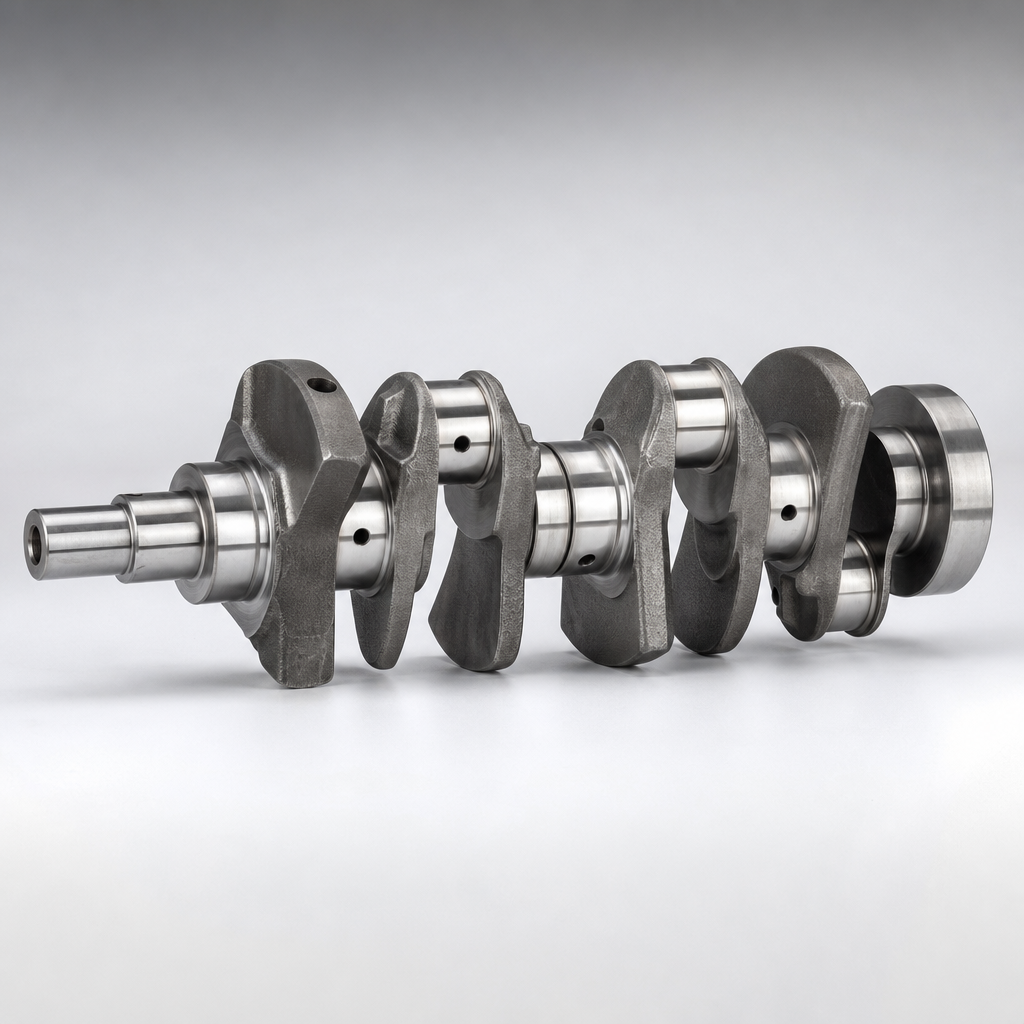
Knowing how to choose a crankshaft supplier is less about finding the lowest quote and more about controlling downstream failure cost. For distributors, OEM buyers, and repair-network procurement teams, the real exposure usually sits in dimensional variation, unstable shipments, weak traceability, and inconsistent metallurgy. Because a crankshaft is a load-critical rotating part, small errors in journal size, fillet geometry, straightness, or balance can shorten bearing life, increase NVH, and turn a “good” buy into a warranty problem.
A better way to review suppliers is to separate the decision into a few practical questions: can this factory make the part correctly, can it prove that consistently, and can it support the order pattern you actually have? That means checking process capability, inspection discipline, material control, production planning, and commercial fit before placing volume orders. For most automotive and industrial programmes, buyers should define critical-to-function characteristics up front: main and rod journal diameter tolerance, taper and out-of-round, total indicated runout, fillet radius, thrust-face width, surface roughness, hardness window, and residual unbalance.
The sections below explain how to choose a crankshaft supplier without relying on a generic checklist. They move from sourcing fit, to technical proof, to failure signals, to approval logic. You will also find the commercial numbers buyers usually need in real sourcing: MOQ logic by SKU, target lead-time bands, pilot-lot sizing, and the checkpoints that should exist between raw material receipt and final packing. Driventus is an independent aftermarket manufacturer; brand names are referenced for fitment only.
First decide what kind of supplier you actually need
Most crankshaft sourcing mistakes start before supplier comparison begins. The brief is too broad, the use case is mixed, or the buyer is trying to solve four problems with one RFQ.
Before you compare factories, define the job clearly. Are you buying for broad aftermarket coverage, OE-equivalent replacement, private-label packaging, low-volume pilot supply, or a multi-SKU replenishment programme? Each points to a different supplier profile.
A useful sourcing brief should lock down four things:
Part scope: cast or forged crankshaft, engine family, stroke variant, counterweight design, rear seal interface, reluctor-wheel requirement
Application scope: passenger car, LCV, off-highway, marine, or industrial engine use
Compliance scope: material declaration, market-specific chemical restrictions, documentation package, and traceability expectations
Then add the operating numbers that separate a workable supplier from an attractive-looking one. State annual volume by SKU, order frequency, safety-stock expectation, and whether demand is stable or seasonal. A supplier that performs well on one 6,000-piece reference may be inefficient for 20 part numbers ordered in monthly batches of 150 to 300 pieces. A plant built around long forged-crankshaft runs may reject pilot batches below 100 to 200 units per SKU unless setup, tooling, and balancing cost are handled separately.
At this stage, define acceptance logic, not just the part number. Useful buyer inputs include:
Critical dimensions: main journal diameter, crankpin diameter, stroke, flange pilot, seal land, nose thread or keyway, thrust width
Typical tolerance expectations: journal diameter often controlled in the low-micron range, runout commonly in hundredths of a millimeter, and bearing-journal finish to a fine Ra suitable for hydrodynamic lubrication
Material route: forged steel versus cast iron, induction-hardened journals versus through-hardened requirements, and whether fillet rolling is mandatory
Service expectation: OE replacement, heavy-duty rebuild, racing or performance margin, or cost-driven aftermarket service part
If the programme includes several references, split fast movers from long-tail demand. Also separate repeat production, pilot or validation parts, and emergency replenishment. Those three buckets often need different MOQ rules, setup charges, and lead-time commitments.
This is the first real step in how to choose a crankshaft supplier: match the supplier model to the demand profile, not just the drawing. Where a wider engine-component sourcing strategy matters, check whether the manufacturer supports adjacent lines through our catalog or offers bundled engine-component programmes via /products/engine-components.html.
Can the factory hold the specs, or just show certificates?
Certificates are a screen, not a decision. A supplier can hold valid paperwork and still struggle with forging quality, heat treatment, machining accuracy, or final balance control.
If you want to know how to choose a crankshaft supplier with lower operating risk, ask one question early: can the plant explain exactly where critical characteristics are created, checked, and protected?
Start with the formal basics. Request the current scope and validity of IATF 16949:2016 and ISO 9001:2015. Then move immediately into the process route.
What to confirm in the factory process
Raw material source and incoming verification
Forging or casting route, including die or mould control
Heat-treatment method and hardness window
CNC machining sequence for main journals, rod journals, thrust faces, and nose features
Fillet rolling or an equivalent fatigue-strengthening process where applicable
Dynamic balancing method and acceptance criteria
Final cleaning, rust prevention, and export packaging
A capable supplier should explain the full manufacturing flow without hesitation. For a forged crankshaft, that may include billet or bar verification, heating, die forging, trimming, shot blasting, rough machining, heat treatment, semi-finish machining, fillet rolling, finish grinding, polishing, balancing, washing, rust protection, and final inspection. For cast crankshafts, ask how the supplier controls porosity, shrinkage, and inclusion risk before machining cost is added.
Do not stop at “we inspect every batch.” Ask for process-capability evidence. On critical finished dimensions, mature suppliers often track Cp/Cpk or equivalent indicators for journal diameters and runout. As a working benchmark, many buyers prefer demonstrated Cpk ≥ 1.33 on stable serial production for agreed critical characteristics, supported by internal machine limits tighter than the customer drawing. If the supplier cannot explain control limits, sampling frequency, or the reaction plan when results drift, treat that as a warning.
Minimum audit questions
Audit point
What to ask for
Why it matters
Material control
Mill certificates, heat/lot traceability
Confirms chemistry and source consistency
Dimensional control
Control plan, gauge list, SPC records
Shows whether critical journals are monitored statistically
Heat treatment
Process records, hardness test reports
Supports wear resistance and core strength
Balance control
Balance reports or standard work
Reduces vibration-related field complaints
Nonconformance handling
NCR process, quarantine area, rework rules
Limits escape of mixed or suspect stock
Change management
Procedure for tooling/material/process changes
Prevents unapproved deviation after SOP
</tr></thead><tbody> </tbody></table>During the audit, go deeper where crankshafts usually fail:
Incoming material: confirm heat-number retention, identification method, and whether chemistry, hardness, or ultrasonic condition is checked at receipt
Machining discipline: verify whether journals are hard-turned, ground, or polished; what in-process gauges are used; and how offsets are corrected
Gauge control: request calibration interval, gauge R&R or MSA evidence, and master-setting practice for micrometers, air gauges, and runout fixtures
Balancing: ask whether balancing is completed at 100% final inspection, what residual unbalance limit applies, and how correction is made
Packing release: check whether final inspection status, lot number, quantity, and rust-prevention date are linked before cartons are closed
Also review whether the supplier's quality system supports PPAP-style submissions, measurement-system discipline, and lot traceability. Even in aftermarket business, these controls reduce claim risk in a very practical way.
Read the evidence package like a failure analysis
A good crankshaft supplier does not just say the part is compliant. It shows why.
When reviewing how to choose a crankshaft supplier, read the technical file the way you would investigate a field failure. What would you need to see before trusting that the next shipment matches the last one?
Request evidence in these areas:
Material specification: base material grade, hardness range, and, where relevant, microstructure verification
Dimensional report: main journal diameter, crankpin diameter, runout, stroke, flange dimensions, key interfaces, and surface finish on critical bearing surfaces
Balance data: dynamic balancing result and correction method
Surface integrity: confirmation of journal finish and fillet condition
Traceability: lot-code format linking finished part to material and production batch
The strongest suppliers provide values, not vague pass/fail language. A dimensional report should show nominal, upper limit, lower limit, measured result, gauge used, and inspection date. Buyers should expect finished journal diameters reported to micron resolution where required, runout as total indicated reading, and surface finish in Ra or an agreed equivalent. On many programmes, practical checkpoints also include journal taper and out-of-round, flange face runout, stroke consistency between throws, seal-surface finish, and nose thread or keyway conformity.
For metallurgy, one hardness number is not enough. Ask for the process logic behind it:
Raw material certificate: chemistry by heat, with heat number tied to the finished lot
Heat-treatment record: furnace or induction parameters, quench and temper route where relevant, and batch identification
Hardness evidence: specified window for journals and core area, with test method and sampling frequency
Microstructure or case-depth check: where induction hardening or other surface treatment is used, confirmation of effective depth and absence of abnormal structure
NDT results: magnetic particle or equivalent crack-detection evidence when this is part of normal release
If the supplier claims OE-equivalent fitment, ask how that claim is built. Is the part controlled by customer drawing, reverse engineering from a master sample, CMM measurement, fixture-based checking, or a mix of methods? A serious supplier can answer this directly. For references tied to known numbers, buyers may also request cross-reference management in the format OE 06A107065 where that number is already defined in the sourcing brief.
For export programmes, include chemical and material compliance in the same package. Depending on destination market and customer policy, ask for declarations relevant to REACH (EC) No 1907/2006 and related substance-reporting requirements.
A useful test here is simple: ask the supplier for the release limit for total runout, the journal surface roughness target after final polish, the production check frequency for critical journals, and the final-audit sample size. Evasive answers usually signal weak control, not just weak communication.
Where crankshaft sourcing usually breaks down in real life
Some supplier problems only appear after the first shipment. Others are visible during quotation if you know where to look.
A technically capable plant can still be the wrong partner if lead times, MOQ structure, packaging discipline, or claims handling do not match your operating model. Crankshaft sourcing often involves mixed references, forecast swings, and long logistics chains. Commercial review needs the same discipline as technical review.
Use a structured checklist:
MOQ by part number: confirm whether MOQ applies per SKU, per order, or per production batch
Lead time: request standard lead time, rush-order policy, and available capacity during peak months
Forecast handling: ask whether raw material or semi-finished stock is reserved against rolling forecasts
Packaging: verify corrosion protection, pallet pattern, carton labelling, and drop-test suitability for sea freight
Claim response: define response time for dimensional claims, shortage claims, and field-failure investigations
Document pack: packing list, commercial invoice, COO, test report, and any customer-specific labels
To make quotations comparable, force the supplier to express its logic in numbers:
Is the MOQ per SKU, per production run, or per shipment?
Does the unit price assume a machining batch of 100, 300, or 500 pieces?
At what annual volumes does pricing change: 100, 500, 1,000, or 3,000 pieces?
What portion of price is material and machining cost, and what portion is setup, tooling amortization, or balancing cost?
Is there a surcharge for small lots, mixed-container shipments, special packaging, or expedited delivery?
In practice, forged crankshaft suppliers often look cost-competitive only when setup and balancing are spread across a stable batch size. A buyer ordering 120 pieces across four SKUs may get a much higher real piece price than a buyer ordering 1,000 pieces of one reference. Compare total landed cost by realistic order pattern, not headline ex-works price.
Lead time also needs to be broken into parts:
Raw material lead time: bar stock or forging-input reservation
Production lead time: machining, heat treatment, balancing, inspection, and packing days
Queue time: how long the batch waits before production starts
Transit lead time: port handling plus ocean, air, or road movement
Expedite option: actual compressed lead time and the premium charged
Many buyers use a practical baseline of 30 to 60 days ex works for regular repeat orders, longer for fresh tooling or low-frequency SKUs, and shorter only where semi-finished stock is held. The exact number matters less than whether the supplier can explain it clearly.
This is also the stage to check whether the supplier can support custom manufacturing, such as private-label packaging, tailored machining features, or controlled pack formats for multi-warehouse distribution.
Practical red flags
Repeated lead-time changes during quotation
No clear answer on safety stock or capacity reserve
Inconsistent unit weight between drawing, quotation, and packing data
No batch-level traceability on labels or cartons
Claims handled only by sales, with no quality-engineer involvement
Add a few more red flags to the same list: unexplained MOQ differences between similar SKUs, pricing that shifts once inspection data is requested, refusal to commit claim-response timing, or packaging that blocks dust but not corrosion during 30 to 45 days at sea. These are not small issues. They are common sources of expensive rework later.
A practical approval sequence: compare, pilot, then nominate
If several suppliers look acceptable, do not pick by instinct. Use a weighted shortlist, then validate with a pilot order.
A scorecard keeps procurement, engineering, and quality aligned and makes the final decision easier to defend internally. It also helps when you are deciding how to choose a crankshaft supplier across several candidate factories with different strengths.
</tr></thead><tbody> </tbody></table>Set disqualification rules before the audit starts. For example, a supplier may fail immediately if it lacks lot traceability, cannot provide hardness and dimensional records, or cannot support the minimum batch size required by your demand plan. After that, use the weighted score to separate acceptable from preferred sources.
One practical scoring logic is:
90–100: ready for pilot order with low open risk
75–89: conditionally acceptable after corrective actions
60–74: high follow-up effort; use only if capacity alternatives are limited
Below 60: do not nominate for serial business
Then place a pilot order before broader approval. The pilot should confirm:
Incoming inspection results against agreed critical characteristics
Packaging integrity after the full logistics route
Documentation completeness
Supplier response time on technical queries
On-time delivery against committed ship date
Pilot orders work best when they are large enough to reveal process variation but small enough to limit exposure. For many programmes, that means 30 to 100 pieces per SKU or one clearly defined trial batch if the normal process requires a larger run. Agree in advance what will be checked at receipt: dimensional conformity, cosmetic condition, rust-prevention performance, label accuracy, documentation match, and any application-specific fitment check.
If pilot performance is stable, move into a controlled rollout by part family instead of shifting every reference at once. That reduces exposure while building confidence in repeatability. It is also sensible to set a first-year review gate covering PPM or defect rate, on-time delivery, claim-closure speed, and price stability against the original quote.
If you need support reviewing crankshaft sourcing requirements, you can request a quote with your target specifications and annual demand profile.
Frequently asked questions
For automotive programmes, start with IATF 16949:2016 and ISO 9001:2015. But certification is only a first filter. You should also review process controls, traceability, inspection records, calibration discipline, and change-management procedures. In practice, ask whether the supplier can show capability on critical dimensions, hardness records, balancing standards, and a lot-traceable release package for each shipment.
Usually not if the lower price comes with weak dimensional control, unstable lead times, or poor claim handling. Warranty cost, line disruption, added incoming inspection, and stock shortages can erase a small piece-price saving quickly. Compare total landed cost by actual order pattern, including MOQ penalties, expedited freight risk, inspection cost, and the cost of late or nonconforming stock.
Yes. A pilot order is one of the most practical ways to confirm fit, dimensional consistency, packaging performance, shipment accuracy, and documentation quality before larger annual volumes are committed. It should also verify measurable release criteria such as runout, journal-size consistency, hardness evidence, label traceability, and on-time delivery against the promised lead time.
If you are comparing crankshaft sources, Driventus can review your drawings, target volumes, and documentation requirements. Contact our team to discuss the programme at /contact.html