Connecting Rod for Honda Pilot Aftermarket Replacement
A replacement rod for Honda Pilot applications has to match more than the basic engine family. Fit depends on model year, engine code, journal diameter, center-to-center length, big-end width, small-end pin fit, and rod bolt specification. If any of those variables drift, the engine can show noise, oil pressure loss at the bearing, or piston-to-deck variation after assembly. Driventus is an independent aftermarket manufacturer; brand names are referenced for fitment only. The practical approach is to verify the VIN, confirm the OE cross-reference, and compare dimensions against the sample rod before purchase. For buyers managing returns, warranty exposure, or rebuild consistency, that is the difference between a usable part and an expensive rework.
What the replacement rod has to match
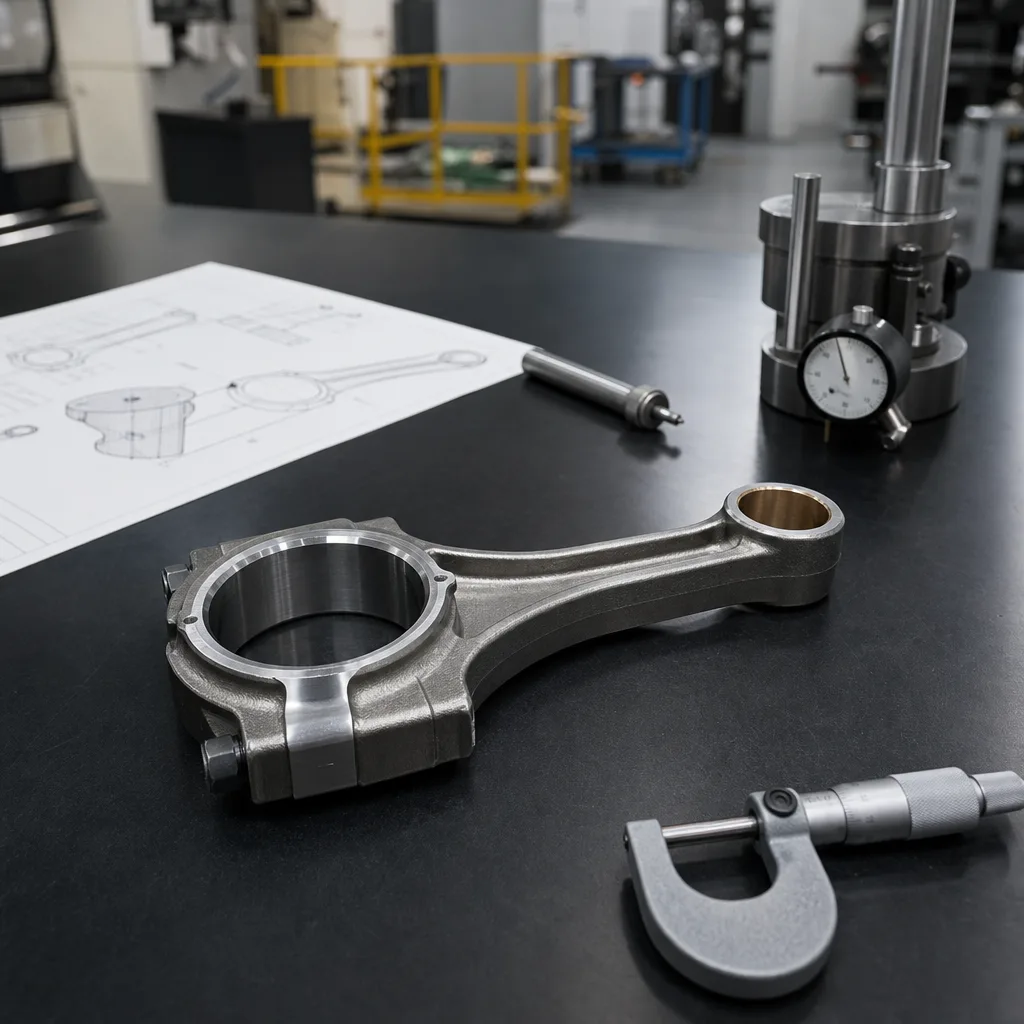
A connecting rod is a load-carrying component, so the first pass should be dimensional, not visual. The rod must match the original geometry closely enough that bearing clearance, piston height, and bolt preload remain within the engine builder's target range.
Check
Why it matters
Typical verification
Center-to-center length
Controls piston deck height and compression geometry
Compare against OE sample or drawing
Big-end bore and width
Sets bearing crush and side clearance
Micrometer, bore gauge, and width gauge
Small-end bore / pin fit
Affects piston pin alignment and wear
Pin gauge and fit check
Rod bolt spec
Determines clamp load and fatigue margin
Bolt grade, stretch, and torque check
Mass and balance
Reduces vibration and cyclic load spread
Individual weight record and match set
</tr></thead><tbody> </tbody></table>For Honda Pilot rebuilds, a small deviation in one of these values can create a repeat failure even when the part looks correct on the bench.
Fitment by engine code and VIN
Pilot applications vary by model year and powertrain, so the correct part is not selected by vehicle name alone. Confirm the engine code, production year, rod journal size, and whether the original rod uses a cracked-cap or machined-cap design. That is the safest way to keep a replacement rod aligned with the intended assembly stack-up.
Use our catalog to narrow the family, then verify the specific application against the vehicle record. If you are cross-checking adjacent parts at the same time, our engine components range can help keep related fitment under one source control process.
A good sourcing record should include the OE description, the measured sample dimensions, and any notes on piston pin interface or bearing code. That documentation reduces the risk of ordering a rod that is technically similar but not actually interchangeable.
Material, heat treatment, and surface control
For a durable replacement, the material route has to be consistent from lot to lot. Buyers should ask for the rod material specification, heat-treatment condition, hardness range, and any secondary process such as shot peening or surface polishing. The goal is not only strength at failure, but stable fatigue life under repeated load.
Common checks for procurement and QA teams:
Material certificate with heat number traceability
Hardness record after heat treatment
Straightness and beam alignment measurement
Big-end roundness and small-end finish verification
Rod bolt traceability and torque or stretch procedure
If the part is supplied as an OE-style cracked-cap design, the fracture faces should be clean, repeatable, and free from handling damage. If it is a machined-cap design, the cap fit and bolt seating must be confirmed during incoming inspection. In either case, surface finish and edge condition should support fatigue life, not just appearance.
Validation, standards, and traceability
A reliable supplier should be able to show how the part was checked before export. At minimum, ask for dimensional inspection records, first-article confirmation, and lot traceability. For an engine component, quality control should sit inside a documented system aligned with IATF 16949:2016 and ISO 9001:2015.
Depending on the build route and market, supporting documents may also cover REACH (EC) No 1907/2006 for restricted substances in coatings, preservatives, or packaging materials. That matters when the part moves into the EU supply chain and the buyer needs a clean compliance file.
What to request before approval
Inspection report with key dimensions and tolerances
Material certificate and batch identification
Sample approval photos or retained sample reference
Packaging specification for corrosion protection in transit
Statement of traceability from production lot to shipment
This is the difference between a nominal replacement and a controlled replacement that can be audited later.
Commercial sourcing terms that reduce risk
For distributors and rebuild programs, the part is only one element of the buy. Lead time, minimum order quantity, packaging, and document quality usually matter as much as unit price. Ask for stable carton counts, corrosion-protection details, and clear label conventions so warehouse intake stays simple.
If the current catalog item does not match your measured sample, custom manufacturing is the right route for a controlled revision. That is useful when you need a non-standard length, a different bolt set, or a private-label supply plan that still respects the same inspection gate.
For commercial review, use quality system to check how inspection, traceability, and release criteria are handled, then request a quote with the engine code, year range, and any target dimensions. Faster quoting starts with complete fitment data.
Frequently asked questions
Start with the VIN, engine code, and a measured sample from the original engine. Confirm center-to-center length, big-end width, small-end pin fit, and bolt spec before placing an order.
Request a dimensional inspection report, material certificate, lot traceability, and packaging specification. For regulated markets, ask how REACH (EC) No 1907/2006 is handled for coatings and preservatives.
Yes, if the application needs a different geometry or assembly requirement. Share the sample part, drawing, or target measurements, and use the custom manufacturing route for review.
If you are validating fitment or building a repeat supply plan, send the engine code, year range, and sample dimensions through our contact form at [request a quote](/contact.html).