Genuine Ford Replacement Parts: What Buyers Verify
When procurement teams search for genuine Ford replacement parts, the question is rarely just brand versus non-brand. The real decision is whether the part will fit correctly, hold up in service, and arrive on schedule with records that survive an audit.
That is where many sourcing programmes succeed or fail. In engine, cooling, sealing, and powertrain categories, small deviations in dimensions, materials, or validation standards can turn into warranty claims, repeat labour, and dead stock. Serious buyers therefore look past catalogue language and focus on evidence: cross-reference control, drawing revisions, batch traceability, test data, MOQ by SKU, lead time, and price logic across sample, trial, and repeat orders.
This article breaks the topic into the questions buyers actually use in practice: what makes a part approval-worthy, where sourcing failures tend to happen, how validation changes by part family, what documents matter before a repeat order, when independent aftermarket supply is commercially rational, and which checks belong in the final RFQ process. Driventus is an independent aftermarket manufacturer; brand names are referenced for fitment only.
Decision framework: what makes a Ford-fit part worth buying
For B2B buyers, a replacement part is not "good" because the listing looks complete. It is good if it installs without rework, performs within the expected operating range, and can be reordered without unpleasant surprises.
That usually comes down to five controls:
Critical dimensions such as bore, journal, flange thickness, groove depth, sealing-face flatness, and bolt-hole position
Material specification including aluminium alloy grade, forged steel chemistry, gasket facing composition, elastomer type, and bearing material stack
Surface finish on sealing areas, shafts, ring grooves, and machined housings
Functional validation such as leakage, pressure, endurance, balance, and thermal-cycle testing
Traceability from raw material lot through inspection release and finished batch
Buyers assessing genuine Ford replacement parts or Ford-fit alternatives often sort offers into three internal priorities:
Buyer priority
First question asked
Evidence usually requested
Fitment accuracy
Will it match the intended application?
OE reference mapping, dimensional report
Service life
Will it survive real operating load?
Test report, hardness data, metallography
Supply stability
Can this source support repeat business?
PPAP-style records, audit summary, delivery history
</tr></thead><tbody> </tbody></table>This is why measurable acceptance limits matter more than generic claims. Buyers may ask for piston pin bore tolerance within ±0.005-0.010 mm, crankshaft journal diameter within ±0.010-0.015 mm, sealing-face flatness within 0.03-0.08 mm depending on span, or water-pump shaft runout below 0.03 mm. For rotating sets, they may also cap batch weight spread at ±3-5 g.
A clean catalogue entry is only the start. If the supplier cannot explain how those limits are controlled in production, the part is not reliable enough for a serious replacement programme. The commercial side matters too. A low unit price loses value fast if first production needs 90 days, MOQ exceeds monthly demand, or repeat replenishment is unpredictable.
Failure modes: how buyers test OE-equivalence instead of trusting branding
In the independent aftermarket, OE-equivalence has to be demonstrated. Buyers should expect evidence tied to a sample, print, or validated master dataset, not vague references to "OEM quality."
Where weak offers usually fail
1. The dimensions look close, but key features are uncontrolled Overall size tells very little. On pistons, buyers focus on compression height, pin bore diameter, skirt profile, and ring groove width. On gaskets, they focus on bore opening, bead location, and compressed thickness. A useful report shows nominal dimension, tolerance, gauge type, sample size, and actual readings. For a first article, many buyers want at least 5-10 samples per cavity or machine setting on critical dimensions.
2. Material similarity is assumed, not verified Visual likeness is not enough. Chemical composition, hardness, tensile performance, and coating thickness should be available where relevant. For elastomer and sealing products, heat resistance and fluid compatibility matter more than appearance. Typical checks include aluminium alloy spectrometer results, forged steel chemistry by heat number, gasket facing density, rubber hardness in Shore A, and coating thickness such as 8-15 μm or 20-30 μm depending on finish type.
3. Functional testing is missing or too generic Water pumps, sealing sets, turbocharger-related hardware, and rotating components need evidence from service-like conditions. Buyers may review leak tests at 0.2-0.3 MPa, endurance testing over 100-300 hours, thermal cycling across -40°C to 120°C, or salt-spray exposure of 72-240 hours where corrosion resistance matters.
4. Process capability exists on paper only A supplier certified to IATF 16949:2016 and ISO 9001:2015 should be able to show inspection plans, calibration records, non-conformance handling, and change management. On higher-volume lines, buyers often ask whether special characteristics are tracked to a target Cpk ≥ 1.33.
5. Cross-references are not under document control If a listing uses an OE reference such as OE 11251..., buyers need to know who maintains the mapping and how supersessions are updated. Poor control here creates fitment claims that look like manufacturing problems but are really data problems.
Commercial review should be just as disciplined. Buyers typically compare sample order, trial order, and repeat volume order scenarios. A supplier may accept a trial MOQ of 20-50 sets at one price, then move to 100-500 pcs per SKU or 1,000+ pcs for standard production. Without that structure, it is difficult to tell whether the source is suitable for pilot stocking, branch testing, or only large container business.
For EU and UK channels, regulatory declarations may also need to align with REACH (EC) No 1907/2006, depending on the component and destination market.
Spec deep-dive: what changes by part family
Not every product family fails in the same way. That is why good buying teams avoid using one generic checklist for every SKU.
</tr></thead><tbody> </tbody></table>### Example technical gates
For engine-component programmes, buyers often use a short but strict approval gate:
Piston weight variation held within an agreed batch window, often ±3-5 g within one balanced set
Ring groove side clearance checked against control samples, with groove width commonly controlled within ±0.01-0.03 mm depending on design
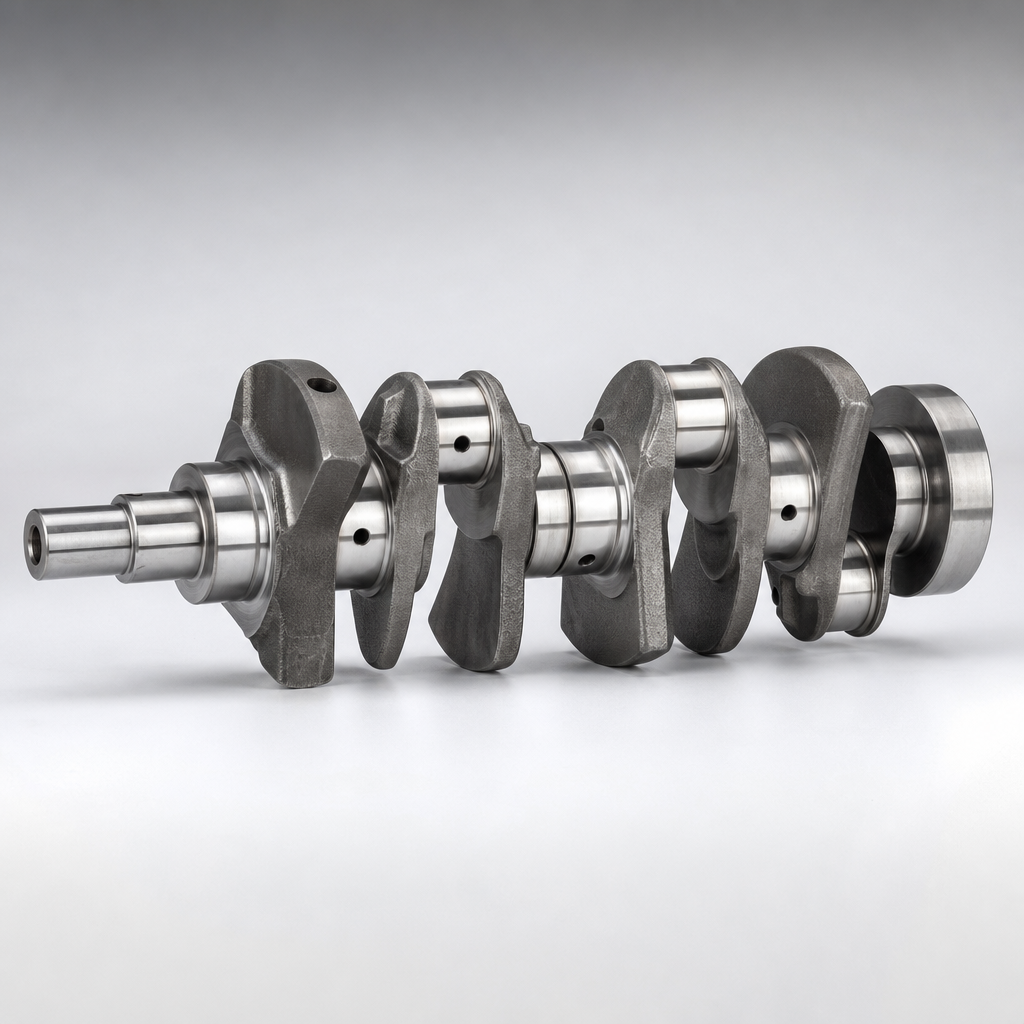
Crankshaft runout and journal roundness recorded per batch, with runout often below 0.03-0.05 mm and journal roundness within 0.005-0.010 mm
Head gasket bore and oil/coolant port alignment checked on fixture, with compressed thickness often reviewed within ±0.03-0.05 mm
Water pump leak and rotational torque testing completed before packing, for example 100% leak test plus sampled checks on bearing torque and impeller pull-off force
The smarter follow-up question is not whether the supplier can measure these items once. It is whether the checks are built into production. A practical control flow often looks like this:
1. Incoming material verification by heat number, alloy certificate, or rubber batch code. 2. First-piece inspection at setup for all critical dimensions. 3. In-process sampling every 30-60 minutes or at a defined lot interval. 4. Final inspection using AQL for appearance and full recording of special characteristics. 5. Batch release only after inspection sign-off and traceable label generation.
Lot definition matters more than many buyers expect. One batch may be tied to a furnace lot, forging lot, molding run, or machining shift. That lets a distributor quarantine 500 pcs instead of 5,000 pcs when a field issue appears.
If you are reviewing multiple engine SKUs, it is usually more efficient to assess a supplier's broader engine-component capability rather than audit each line in isolation. Relevant product groups can be reviewed through our catalog and, where applicable, engine ranges under /products/engine-components.html.
Before the repeat PO: the document pack that actually matters
A sourcing programme becomes scalable only when the documents are usable after the first shipment. Buyers should ask for records that support incoming inspection, claim handling, regulatory review, and change control.
The core package usually includes:
Part drawing or controlled specification sheet with revision status
Cross-reference list showing internal item code and OE reference format where applicable
Material certificate or statement of conformity for relevant components
Inspection report covering critical dimensions and visual criteria
Test report linked to the part family and batch or validation sample
Packaging specification including corrosion protection, label content, and carton count
Compliance declaration where market rules require it
For larger import programmes, buyers may also request:
Supplier audit summary
Process flow chart
Control plan
PFMEA or equivalent risk review
Change notification commitment
Specificity is what makes these documents useful. An inspection report should include sample quantity, inspection frequency, measured result, specification limit, gauge ID, and inspector/date, not just "pass." A packaging specification should confirm inner pack quantity, master carton quantity, gross weight, pallet pattern, anti-rust protection, barcode format, and label fields such as part number, batch code, quantity, country of origin, and production date.
Commercial records deserve the same scrutiny. Before repeat orders, buyers usually confirm:
MOQ per SKU and whether mixed-size or mixed-part consolidation is allowed
Price ladder for sample, trial, and volume orders
Lead time split between tooling/sample timing, first-order production, and repeat replenishment
Payment terms linked to sampling, tooling, or production release
Claim window and debit-note process for quality issues
As a working benchmark, many aftermarket suppliers quote around 30-45 days for repeat production after deposit and artwork confirmation, while first orders involving new packaging, fixtures, or sample approval may take 45-75 days. MOQ varies by process: gasket sets may run 100-300 sets, machined engine parts 50-200 pcs, and high-mix orders may work better under a minimum order value rather than a fixed per-SKU quantity.
These records become critical when supplying fleets, workshop groups, and multi-branch retailers. If a field issue appears, the distributor needs to isolate the affected batch quickly instead of freezing all stock.
A strong supplier should also explain how drawing, casting, seal-material, or machining revisions are controlled over time. That discipline is part of a robust quality system, not an optional add-on.
Scenario comparison: when independent aftermarket supply is the smarter move
Some buyers begin with a search for genuine Ford replacement parts, then move to independent aftermarket sourcing for practical reasons. The shift is rarely ideological. It is usually driven by supply gaps, ageing platforms, mixed-container purchasing, or the need to standardise sourcing across several brands.
In that situation, the right comparison is not "genuine" versus "aftermarket" in the abstract. It is one sourcing model against another.
An independent manufacturer becomes the practical option when it can provide:
Stable dimensional conformity across production lots
Controlled raw material sourcing
Batch traceability with retained inspection data
Export packaging suited to sea or inland distribution
Predictable lead times and reorder visibility
The operational advantage is flexibility. A buyer may combine low-volume Ford-fit engine parts with other makes in one shipment, reduce dead stock through lower mixed-order MOQ, or manage replenishment risk by reserving raw material rather than finished stock.
The commercial lesson is simple: the lowest ex-works price does not always produce the lowest total cost. A cheap offer can become expensive if it forces 1,000 pcs per SKU on slow movers. By contrast, a slightly higher ex-works price with 100-200 pcs MOQ, stable carton specifications, and a 35-day repeat lead time may improve inventory turns and reduce write-offs.
Buyers should also ask whether the supplier supports rolling forecasts, safety-stock agreements, or scheduled releases against blanket POs, especially in cooling and sealing categories where demand can move seasonally.
Driventus supplies engine and powertrain components for B2B aftermarket channels and supports customer-specific specifications through custom manufacturing. For buyers consolidating pistons, crankshafts, gaskets, water pumps, and related assemblies, that can reduce supplier count while keeping validation standards consistent.
Even then, risk segmentation still matters. High-turn engine parts, sealing kits, and cooling components should each have their own approval logic, service-claim thresholds, and sampling plans.
Step-by-step RFQ checklist for Ford-fit replacement programmes
Before releasing a purchase order, buyers can use a simple sequence to reduce avoidable claims when sourcing genuine Ford replacement parts or Ford-fit aftermarket alternatives.
1. Confirm the exact vehicle application, engine code, and market version. 2. Verify the cross-reference and any supersession history. 3. Review dimensional and material data for function-critical features. 4. Check whether validation reports are current for the offered revision. 5. Confirm compliance declarations required for the destination market. 6. Approve packaging, label format, and carton quantities. 7. Align AQL or incoming-inspection rules with product risk. 8. Agree claim handling, traceability, and change notification procedures.
For higher-volume programmes, sample approval before first shipment is usually worth the extra time. It matters most on sealing interfaces, rotating assemblies, and heat-loaded components.
A stronger RFQ workflow also adds these commercial and technical gates before release:
Request 3-5 sample pieces or 1 full set for dimensional check and installation review
Define inspection rules, for example critical dimensions at 100% or tightened sampling, plus visual inspection to an agreed AQL such as 0.65/1.0/1.5 depending on risk
Freeze the approved revision and sample status before mass production
Align lead times for sample submission, first bulk order, and replenishment orders
State the claim response timeline, such as containment feedback within 48-72 hours and corrective action within an agreed period
This structure gives buyers something more useful than a low quoted price. It produces cleaner supplier comparisons, fewer launch surprises, and a lower total cost through better fitment performance, fewer returns, and stronger stock confidence.
If you need technical support on aftermarket replacement parts for Ford-fit applications, you can review our catalog first and then request a quote with the part list, annual volume, target market, expected MOQ, and preferred delivery schedule.
Frequently asked questions
No. They are different supply categories. Independent aftermarket parts should be evaluated on fit, material, validation testing, traceability, MOQ, lead time, and claim control rather than branding language. Buyers should request measurable evidence of OE-equivalent performance and confirm whether the commercial terms work for the intended stock programme.
The essential set usually includes a controlled specification or drawing, a cross-reference list, an inspection report with actual measured values, a material declaration where relevant, a validation test report, a packaging specification, and a batch traceability procedure. For repeat orders, buyers should also confirm MOQ per SKU, price breaks, and first-order versus repeat-order lead times.
For process management, IATF 16949:2016 and ISO 9001:2015 are the main quality framework references. For EU chemical compliance, REACH (EC) No 1907/2006 may also be relevant depending on the product and market. On higher-risk lines, buyers often also ask how critical characteristics are controlled in production, including inspection frequency, calibration status, and process capability targets such as Cpk levels where applicable.
If you are qualifying a supplier for Ford-fit aftermarket replacement parts, Driventus can review your drawings, cross-references, target tolerances, MOQ, and volume plan with a technical team. Send your RFQ through /contact.html.