Front lower control arm replacement is usually seen as a workshop procedure, but it carries real procurement risk for aftermarket buyers. If the arm does not hold OE-equivalent geometry, the result can be alignment drift, uneven tyre wear, bushing noise, ball joint preload problems, steering complaints, or early warranty returns across a repair network. For distributors, wholesalers, and multi-location repair chains, the key question is not simply whether the part installs on the vehicle. It is whether every production batch maintains the same pivot geometry, weld integrity, coating performance, rubber-metal bonding, and packaging protection. This article explains the replacement-critical specifications buyers should review when sourcing front lower control arms for aftermarket programmes. It covers dimensional control, validation testing, warranty feedback, documentation, and supplier checks for importers serving the EU, UK, US, Canada, Australia, Brazil, and other regulated markets. Driventus is an independent aftermarket manufacturer; vehicle brand names are referenced for fitment identification only.
Replacement Fit Depends on Geometry Control
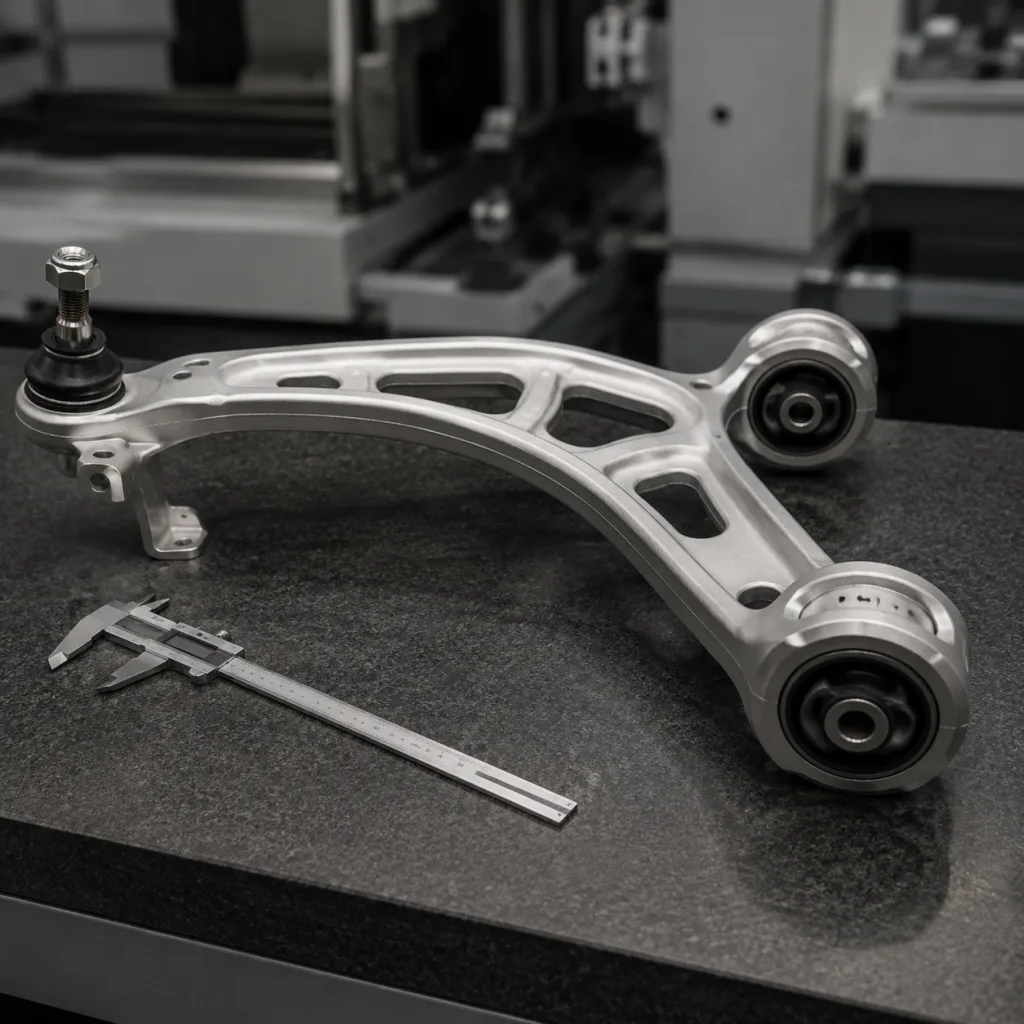
A front lower control arm fixes the wheel hub position relative to the subframe and helps maintain the designed suspension arc. Even small variation in pivot spacing, ball joint taper location, or bushing axis angle can shift camber, caster, and toe after installation. For procurement teams, reliable replacement quality begins with controlled drawings, reference samples, and production fixtures—not with the carton label.
Critical dimensions normally include:
Inner bushing centre-to-centre distance
Ball joint centre position relative to bushing datum points
Ball joint taper angle and stud thread specification
Arm twist angle under unloaded condition
Bracket hole diameter, slot length, and edge clearance
Bushing sleeve length and press-fit interference
Stabiliser link or ride-height sensor bracket location where applicable
Material and forming method also influence fit consistency. Stamped steel arms depend heavily on die condition and welding fixture control, while aluminium forged or cast arms require close monitoring of machining datums, heat treatment, and surface protection. In all cases, the approved reference part should be tied to a documented inspection method so later batches can be compared against the same standard.
For OE-equivalent supply, Driventus works from controlled samples, 3D scan data, customer drawings, and application-specific fixtures. First article inspection confirms that production parts match the approved reference before bulk shipment. Buyers can review broader suspension and chassis coverage through our catalog.
Specification Points for Procurement Approval
A sourcing review should translate replacement performance into measurable controls. Exact targets vary by application, material, and customer drawing, but the inspection logic remains consistent: confirm that the arm fits correctly, carries load safely, resists corrosion, and arrives without damage.
Item
Typical control method
Why it matters for replacement
Arm body material
Steel stamping, forged aluminium, or cast aluminium verified by material certificate
Confirms strength class, weight target, and corrosion behaviour
Key hole positions
CMM, go/no-go fixture, or calibrated inspection jig
Supports correct wheel alignment after installation
Prevents fatigue cracks, porosity issues, and bracket distortion
Packaging
Drop test, separator design, corrosion inhibitor
Limits transit damage, thread impact, and surface oxidation
</tr></thead><tbody> </tbody></table>Buyers should request PPAP-style documents when programme volume or customer risk justifies them. A practical file may include dimensional reports, material certificates, process flow, control plan, appearance approval, sample approval records, and packaging specification. For standard aftermarket stock, a simplified approval file may be acceptable if the factory can provide batch inspection reports, traceable production records, and evidence that critical dimensions are checked before shipment.
Procurement teams should also define what is not acceptable. Examples include mixed left/right labels, unprotected ball joint studs, rubber contamination, torn dust boots, damaged threads, inconsistent coating coverage, or carton designs that allow arms to strike each other in transit.
A reliable replacement arm must withstand static load, cyclic suspension movement, steering input, braking force, curb impact exposure, and environmental stress. Testing should match the part design and the risk level of the application. A high-volume SUV arm used in salted-road markets, for example, may require a stronger validation package than a low-volume passenger car arm for mild climates.
Common validation checks include:
Static load test on the arm body and ball joint area
Ball joint pull-out and push-out resistance
Ball joint articulation torque and rotational torque
Rubber bushing radial and axial stiffness checks
Rubber-to-metal bond strength testing
Fatigue cycling on welded, forged, or cast structures
Coating thickness and salt spray corrosion testing
Thread gauge and torque verification for supplied fasteners
The test results should be linked to the approved construction. If a supplier changes the bushing compound, ball joint source, coating process, welding fixture, heat treatment, or arm body material, previous validation may no longer represent current production. Change control is therefore part of product safety, not only an administrative requirement.
Quality management also needs to operate at system level. Driventus operates under IATF 16949:2016 and ISO 9001:2015, with incoming inspection, in-process control, final inspection, and shipment traceability. Buyers can review the company quality system before placing programme-level orders.
For chemical compliance, importers selling into Europe may need material declarations relevant to REACH (EC) No 1907/2006. Control arms are not emissions components, so standards such as ECE R-83 are not directly applicable. However, vehicle-level safety still depends on suspension parts that preserve the intended steering, braking, and wheel-location geometry.
When Replacement Demand Indicates Product Risk
High demand for control arm replacement can result from normal vehicle age, rough roads, curb impacts, salted-road corrosion, or recurring weaknesses in the original design. Procurement teams should separate normal wear from avoidable aftermarket failure before expanding a programme.
Typical field symptoms include knocking over bumps, uneven tyre wear, steering wander, vibration during braking, and visible bushing cracking. In repair-chain data, these complaints should be reviewed together with mileage, climate, vehicle platform, installation method, and whether fasteners were tightened at normal ride height where the vehicle design requires it. This context helps avoid blaming the part for issues caused by installation practice or severe service conditions.
Premature returns often trace back to one of several causes: bushing rubber compound mismatch, ball joint boot damage during handling, dimensional offset affecting alignment, weak corrosion protection in salted-road markets, or packaging that allows impact during container transport. Clear failure coding gives the supplier enough information to act. A carton marked only as “defective” is not useful for root-cause analysis.
For distributors, warranty codes should distinguish between installation damage, noise complaint, failed bushing, failed ball joint, wrong fitment, coating corrosion, and transit damage. Photos, mileage, vehicle identification, installation date, and inspection notes make corrective action faster and reduce repeated disputes.
Catalogue accuracy is equally important where one platform has several suspension variants. Left-hand and right-hand arms, aluminium and steel versions, sport suspension options, different bushing stiffness levels, and different ball joint tapers may look similar in photographs. Fitment data should be confirmed before launch, especially for high-volume European and North American applications.
Sourcing Requirements for Aftermarket Programmes
For import managers, the commercial risk is rarely one isolated faulty arm. The larger risk is inconsistent production that creates uneven field performance across multiple containers, regions, or repair-chain branches. A sourcing package should therefore define both the product standard and the process controls used to maintain it.
Recommended purchasing checks include:
Confirm application list, side, suspension variant, and model-year coverage
Approve golden sample and inspection fixture before mass production
Define acceptable dimensional tolerances on key datum points
Require batch traceability by production date and lot number
Specify coating and packaging suitable for the destination climate
Review carton label data, barcode format, and pallet configuration
Ask for inspection reports before shipment release
Agree on change-notification rules for materials, tooling, and sub-suppliers
Commercial terms should also reflect technical risk. New applications may need tooling review, sample testing, and a pilot order before full container release. Existing applications can usually move faster, but buyers should still verify whether the current production version matches the approved sample and target market requirements.
Driventus supplies control arms for aftermarket distributors, wholesalers, OEM/Tier-1 projects, and repair-chain programmes. For customers requiring specific materials, private-label packaging, altered bushings, or drawing-controlled production, custom manufacturing is available.
The company is based in Taizhou, Zhejiang, and exports automotive components to more than 60 countries. Minimum order quantity, tooling cost, validation scope, and lead time depend on the application, annual volume, and whether the arm comes from an existing programme or a new development.
Documentation to Request Before Shipment
A complete shipment file helps buyers reduce receiving delays, customs questions, and warranty disputes. At minimum, the supplier should provide the purchase order reference, part number, application summary, packing list, carton quantity, gross and net weight, and batch inspection record. For higher-volume programmes, add dimensional reports, material certificates, coating test evidence, packaging photos, and change-control records.
For a front lower control arm replacement programme, procurement teams should define how engineering and process changes are communicated. A bushing compound change, ball joint supplier change, welding fixture modification, machining datum update, heat-treatment adjustment, or coating process change can affect field performance even if the part number stays the same. The supplier should not treat these changes as invisible if they influence fit, durability, corrosion resistance, or warranty exposure.
Importers should keep approved samples and inspection records for each major application. These records provide a reference for future audits and make it easier to compare new batches against the accepted standard. They also support internal training for warehouse teams, sales teams, and warranty reviewers who may need to identify left/right parts, variant differences, or packaging damage.
Driventus can support sourcing teams with drawings, samples, validation records, inspection reports, and packaging reviews before bulk release. For pricing, fitment checks, and application coverage, buyers can request a quote.
Frequently asked questions
Check dimensional reports, bushing and ball joint validation, coating performance, traceability, packaging design, and quality certification. IATF 16949:2016 and ISO 9001:2015 certification are useful indicators, but buyers should still review part-level inspection data and shipment records.
Sometimes, but fitment must be verified by geometry, side, suspension variant, material type, bushing specification, ball joint taper, and model-year range. Similar-looking arms can differ in ways that affect alignment, ride feel, or installation safety.
No. Driventus is an independent aftermarket manufacturer; brand names are referenced for fitment identification only. Parts are developed for OE-equivalent replacement performance according to customer requirements and internal validation controls.
If you are building a front lower control arm replacement programme for distribution or repair-chain supply, Driventus can review fitment, samples, validation records, inspection reports, and packaging requirements. Start with a sourcing enquiry at /contact.html