Front Brake Replacement: OE-Equivalent Fitment Checklist
Front brake replacement should not be treated as a simple pad-and-disc reorder. For B2B buyers, it is a controlled fitment decision: the rotor, pad, caliper, hardware, wear sensor, packaging, and compliance file all have to support the same vehicle population. One wrong offset, sensor lead, friction level, or brake-package assumption can turn a fast-moving SKU into a returns problem.
The buying question is therefore practical: can the part replace the original on dimensional, material, thermal, and validation grounds, then be supplied at an MOQ, price, and lead time that works for the channel? Driventus is an independent aftermarket manufacturer; brand names are referenced for fitment only. We support distributors, OEM and Tier-1 programmes, and repair networks that need repeatable catalogue data, stable packaging, and traceable production batches. Use the checks below before committing stock, approving a sample, or moving a line into private-label supply.
Decision point: repair the front axle or keep monitoring?
Do not open the purchase file on mileage alone. Start with evidence from the vehicle, the workshop, or the warranty return stream. A front axle set is usually ready for replacement when pad friction material is close to the backing plate, the rotor is below the cast or engraved minimum thickness, the braking surface shows radial heat cracking, blue spots, heavy scoring over about 0.5 mm, or the driver reports vibration under braking that points to disc runout or disc thickness variation.
Set the trigger in numbers. Common passenger-vehicle front pads are replaced when friction material reaches 2–3 mm, or earlier where fleet policy requires it. Rotor limits are application-specific, so the procurement file should capture nominal thickness, minimum thickness, and discard thickness exactly as shown in OE service data or the approved drawing. As sample-check targets, many buyers use hub-measured runout below 0.03–0.05 mm at roughly 10 mm from the disc outer edge and disc thickness variation within 0.010–0.015 mm. These are not universal limits; the application data wins.
The failure mode to watch is partial replacement. If one side shows overheating, taper wear above 1.0 mm across the pad, cracked lining, or seized slide pins, the mating side needs inspection too. Treat pads, rotors, caliper hardware, and wear sensors as a system. Matching only the friction layer can leave pedal feel, noise control, and fade resistance outside the original service intent.
For fleet and export programmes, link the front brake replacement decision to service data and warranty coding. Verify axle configuration, rotor ventilation, number of wheel studs, bolt-circle pattern, ABS sensor routing, and wheel clearance before adding the part to the range. That prevents the common mistake of stocking a component that is correct on the drawing but wrong for the actual vehicles in the market.
Spec deep-dive: the dimensions that decide whether it fits
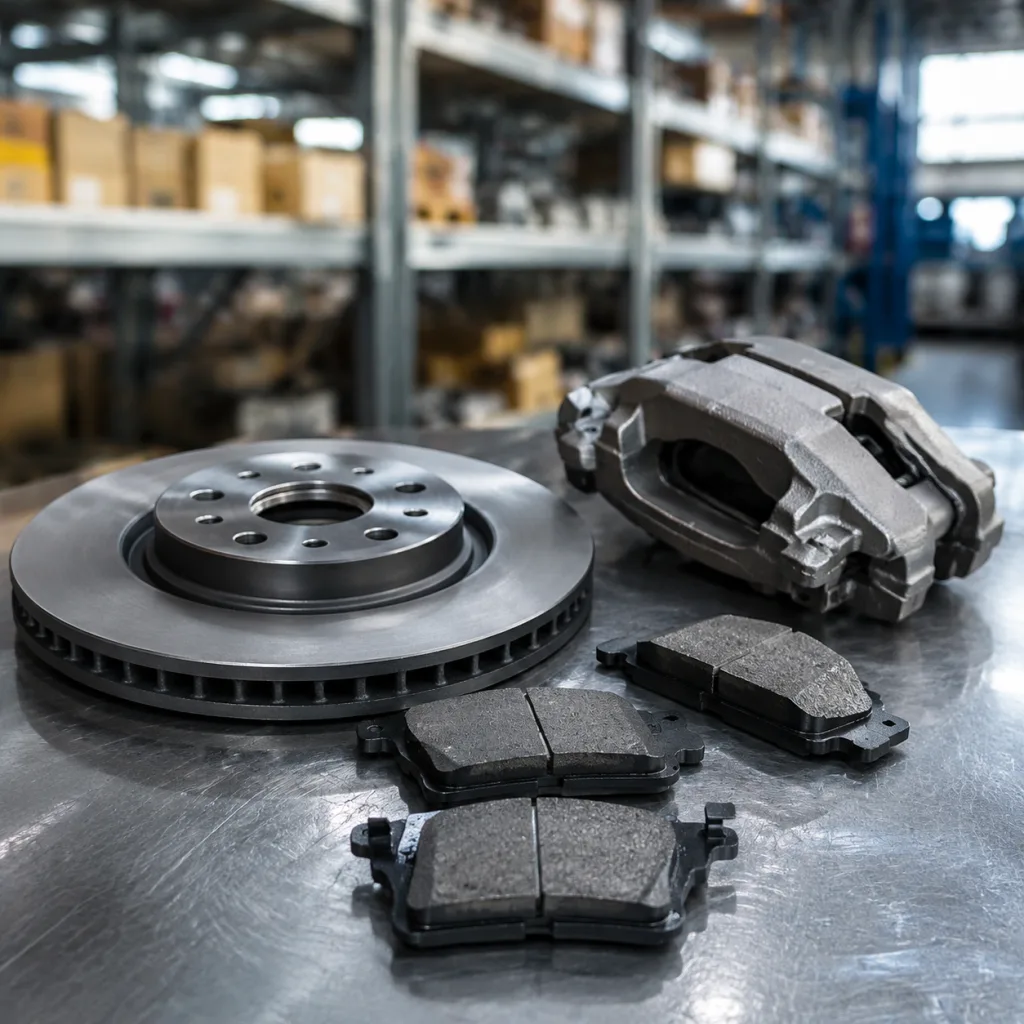
Dimensional match is the first gate. The rotor outer diameter, thickness, centre bore, total height, hat offset, bolt holes, countersink, and ventilation style must suit the hub and caliper bracket. For most machined rotor dimensions, drawing tolerances often sit around ±0.05–0.20 mm depending on the feature, with tighter controls on hub bore, parallelism, lateral runout, and braking-face thickness. Pads need the right outline, backing-plate thickness, abutment ear width, shim stack, slot and chamfer design, and anti-rattle clip geometry. If a wear sensor is used, check connector keying, resistance logic where applicable, lead length, grommet position, and routing clips.
Check
What to verify
Buyer acceptance point
Rotor size
Diameter, nominal thickness, minimum thickness, total height, offset
Diameter and height must match the caliper envelope; record nominal and minimum thickness on the drawing
Hub interface
Centre bore, bolt holes, PCD, countersink, pilot fit
Bore should locate without play; hub-face runout risk rises if bore or mounting face is wrong
Braking faces
Parallelism, runout, surface finish, balance
Typical sample target: runout ≤0.05 mm and controlled DTV before release
Must match hydraulic balance, pad sweep, and rotor thickness range
Sensors
Wear lead, connector, routing, clip points
Avoids warning-light faults, wheel contact, and short-lead returns
</tr></thead><tbody> </tbody></table>After installation, runout should be measured on the hub after the disc or wheel is torqued with the correct clamping load. Many service data sheets call for values below 0.05 mm, but the vehicle application data should remain the final reference. Also confirm disc thickness variation limits, wheel spoke clearance, and the relationship between rotor hat height and caliper carrier. A 1–2 mm offset error can create noise, drag, or pedal pulsation even when the diameter looks correct.
For sample approval, request at least one marked production-intent axle set. Measure it against the drawing with a caliper, micrometer, height gauge, and dial indicator. Record centre bore, total height, nominal thickness, bolt-hole diameter, pad backing thickness, ear width, and sensor lead length. Keep those actuals in the sourcing file so later batches can be checked quickly instead of debated from memory.
Evidence pack: what separates a validated brake line from a brochure claim
A credible brake programme gives you material data and test evidence, not just a catalogue cross-reference. For friction parts, ask for the compound family, hot and cold friction level, fade curve, recovery behaviour, bedding behaviour, compressibility, shear strength, noise countermeasures, and dust expectations. For passenger and light commercial front pads, compare friction stability across 100–500°C rather than relying on one coefficient number.
For rotors, request grey iron grade, carbon content logic, hardness range, coating type, salt-spray target, and corrosion protection method. A common expectation is a pearlitic grey iron casting with controlled hardness, often around 180–240 HB depending on design. For calipers and hardware, check seal material, piston finish, guide-pin plating, boot material, and spring clip treatment.
Standards matter because they show how the process is controlled. A supplier working to IATF 16949:2016 and ISO 9001:2015 should be able to provide process flow, traceability, gauge calibration, nonconforming-material handling, and inspection records. For regulated replacement friction material, ECE R-90 is the reference point in many markets; confirm that the approval covers the exact part number and axle application. If your compliance file requires material declarations, review REACH (EC) No 1907/2006 as well.
Validation should cover dimensional inspection, friction performance, shear and compressibility checks for pads, thermal cycling, corrosion exposure, balance and runout checks for rotors, and braking performance checks on representative samples. Useful records include 100% or sampling inspection reports for critical dimensions, incoming material certificates, first-article inspection, coating thickness checks, and salt-spray data such as 96–240 hours depending on coating class and market requirement. Ask for lot-level reports. Generic claims are not enough for a front brake replacement programme.
Process control is where many sourcing files are thin. Rotor control should cover casting lot, heat treatment or stress relief where used, rough machining, finish machining, drilling or slotting if applicable, washing, coating, balancing, final runout and DTV checks, and packing protection. Pad control should cover backing-plate stamping, shot blasting, adhesive application, friction mixing, hot pressing, curing, scorching where specified, grinding, chamfering, shim bonding, marking, and final inspection. For export applications, request proof that the same part number has been tested against the relevant platform and that market-specific marking, packaging, and compliance language are controlled in the production file.
Step-by-step sourcing workflow for distributors and repair chains
The sourcing task is not only to find a part that fits. It is to build a programme that can be stocked, sold, installed, and repeated without avoidable returns. Organise the front axle line by vehicle family, model year, brake size, axle code, engine group, and market. This keeps SKU overlap low and reduces the risk of stocking a rotor that fits the bolt pattern but misses the caliper envelope.
1. Map demand first. Start with the highest-moving applications, then add low-volume variants only when MOQ and shelf-space economics make sense. 2. Define each application at axle level. Include brake package, rotor size, pad shape, sensor requirement, and market. 3. Request drawings and sample evidence before price approval, not after. 4. Confirm hardware and sensor contents by SKU. Small kit differences drive many returns. 5. Fix the packaging and label rules early if the programme will be private label. 6. Agree revision-control terms before the first volume order.
Start with our catalog to compare available brake ranges, review the quality system for traceability and inspection controls, and discuss custom manufacturing if you need private-label packaging, market-specific labels, a revised hardware kit, or carton artwork. If pricing, MOQ, lead time, or carton quantity are the main constraints, use request a quote and send the target application list with annual forecast, launch quantity, destination country, packing requirement, and required incoterm.
Documents to request before order confirmation:
dimensional drawing with critical tolerances and revision number
material, hardness, coating, and friction specification
first-article inspection report for the sample lot
process flow, control plan, and key inspection points
ECE R-90 or market compliance statement where applicable
box quantity, carton size, pallet pattern, gross weight, and barcode format
hardware and sensor inclusion list by SKU
production date code and batch traceability format
MOQ and price logic should be clear before sample approval. A common brake sourcing model uses one MOQ for catalogue items and a higher MOQ for private-label or revised hardware kits. Catalogue pads may be quoted by axle set and rotors by piece or pair. Private-label packaging, special coating, sensor variants, and low-volume caliper hardware can change unit cost materially. Ask for realistic price tiers: sample quantity, pilot order, mixed-SKU pallet, and container-load levels. Avoid a flat quote that hides tooling, carton, or label cost.
Lead time should be split into sample, approval, production, and transit. Existing applications may be sampled from stock or the next production lot. Custom packaging or revised kits need extra time for artwork approval, barcode confirmation, label translation, and carton drop or stack checks. Production timing depends on casting, friction batch scheduling, coating capacity, and inspection queue, so the PO should state whether partial shipment, mixed pallets, or back-order release is acceptable.
For repeat programmes, lock down revision control. One catalogue line can change across model years, axle codes, or brake package options. The commercial file should show which build range the part covers and what evidence was used to approve it. Require written notice before changes to friction compound, backing plate, coating, sensor supplier, clip kit, country-of-origin marking, carton dimensions, or barcode format.
Failure modes: nine small mismatches that create big returns
Most front brake replacement returns do not come from a completely wrong part. They come from small mismatches that look harmless until the workshop installs the axle set.
Rotor diameter matches, but offset or total height does not, so the disc sits too far inboard or outboard.
Nominal rotor thickness is correct, but the minimum thickness marking or caliper clearance is wrong.
Centre bore is loose or too tight, creating hub-location problems or installation damage.
Pad outline is close, but the shim stack, abutment ear width, or clip geometry changes noise behaviour.
Caliper hardware is reused even though springs, guide pins, or rubber boots are fatigued.
Hub face corrosion is not removed, creating runout and steering shake under braking.
Wheel bolts or nuts are tightened unevenly, distorting the disc after installation.
The sensor connector is correct, but the lead is 30–80 mm too short or routes against the wheel.
A standard brake package is stocked for a vehicle population that mostly uses a sport, towing, police, taxi, or high-performance package.
The prevention is a stronger replacement file. Include install notes, torque values, bedding guidance, sensor routing notes, and a clear axle-level application statement. Torque values must come from vehicle service data, but the catalogue should identify torque-critical points such as caliper bracket bolts, slide pins, wheel fasteners, and rotor retaining screws. Installation notes should call for hub cleaning, hub runout check, correct lubrication on slide points only, no grease on friction surfaces, and bedding with moderate stops before heavy braking.
If the market includes mixed wheel sizes or option packages, confirm the brake package by VIN-derived build data or verified service dimensions before release to stock. Also check whether the vehicle uses a standard or high-performance brake package. Pad friction profile and rotor thermal capacity can differ even when the caliper casting looks similar.
For warranty screening, ask workshops to return the rotor, pads, hardware, sensor, mileage, installation date, hub runout reading, and photos of the wear pattern. That evidence separates product issues from installation or application errors and makes the next sourcing decision sharper.
Frequently asked questions
Send the vehicle application, model year range, axle code or brake package, rotor diameter and thickness, pad shape, sensor type, target market, annual forecast, packaging requirement, and incoterm. We confirm dimensional match, material spec, MOQ, lead time, and packing format before quotation.
Yes. We match the required dimensions and service intent, but we do not claim manufacturer approval or endorsement. Driventus is an independent aftermarket manufacturer; brand names are referenced for fitment only.
Ask for the drawing, first-article inspection report, material and coating specification, compliance statement, and sample validation data. Also confirm box quantity, pallet pattern, barcode format, minimum thickness marking, hardware inclusion, sensor inclusion, MOQ, price breaks, and production lead time.
If you need fitment support, private-label options, or a quotation for a specific vehicle range, use /contact.html and send the application list, annual forecast, target MOQ, and destination market.