Front Brake Pad Replacement: B2B Fitment Criteria
Front brake pad replacement is a high-volume aftermarket category, but procurement risk sits in details that are easy to miss: application accuracy, stable friction behaviour, NVH control, corrosion protection, and batch-to-batch repeatability. For distributors, repair chains, and programme buyers, a pad can match the general outline yet still cause returns if chamfers, backing-plate coating, shim retention, wear-sensor routing, or compressibility does not suit the caliper platform. This guide explains how Driventus evaluates OE-equivalent front brake pad sets for export programmes, from fitment data and dimensional controls to validation evidence, packaging, and shipment documentation. It is written for category buyers and sourcing engineers who need reliable supply, transparent records, and private-label-ready packaging for multi-location distribution. Driventus is an independent aftermarket manufacturer; vehicle brand names and OE references are used for fitment identification only.
Fitment Data Before Tooling or Purchase Orders
A reliable programme begins with application mapping, not only pad outline drawings. Front axle brake systems carry most of the braking load in many passenger vehicles and light commercial vehicles, so small geometry errors can lead to noise, tapered wear, difficult installation, or caliper drag.
For each part family, procurement teams should confirm:
- Vehicle application range by model year, engine, axle load, body style, and braking system.
- OE-equivalent part-number cross-references where available, using neutral references such as OE 06A… only when already present in the buyer’s data.
- Backing plate length, width, thickness, tab form, slot position, abutment ear geometry, and coating specification.
- Friction block profile, edge chamfer, centre slot, adhesive or underlayer design, scorch depth, and nominal material thickness.
- Shim type, clip position, wear indicator, electronic sensor interface, and accessory kit contents where specified.
- Minimum order quantity, carton configuration, pallet height, barcode format, and private label artwork requirements.
Fitment data should be checked against the caliper bracket and accessory configuration, not just the vehicle name. A single model year can use more than one brake system depending on engine, trim, axle load, production region, or wheel size.
Buyers can review standard part families in our catalog. For non-standard caliper platforms, private label programmes, or drawing-controlled pads, Driventus can support custom manufacturing based on approved samples, 2D drawings, 3D scans, or validated OE-equivalent references.
Dimensional Match and Production Controls
In front brake pad replacement programmes, the most common commercial failures are usually installation complaints, returned stock, uneven wear, brake judder, noise, and catalogue disputes rather than complete loss of braking. Many of these issues trace back to dimensional variation, surface finishing, accessory mismatch, or uncontrolled changes between batches.
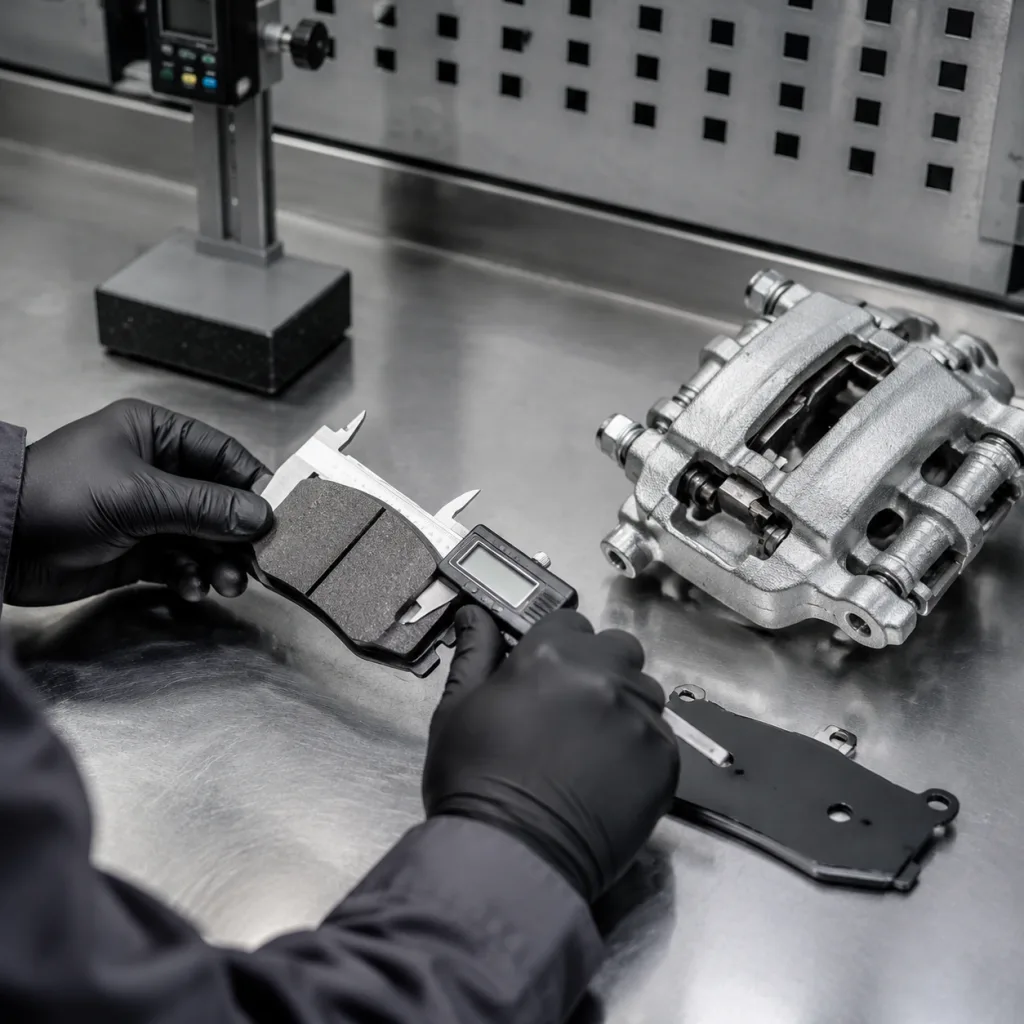
Typical inspection points for an OE-equivalent pad set are shown below. Actual limits depend on the pad family, caliper design, target market, and buyer specification.
| Control point | Procurement relevance | Typical verification method | |
|---|---|---|---|
| Backing plate thickness | Caliper clearance, piston travel, and pedal feel | Micrometre or go/no-go gauge | |
| Overall pad length and height | Fitment in bracket and abutment areas | Coordinate measurement or fixture gauge | |
| Friction material thickness | Service life and axle balance | Digital thickness gauge | |
| Parallelism of friction surface | Bedding behaviour and noise risk | Surface plate and dial indicator | |
| Shim retention | NVH control and warranty exposure | Pull check and visual inspection | |
| Slot and chamfer position | Dust evacuation, edge contact, and noise behaviour | Optical or fixture inspection | |
| Coating coverage | Corrosion protection in storage and service | Salt-spray plan or visual audit |
| Friction type | Typical strength | Typical trade-off | Suitable procurement use |
|---|---|---|---|
| Semi-metallic | High thermal capacity and durability | More rotor wear and possible noise | Light commercial and high-load use |
| Low-metallic NAO | Strong bite and heat handling | Higher visible dust | Broad aftermarket coverage |
| Ceramic | Low dust and stable NVH | Higher material cost | Premium passenger car lines |
| NAO | Quiet operation and rotor friendliness | Lower high-temperature margin | City driving and value lines |