Flex Plate vs Federal-Mogul Alternative: Sourcing Guide
Buyers comparing a flex plate vs Federal-Mogul alternative need more than a catalog interchange. The replacement has to reproduce the OE mounting geometry, crankshaft register, torque-converter bolt pattern, starter ring gear specification, balance condition, dish depth, and fatigue resistance, while also giving procurement a repeatable supply path. The real question is not brand preference. It is whether the part will assemble without force, keep converter alignment stable, engage the starter correctly, and pass incoming inspection with consistent dimensional control from batch to batch.
Driventus is an independent aftermarket manufacturer; brand names are referenced for fitment and cross-reference identification only. Our flex plates are produced under IATF 16949:2016 and ISO 9001:2015 controls, with process checks for flatness, total indicated runout, tooth profile, bolt-circle accuracy, ring gear seating, and weld integrity where applicable. For export programs, we can also support REACH (EC) No 1907/2006 documentation and application-specific validation requirements. This sourcing guide explains how to evaluate a Federal-Mogul cross-reference replacement for passenger car and light commercial applications, what evidence to request before release, and how to compare suppliers beyond unit price.
What buyers mean by a Federal-Mogul alternative
In procurement terms, a Federal-Mogul alternative is a flex plate intended to replace an existing catalog application by fitment, performance, and service function, not by brand ownership. The source part may be identified by an OE number, aftermarket cross-reference, transmission family, engine code, VIN range, or measured dimensions taken from an approved sample. In many sourcing projects, the buyer is not trying to replicate packaging or distribution. The buyer needs a technically equivalent flex plate that can be qualified, reordered, and stocked with confidence.
A flex plate does several jobs at once. It connects the crankshaft flange to the torque converter, carries the starter ring gear, transfers engine torque, and tolerates normal torsional vibration between the engine and automatic transmission. Because it is thin compared with a manual-transmission flywheel, small deviations in flatness, bolt-circle position, or ring gear location can create starter noise, converter misalignment, pump-load issues, fastener stress, or fatigue cracking around the crank and converter holes. That is why a valid alternative has to be confirmed by specification, not only by a catalog interchange line.
For a valid substitute, confirm these points before approval:
Outer diameter, centre bore, and crankshaft register fit
Crankshaft bolt pattern, torque-converter bolt pattern, and bolt-hole true position
Starter ring gear pitch, tooth count, tooth profile, and lead-in chamfer direction
Overall thickness, local reinforcement thickness, dish depth, offset, and allowable runout
Material grade, forming condition, and heat-treatment or stress-relief status where applicable
Ring gear hardness and seating method, including weld, press-fit, shrink-fit, or mechanical joining details
Balancing method, balance marks, and any offset-weight or asymmetrical design features
Surface finish at the crankshaft and torque-converter interfaces, including burr control around pierced holes
Corrosion protection, oil film, phosphate, paint, or other storage coating
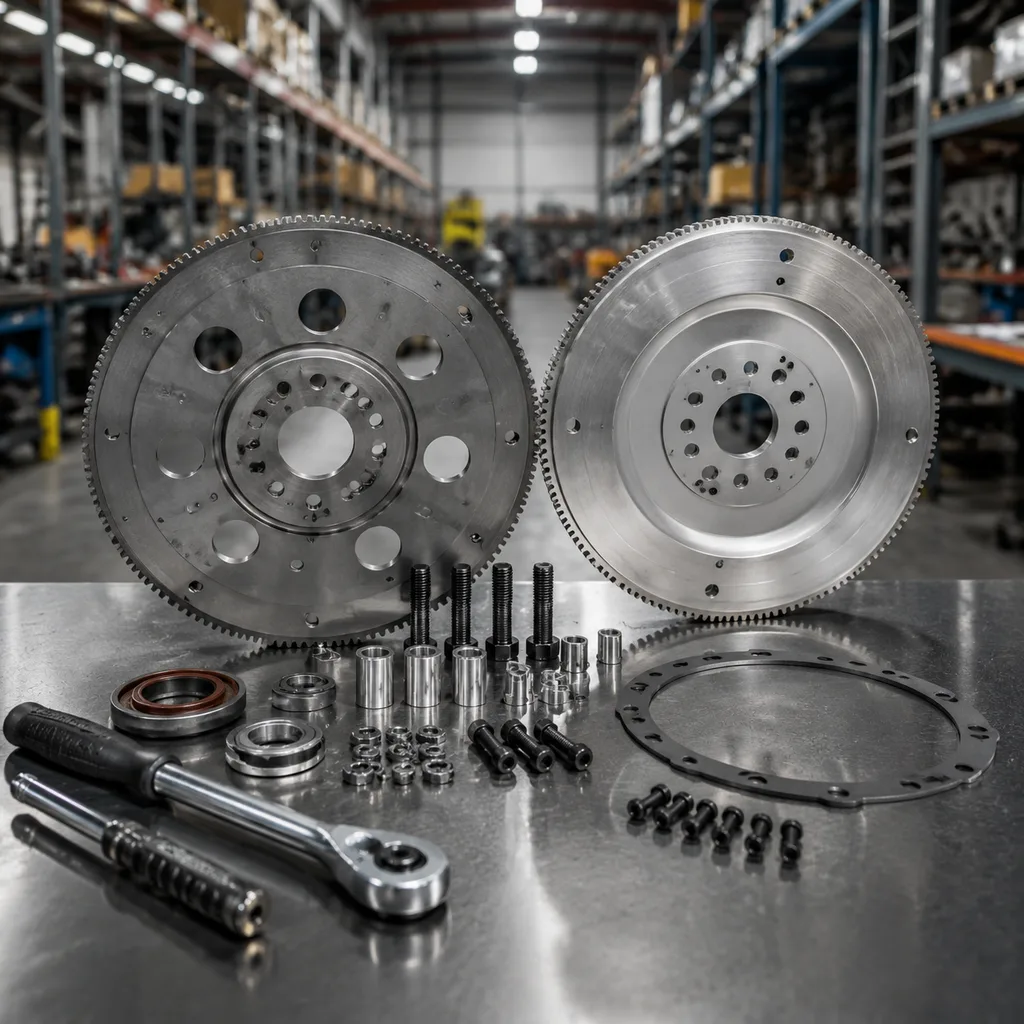
If the vehicle list is wide, ask for dimensional records and clear photos of the mounting face, crank holes, converter holes, weld area, tooth form, and side profile. A top-view image alone is not enough because many flex plates look similar but differ in dish depth, converter offset, or ring gear axial position. Ask the supplier to state whether the part is symmetrical or directional, whether any side must face the engine, and whether the supplied sample has been trial-fitted or measured against the application file.
For broader coverage across rotating, sealing, and engine-related components, see our catalog and engine components. These pages can help buyers combine flex plate sourcing with related drivetrain and engine component programs when SKU consolidation is part of the purchasing brief.
Flex plate vs Federal-Mogul alternative: side-by-side comparison
When comparing a flex plate vs Federal-Mogul alternative, buyers should separate the commercial label from the technical evidence behind the part. A familiar branded reference can help identify the application, but the sourcing decision should depend on fitment control, production repeatability, documentation, and delivery risk. The comparison below highlights the practical differences procurement teams normally review before approving a replacement source.
Catalog match may be sufficient, but dimensional disclosure can vary by channel
Manufacturing base
Vertical production in Taizhou, Zhejiang, with direct production planning
Often multi-source, distributor-supplied, or contract-produced depending on region
Quality system
IATF 16949:2016 and ISO 9001:2015 process controls
Depends on supplier chain and local distribution structure
Documentation
Dimensional inspection report, packing list, batch reference, and material traceability on request
Varies by distributor, region, and order size
Engineering access
Drawing review, sample comparison, tolerance alignment, and first-sample review available
Usually limited when the source is several steps removed from production
Lead-time control
Factory-direct planning for export orders and repeat programs
May include distributor stock constraints or replenishment uncertainty
Customisation
Available through custom manufacturing for hole pattern, coating, packaging, thickness, offset, or specification adjustment
Usually limited to listed references and standard packaging
Packaging control
Export cartons, rust-prevention media, palletisation, moisture control, and private-label options can be defined before production
May be fixed by channel inventory and existing pack format
Batch consistency
Repeat production can be tied to approved samples, gauge plans, and inspection points
Can vary if supply is substituted within a distribution network
</tr></thead><tbody> </tbody></table>The technical trade-off is straightforward. A branded cross-reference may be convenient when local stock is available and the purchase is urgent. A factory-direct alternative is more useful when the buyer needs repeatable dimensions, batch traceability, and the option to adapt hole pattern, thickness, coating, dish depth, or ring gear configuration for a platform program. For buyers managing multiple regions, supplier consistency often matters more than logo recognition because the same SKU must fit the same way in different warehouses and service networks.
There is also a cost-of-quality issue. If a flex plate arrives with excessive runout, inaccurate converter holes, the wrong chamfer direction, tooth burrs, or poor ring gear seating, the savings on unit price disappear through inspection sorting, returns, installation delays, and warranty exposure. A qualified alternative should therefore be evaluated as a controlled manufacturing source, not only as a lower-priced interchange part. In a structured RFQ, ask each supplier to describe how the reference was validated, which characteristics are checked in process, what gauges are used, and what evidence will be supplied before shipment.
Critical specifications to verify before release
Flex plates fail or create installation problems when the geometry is close but not correct. Before purchase approval, verify the specification against the sample, drawing, OE reference, or approved application file. The goal is to confirm both static dimensions and functional alignment, because the part must work with the crankshaft, torque converter, starter motor, and transmission bellhousing at the same time.
Start with the crankshaft interface. The centre bore must locate correctly on the crank register, and the crank bolt pattern must match the engine without forcing bolts into position. Bolt holes should be checked for diameter, pitch circle diameter, true position, burrs, chamfer, and surface condition around the clamping area. In many aftermarket programs, buyers define critical hole position and runout tolerances in the 0.10–0.30 mm range, but the correct tolerance should always follow the OE drawing, approved sample, or customer inspection plan. A small positional error can create uneven clamp load or stress concentration around the bolt holes. If the flex plate includes reinforcement plates or a layered construction, confirm that the stack height and rivet or weld positions do not interfere with installation.
Next, verify the torque-converter interface. The converter bolt pattern, offset, and dish depth must place the converter pads in the correct position. If the flex plate is too flat, too deep, or incorrectly offset, the converter may be pulled forward or pushed backward during assembly, increasing load on the transmission pump, pilot, or fasteners. For service replacement programs, request sample measurement of converter bolt spacing and compare it with the removed part or approved OE drawing. Also check whether the converter pattern is equally spaced or indexed, because some applications use an asymmetrical pattern to prevent incorrect installation.
Ring gear specification is another release-critical area. Confirm tooth count, pitch, outside diameter, tooth height, tooth chamfer, lead-in direction, and hardness. Starter engagement depends on the ring gear being positioned correctly relative to the starter pinion. Burrs, uneven weld seating, excessive radial runout, or incorrect chamfer direction can produce grinding noise, hard starts, or premature starter wear. Where a hardened ring gear is specified, request hardness readings according to the supplier’s control plan, commonly reported in HRC or HV depending on the process and customer requirement.
Before purchase release, include these items in the technical review:
Thickness tolerance: confirm the nominal value, local reinforcement thickness, and allowable variation
Flatness and runout: request measured results for axial and radial runout, not only nominal dimensions
Bolt-hole diameter and true position: especially for converter bolt patterns and crankshaft holes
Dish depth and offset: confirm the distance between crank mounting face and converter mounting plane
Ring gear hardness and tooth integrity: check for burrs, chipped teeth, uneven seating, and tooth profile consistency
Weld or press-fit quality: inspect the joint between plate and ring gear for continuity, spatter control, heat distortion, and seating depth
Balance condition: identify whether the application is neutral balanced or externally balanced with a weight or offset pattern
Corrosion protection: confirm coating type, oiling method, storage condition, and expected shelf life
Marking and orientation: verify any engine-side, transmission-side, or timing-related marking required for correct assembly
Typical buyer checklist
1. Match OE 06A107065-type references only where the application file already uses that convention. 2. Confirm engine code, transmission family, model year range, drive configuration, and market variation. 3. Verify centre bore, crankshaft bolt circle, converter bolt pattern, and hole indexing against the sample. 4. Confirm starter engagement depth by checking ring gear axial position and tooth chamfer direction. 5. Review axial runout, radial runout, flatness, and dish depth measurement data before approving mass production. 6. Confirm whether the part is neutral balanced or requires a balance weight, offset hole pattern, or asymmetric mass distribution. 7. Check packaging, coating, and preservation for ocean freight and warehouse storage. 8. Request pre-shipment photos or video for first orders and new references.
If your team needs a controlled specification package, include drawings, photos, cross-reference numbers, sample condition, target market, destination warehouse, and target annual volume in the RFQ. That allows the supplier to define inspection points, tooling requirements, packing method, and approval samples before production starts. It also prevents late-stage disputes where the supplier priced only a visual match while the buyer expected full application validation.
Testing and compliance that support procurement approval
A credible flex plate program should include both in-process controls and batch-level verification. The part is relatively simple in appearance, but it operates under repeated torsional load, heat exposure, starter impact, and converter-clamp force. Procurement approval should therefore be supported by measurable evidence, not only by a product photo and interchange number.
For export supply, buyers commonly ask for:
Incoming material certificates or material traceability records, including steel grade where specified
Dimensional inspection report covering key interfaces and tolerances
Concentricity, flatness, axial runout, and radial runout checks on sample or batch units
Ring gear tooth inspection, including pitch, chamfer, burr control, and tooth count confirmation
Hardness testing for ring gear or specified heat-treated areas
Weld inspection or joining verification where the ring gear is attached
Torque-related assembly verification on sample units, including bolt fit and thread-clearance confirmation
Coating, salt-spray, or corrosion-prevention review where required by the customer
Packaging drop, stacking, moisture-control, and export-carton assessment
Pre-shipment photos, batch coding, and packing list verification
In-process controls should cover blanking, stamping or forming accuracy, hole piercing quality, deburring, ring gear fitment, welding or joining parameters, final cleaning, and preservation. Typical control plans include first-piece inspection at setup, patrol inspection during production, and final inspection against approved gauges or drawings. If the part is externally balanced, balance-weight location and mass control should be recorded. If the part is neutral balanced, the inspection plan should still check runout and concentricity because eccentricity can affect driveline smoothness and starter operation even when mass balance is nominally correct.
Where market requirements apply, document compliance pathways for REACH (EC) No 1907/2006 and any customer-specific restricted-substance declarations. If the application is linked to emissions-related drivetrain testing, durability validation, or a customer-specific vehicle program, align validation with the buyer’s internal test plan. Do not assume a generic part approval is sufficient for every market, especially where distributor liability, warranty terms, or private-label obligations are involved.
For procurement teams, the main value of a qualified alternative is lower rejection risk at goods-in and fewer warranty claims in the field. Incoming inspection can be simplified when the supplier provides repeatable inspection records, traceable batches, and a defined corrective-action process such as 8D reporting for nonconformities. That is why our quality system focuses on traceability, process stability, and inspection records that can be reviewed before shipment. A sourcing decision based on documented controls gives buyers stronger protection than a decision based only on brand familiarity or short-term stock availability.
When to choose a factory-direct replacement
A factory-direct flex plate is usually the better option when the sourcing brief requires control over more than immediate availability. Distributors can be effective for urgent small orders, but factory-direct sourcing gives the buyer more influence over specification, inspection, packaging, production scheduling, and corrective action. This matters when the flex plate is part of a planned aftermarket line, service program, private-label range, or regional distribution strategy.
Choose a factory-direct replacement when the sourcing brief includes any of the following:
Multiple SKU consolidation across vehicle lines or regional catalogs
Stable supply planning over 6 to 12 months or longer
Custom hole pattern, thickness, dish depth, coating, ring gear position, or tooth specification adjustment
Private-label packaging, barcode labels, batch labels, or regional compliance marking
Audit requirement for manufacturing capability and process control
Need for pre-production samples, golden samples, and controlled approval records
Repeated orders where the same specification must be maintained across batches
Export logistics requiring defined cartons, palletisation, moisture control, rust prevention, and documentation
Application expansion where buyer-supplied samples or drawings must be converted into production parts
For OEM, Tier-1, and professional aftermarket programs, the main questions are not marketing claims but repeatability, corrective-action response, and sample approval discipline. Driventus supports custom manufacturing for drawings, samples, and application-specific specification alignment. If your team is building a replacement line or expanding an existing range, a controlled factory source can be easier to qualify than a mixed-distributor chain because the same production and inspection assumptions can be applied across references.
Factory-direct sourcing is especially relevant when the flex plate must match starter engagement, converter bolt spacing, crankshaft register location, and engine-to-transmission alignment without deviation. It also supports commercial planning. Buyers can define MOQ, annual volume, packaging format, phased delivery, inspection requirements, retained-sample rules, and documentation expectations before the purchase order is placed. This reduces the risk of approving a supplier based on a sample and later receiving production parts that differ in coating, marking, hole quality, ring gear finish, or balance configuration.
Another advantage is engineering communication. When a buyer reports an installation issue, the factory can review tooling, inspection records, sample measurements, gauge results, and process history directly. That shortens root-cause analysis and supports corrective action. For repeat programs, this responsiveness can be as important as the initial unit price.
How to compare quotes from different suppliers
When you receive quotations for a flex plate vs Federal-Mogul alternative program, compare more than unit price. A low-cost flex plate can become expensive if it carries higher rejection rates, unclear fitment, weak export packaging, or inconsistent batch quality. The best quote is the one that defines the part clearly, supports the required approval evidence, and can be repeated without requalification surprises.
Use this comparison list when reviewing supplier quotations:
Unit price, MOQ, price validity, and tooling cost if applicable
Lead time, seasonal capacity, production slot availability, and ability to support repeat orders
Traceability marks, batch coding, labels, barcode format, and private-label packaging options
Documentation package, including inspection report, packing list, material record, and compliance declarations where required
Incoterms, payment terms, warranty handling, claim response time, and corrective-action process
Ask each supplier for the same reference list and the same photo set: front face, rear face, side profile, centre bore, crank holes, converter holes, ring gear teeth, weld or joint area, and packaging. If the responses differ in part definition, stop and re-align the application before award. Differences in tooth count, offset, bolt-hole spacing, ring gear axial position, or balance type can mean the suppliers are quoting different parts even when they use the same interchange reference.
It is also useful to calculate total landed and qualified cost. Include incoming inspection time, rejection risk, sample testing, packaging damage, freight efficiency, delayed replenishment, and the cost of requalification if the manufacturing source changes. For distributors, consider whether the supplier can maintain the same manufacturing source over time. For factory-direct programs, confirm whether the approved sample will be retained as a production reference and whether any specification change requires buyer approval before shipment.
For procurement teams in the EU, UK, US, Canada, Australia, and Brazil, the best result is a part that clears internal QA, fits first time, and can be reordered without requalification surprises. To review current offerings, start with our catalog or request a quote. A complete RFQ should include the cross-reference number, OE number if available, application details, sample photos, target annual volume, packaging requirements, destination market, and any compliance documents required by your customer.
Frequently asked questions
Yes, if the centre bore, crank and converter bolt patterns, tooth count, tooth form, thickness, offset, balance condition, and runout match the approved application file. Driventus is an independent aftermarket manufacturer; brand names are referenced for fitment only.
Ask for the drawing or key dimensions, inspection report, material traceability, ring gear and runout checks, balance confirmation, packaging details, and sample photos. For high-volume programs, request a pre-production or pre-shipment sample.
Yes. We support drawing-based and sample-based programs through [custom manufacturing](/oem-services.html), including specification alignment, packaging options, inspection documentation, and export-market documentation support.
If you are comparing a flex plate vs Federal-Mogul alternative for an active sourcing program, send your reference details, OE number if available, application information, sample photos, packaging requirements, destination market, and target volume for review. [request a quote](/contact.html)