Engine Ticking Noise Engine Valve: Causes and Checks
A ticking noise from the top end of an engine often gets blamed on the valve train first. Sometimes that is right. Often it is only partly right. For buyers supplying workshops, rebuilders, or fleet service networks, the real task is to separate oil-related noise, lash error, rocker wear, hydraulic lifter faults, and actual valve or seat damage before parts are approved. Bad diagnosis drives returns, repeat labor, and unnecessary downtime.
This article approaches the problem from several angles instead of treating every tick as the same failure. It maps noise patterns to likely causes, shows which checks should happen before parts are ordered, and explains when replacement is the lower-risk move. On the sourcing side, consistency matters as much as diagnosis: replacement valves, guides, seals, and related hardware need to match the original material, hardness, and dimensional requirements, and they should come from controlled systems such as IATF 16949:2016 and ISO 9001:2015. In practice, that means agreeing critical dimensions up front, defining acceptable process capability on stem and face features, and aligning MOQ, target price, and lead time with the actual service program rather than buying generic stock on fitment alone. Driventus is an independent aftermarket manufacturer; any brand names are referenced for fitment only.
Start with the noise pattern, not the part name
A regular metallic tick from the cylinder head usually means repeated clearance take-up or impact somewhere in the valve train. That still leaves several possible causes. The useful question is not "is it the valve?" but "when does the sound appear, and what changes it?"
Common sources include:
Excessive valve lash in mechanical adjustment systems
Slow-filling or collapsed hydraulic lash adjusters
Worn rocker arms, cam followers, or cam lobes
Valve stem or guide wear causing unstable valve motion
Weak valve springs that reduce seating control at higher speed
Carbon deposits on the valve face or seat area
Low oil pressure or oil aeration affecting hydraulic components
For distributors and workshop groups, this matters because an "engine ticking noise engine valve" complaint may actually be a lubrication problem, timing-related wear, or broader cam-train damage. Replacing the valve alone will not fix low hot oil pressure or a collapsing lash adjuster.
As a first screen, ask the workshop for three numbers before parts approval: hot idle oil pressure, valve lash on the suspect cylinder if the engine is mechanically adjustable, and leak-down percentage if sealing is in question. Those three data points often separate a lubrication fault from a true engine ticking noise engine valve issue.
Noise pattern and likely cause
Symptom pattern
Inspect this area first
Typical numeric check
Risk if ignored
Tick on cold start, improves warm
Hydraulic lifters, oil drain-down, oil viscosity
Oil pressure build within the first 2-5 seconds; compare oil grade to OE spec such as 5W-30 or 10W-40
Hot idle oil pressure commonly needs to stay above about 0.7-1.0 bar, but always verify OE data
Ongoing head wear and repeat complaints
Tick increases with rpm
Lash, spring control, follower wear
Lash often checked in the 0.15-0.40 mm range depending on engine family
Valve-train instability at higher speed
Sharp single-cylinder tick
Local valve, guide, rocker, or seat issue
Leak-down above roughly 15-20% on one cylinder justifies deeper head inspection
Burnt valve or compression loss
Tick after overhaul
Incorrect installed height, lash setting, seat finish, or debris
Spring installed height commonly held within +/-0.25 mm; stem protrusion and lash must match build sheet
Early failure and warranty exposure
</tr></thead><tbody> </tbody></table>These patterns also change order urgency. A vehicle with hot-idle ticking and confirmed pressure loss usually needs more diagnosis before parts release. A confirmed single-cylinder sealing fault with acceptable lubrication data is a different case and may justify immediate valve-train parts allocation.
Where the valve assembly actually fails
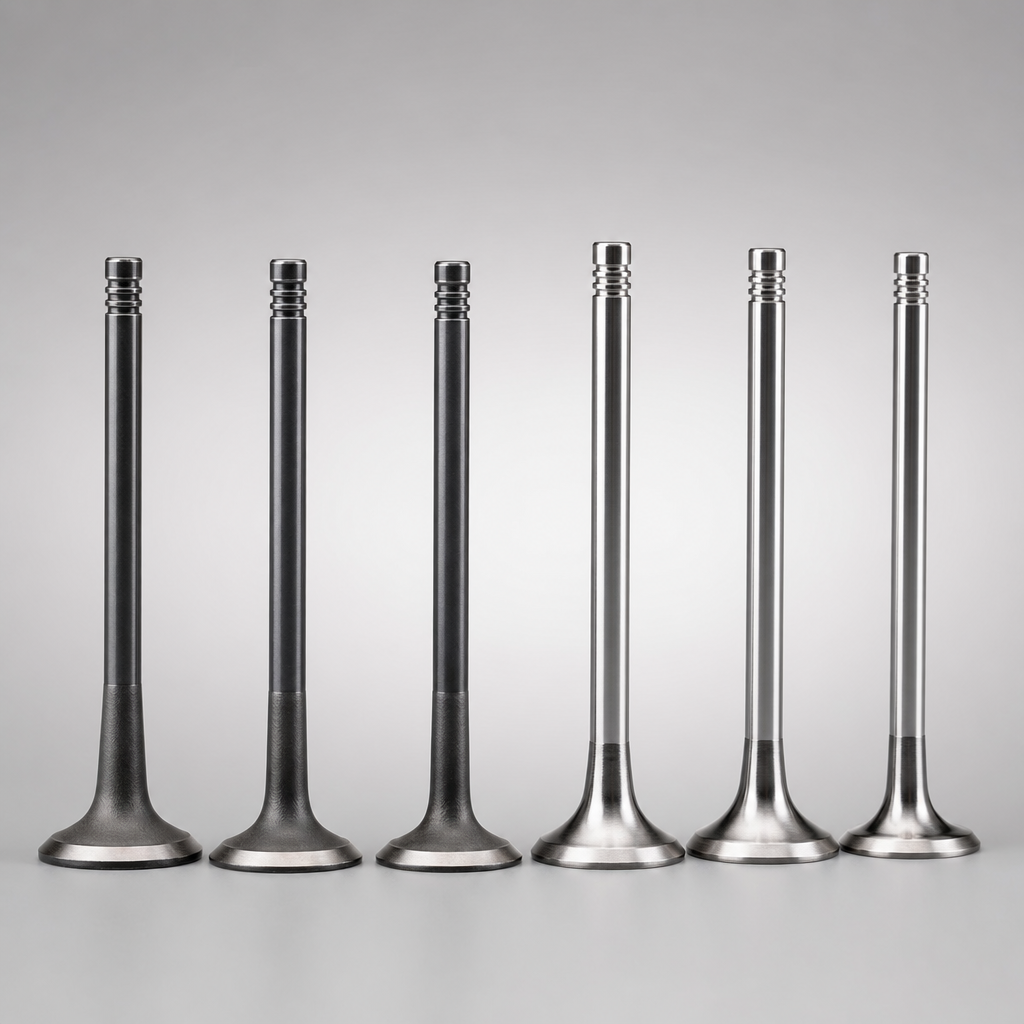
If the fault is inside the valve assembly, the failure mode usually falls into one of four groups: stem and guide wear, poor seat contact, sticking valve movement, or spring-control problems. Grouping all of them under generic valve noise is where bad parts decisions start.
A worn valve stem can create excess clearance in the guide. The valve then loses stable motion and may tick as the system takes up slack on every cycle. In more advanced cases, oil consumption rises as guide and seal wear develop together. On many light-vehicle engines, stem-to-guide clearance is measured in hundredths of a millimeter, with intake clearance often around 0.020-0.055 mm and exhaust around 0.030-0.065 mm when new, though service limits vary by engine.
Poor seat contact is another direct route to an engine ticking noise engine valve complaint. If the valve face or seat insert shows pitting, recession, micro-welding damage, or thermal erosion, the valve may not seal cleanly each time it closes. The sound may come with low compression, load-related misfire, or high exhaust temperature on one cylinder. Typical valve face angles are 45 degrees, with seat width often controlled around 1.0-2.0 mm on passenger vehicles. Too narrow and heat transfer suffers. Too wide and seating quality can deteriorate.
Sticking valves follow a different path. Carbon, varnish, overheating, or a stem-to-guide mismatch can all cause intermittent movement. This is a sourcing issue as much as a repair issue. Stem diameter control, stem finish, coating quality where applicable, and heat treatment all influence how freely the valve moves in the guide. In practical terms, stem diameter is commonly held to tolerances around +/-0.005 to +/-0.010 mm, with low stem roughness values such as Ra 0.2-0.4 um often specified.
For engine valve procurement, these are the features worth reviewing every time:
Valve head material and heat resistance suited to intake or exhaust duty, such as chrome-silicon intake grades or austenitic exhaust grades like 21-4N where required
Stem diameter tolerance, straightness, and roundness control, commonly within 0.01 mm or tighter on critical programs
Stem tip hardness and wear resistance, often verified in HRC depending on alloy and heat-treatment route
Face angle accuracy and seat contact consistency, typically within minutes of angle rather than whole degrees
Keeper groove geometry, fillet condition, and groove hardness
Surface finish on the stem and face
Spring installed height compatibility and retainer/collet fit
Where applications need tailored geometry or upgraded materials, custom manufacturing is often more practical than trying to force one generic part across several fitments. That becomes especially relevant where fleets want sodium-filled exhaust valves, stellite-facing, nitrided stems, or revised groove geometry for heavy-duty service.
Eight checks before you approve parts
A disciplined inspection sequence cuts false replacement and protects warranty performance. For workshop groups and technical buyers, the order matters: confirm lubrication first, isolate the affected cylinder or bank next, then measure the hardware.
1. Confirm oil level, oil grade, and service condition. Incorrect viscosity, fuel dilution, sludge, or aeration can change hydraulic lash adjuster behavior. Record the actual oil used, such as 0W-20, 5W-30, or 15W-40. 2. Verify hot and cold oil pressure against engine specification. As a working benchmark, many passenger engines show around 3-5 bar when cold and 0.7-1.5 bar at hot idle, but approval should follow the OE manual. 3. Use a stethoscope or chassis ear to locate whether the tick is concentrated at the cam cover, injector area, or lower end. Injector pulse is often mistaken for valve noise on direct-injection engines. 4. Check whether the noise frequency follows engine speed directly. A valve-train tick usually scales predictably with rpm. Random metallic noise points elsewhere. 5. Measure valve lash where the engine uses mechanical adjustment. Many intake settings fall near 0.15-0.25 mm and exhaust near 0.25-0.35 mm at the specified temperature, but the engine code governs. 6. Inspect rocker pads, followers, lash adjusters, and cam lobes for scoring, pitting, or abnormal contact wear. A cam lobe base-circle wear difference greater than a few hundredths of a millimeter can already be meaningful on some heads. 7. Run compression or leak-down testing if a sealing fault is suspected. Many rebuilders treat less than 10% leak-down as good, 10-20% as cautionary, and above 20% as requiring deeper investigation. 8. If the cylinder head is removed, measure valve stem diameter, guide clearance, spring free length, installed height, stem projection, and seat concentricity.
Leak-down testing is especially useful because it confirms whether the engine ticking noise engine valve complaint is really about sealing. Air loss through the intake or exhaust port helps distinguish a true valve fault from a simple clearance or hydraulic control issue. Seat runout and guide concentricity also matter during head work; even a good new valve can tick or fail early if the guide-to-seat relationship is poor.
From a procurement standpoint, this sequence also clarifies repair scope. One noisy valve does not always mean a one-part repair. Depending on wear distribution, labor cost, and head age, a broader set including valves, guides, stem seals, and springs may be the lower-risk order.
It also improves purchase efficiency. A workshop that submits measured lash, leak-down, stem wear, and installed height data is far less likely to order the wrong kit. That reduces returns, expedited freight, and partial claims.
Single valve or full wear set? Use a risk comparison
Replacement is the lower-risk decision when measurements are outside service limits, when seat damage is visible, or when the ticking returns after adjustment or partial repair. In professional workshop and fleet environments, the cost of a second teardown is often higher than replacing the full wear set during the first intervention.
Typical replacement triggers include:
Valve stem or guide clearance beyond service limit
Burnt, pitted, or recessed valve faces
Stem tip mushrooming or abnormal hardness loss
Weak or uneven springs, including seat pressure below spec or more than about 5-10% variation across cylinders
Collapsed hydraulic lash adjusters
Rocker or follower wear that has changed contact geometry
Exhaust valves deserve extra attention because thermal loading is much higher than on the intake side. That means a sourcing decision should cover metallurgy, hardness profile, grain flow or forging route where relevant, and production control, not just nominal fitment.
For buyers comparing supply options, this checklist is the practical one:
Procurement point
Why it matters
Typical buyer target
Dimensional consistency
Prevents sticking, poor seating, and noisy operation
Critical dimensions held to drawing tolerance with Cp/Cpk target agreed on serial supply
Material traceability
Reduces risk of thermal or fatigue failure
Heat/lot traceability to raw material certificate
Hardness verification
Protects stem tip, groove, and face wear surfaces
Defined HRC/HV range by feature and alloy
Batch inspection records
Supports warranty analysis and repeatability
Final inspection report per lot or per shipment
Clean packaging and corrosion control
Prevents stem damage before installation
VCI or equivalent export packaging, rust-prevention period defined
Stable lead time
Avoids partial head rebuild delays
Sample lead time often 20-35 days; repeat production often 30-45 days after confirmation
</tr></thead><tbody> </tbody></table>Buyers should also classify the program early: service stock, emergency replenishment, or scheduled fleet support. That changes the commercial logic.
Low-volume or trial orders often carry higher unit pricing because setup, tooling checks, and inspection cost are spread over fewer pieces.
Consolidated orders across several engine families can reduce unit cost, but only when drawings and validation status are clear.
MOQ is commonly set by part number, material route, or heat-treatment batch. For aftermarket valves, practical MOQs may start around 300-500 pieces per item for repeat production, while custom or low-run programs may require 1,000 pieces or more to reach target price.
Faster lead times usually increase cost if they require schedule interruption, split heat-treatment loads, or premium freight.
Driventus supports valve and related engine component programs through our catalog and application-specific supply for engine components.
Ask suppliers for proof, not just fitment
For aftermarket distributors and OEM-oriented sourcing teams, documentation quality is a strong predictor of field performance. A capable supplier should be able to show process control, inspection discipline, and traceability, not just a fitment list.
Ask for the following where relevant:
Quality management certification to IATF 16949:2016 and ISO 9001:2015
Incoming material controls and traceability by batch, including mill cert or equivalent chemistry and mechanical-property record
Critical dimension inspection records for stem diameter, overall length, keeper groove, face angle, tip height, and head diameter
Hardness test records for the stem tip and other wear surfaces
Surface roughness control on the stem, commonly reported as Ra value
Straightness, runout, or concentricity data where called out on the drawing
Cleanliness and corrosion-protection standards for export packing
Substance compliance declarations where required, including REACH (EC) No 1907/2006
If the program includes validation under customer-specific protocols, define acceptance criteria before SOP. That reduces disputes over ticking complaints that actually come from surrounding worn parts, installation variables, or lubrication issues outside the supplied valve itself.
For custom and repeat-buy programs, buyers should also ask the supplier to state the commercial framework in measurable terms:
Item to confirm
Why it matters in practice
MOQ per part number
Prevents RFQs that look attractive on price but cannot support the required order pattern
Target EXW/FOB price breaks
Shows where quantity actually changes the economics
Tooling charge or sample charge
Avoids hidden NPI cost on non-catalogue valves
Sample lead time
Helps planning for first-article approval and pilot rebuilds
Mass-production lead time
Sets realistic stocking policy for distributors
PPAP, FAI, or equivalent submission level
Clarifies how much validation evidence will be delivered
Claim-response window and lot-retention period
Improves traceability if field noise complaints appear months later
</tr></thead><tbody> </tbody></table>A buyer can move faster when the supplier answers with a simple matrix, for example: MOQ 500 pieces, sample lead time 25-30 days, repeat lead time 35 days, and staged price breaks at 500, 1,000, and 3,000 pieces. That is far more useful than a generic statement that pricing depends on volume.
Driventus maintains a documented quality system for engine and powertrain components supplied to international B2B customers. It does not replace workshop diagnosis, but it helps reduce variation in the replacement parts entering the repair chain.
How valve jobs turn into warranty claims
Most post-repair valve-noise claims come from three failures in process: incomplete fault isolation, mixing new parts with badly worn contact surfaces, or incorrect installation practice. Procurement can reduce claim rates by tying part release to a consistent repair standard.
Recommended controls:
Replace associated wear parts as a set when head wear is distributed
Confirm valve seat condition before fitting new valves
Check installed spring height and seat pressure
Lubricate stems and verify free movement before final assembly
Prime hydraulic elements where the service method requires it
Verify oil supply cleanliness after any internal engine failure
Record compression or leak-down results before and after repair
For higher-volume service networks, it helps to convert those controls into a release checklist. A practical checklist might require leak-down readings, valve lash readings, spring installed height, and seat condition photos before warranty approval on any engine ticking noise engine valve claim. That adds a little administration, but it sharply reduces repeat labor claims caused by partial diagnosis.
For multi-site workshop groups, a standard repair kit is often more reliable than line-item ordering. It reduces omission risk, improves consistency across locations, and makes technical approval easier when the same engine family appears repeatedly in service. Commercially, kit logic also helps with MOQ and stocking. Instead of carrying slow-moving single items, buyers can forecast one service kit per engine family and negotiate price and replenishment around monthly or quarterly consumption.
Typical examples include:
Valve set plus stem seals for a localized top-end refresh where guides remain in spec
Valve set, guides, seals, and springs for high-mileage cylinder heads
Full valve-train kit including followers or lash adjusters where contact wear is already present
A ticking complaint is not always caused by the valve itself. But when the engine valve and related hardware are the source, precision, material control, and repeatability matter. That is why buyers should treat dimensional control, material specification, inspection evidence, MOQ assumptions, and lead-time commitments as commercial requirements, not optional extras.
Frequently asked questions
Yes. Early lash problems, rocker wear, or hydraulic adjuster faults can create ticking before compression drops. Compression and leak-down tests are still useful because they help separate sealing faults from clearance-related noise. In practice, an engine can still show acceptable compression while valve lash is out by 0.05-0.10 mm or a lash adjuster is slow to fill, especially when the complaint is mainly on cold start.
That depends on measured wear and labor economics. If wear is localized, a single-valve repair may be valid. If guide clearance, seat wear, or spring fatigue is spread across the head, a broader replacement set usually carries lower comeback risk. Buyers should compare the added parts cost against the cost of a second teardown, and many professional repairers switch to a full-set approach once multiple cylinders show wear near service limit.
At minimum: certification to IATF 16949:2016 or ISO 9001:2015 where applicable, batch traceability, dimensional inspection records, hardness data, and REACH (EC) No 1907/2006 compliance declarations for the destination market. For custom programs, also request MOQ, sample lead time, repeat lead time, price-break structure, and first-article or PPAP-style submission requirements so sourcing decisions can be made on both technical and commercial evidence.
If you are sourcing replacement valves or related head components for distributor, OEM, or repair-chain programs, Driventus can review your application and supply requirements. Use this page to [request a quote](/contact.html). Include engine code, required quantity, target MOQ, expected annual volume, and any measured stem, guide, lash, or leak-down data so the quotation can be aligned with the actual repair scope.