Engine surging at idle usually means the ECU is correcting for a fault it cannot fully stabilize. The engine reaches for target rpm, overshoots, corrects again, and repeats the cycle. On petrol engines, that pattern usually traces back to unstable airflow, incorrect fuel delivery, uneven combustion, or misleading sensor data.
For workshops and parts buyers, the issue is larger than drivability. Repeat misdiagnosis wastes labour, inflates warranty claims, and pushes replacement of surrounding parts that were not failed in the first place. Idle faults are especially sensitive because airflow at closed throttle is small. A leak, deposit, bias, or weak cylinder contribution that seems minor elsewhere can be enough to start a surge at idle.
This article covers engine surging at idle causes and fixes through a more practical lens: how to classify the symptom, what usually fails first, where diagnosis commonly goes wrong, and when cleaning or relearn is enough versus when replacement is justified. Where parts are needed, consistency matters. Small errors in sealing, connector retention, calibration, or fit can recreate the same complaint. For sourcing teams, that means supplier control on leak rate, dimensional tolerance, electrical stability, MOQ, lead time, and traceability matters as much as unit price. Driventus is an independent aftermarket manufacturer; brand names are referenced for fitment only.
Start With The Pattern, Not The Part
A fluctuating idle is a control-system symptom. It does not identify the failed part by itself. The useful first move is to sort the complaint by pattern.
Typical signs include:
Idle cycling roughly 50 to 300 rpm around target
Stronger fluctuation when air conditioning or electrical load is added
Better behaviour after full warm-up
Lean codes, hesitation, roughness, or occasional stalling
Little complaint above about 1,500 rpm under light throttle
For workshop groups, one of the most expensive habits is jumping straight to major assemblies. Many idle surge cases are resolved by confirming simpler faults first: vacuum leaks, PCV failures, throttle deposits, coolant temperature signal errors, or ageing gaskets. These are cheaper parts, but more importantly, they are faster checks.
Dirty throttle, weak idle control response, charging issue
Voltage, throttle response, load compensation
Surge with lean DTC
Unmetered air or weak fuel delivery
Smoke test, fuel pressure, injector balance
</tr></thead><tbody> </tbody></table>One field check is especially useful: compare fuel trims at hot idle versus roughly 2,000 to 2,500 rpm in neutral. If trims are strongly positive at idle and improve off idle, unmetered air moves high on the list. If trims stay abnormal everywhere, think sensor bias, fuel delivery, or exhaust-feedback error instead.
The Failures That Actually Solve Most Idle Surge Jobs
For engine surging at idle causes and fixes, the highest-value sequence is the one that confirms common faults early and avoids speculative replacement.
1. Unmetered air leaks
This is one of the most common causes. Air entering after the MAF creates a lean condition, and at idle even a small leak matters because total airflow is low.
Common leak points:
Intake manifold gaskets
Throttle body gaskets
Brake booster hoses
EVAP purge lines
Injector seals
Split PCV hoses
What to check:
STFT and LTFT at idle versus 2,500 rpm
Smoke test of intake and vacuum circuits, typically at 0.5 to 2.0 psi regulated pressure
As a working rule, combined trim above about +10 percent at hot idle deserves explanation. Above +15 percent, with clear improvement off idle, strongly supports a leak diagnosis.
2. Dirty or unstable throttle body
At very small opening angles, carbon around the plate edge changes airflow enough to upset idle control. The result is often overshoot and correction rather than an obvious hard fault.
Look for:
Carbon build-up at the bore and plate edge
Lost adaptation after cleaning or battery disconnect
Commanded and actual throttle angle not tracking cleanly
Visible deposits alone do not prove replacement is needed. Erratic feedback or poor tracking is the stronger indicator.
3. PCV system faults
A stuck PCV valve or torn diaphragm behaves like a variable vacuum leak. This is common on many modern small turbo petrol engines.
Useful clues:
Excessive crankcase vacuum
Whistle noise
Oil cap suction stronger than expected
Idle change that varies with manifold vacuum
4. MAF or MAP sensor drift
Not every bad sensor sets a code. Some simply bias load calculation enough to destabilize idle.
Checks that matter:
MAP at key-on, engine-off should be close to local barometric pressure
MAF or MAP at hot idle should make sense for engine size and load
Readings that look plausible but do not fit the rest of the data deserve comparison with known-good values
5. Fuel delivery imbalance
Low pressure, restricted injectors, leakage, or poor spray pattern can show up most clearly at idle. Under load the fault may feel smaller, which is why it gets missed.
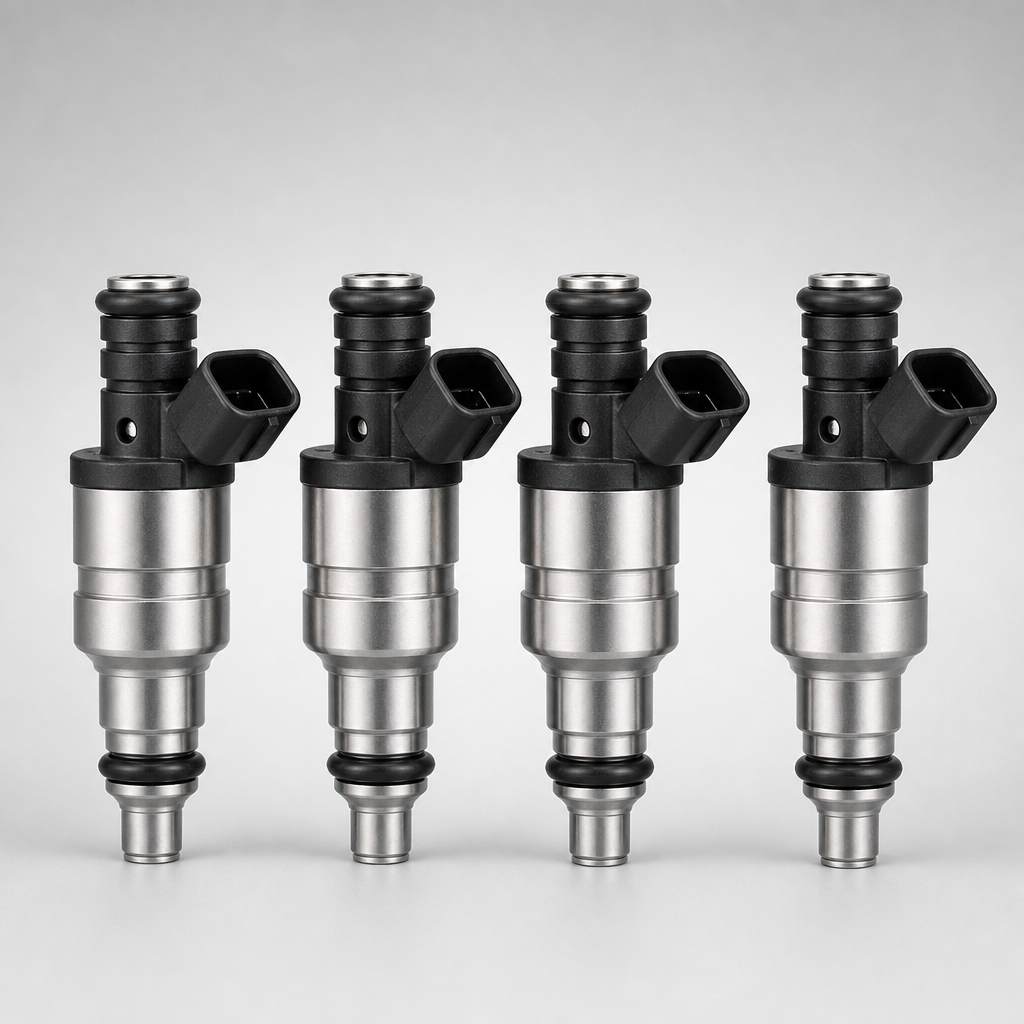
For port injection, rail pressure often sits around 3.0 to 4.0 bar, but OE data governs. Residual pressure that falls too quickly after shutdown can also point to injector or regulator issues.
6. ECT sensor errors
If the ECU thinks the engine is colder or hotter than it is, fuelling and idle strategy will be wrong. This often shows up during warm-up.
A practical check is scan-tool ECT against measured housing temperature after the thermostat opens. A stable bias of more than roughly 5 to 10 degrees C needs confirmation.
7. Ignition weakness
A marginal coil or worn plug does not always feel like a clean misfire. At low rpm it can feel like idle surge because small torque drops are easy to feel.
Look for:
Cylinder-specific misfire counters
Plug gaps beyond spec
Oil in plug wells
Tracking on coil boots
8. EVAP purge valve leaking at idle
A purge valve that does not seal can admit vapour or fresh air at the wrong time. The result is unstable mixture control at idle, sometimes with hot-restart complaints.
9. Charging or voltage instability
Low voltage and bad grounds affect throttle control, injector response, and idle compensation under load. If the surge becomes more obvious with lights, blower motor, or HVAC, electrical checks move up the queue. Warm idle charging voltage on most 12 V systems is often around 13.5 to 14.7 V depending on strategy.
A Workshop Sequence That Cuts Repeat Repairs
A fixed diagnostic routine reduces wasted parts and no-fault-found returns. For this complaint, consistency matters more than speed.
1. Pull codes and freeze-frame first Record stored and pending DTCs. Save freeze-frame before clearing anything. Coolant temperature, fuel trims, throttle angle, load, and system voltage at fault capture often tell you where to start.
2. Reproduce the complaint on purpose Check cold idle, hot idle, and idle with electrical and HVAC load applied. Watch at least 60 to 120 seconds in each state. Short observations miss cyclical surge patterns.
3. Read live data before touching parts Focus on: - STFT and LTFT - MAF g/s or MAP kPa - ECT versus warm-up state - Upstream oxygen sensor behaviour - Misfire counters by cylinder - Commanded versus actual throttle position - Battery and charging voltage
Useful triage markers: - Combined trim within about +/-5 percent at hot idle is usually acceptable - Combined trim above +10 percent needs a reason - Hot idle charging voltage below about 13.2 V under light load deserves electrical review - ECT failing to reach expected warm range, often roughly 85 to 105 degrees C depending on platform, points to sensor or thermostat issues
4. Smoke-test early Small leaks cost hours when they are guessed at instead of confirmed. Use regulated pressure so the test reflects real service conditions.
5. Inspect and clean the throttle body when deposits are present Use the right cleaner and method. Do not damage the coating or motor drive. Complete the required relearn before judging the result.
6. Isolate PCV and purge faults A failed PCV diaphragm or purge valve can distort trims even without a hard code. During diagnosis, temporarily isolating a suspect hose can quickly show whether idle and trims stabilize.
7. Move to fuel pressure and injector balance only when data supports it Compare running pressure, key-on pressure, and residual pressure with OE spec. For injector balance, look for one cylinder deviating materially from the rest.
8. Check ignition if roughness or cylinder-specific faults appear Inspect plugs, coils, contamination, and tracking. Measure plug gap rather than judging only by appearance.
9. Replace the confirmed failed part and retest under the same conditions The job is not done when the engine sounds better for 10 seconds. The original symptom pattern and the abnormal data point both need to be gone.
For distributor and service-chain programs, this same routine also reduces no-fault-found returns. Better replacement-part consistency in sealing faces, connector fit, and material quality improves first-time fix rates. You can review related component lines in our catalog and engine-related items under /products/engine-components.html.
It also helps with stocking logic. Fast-moving idle-fault items often justify local inventory when lead time is 7 to 30 days and downtime is expensive. Slower-moving electronic assemblies are usually better sourced to order unless field data says otherwise.
Replacement Parts That Matter Most, And Why They Fail Again
The parts that most often resolve idle surge complaints are not always expensive. They are simply sensitive. If sealing, calibration, or fit is inconsistent, the same complaint comes back.
Part family
Typical failure mode
What to verify first
Relevant quality points
Intake manifold gasket
Air leak at port or runner junction
Smoke-test leak path, trim pattern
Compression set, material compatibility, flange conformity, thickness tolerance commonly within +/-0.10 mm to +/-0.20 mm depending on design
Throttle body gasket
Air leak after service or ageing
Mounting flatness, bore contamination
Thickness control, cut accuracy, oil resistance, deformation control in packaging
PCV valve / diaphragm
Stuck open, torn membrane
Crankcase vacuum behaviour, hose condition
Diaphragm material stability, spring rate consistency, vacuum response repeatability
Signal stability, connector fit, sealing integrity, resistance curve consistency
EVAP purge valve
Leaking or stuck open at idle
Command test, vacuum holding behaviour
Solenoid durability, sealing consistency, response stability, leak-rate control
Ignition coil or spark plug
Weak spark, intermittent misfire
Misfire counters, plug condition, swap test
Insulation quality, winding consistency, heat range control
Water pump or thermostat housing gasket
Coolant leak affecting warm-up control
Warm-up curve, pressure test
Surface finish, material and sealing design
</tr></thead><tbody> </tbody></table>A common failure mode in the repair process is replacing a part that is merely dirty or affected by another fault. A lightly carboned throttle body may need cleaning and adaptation, not replacement. A PCV unit with a torn diaphragm is different. That part is failed.
For buyers, the sourcing logic changes by category:
Gaskets and seals: often fit higher-MOQ, lower-unit-price programs because they store well and suit kitted repairs. Export MOQs commonly begin around 500 to 2,000 pcs per SKU depending on material and tooling.
Rubber hoses and elbows: need tighter incoming checks for wall thickness, durometer, and bend geometry. MOQ is often shaped by mould cavity count and compound batch size.
Sensors and valves: justify stricter defect-rate control because labour cost quickly exceeds part value. Better validation and traceability often matter more than a small price concession.
Throttle bodies and actuators: usually sit in lower-volume, higher-value ordering, where warranty exposure and calibration stability matter more than nominal piece price.
In practice, saving USD 0.20 to USD 1.00 on a part is a poor trade if repeat-repair rate rises even 2 to 3 percent.
When sourcing these components, traceability and process control matter more than broad catalogue breadth. Driventus manufactures engine and powertrain components under an audited quality system aligned with IATF 16949:2016 and ISO 9001:2015. For export markets, buyers typically also review REACH (EC) No 1907/2006 obligations where applicable.
How Buyers Should Compare Suppliers For Idle-Fault Components
Idle surge repairs often depend on low-cost parts with high labour sensitivity. That shifts the buying decision. The cheap part becomes expensive very quickly when fitment or signal stability is inconsistent.
Buyers should ask suppliers for:
Dimensional control plans for sealing parts and moulded rubber
Batch traceability and incoming material verification
Validation records for heat, oil, vacuum, and pressure exposure where relevant
Connector and terminal retention checks for sensors and actuators
Functional test standards for valves or sensor output where applicable
Packaging controls that prevent deformation in transit
Return analysis is more useful when grouped by failure mode than by broad part family. Idle-related claims often come back because of repeat leaks, unstable signals, or poor fit, not catastrophic breakage. That means moulding control, sealing surfaces, connector retention, and calibration consistency have direct impact on workshop productivity.
Questions that produce usable answers:
What tolerance is held on gasket thickness, bead height, and critical port geometry?
Which leak, flow, or electrical-output checks are run 100 percent, and which are sample-based?
What is the standard MOQ by SKU, and how does pricing move at 500, 1,000, and 3,000 pcs?
What is repeat-order lead time versus first-order lead time with custom packaging or branding?
Are PPAP-style records, material certs, or validation summaries available for export programs?
How are mixed-SKU repair kits packed, labelled, and traced by batch?
Typical commercial patterns in this category are:
Part type
Common MOQ logic
Price logic
Lead-time logic
Gaskets and seals
Higher MOQ, often 500 to 2,000 pcs per SKU
Strong price breaks from material nesting and die utilisation
Often 20 to 35 days for repeat orders
Rubber hoses and elbows
MOQ tied to mould cavity and compound batch
Price influenced by compound, reinforcement, and trimming labour
Often 25 to 45 days
PCV valves and purge valves
Mid-range MOQ, commonly 200 to 1,000 pcs
Price depends on test level, spring/diaphragm quality, and connector configuration
Often 30 to 45 days
Sensors
Lower MOQ possible on common references, but testing drives cost
Unit price less flexible if calibration and electronics validation are controlled tightly
Often 30 to 60 days
Kitted repair sets
MOQ set by carton planning and component balancing
Margin improves when several low-cost parts are bundled into one service kit
Lead time depends on slowest subcomponent
</tr></thead><tbody> </tbody></table>Where private label, repair kits, or application-specific changes are required, custom manufacturing may be relevant. This is often useful for kits combining gaskets, PCV components, vacuum lines, and related seals used in repeat idle-fault jobs.
If a search term already includes an OE reference, buyers may organise fitment using formats such as OE 06A107065 or OE 11251..., but cross-reference practice should remain application-controlled and validated. No supplier should present this as vehicle manufacturer endorsement.
Driventus is an independent aftermarket manufacturer; brand names are referenced for fitment only.
Clean, Relearn, Or Replace? Use This Threshold
Not every unstable idle needs a new part. A large share of cases sit in the middle ground between contamination and component failure. That is where wasted spend usually happens.
Replacement is usually justified when:
A smoke test confirms leakage at a gasket, hose, or diaphragm
PCV diaphragm damage is visible or crankcase vacuum behaviour is clearly abnormal
Sensor output stays biased against measured temperature, airflow expectation, or known-good reference data
Injector balance or fuel pressure is outside specification
Throttle body motor or position feedback is unstable
Purge valve leakage at idle is confirmed
Ignition components show repeatable cylinder-specific faults
Cleaning or calibration is often enough when:
Throttle deposits are present but hardware is intact
Idle instability started after battery disconnect or throttle service
No leaks are found and trims normalize after adaptation
The complaint disappears after the correct relearn procedure and does not return in retest
A useful threshold for workshops is simple: cleaning and relearn are reasonable first steps when there is visible contamination but no confirmed air leak, no electrical fault, and no persistent live-data deviation after adaptation. Replacement becomes easy to justify when the failure can be reproduced and measured.
For fleets and service groups, documenting the root cause by failure mode pays off later. Over time, the data shows whether the real issue is sealing quality, hose ageing, actuator contamination, sensor drift, or a process gap such as missed throttle adaptation. That same history improves stocking decisions: high-usage leak-related items usually belong on the shelf, while low-frequency actuators are better controlled through approved-vendor lists and tighter validation.
If your team is evaluating supply options for sensors, gaskets, PCV components, or related engine parts, you can request a quote for application review and supply discussion.
Frequently asked questions
Yes. Small intake, injector seal, or PCV-related leaks may disturb idle control without setting a DTC right away. A smoke test and a trim comparison at idle versus 2,000 to 2,500 rpm are usually the fastest first checks. In practice, positive combined trim above about +10 percent at idle with improvement off idle is a strong sign of unmetered air.
If the issue appears deposit-related and the motor and position feedback are stable, clean it first and complete the correct relearn. Replace the unit when adaptation fails, feedback is erratic, or the actuator response is inconsistent. For buyers, that distinction matters because unnecessary throttle body replacement drives claim cost far more than stocking the right gasket and cleaning-related service parts.
Low-cost sealing and vacuum parts often create the most repeat claims because small dimensional or material variation can reopen the same idle complaint. Gaskets, PCV diaphragms, hoses, purge valves, and sensor connectors need tight process control and batch traceability. In this category, tolerance control, packaging protection, and validation usually matter more than very small unit-price savings.
If you are reviewing supply for diagnostic-related engine replacement parts, Driventus can support application discussion, validation data review, MOQ and lead-time planning, and export supply planning. Contact our team here: /contact.html