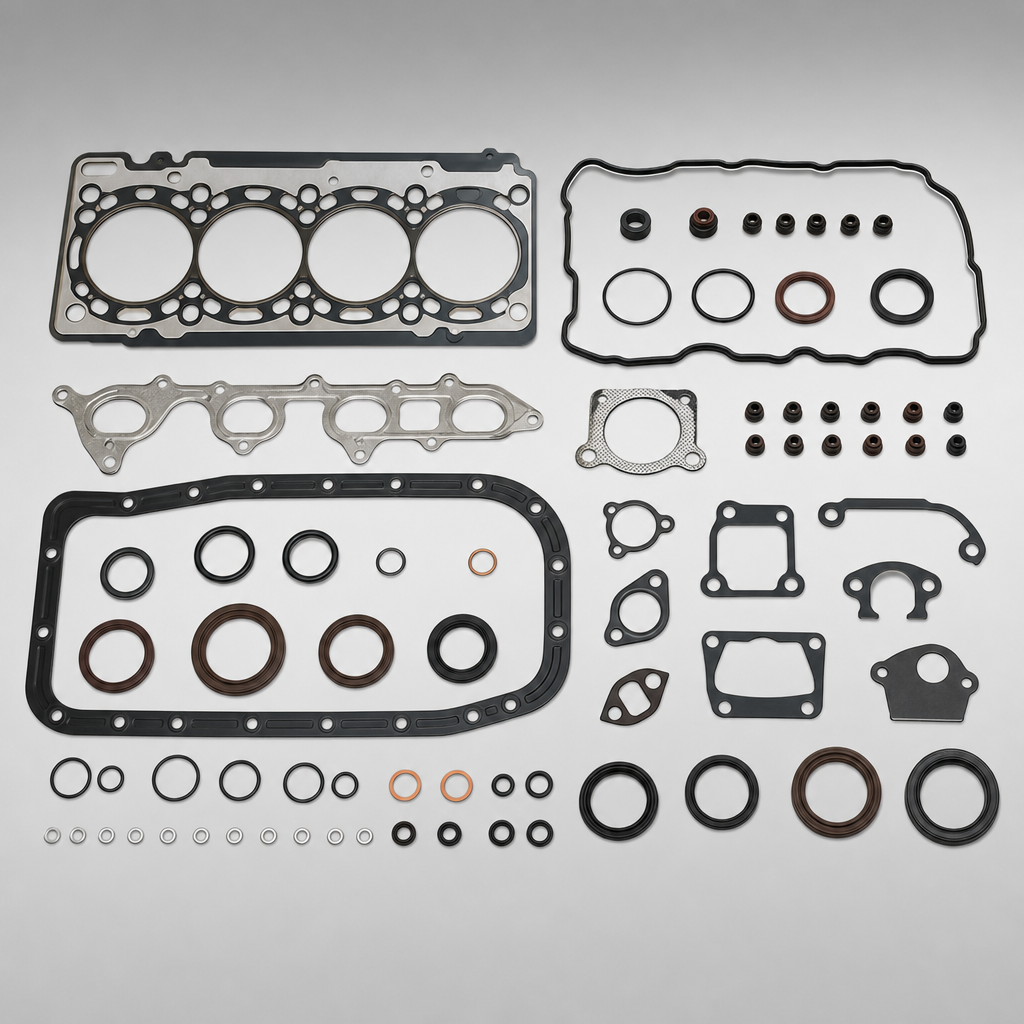
Most misfires are traced to ignition, fueling, compression, or valve timing—not the lower end. That is exactly why lower sealing gets missed. In an **engine misfire lower engine gasket set** case, the gasket set is rarely the first failed part in the story, but it can be the reason the misfire diagnosis stays unresolved: coolant reaches places it should not, oil contaminates breather or sensor areas, crankcase pressure drifts, or sealing loss follows an overheating or rebuild event.
For B2B buyers, this is not just a workshop troubleshooting topic. It affects warranty exposure, repeat labor, and supplier approval. A low-cost kit with weak material control, missing pieces, or unstable dimensions can turn one repair into two. Buyers should therefore assess lower engine gasket sets as complete sealing systems, with attention to thickness tolerance, bead consistency, fluid resistance, BOM completeness, MOQ, price breaks, and lead-time stability.
The sections below take a practical angle: when lower-end sealing belongs in the misfire decision tree, which failure modes matter most, when a full set makes more sense than a spot repair, and what procurement teams should verify before sourcing replacement kits.
Decision framework: when lower-end sealing belongs in a misfire diagnosis
A lower engine gasket set is rarely the first suspect when a cylinder misfire code appears. Technicians normally start with coils, plugs, injectors, air leaks, compression, and timing. That is still the right sequence. The key question is when to widen the scope.
Lower-end sealing should move into the diagnostic path when the primary checks do not fully explain the symptom, or when the engine has supporting history such as overheating, prior teardown, visible oil leaks, abnormal crankcase behavior, or fluid contamination.
The most common routes from sealing fault to misfire are indirect:
Coolant contamination that disrupts combustion, leaves steam-cleaned plugs, or creates cylinder-to-cylinder compression imbalance
Oil contamination affecting breather passages and, on some layouts, adjacent ignition or sensor areas
Crankcase pressure imbalance that changes PCV behavior, idle quality, and fuel control; on many passenger-car engines, warm-idle readings outside roughly -1 to -6 inH2O deserve attention
Sensor-related faults caused by oil ingress at wiring, connectors, or speed/reference sensors
Compression instability linked to distortion at block, bedplate, or related lower sealing interfaces after overheating or poor assembly; even 10-15% cylinder-to-cylinder variation can support a misfire complaint
For workshop groups, the takeaway is simple: do not begin with the lower engine, but do not exclude it too early. That is where the engine misfire lower engine gasket set becomes relevant—as part of a broader decision framework, not as a generic catch-all explanation.
For buyers, that same logic changes how the part should be evaluated. This is not a generic low-price kit purchase. Lower-end sealing depends on clamp-load distribution and dimensional accuracy, so common procurement checks include rubber-coated steel or composite carrier quality, formed bead consistency within roughly ±0.10 mm to ±0.20 mm depending on design, and cut-part thickness control often held within ±0.05 mm to ±0.15 mm. If those numbers drift, the repair may stop one leak and create another problem.
Step-by-step: how technicians narrow a misfire down to a lower gasket issue
When a misfire may involve lower sealing, technicians usually work from symptom to evidence, then from evidence to teardown decision. Procurement teams benefit from understanding that sequence because it determines which parts must be ordered together.
Symptom observed
Possible lower sealing issue
Typical inspection method
Follow-up action
Intermittent misfire at idle
Crankcase pressure instability or oil leak affecting breather function
Mating surface distortion or coolant/oil cross-contamination
Compression test, leak-down test, fluid analysis
Strip engine and inspect gasket interfaces
Oil fouling with unstable combustion
Oil migration from failed lower sealing area
Check breather system, sump sealing, front and rear lower-end areas
Replace set and correct root cause
DTC with sensor correlation issues
Oil ingress contaminating speed or position sensor area
Inspect connectors and sensor faces
Renew seals and clean or replace affected sensors
Repeat misfire after prior repair
Incomplete kit, incorrect torque sequence, or material mismatch
Review service records and removed parts
Install validated full set
</tr></thead><tbody> </tbody></table>### What should be checked before parts are ordered
Condition of sump rail and lower block mating surfaces; flange warpage above about 0.10 mm per 100 mm or beyond the OE limit should be corrected before reassembly
Evidence of RTV overuse or wrong sealant choice from a previous repair; bead width above roughly 2-3 mm often signals uncontrolled application
Flatness of related flanges after overheating or impact damage, confirmed with straightedge and feeler gauges
Condition of bolts where torque-to-yield fasteners are specified; reused TTY hardware can reduce final clamp load
Presence of sludge, varnish, or coolant traces in lower-end cavities
Material compatibility with oil, coolant, and operating temperature; NBR may fit many oil-sealing points, while ACM or FKM is often preferred where sustained temperatures exceed about 150°C
A practical workflow often means 15-30 minutes of visual and scan-tool checks, 20-40 minutes for smoke, pressure, or leak-down testing, and only then a parts decision. This is the point where kit completeness matters. Missing O-rings, half-moon seals, or auxiliary lower-end components are a common reason a nominally successful repair returns as a leak or renewed drivability complaint.
For buyers, the order logic follows the inspection logic. If the workshop confirms lower pan removal, front cover disturbance, and PCV contamination in one job, the kit should support that full disturbance pattern in one BOM. A partial set may save 5-12% on unit cost, but that saving disappears quickly if a second teardown is needed.
Replacement vs. spot repair: the commercial break-even point
The technical question is whether only one seal failed. The commercial question is whether replacing only that seal is worth the comeback risk.
For fleet service chains and rebuilders, a spot repair can reduce immediate parts spend, but it often increases total labor exposure. Once the lower engine is open, a full set is usually justified when one or more of these conditions apply:
Service mileage is high, commonly above 120,000-150,000 km on many passenger applications
Thermal cycling damage or material hardening is visible
Multiple lower-end leak points are already present
Previous repair history is unclear
The engine is in rebuild or reconditioning work
The removed seal shows compression set, swelling, tearing, or chemical attack; if compression-set values exceed the supplier's validated limit, adjacent seals may be near end of life as well
A fit-for-purpose kit should cover all sealing interfaces typically disturbed during the job. Depending on architecture, that may include sump gasket elements, lower crankcase seals, front and rear lower-end seals, O-rings, and auxiliary pieces. On many aftermarket lower engine sets, buyers should expect 8-25 pieces. For professional rebuild channels, a count sheet and exploded-view mapping help reduce picking errors and workshop disputes.
This is where a simple cost comparison is useful. If a partial gasket costs $6-12 and a complete lower set costs $18-45, but teardown and reassembly labor runs 3.5-8.0 hours, the incremental parts cost is usually the smaller risk. One repeat repair can consume the margin from many low-price kit purchases.
From a sourcing perspective, ask whether the manufacturer validates compounds for fluid resistance, compression recovery, and dimensional stability, and whether lot traceability is maintained under IATF 16949:2016 and ISO 9001:2015 controls. For Europe-focused distribution, material compliance should also align with REACH (EC) No 1907/2006 where applicable.
In short: if the job already requires lower-end disassembly, the safer decision is often to source a complete engine misfire lower engine gasket set rather than approve a narrow spot repair.
Spec deep-dive: what procurement teams should verify before approving a kit
Misfire-related repairs carry a higher warranty risk because the original symptom may have more than one cause. That makes consistency more important than headline price.
Key technical checks
Material selection: NBR, ACM, FKM, fiber, steel-core, or mixed-material construction matched to clamp load, fluid exposure, and temperature; typical continuous-use ranges are about -40°C to 120°C for NBR, -30°C to 150°C for ACM, and -20°C to 200°C for FKM depending on grade
Dimensional control: bead height, thickness, hole position, edge finish, and compression behavior must fit the target engine; many buyers look for thickness tolerance within ±0.05 mm to ±0.15 mm and hole-position tolerance within ±0.10 mm to ±0.25 mm
Fluid compatibility: resistance to engine oil, coolant, blow-by gases, and approved assembly sealants, ideally backed by immersion and heat-aging data
Kit completeness: all disturbed lower-end seals included where program design allows, with fixed BOM and revision control
Packaging control: formed gaskets should be protected from transit deformation using trays, layered card supports, or compartmentalized bags
Traceability: lot coding linked to incoming material and production batch records
Validation and documentation
Ask for evidence of:
Incoming raw-material inspection covering hardness, thickness, and surface condition
In-process dimensional checks using gauges, optical systems, or SPC on critical dimensions
Compression and recovery verification where relevant; many buyers request compression-set data at elevated temperature over 22-70 hours depending on material and standard
Leak or fitment validation on representative assemblies, including torque-sequence confirmation on sample engines or fixtures
PPAP-style documentation when the program requires it
Controlled cross-reference management to reduce fitment errors
MOQ, price, and lead-time logic
Commercial checkpoints matter too:
MOQ: many aftermarket stocking orders begin at 50-200 sets per SKU, while private-label or custom-pack programs often start at 300-1,000 sets per SKU depending on tooling and packaging
Price tiers: unit pricing often improves at 100 / 300 / 500 / 1,000 sets; quotes should be compared on a like-for-like basis, including bagging, barcode labels, and export carton marks
Lead time: ex-stock items may ship in 7-15 days, standard repeat production often takes 25-40 days, and new private-label or first-article programs may need 45-60+ days
Claim-cost logic: a supplier priced 8-15% higher may still be lower cost overall if fitment accuracy and BOM control reduce claims and workshop credits
When the application involves an engine misfire lower engine gasket set, those checks matter more, not less, because the repair outcome is judged on two fronts: leak control and restored combustion stability.
At Driventus, buyers can review relevant engine component ranges in our catalog and discuss program-specific requirements for custom manufacturing. Further information on process control and traceability is available through our quality system.
Failure modes that turn one gasket job into a repeat misfire claim
Repeat misfire complaints after gasket replacement usually come from four places: wrong diagnosis, incomplete kit coverage, poor installation discipline, or weak part quality. The visible leak gets fixed; the real cause does not.
Typical repeat-failure modes include:
Replacing the obvious leaking gasket without correcting crankcase ventilation faults
Reusing deformed fasteners where service procedure requires replacement
Incorrect torque angle or tightening sequence, causing uneven clamp load
Excess sealant application that blocks oil return paths or contaminates sensors
Using a kit with incorrect thickness or poor edge definition
Installing seals on scratched, warped, or contaminated surfaces
For workshop networks, repeat-repair prevention depends on process control. Torque data must be confirmed. Surfaces must be prepared correctly. Post-repair checks should include idle stability, fuel-trim behavior, and leak verification. On many sump or bedplate jobs, small assembly errors matter: an over-thick RTV bead, an under-torqued corner fastener, or incorrect cure time before oil fill can all lead to early seepage or unstable air-fuel control.
From a buyer's side, it is worth asking suppliers how their process reduces these field failures. Strong answers include controlled die-cut tolerances, molded-seal flash inspection, 100% piece-count verification, revision-locked BOMs, and packaging that separates delicate formed gaskets from metal hardware. If the kit uses mixed elastomer types, the supplier should be able to explain exactly which pieces see hot oil, coolant, or dynamic shaft contact.
A practical field-control checklist often includes:
Surface flatness recorded before assembly
Fastener replacement where torque-to-yield is specified
Sealant bead width held to the OE procedure, commonly around 2-3 mm where RTV is required
Initial leak check after warm-up and again after one heat cycle
Idle speed, short-term fuel trim, and misfire counter review after repair
For distributors, technical data sheets and stable BOM control help reduce claims caused by mixed kit content. Where the application sits inside a broader rebuild program, buyers may also wish to review related engine products at /products/engine-components.html to align sealing and rotating-component sourcing.
If a supplier is marketing an engine misfire lower engine gasket set to professional channels, repeat-repair prevention should be a core selling point.
Scenario planning for distributors and rebuild programs
A distributor ordering for one warehouse and a rebuilder supplying multiple service points do not buy in the same way. The gasket may be the same; the risk profile is not.
If you are buying across markets, the usual requirement is a balance of fitment accuracy, lead-time stability, and claim control. Lower-end gasket sets used in misfire-related repairs are often installed under time pressure, so application clarity and packaging accuracy matter almost as much as the material spec.
A practical supplier review should cover:
Plant certification to IATF 16949:2016 and ISO 9001:2015
Defined inspection plans for critical dimensions such as thickness, hole position, and molded bead height
Batch traceability from raw material to packed kit
Export packaging suitable for sea and road transport, with moisture protection and anti-deformation support where needed
Cross-reference discipline for aftermarket cataloging
Different buying scenarios also change order structure:
Stock orders: best for fast-moving SKUs with stable demand, often using replenishment windows of 30-45 days and safety stock equal to 1.5-2.0 months of average sales
Project orders: better for rebuild programs or tenders where kit content, branding, and carton labeling are fixed in advance
Mixed-container exports: require stronger carton discipline, clear inner labels, and transit-tested packing to prevent crushed molded seals
Supplier approval: should include sample review, dimensional-report evaluation, pilot-order feedback, and claim-rate tracking over the first 3-6 months
Price comparison should be done against full landed and claim-adjusted cost. A low FOB quote can lose its advantage if MOQ is high, lead time is unstable, or the kit requires manual rework in the warehouse because labels, cross-references, or piece counts are inconsistent. Many buyers therefore score suppliers across four weighted categories: fitment accuracy, documentation, delivery performance, and claim rate.
Typical commercial ranges are straightforward enough to benchmark:
MOQ:50-200 sets for standard aftermarket stock, 300-1,000+ sets for private-label runs
Lead time:7-15 days from stock, 25-40 days for repeat production, 45-60+ days for new labeled programs
Price sensitivity: differences of $1-3 per set often matter less than a 1-2% reduction in claim rate on professional-channel business
Driventus is an independent aftermarket manufacturer; brand names are referenced for fitment only.
If your team is reviewing supply for rebuild channels, wholesalers, or service groups, start with our catalog and compare kit content, documentation, and quality controls against your current approval criteria.
Frequently asked questions
Sometimes, but usually indirectly. Lower sealing problems more often create oil contamination, coolant contamination, crankcase pressure imbalance, or sensor-related issues that then contribute to unstable combustion. Ignition, fueling, compression, and timing should still be ruled out first.
If the lower engine is already open, a full set is often the lower-risk choice—especially on higher-mileage engines, unknown repair history, or rebuild work. It reduces the chance of adjacent aged seals causing a second leak and usually makes better sense when labor is the dominant cost.
At minimum, request application coverage, material data, lot traceability, inspection controls, and certification status under IATF 16949:2016 and ISO 9001:2015. For EU distribution, ask for relevant material compliance information for REACH (EC) No 1907/2006 as well.
If you are qualifying a lower-end sealing supplier or reviewing kit content for rebuild and service channels, you can request technical details or application support here: /contact.html