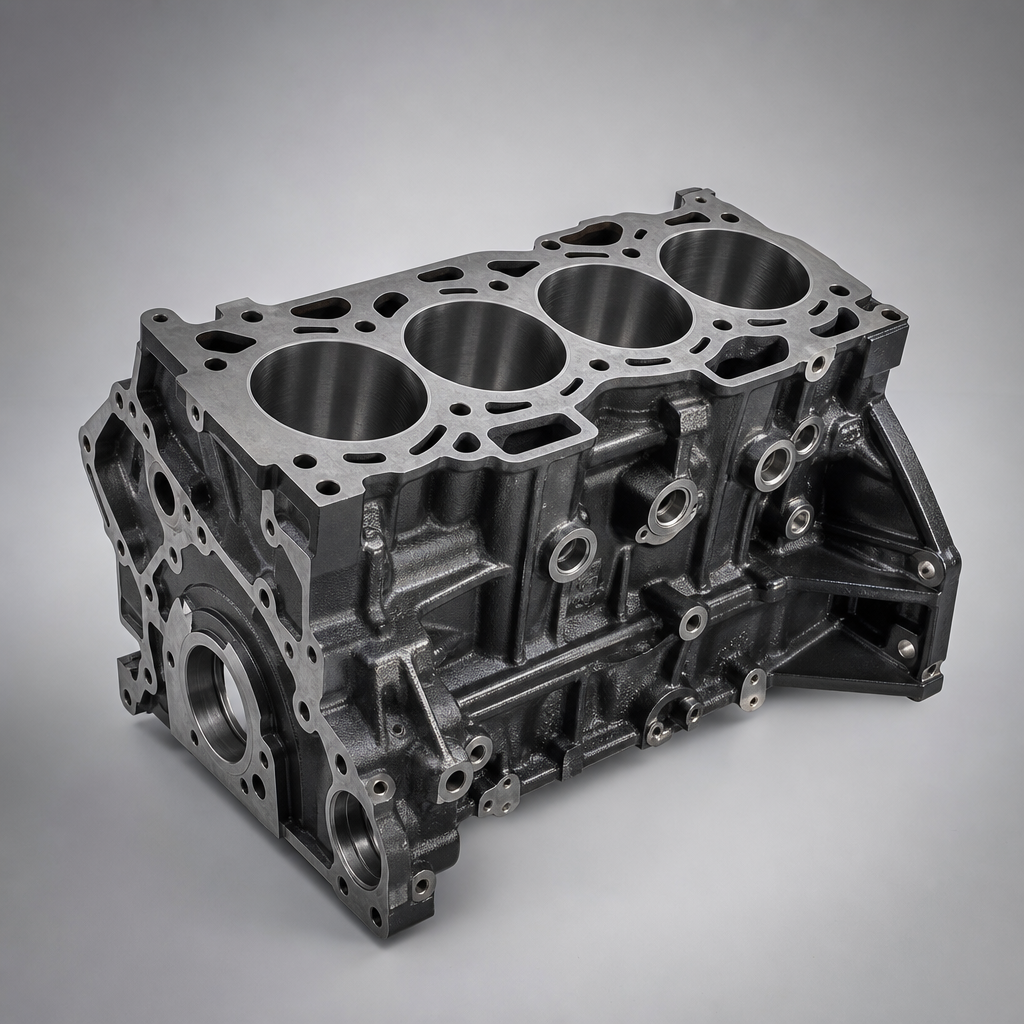
Choosing an **engine block Mercedes-Benz supplier** is less about finding a low quote and more about controlling expensive failure risk. If bore geometry drifts, deck flatness varies, or main tunnel alignment moves out of range, the problem usually appears later as rework, claim costs, or field failures—not at the moment the PO is issued.
That is why experienced importers and sourcing teams compare suppliers on evidence: casting control, machining stability, batch traceability, inspection records, packaging discipline, and delivery performance. A factory that can explain its real process in numbers is far easier to approve than one that only sends a catalogue and a certificate scan.
This guide is built for practical B2B evaluation. It breaks the review into decision points, common failure modes, technical checkpoints, commercial trade-offs, and RFQ questions so buyers in the EU, UK, US, Canada, Australia, and Brazil can compare suppliers on the same basis. Driventus is an independent aftermarket manufacturer; brand names are referenced for fitment only.
Start with a yes-or-no screening filter
Before comparing prices, apply a simple first-pass filter. A credible engine block Mercedes-Benz supplier should be able to describe the production route from casting receipt to final packing without hesitation. If that explanation is vague, the sourcing risk is usually high.
Use the first conversation to confirm five points:
Certification scope: verify whether the plant runs under IATF 16949:2016 and ISO 9001:2015, and whether machining, inspection, and engine-component production are actually covered.
Casting source control: ask whether castings are made in-house or purchased, and how chemistry, hardness, microstructure, and incoming defects are checked lot by lot.
Critical machining capability: confirm control over cylinder bores, deck face, main bearing tunnel alignment, threaded holes, and other fit-critical features.
Traceability: each batch should link to melt number, casting lot, machining route, inspection record, washing or preservation batch, and packing date.
Export readiness: check rust prevention, pallet stability, moisture protection, and shipment labelling for sea freight.
Then ask for two documents immediately: a one-page process flow and a sample inspection report. Those two items reveal a lot. Serious suppliers usually provide them quickly; generic traders often cannot.
Commercial basics should also be clarified early, not after technical review. Typical working ranges are:
sample MOQ: often 1-5 pcs if fixtures already exist
pilot MOQ: often 20-50 pcs per SKU
standard production MOQ: commonly 50-150 pcs per SKU
repeat lead time: typically 45-75 days depending on casting supply and machine loading
For buyers handling multiple references, it can be efficient to begin with our catalog at /products.html and shortlist by engine family before moving into technical approval.
Where engine block programs usually fail
Most engine block problems do not start at final inspection. They start earlier—in the casting, in datum control, in unstable tooling, or in poor cleaning after machining. Buyers who know the common failure modes ask sharper questions and approve suppliers faster.
Typical risk areas include:
hidden porosity that only appears during pressure testing or field use
core shift around water jackets or oil passages
cylinder bore size drift across long machining runs
deck flatness variation that affects head gasket sealing
main tunnel misalignment that creates assembly or durability problems
burrs, residual sand, or blocked passages after machining and washing
weak corrosion protection during sea freight
This is why metallurgy and machining must be reviewed together. A good block can be ruined by poor process discipline; a well-run machining line cannot rescue a bad casting lot.
Material and casting controls
Buyers should ask the supplier to define, not just mention, its casting controls. Depending on the application, the block may be grey cast iron, aluminium alloy, or compacted graphite iron. The supplier should be able to document:
chemistry limits for the relevant grade
hardness range by batch, for example HB 187-241 or approved equivalent
acceptance criteria for shrinkage, porosity, inclusions, and cold shuts
leak-path inspection method and rejection rule
core shift control at cylinder walls, jackets, and oil passages
cleanliness limits after blasting and washing
wall-thickness verification at critical sections
Machining and dimensional controls
For serial supply, the conversation has to move from “can you machine this part?” to “what variation do you hold every week?” Buyers should request actual tolerance capability and inspection frequency for critical features.
Feature
Typical buyer focus
Example tolerance or target
Verification method
Cylinder bore
Diameter, taper, roundness, surface finish
Bore size often within 0.01-0.03 mm, roundness within 0.01-0.02 mm, Ra often 0.8-1.6 um depending on finish stage
Air gauge, bore gauge, profilometer
Deck face
Flatness and surface condition
Flatness often within 0.03-0.05 mm across full face; Ra matched to gasket requirement
Granite table, CMM, roughness test
Main bearing tunnel
Alignment and diameter consistency
Alignment commonly controlled within 0.02-0.04 mm; bore diameter to drawing tolerance
Dial bore gauge, line-bore fixture, CMM
Bore-to-bore centre distance
Positional accuracy between cylinders
Commonly held within 0.02-0.05 mm depending on design
CMM, dedicated fixture
Threaded holes
Position and thread quality
Position to drawing; thread class verified with Go/No-Go gauges
Go/No-Go gauges, torque spot check
Coolant and oil passages
Blockage, burrs, leakage risk
Zero blockage, burr-free edges, pass pressure test standard
Visual inspection, pressure/leak test
</tr></thead><tbody> </tbody></table>If the supplier claims strong process capability, ask for proof: Cp/Cpk on tight features, first-off records, in-process checks, and pressure-test parameters such as test medium, pressure, hold time, and allowable drop.
For EU and UK buyers, material declarations should also align with REACH (EC) No 1907/2006 where relevant.
Compare suppliers like a buyer, not like a catalogue reader
Two suppliers can offer the same part number and still present very different sourcing economics. One may quote lower but require a large MOQ, weak packaging, or long replenishment cycles. The other may cost more per piece but reduce inventory exposure and claim risk. That is the real comparison.
Use a side-by-side commercial framework:
Procurement item
What to ask
Typical working range
Why it matters
MOQ
Trial MOQ, standard MOQ, mixed-model policy
Sample 1-5 pcs; pilot 20-50 pcs; production 50-150 pcs per SKU
Reduces inventory risk during launch
Lead time
Tooling if needed, first article, repeat order cycle
Existing item sample 2-4 weeks; new machining setup 4-8 weeks; repeat order 45-75 days
Impacts fill rate and working capital
Capacity
Monthly output by block family and machine line
Ask for capacity in pcs/month, shift pattern, and bottleneck process
Confirms supply continuity
Audit access
Process audit, final inspection witness, document review
Remote desktop review or on-site audit before nomination
Validates actual controls
Packaging
VCI, rust prevention, export carton/pallet standard
Initial containment within 24-72 hours is a common buyer expectation
Protects importer margin
</tr></thead><tbody> </tbody></table>Price should also be broken into components. Ask the supplier to separate:
raw casting cost
machining cost
tooling or fixture amortisation
inspection and testing cost
packaging cost
inland transport to port
That breakdown exposes whether a “cheap” quote simply omits process steps you actually need.
Also ask how pricing changes by order stage:
sample price: usually highest because setup and inspection are absorbed into tiny volume
pilot price: lower, but still carries setup cost
serial price: reflects the supplier's economic run quantity
annual volume break: may improve at 100 pcs, 300 pcs, or 500+ pcs per year per SKU
mixed-load policy: useful when several SKUs need to fill one casting or machining batch
If private label, packaging adaptation, or non-standard machining status is part of the programme, review custom manufacturing at /oem-services.html during sourcing discussions.
Ask for live quality evidence, not certificate wallpaper
A framed certificate on the wall is a starting point. It is not proof that the last shipped batch was controlled properly. The better test is simple: can the supplier pull real, recent records tied to an actual lot?
During qualification, request:
dimensional inspection reports with actual measured values
calibration records for bore gauges, CMMs, thread gauges, torque tools, and leak-test equipment
incoming inspection criteria for castings and the sampling plan used
control plan or equivalent showing critical characteristics and check frequency
non-conformance reports with containment and corrective action examples
packing validation for sea freight, including rust-prevention method
A documented quality system should make these records easy to retrieve. Buyers can review the broader framework at /quality.html.
Then go one step further: ask the supplier to walk one recent lot from receipt to shipment. The file should normally include:
melt or casting batch reference
machining work order or route card
first-off inspection result
in-process inspection frequency, such as every 10 pcs, 20 pcs, or once per shift
final inspection summary
pressure or leak test result where required
washing and preservation confirmation
pallet or packing list tied to shipment ID
This exercise quickly separates controlled manufacturers from companies that rely on generic assurances.
For engine blocks, scrap and rework data are especially revealing. Ask directly:
What is the internal rejection rate for this block family?
Which defects cause most rework: bore size, threads, deck finish, or leakage?
Are critical bores checked 100% or by sampling?
What is the gauge R&R result for the bore measurement method?
Where blocks are part of a wider engine component programme, it also helps to review related categories at /products/engine-components.html so sourcing standards stay consistent across the full build.
Driventus is an independent aftermarket manufacturer; brand names are referenced for fitment only.
Build an RFQ that forces comparable answers
A weak RFQ produces vague quotations. A strong RFQ makes suppliers answer with numbers, assumptions, and limits. That shortens approval time and gives purchasing, engineering, and logistics teams the same basis for comparison.
Include these items in the RFQ package:
target application, engine family, and reference cross-match
annual demand and forecast split by SKU
launch quantity and safety-stock expectation
required material specification or approved equivalent
critical dimensions to be reported with samples
leak-test or pressure-test requirement, including pressure and hold time
surface protection and packaging specification
labelling, barcode, and pallet standard
requested Incoterm, destination port, and shipment frequency
compliance documents required by market
sample approval route and warranty terms
target SOP date and whether phased deliveries are acceptable
If you already hold approved drawings, send them with the tolerance classes that matter most. If not, ask the supplier for its standard inspection characteristic list and sample-report format before nomination. That reveals whether the engine block Mercedes-Benz supplier can report the dimensions your programme actually cares about.
The RFQ should also force direct numeric responses on:
MOQ by stage: sample, pilot, and serial
price breaks: for example 50, 100, 300, and 500 pcs
tooling or fixture cost: one-off or amortised
sample lead time: from drawing confirmation to dispatch
repeat lead time: from PO and deposit to shipment
inspection submission: quantity of samples with full dimensional report
warranty claim response: containment timing and credit or replacement policy
Many buyers add a supplier questionnaire covering monthly capacity, normal shift pattern, subcontracted operations, and maximum container loading per reference. Those details matter because landed cost is shaped by more than unit price.
For buyers ready to move from screening to quotation, use request a quote at /contact.html with annual demand, target markets, and audit requirements.
Frequently asked questions
MOQ depends on the casting route, machining fixture availability, and SKU mix. In many aftermarket programmes, sample MOQ is around 1-5 pcs, pilot MOQ around 20-50 pcs, and serial MOQ around 50-150 pcs per SKU. Buyers should request separate sample, pilot, and serial-production terms, plus any mixed-model option to reach an economic batch size.
At minimum, request certification details, material certificates, dimensional reports with actual measured values, traceability records, calibration evidence, control plans, and corrective action examples. For ongoing programmes, batch-level inspection records, leak-test results where applicable, and packing specifications are also important.
Focus on process control, not only price. Review bore, deck, and main tunnel inspection data, confirm traceability by batch, verify actual machining tolerances, assess export packaging, and audit how non-conformances are contained within 24-72 hours. A controlled approval process usually lowers claim risk and prevents hidden costs from rework or field failure.
If you are qualifying a new source for engine blocks or related powertrain components, Driventus can review your drawings, volume forecast, tolerance priorities, and audit requirements. Contact the team here: /contact.html