Engine Block Material: How Buyers Compare Supplier Options
Choosing engine block material is a sourcing decision as much as a design decision. Buyers have to balance thermal expansion, bore stability, deck sealing, machining cost, corrosion risk, warranty exposure, and the validation pack that follows the part into production. A high-load gasoline programme may put cylinder pressure capability, main web stiffness, and dimensional retention around the bores and main tunnel first. A light-duty replacement line, by contrast, may care more about casting yield, machining cycle time, and broad fitment coverage. Driventus is an independent aftermarket manufacturer; brand names are referenced for fitment only. The useful question is not which alloy sounds more modern, but which material and process route fit the duty cycle, machining datum scheme, inspection plan, and commercial risk. The sections below compare the main options, the tolerances that matter, and the records a buyer should request before a trial order. If you need a supplier view of the range, start with [our catalog](/products.html) and [our quality system](/quality.html).
What to define before an RFQ
Material selection should start with the duty cycle and drawing requirements, not the catalog label. Before a supplier can recommend an engine block material, the buyer needs to define how the block will be used, how much machining is included in the scope, and which inspection records will release the first article and pilot lot. A replacement block for a naturally aspirated passenger application has different risk points from a turbocharged, LPG/CNG, marine, generator, or heavy-duty application, even when the external mounting points look similar.
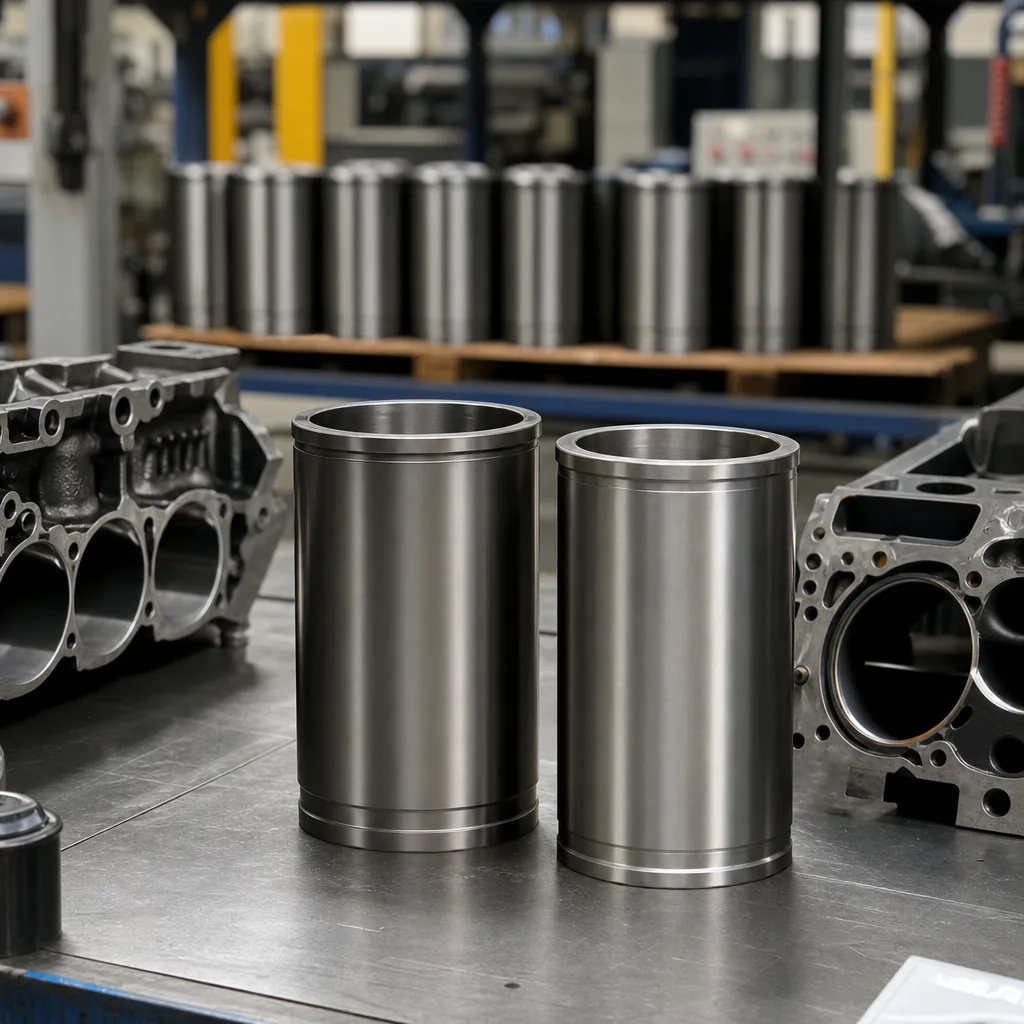
For each RFQ, define the cylinder count, bore spacing, deck height, deck thickness, main bearing arrangement, coolant passage layout, oil gallery layout, target casting weight or finished mass, and whether the block is required as rough cast, semi-finished, or fully machined. Also state the intended bore surface strategy: parent bore, cast-in liner, dry sleeve, wet sleeve, or a finish-machined liner supplied separately. This matters because the selected material affects heat transfer, honing allowance, head-bolt thread engagement, liner interference, and the amount of distortion expected after head torquing and thermal cycling.
Buyers should also make the inspection gate explicit. A basic quotation based only on a part number can hide major differences in scope. The RFQ should state whether approval requires a dimensional report, pressure test, hardness range, microstructure check, chemical composition certificate, machining capability study, and traceability from melt or casting lot to finished block. If the programme needs revised coolant routing, extra bosses, alternative plug positions, additional machining stock, different liner material, or a different finish state, custom manufacturing is the correct sourcing path rather than treating the job as a standard replacement order.
Minimum RFQ data
Base engine family, displacement range, cylinder count, and intended market application
Target engine load profile, fuel type, boost level or peak cylinder pressure if known, and duty cycle
Required engine block material or acceptable alloy family alternatives, such as gray iron, CGI, or aluminium alloy with liners
Casting route, heat treatment or ageing condition, machining allowance, and expected finish state
Cylinder bore size, bore spacing, liner type, deck thickness, and head fastener pattern
Main tunnel line-bore, bearing cap, register, and fastener requirements
Coolant and oil gallery layout, plugs, threaded features, dowel holes, and sealing interfaces
Machined surfaces, datum scheme, surface finish requirements, CMM or gauge method, and inspection temperature
Annual volume, trial quantity, MOQ expectations, packaging, corrosion protection, and target lead time
Required documents, sample approval process, PPAP level if applicable, and nonconformance response timing
Common materials and trade-offs
The main engine block materials are mature, but they do not solve the same problems. The right choice depends on elastic modulus, fatigue strength, heat rejection, wear surface strategy, casting process capability, machining cost, and the cost of scrap if a defect is found after finish machining. Buyers should compare the total delivered performance of the block, not just the raw material price.
Material
Strength and stiffness
Weight
Machining and cost
Typical sourcing note
Gray cast iron
Good damping, stable bores, strong compressive behavior, and typical elastic modulus around 100-130 GPa depending on grade
Heavy, commonly about 7.1-7.3 g/cm3 density
Predictable machining; graphite improves chip breakage and tool life
Common for durability-focused, cost-sensitive, reman, and service replacement programmes
Compacted graphite iron (CGI)
Higher tensile and fatigue strength than gray iron, with improved stiffness around bores and main webs; modulus often about 140-170 GPa
Heavy to medium, similar density to cast iron but may allow thinner sections
Requires tighter foundry control and can increase cutting forces and tool wear
Used where higher cylinder pressure, reduced wall thickness, or main web stiffness is needed without moving to aluminium architecture
Aluminium alloy
Low mass, high thermal conductivity, and lower modulus around 70 GPa, so structure and fasteners carry more of the stiffness burden
Light, commonly about 2.65-2.80 g/cm3 density
More sensitive to porosity, bore distortion, thread design, inserts, heat treatment, and fixture strategy
Common in efficiency-focused designs where weight reduction is a primary requirement
Aluminium with cast-in or dry liners
Combines lower mass with an iron or steel wear surface for piston ring contact
Light to medium
More process steps; liner location, interference, bonding, and machining allowance are critical
Often chosen for replacement and mixed-duty programmes where bore wear, rebuildability, and ring compatibility must be controlled
</tr></thead><tbody> </tbody></table>Gray cast iron remains attractive when the programme values bore stability, vibration damping, and proven machining routines. It is often practical for replacement engine blocks because it provides a robust parent bore or liner seat without complex insert systems. Sourcing discussions should cover grade, tensile strength class, hardness window, graphite flake distribution, pearlite/ferrite target, and whether the casting is naturally aged or stress relieved before finish machining. The trade-off is mass, which may be unacceptable where vehicle efficiency or handling targets are strict.
CGI is often selected when the block must resist higher cylinder pressure or fatigue loading while preserving many of the packaging characteristics of iron. It can support thinner sections or improved stiffness in critical areas, but it is not simply a premium version of gray iron. The foundry process window, magnesium treatment, graphite compactness, chill control, and machining strategy all need close management. Buyers should therefore expect a more detailed process-control discussion and clear tool-life assumptions in the quotation.
Aluminium alloys reduce mass and transfer heat well, but they demand more attention to thread reinforcement, deck sealing, bore geometry, galvanic corrosion, and local stiffness. An aluminium block may need steel or iron liners, coated bores, cast-in inserts, bedplate reinforcement, or thread inserts depending on the design. For procurement, the supplier’s control of porosity, heat treatment condition such as T6 where specified, liner positioning, and finish machining is as important as the alloy designation.
The engine block material label alone does not tell you enough. Ask how the supplier controls bore distortion during head-plate honing, gasket sealing surface finish, main bearing alignment, local wall thickness after machining, and corrosion protection. Those details usually decide whether the block performs consistently in the field.
Machining and dimensional control
For buyers, the critical dimensions go well beyond nominal bore size. An engine block can match the catalog reference and still create assembly problems if the deck face, main tunnel, threaded bosses, oil galleries, dowel locations, or coolant passages are not controlled. Machining strategy should be reviewed alongside material choice because each engine block material responds differently to clamping load, cutting heat, residual stress, heat treatment, and final inspection temperature.
Ask the supplier to define bore diameter, roundness, taper, cylindricity, deck flatness, main bore alignment, and liner protrusion if fitted. Typical drawings may call out bore roundness and taper in the 0.01-0.03 mm range, deck flatness around 0.03-0.08 mm depending on length and gasket system, and liner protrusion controlled within a few hundredths of a millimetre. The exact limits, however, must come from the signed drawing and engine sealing design. For lined aluminium blocks, document the relationship between liner material, interference fit, step height, protrusion, and final hone size. For cast iron blocks, buyers should still check bore finish, main cap fit, stress relief or ageing, and whether torque plates are used for final honing where the engine design requires it.
A block can meet drawing size and still fail if the deck finish does not seal, a threaded boss pulls out during assembly, or the main tunnel shifts after heat treatment or finish machining. The inspection plan should identify the datums used, the gauge type, the measuring temperature, and the acceptance criteria for every critical feature. Use CMM for datum-related geometry, air gauges or bore gauges for cylinder and main bore checks, surface roughness testers for gasket and bore surfaces, and calibrated thread gauges or pull tests where thread retention is a known risk. This is especially important when comparing quotations from multiple suppliers: one quote may include full machining and inspection, while another may cover only rough casting plus basic checks.
Key machining and dimensional controls include:
Cylinder bore diameter, roundness, taper, and cylindricity at the agreed inspection temperature, usually referenced to 20 C
Honing finish, crosshatch requirement, plateau finish where specified, and bore surface roughness where rings contact the bore
Deck flatness, surface roughness, waviness, and finish direction after final machining and stress relief
Main bearing bore alignment, size, straightness, and cap register control across the full tunnel
Cam bore alignment where applicable, including concentricity to the defined datum scheme
Liner protrusion, liner step, liner concentricity, liner interference, or liner location control if liners are fitted
Thread pull-out resistance for mounts, covers, head bolts, main caps, brackets, and accessories
Oil gallery and coolant passage cleanliness, plug torque or staking method, sealing method, and pressure-test acceptance limits
Surface roughness on gasket faces, sealing bores, rear seal housings, oil pan rails, and machined mounting pads
Local wall thickness after machining, especially between cylinders, around water jackets, and near head bolt bosses
Corrosion protection for raw cast, machined, coated, or stored surfaces, including VCI packaging or rust preventive where required
A direct replacement programme should compare measured data, not only nominal drawings. That is the difference between a part that installs and one that holds tolerance after heat cycles, torque loading, and customer use. When possible, request a sample inspection report using the same datum scheme, gauges, and acceptance limits planned for production release.
Validation and compliance pack
A credible supply package should combine certification, process control, product validation, and market-specific compliance. For engine blocks, validation should show that the selected engine block material and manufacturing route can consistently deliver the required strength, sealing, dimensional accuracy, cleanliness, and corrosion resistance. A supplier that provides only a material name and a price has not given the buyer enough information to judge production risk.
At minimum, ask for evidence of IATF 16949:2016 and ISO 9001:2015 where applicable to the production site and process scope. Request a material declaration for REACH (EC) No 1907/2006 where coatings, sealants, rust preventives, impregnation chemicals, or other controlled substances are involved. The traceability method should link melt or heat records, casting lots, heat treatment batches, machining batches, inspection records, pressure-test results, and final packaging labels so that a quality issue can be isolated without holding all inventory.
Validation pack
First article or sample approval report with signed drawing revision and part-number cross-reference
Chemical composition certificate and heat, melt, or batch record
Mechanical property data where applicable to the alloy route, casting process, and heat treatment condition
Hardness, microstructure, graphite-flake class, or graphite-form verification for cast iron and CGI routes where required
Porosity, inclusion, impregnation, or X-ray inspection criteria for aluminium castings where required
Dimensional inspection report with agreed gauges, datums, sampling plan, and measurement temperature
Bore finish and deck surface roughness report for machined blocks, including Ra/Rz/Rpk/Rk/Rvk where specified
Pressure or leak test report for coolant passages and oil galleries, with test pressure, hold time, medium, and acceptance limit
Cleanliness requirement and flushing, drying, plugging, or particle-count process for internal passages
Coating, rust-prevention, VCI, desiccant, and export packaging specification for transit and storage
Traceability plan linking casting, heat treatment, machining, inspection, rework, and shipment records
Control plan, process flow, PFMEA where applicable, and corrective-action method for recurring production lots
For programmes with external durability exposure, some buyers also ask for data aligned to SAE J2527 for coating or corrosion exposure where relevant to the supplied finish. For emissions-sensitive assemblies, document the programme requirement separately; do not treat ECE R-83 as a blanket approval of the block itself. The block may support an emissions-related engine assembly, but the buyer still needs part-specific evidence for material, machining, sealing, cleanliness, and durability.
Validation should also match the ordering model. A one-time service replacement order may require first article approval, dimensional reporting, leak testing, packaging checks, and a retained master sample. A recurring OEM-style programme should go further, with control plans, capability data for critical features, change-control rules, periodic requalification, and incoming quality targets. Any change in foundry source, melt practice, machining fixture, CNC programme, heat treatment, liner supplier, impregnation process, or inspection method should trigger buyer notification before shipment.
How to qualify a supplier
Sourcing should be evaluated on repeatability, not on sample quality alone. A polished sample can hide unstable casting yield, fixture variation, weak traceability, excessive rework, or inconsistent final inspection. Buyers need to confirm that the supplier can support the same tooling, machining route, material controls, and inspection plan at the target annual volume, not only during the first prototype or trial lot.
Start by separating commercial capability from technical capability. Commercially, check lead time by stage, MOQ, payment terms, export packaging, spare tooling policy, incoterms, and how the supplier handles forecast changes. Technically, review the foundry route, core-making method, melt control, heat treatment or ageing, machining equipment, fixture control, tool-life management, washing and deburring, inspection equipment, pressure-test method, and the corrective-action process used when a feature trends out of tolerance. For an engine block material decision, the strongest supplier is usually the one that can explain both why the material fits the application and how the process keeps it stable batch after batch.
If the programme covers several applications, our catalog and engine components help map the platform range, while our quality system shows the controls behind production. custom manufacturing is the route for drawing changes, revised machining, or material alternatives, and request a quote is the right next step once the RFQ pack is complete.
A practical buyer checklist:
Confirm fitment range and any OE cross-reference used in the market
Verify the proposed engine block material, casting process, heat treatment or ageing condition, and finish state
Review the supplier’s drawing revision control, engineering change notice process, and change-notification timing
Verify sample dimensions against the signed drawing and agreed datum scheme
Check bore, deck, main tunnel, liner, dowel, and threaded feature inspection records
Review pressure-test results for coolant and oil passages, including pressure, hold time, and leak limit
Align acceptance criteria before the first production lot, including sorting, rework, concession, and scrap rules
Confirm lead time for tooling, samples, pilot lot, PPAP or sample approval, and repeat production
Lock the corrective-action path for any nonconformance, including containment timing, 8D response, root-cause method, and replacement policy
The final decision should combine price, technical evidence, and operating risk. A lower quote can become expensive if casting yield is unstable, machining scrap is high, incoming inspection must be duplicated, or dimensional drift causes warranty claims. A qualified supplier should be able to show how the chosen material, casting route, machining plan, inspection controls, and validation records work together as one controlled production system.
Frequently asked questions
Gray cast iron and CGI usually offer better stiffness and bore stability than aluminium because their elastic modulus is higher and thermal expansion is lower. CGI can be attractive where fatigue resistance, thinner walls, or higher cylinder pressure capability are important, but it requires tighter melt, graphite-form, and machining control. The right choice still depends on bore spacing, deck design, cooling layout, fastener strategy, and whether liners are used. For procurement, ask for the casting route, machining sequence, material controls, hardness or microstructure data, and dimensional report, not only the material name.
Sometimes, but only with verified deck height, mounting points, liner design, thread strength, cooling performance, corrosion strategy, and thermal growth targets. Aluminium expands more than cast iron and may need liners, inserts, revised fastener engagement, or local reinforcement. A direct-fit claim should be supported by measured data, leak testing, and fitment checks. If the bore system, sealing face, coolant routing, main tunnel, or accessory bosses change, treat it as a validated substitute rather than a simple swap.
Ask for the material certificate, dimensional inspection report, hardness or microstructure data where relevant, pressure or leak-test report, traceability plan, sample approval records, and certification status for IATF 16949:2016 and ISO 9001:2015. For export programmes, also confirm packaging, corrosion protection, cleanliness controls, labeling, sampling plan, and the agreed nonconformance response.
If you are comparing material options for a new block programme or replacement line, share the drawing, target volume, duty cycle, preferred engine block material, finish state, and test plan, then [request a quote](/contact.html).