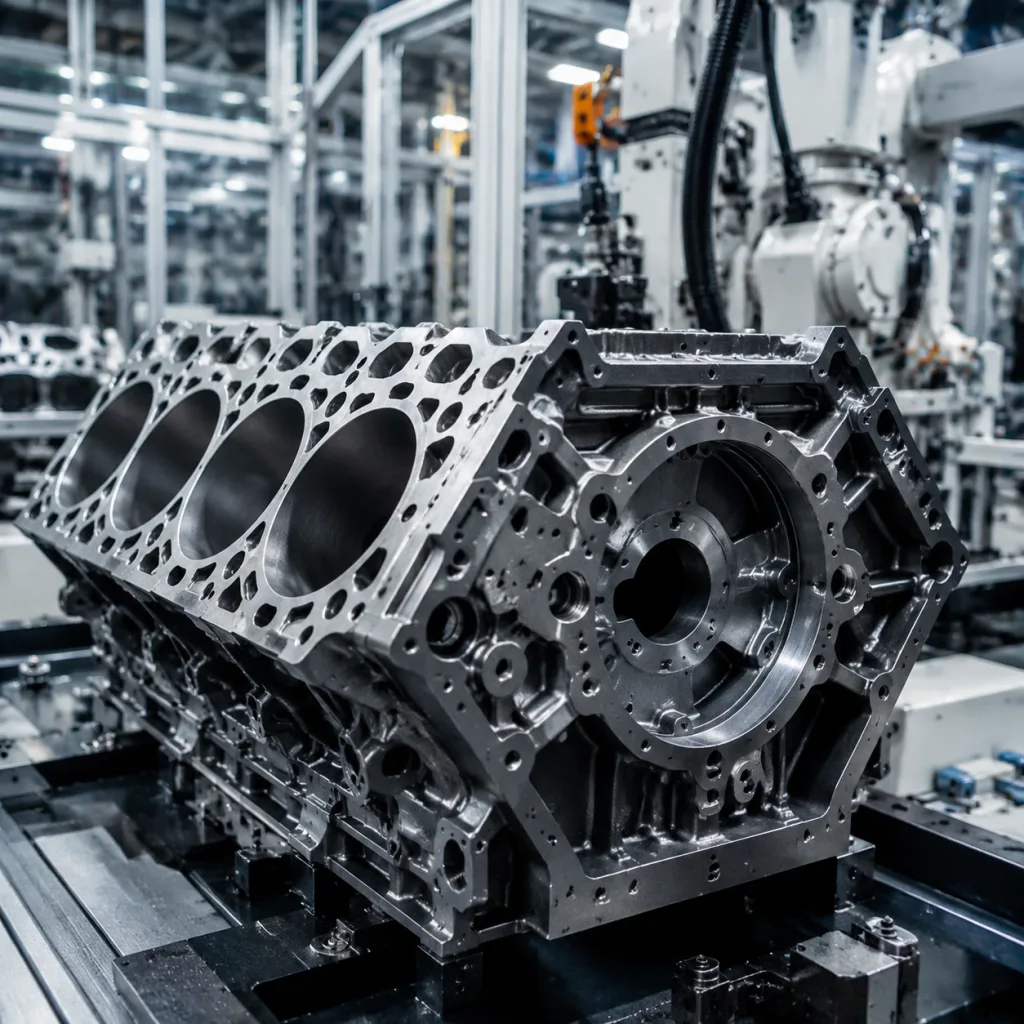
If you are sourcing an `engine block infiniti supplier` relationship for aftermarket distribution, OEM programmes, or repair-chain replenishment, the main risks are dimensional drift, inconsistent machining, and weak traceability. Engine blocks must match bore spacing, deck height, main bore geometry, and material specification closely enough to support reliable assembly and long service life. Buyers also need stable lead times, controlled MOQ, and documentation that stands up to audit. Driventus is an independent aftermarket manufacturer; brand names are referenced for fitment only. For buyers comparing supply options, the right starting point is a supplier that can support OE part-number cross-references, process control, and repeatable inspection data, not just low unit price. If you are building a sourcing shortlist, use published standards, ask for sample inspection records, and verify how the factory manages machining, testing, and packaging before placing volume orders.
Decision frame: what to lock before RFQ
For an `engine block infiniti supplier` search, the first decision is not price. It is the sourcing model: direct replacement, remanufacturing core, or private-label aftermarket unit. Fix that up front, or every quote will be hard to compare.
Core procurement checks
Alloy or casting grade, with heat-treatment route where applicable
Bore diameter, bore spacing, and deck height tolerance
Main bearing tunnel alignment and cap compatibility
Cylinder finish, liner type, and surface roughness target
OE part-number cross-reference, such as `OE 06A107065` when the application calls for it
Packaging, labelling, and carton drop-test expectations
Dimensional report covering 100% of critical-to-fit features on pilot samples
A credible supplier should tell you whether parts are built to drawing, sampled from an approved reference, or produced from a reverse-engineered pattern. That choice changes dimensional risk, warranty exposure, and how much validation your team needs before release. For engine blocks, ask for explicit tolerances before you compare prices. Bore diameter should sit within the drawing callout, deck height often needs to stay within ±0.03 mm on precision-machined programs, and main bore roundness and alignment commonly sit within 0.01-0.02 mm depending on the engine family. If the supplier cannot quote the tolerance stack, they are not ready for controlled procurement.
Failure modes that turn a cheap block expensive
Engine blocks are heavy machined parts, so the obvious risks are not the only risks. A low unit price can hide rework, freight damage, and approval delays.
Item
What to confirm
Typical buyer risk
MOQ
Per part number, per engine family, or mixed order
Overstock on slow movers
First sample lead time
Pattern readiness, machining slot, and inspection sign-off
Delayed validation
Mass-production lead time
Raw casting, machining, final inspection, and packing
Stock-out risk
Packing method
Rust prevention, pallet spec, and crate strength
Transit damage
Documentation
Inspection report, COO, invoice, and packing list
Customs delay
Price break
At 50, 100, 300, and 500 units
Misread landed cost
</tr></thead><tbody> </tbody></table>For planning, many buyers use 1-2 units for prototypes, 3-5 units for engineering samples, and 20-50 units as a practical production MOQ per part number. That is a benchmark, not a rule. Ask the supplier to quote sample, MOQ, and tiered volume separately, then compare landed cost at the same incoterm. A lower ex-works price disappears fast once freight, duties, insurance, palletisation, and inspection rework are added.
Also confirm whether the line is dedicated or shared, and whether urgent replenishment is possible after the first approved run. If you need forecast protection, request a time-phased quotation with a 30/60/90-day release window and a written validity period for the quoted pricing.
Spec deep-dive: quality, machining, and audit trail
A reliable source should operate under `IATF 16949:2016` where automotive programme requirements apply, and `ISO 9001:2015` at minimum. For engine blocks, process control matters more than brochure claims.
Driventus publishes its quality system for buyers who need evidence of inspection discipline, corrective-action handling, and traceability. If your purchasing team is qualifying multiple plants, request:
Material certificates tied to heat or batch number
First article inspection reports with full dimensional results
Machining process controls for bore, deck, and main tunnel features
Non-conformance handling procedure and containment response time
Incoming and final inspection criteria
Gauge calibration status for micrometers, bore gauges, and CMM equipment
Surface finish and hardness test records when the application requires them
For engine blocks, ask how the plant controls warpage after rough machining, how many in-process checks occur before final inspection, and whether the main bore is checked before and after cap torquing. A capable supplier should be able to name the inspection method, the measurement frequency, and the acceptance limit for each critical feature. If your programme requires audited supplier development, ask how the factory handles corrective actions after field feedback, and whether the same gauges are used across repeat orders. That is often where supply consistency is won or lost.
Fitment control: compare the block to the application, not the badge
Engine block sourcing should be treated as a fitment-control exercise. Buyers should not rely on model names alone. The same vehicle line may use multiple engine codes, revisions, and market-specific variants.
A practical cross-reference file should include:
Engine family and displacement
Casting number or OE reference where available
Critical dimensions, including deck height and main bore size
Compatible cylinder head and gasket family
Notes on sensor bosses, oil gallery routing, and bracket mounts
Revision level, build date range, and market application
When a programme requires custom adaptation, custom manufacturing can align the block to customer-specific packaging, machining, or finishing needs. That is useful for private-label distributors and regional programme owners who need controlled variation without changing the base engineering intent. In practical terms, confirm whether the supplier can hold the same bore spacing and deck datum while changing external boss machining, accessory mounts, or coating specification. If a special finish is required, state the target roughness, coverage area, and any masking zones in the RFQ.
Driventus is an independent aftermarket manufacturer; brand names are referenced for fitment only.
Where Driventus fits in the supply comparison
Driventus supplies engine and powertrain components from Taizhou, Zhejiang, with export experience across 60+ countries. For procurement teams, that matters because it supports repeatable documentation, consolidated shipment planning, and consistent communication across time zones.
Use our catalog to map the part family, then narrow the scope through engine components if you are building a wider bill of materials. Buyers often combine engine blocks with gaskets, water pumps, pistons, or related hard parts to reduce supplier count and improve container utilisation.
For team-level buying, the main advantages are straightforward:
Controlled production from a single manufacturing base
Parts aligned to export documentation requirements
Support for sample approval before volume release
Ability to discuss OE cross-reference fitment on a programme basis
Consolidated packing options for mixed SKUs or full-carton dispatch
Support for release planning against forecasted monthly call-offs
If your category strategy includes supplier consolidation, Driventus can support a structured evaluation with sample review, specification confirmation, and order planning. A buyer can use one RFQ to compare sample cost, MOQ, and 6- to 12-month supply assumptions across multiple engine families before deciding whether to dual-source or single-source the programme.
RFQ checklist: the fastest path to approval
A complete RFQ reduces back-and-forth and shortens the path to sampling. Include the engine code, application market, target annual volume, and whether you need boxed retail packing or bulk export packaging.
To improve response quality, attach:
Photos of the existing block and identification marks
Dimensions that are critical to installation
OE reference numbers, if known
Target certification and test-document requirements
Forecast volumes and target delivery window
Required tolerance callouts for bore, deck height, and main tunnel alignment
Desired unit-price breakpoints and approval sample quantity
You can request a quote with either an OE reference or a sample-to-match request. If your team needs a broader sourcing review, a side-by-side comparison against alternate suppliers is often the fastest way to align pricing, quality, and lead time before final approval. To move quickly, ask for a quotation that separates sample tooling, first-run inspection, repeat-order pricing, and freight assumptions so procurement, engineering, and finance can approve on the same data set.
Frequently asked questions
Yes. Buyers can provide an OE reference or engine code for fitment review. Driventus does not claim OEM approval, and brand names are referenced for fitment only.
Ask for dimensional inspection data, material traceability, packing details, and the supplier’s quality certificates. For automotive programmes, `IATF 16949:2016` and `ISO 9001:2015` are important references.
Yes. Custom packaging and customer-specific programme requirements can be reviewed through our OEM workflow. Share your volume, market, and labelling requirements during enquiry.
If you are qualifying an engine block Infiniti supplier for repeat procurement, send your OE reference, target volume, and packing spec through our contact form: /contact.html