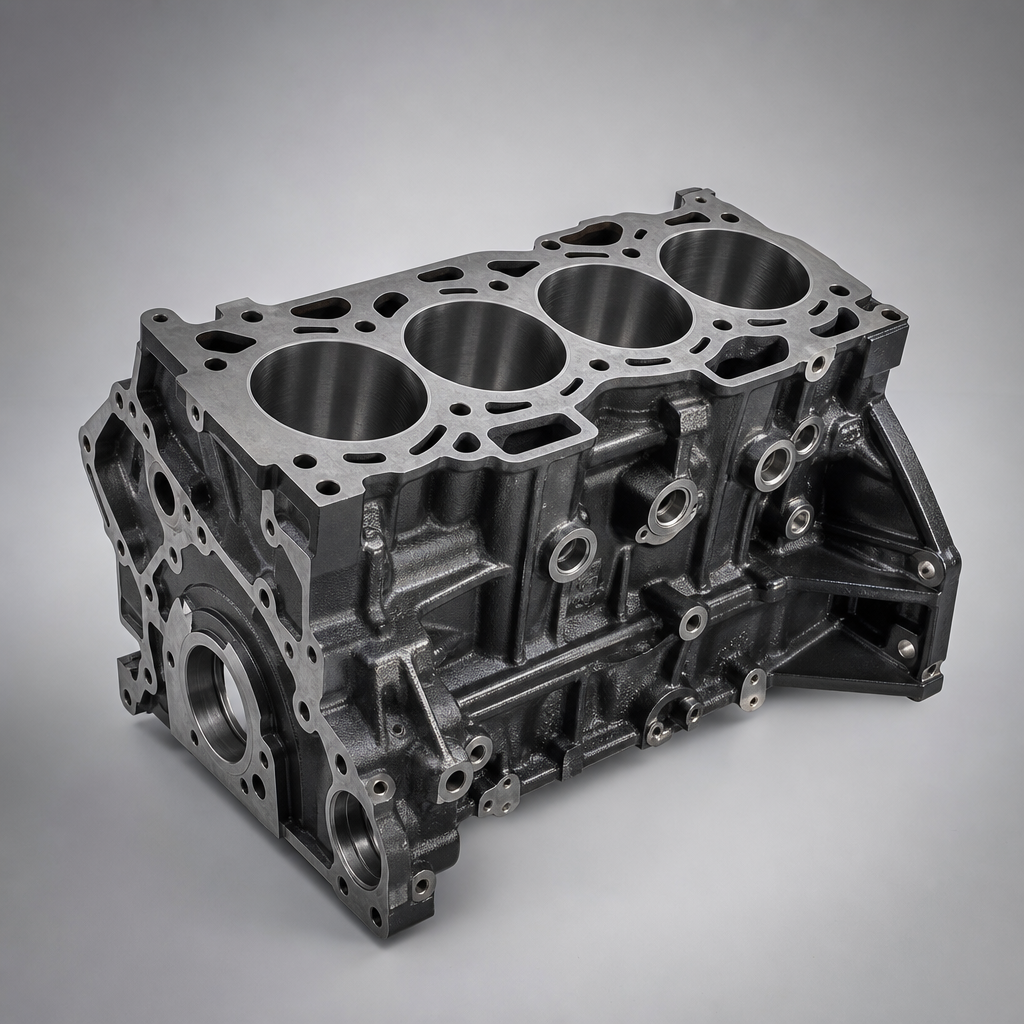
How to Evaluate an Engine Block Infiniti Manufacturer in China
For importers and category buyers, choosing an engine block supplier is less about finding the lowest quote and more about limiting expensive failure. When sourcing Infiniti-fitment engine blocks from China, the real questions are operational: can the manufacturer control casting integrity, machine to repeatable tolerance, trace batches back to the melt, and ship the same quality again on the next order? Buyers also need direct answers on MOQ, tooling status, documentation, packaging, and whether the factory can support both standard aftermarket references and customised programmes.
The fastest way to separate real manufacturers from catalogue traders is to ask for process evidence, not broad claims. Request the cast iron grade and hardness window, bore and deck tolerance capability, pressure-test parameters, CMM sampling logic, first-order MOQ structure, and realistic lead times by order size. This article breaks down how to qualify an engine block infiniti manufacturer china source with a practical lens: what to verify first, where suppliers usually fail, how to compare quotations correctly, and how to reduce claims before launch. Driventus is an independent aftermarket manufacturer; any brand names mentioned are for fitment reference only.
Start with a risk screen, not the catalogue
A long reference list does not prove manufacturing control. Before you negotiate price, test whether the supplier can run a disciplined process.
For buyers in the EU, UK, US, Canada, Australia, and Brazil, the first screen should cover:
Quality certification: documented compliance with IATF 16949:2016 and ISO 9001:2015
Manufacturing scope: whether casting, machining, washing, inspection, rust prevention, and export packing are managed in-house or through controlled partners
Material control: cast iron grade verification, chemistry records, hardness checks, and batch traceability
Machining capability: cylinder bore control, deck flatness, main tunnel alignment, and threaded-hole consistency
Inspection records: CMM reports, leak or pressure testing where applicable, and final dimensional reports
For anyone searching for an engine block infiniti manufacturer china source, those basics matter more than catalogue breadth. A supplier can list dozens of part numbers and still create claim exposure if the process is unstable.
At first contact, ask for measurable data. Useful screening requests include:
Typical material grades used for blocks, such as high-strength grey iron or nodular iron where required by drawing
Hardness range by process, for example around HB 180-240 for common cast iron blocks, subject to drawing and heat history
Typical bore tolerance capability, such as holding finished cylinder bores within about ±0.01-0.03 mm depending on diameter and finish stage
Typical deck flatness control, often expected within 0.03-0.08 mm across the sealing face depending on block size and gasket design
Main bore alignment/concentricity capability, commonly verified within roughly 0.01-0.03 mm by line-bore control and final gauging
Whether the factory performs 100% visual inspection, 100% thread gauging on critical features, and lot-based CMM checks such as 3 pcs per batch, 5 pcs per shift, or first-off/last-off verification
A practical commercial screen should also test how the supplier thinks about volume:
Stocked references with existing patterns and fixtures may support lower trial MOQs, sometimes 20-50 pcs mixed on a pallet or 50-100 pcs per reference
Non-stock references using existing tooling but fresh setup often need 100-200 pcs per item to absorb foundry setup, CNC fixture changeover, washing, and final inspection cost
New tooling programmes usually require separate pattern and fixture charges, with MOQ logic linked to annual volume, often 300-500 pcs+ to make cast and machine economics workable
Audit the factory where engine block programs usually break down
Most expensive problems are not caused by one obvious defect. They come from weak control between foundry, machining, cleaning, and release. A factory audit should follow that chain.
Casting and raw material control
Confirm that the factory maintains:
Melt composition records by heat number
Incoming raw-material segregation and identification
Core-making controls for water jackets, oil galleries, and internal passages
Visual and destructive checks for casting defects such as porosity, shrinkage, inclusions, and cold shuts
Traceability from casting lot to finished block serial number or batch code
This matters because hidden porosity, unstable wall thickness, or poor core positioning may not show up at receiving inspection. They often appear later, during machining, pressure testing, or engine assembly.
During the audit, ask to see the real process route:
1. Charge-material verification and melt log by furnace/heat number 2. Spectrometer chemistry check before pouring 3. Moulding and core assembly with work instructions and revision control 4. Pouring, shakeout, shot blasting, and riser removal 5. Rough visual inspection and defect segregation 6. Stress relief or normalising if used by the programme 7. Rough machining, semi-finish machining, finish machining 8. Washing, drying, rust prevention, final inspection, packing
For foundry control, verify whether the supplier tracks indicators such as:
Chemistry windows for C, Si, Mn, P, S and alloy additions per internal or customer specification
Hardness sampling per heat or per lot, often at 2-5 pcs per batch depending on lot size
Wall-thickness verification at key areas on first article or periodic cut-up samples
NDT or pressure test criteria where applicable for water jacket integrity, for example low-pressure air-under-water or fixture pressure test at agreed parameters
Casting yield and defect ppm tracking, which shows whether the factory is controlling porosity and core shift or just sorting bad parts later
Machining and final inspection
For finished engine blocks, the audit should answer a few non-negotiable questions:
How is cylinder bore size measured, recorded, and released?
What is the control plan for deck height and deck flatness?
How is main bearing bore concentricity verified?
Are threaded features checked with calibrated gauges?
Is washing validated to remove chips from oil passages and coolant channels?
How are non-conforming parts identified, segregated, and reviewed?
Do not be satisfied with a bench full of gauges. Check whether the machining line has:
Dedicated fixtures with poka-yoke location points to prevent wrong-orientation loading
Tool-life control by count or machine alarm rather than operator judgement only
In-process gauging for critical bores and decks
Calibration status visible on bore gauges, plug gauges, torque tools, and CMM probes
First-off approval at each shift and after tool change
SPC or trend charts on critical dimensions such as bore diameter, deck height, and main tunnel size
Typical dimensional controls for a machined block may include:
Cylinder bore diameter to drawing, often held within ±0.01-0.03 mm depending on whether the block is semi-finished or finish-honed
Bore taper/out-of-round commonly limited to around 0.01-0.03 mm
Deck flatness often controlled within 0.03-0.08 mm
Surface roughness on deck face commonly around Ra 1.6-3.2 µm depending on gasket system
Main bearing bore size/alignment often controlled within 0.01-0.03 mm
Thread acceptance by GO/NO-GO gauge with 100% check on critical assembly holes
A concise audit table helps keep the visit focused:
Audit area
What to verify
Why it matters
Foundry process
Heat records, core control, defect screening
Reduces hidden porosity and casting instability
Machining
CNC capability, fixture repeatability, tool-life control
Supports bore accuracy and assembly fit
Metrology
CMM, bore gauges, surface roughness checks
Confirms dimensional compliance
Traceability
Batch IDs, inspection linking, shipment records
Speeds containment if a claim occurs
Packaging
Rust prevention, bracing, impact protection
Prevents transit damage on export routes
Documentation
PPAP-style records where requested, CoC, packing list
Supports customs and customer quality review
</tr></thead><tbody> </tbody></table>Before approving serial supply, it is worth reviewing the factory's quality system in detail.
Match the control plan to the block you are actually buying
One common sourcing mistake is to accept generic inspection language for a highly specific part. Engine blocks need a control plan that reflects the supply condition: raw casting, semi-finished, or fully machined.
For aftermarket programmes, buyers commonly expect control over:
Material: cast iron specification confirmed by chemistry and hardness testing
Bore geometry: diameter, taper, and out-of-round measured against drawing limits
Deck surface: flatness and surface finish suitable for head gasket sealing
Main bearing tunnel: alignment and bore size verified with calibrated tools
Oil and coolant passages: cleanliness confirmed after washing
Critical threaded holes: gauge checks to prevent assembly failure during engine build
Corrosion protection: rust inhibitor or VCI packing matched to sea-freight duration and destination climate
Depending on the programme, you may also need controls on cam bore geometry, core plug seating areas, oil gallery plug threads, and other machined sealing faces.
To make the control plan usable, require the supplier to state each feature with specification, method, sampling, and reaction plan. For example:
Feature
Typical control point
Inspection method
Common sampling logic
Material chemistry
Heat composition vs internal/customer spec
Spectrometer
Each heat
Hardness
Brinell hardness window
Hardness tester
2-5 pcs per lot
Cylinder bore
Diameter, taper, out-of-round
Air gauge / bore gauge / CMM
First-off + periodic + final lot check
Deck face
Flatness and Ra
Straightedge/CMM/surface roughness tester
First-off + lot sample
Main tunnel
Bore size and alignment
Dial bore gauge / line-bore fixture / CMM
First-off + periodic
Threads
Major critical assembly threads
GO/NO-GO gauges
100% on critical holes
Cleanliness
Chips/residue in oil and coolant passages
Visual + borescope + flushing verification
Per batch or 100% by process control
Pressure integrity
Water jacket leak tightness where specified
Air/pressure fixture test
Lot sample or 100% by programme
</tr></thead><tbody> </tbody></table>Buyers should also confirm which of these three supply states applies, because price and tolerances change materially:
1. Raw casting: lowest machining content, broader dimensional tolerance, buyer finishes critical features 2. Semi-finished block: key datums and rough bores machined, final honing or align boring may remain with customer 3. Fully machined block: highest unit cost but lowest downstream processing burden; requires full bore, deck, thread, gallery, and cleanliness control
That distinction matters in quotation review. A low ex-works price for a semi-finished block is not directly comparable with a fully machined, washed, rust-protected, export-packed block that includes inspection records.
Published standards also sit in the background of the sourcing file. An engine block itself is not usually certified under vehicle emissions rules, but downstream engine assembly programmes may still require documentation linked to REACH (EC) No 1907/2006 for substance compliance in materials, coatings, and preservatives. Buyers in automotive channels also commonly expect systems aligned to broader requirements such as IATF 16949:2016.
If your programme includes drawing changes, private labelling, or dedicated packaging, manage it through a controlled custom manufacturing process rather than through informal PO notes.
Compare MOQ and lead time the way buyers actually feel the risk
Commercial feasibility is not just unit cost. With engine blocks, stockouts and delays can erase a low price very quickly.
A Chinese supplier should give clear answers on:
MOQ by reference: whether minimums apply per part number, per shipment, or per mixed pallet
Tooling status: whether casting patterns and machining fixtures are already in production or require new investment
Pilot order quantity: first-order validation quantity before a full launch
Normal lead time: production days excluding ocean transit and customs clearance
Safety stock policy: whether the supplier can hold agreed buffer stock for rolling releases
Container utilisation: pallet count, gross weight, and packaging density
A common sourcing sequence is:
1. Sample or pilot batch 2. Dimensional and assembly validation 3. Trial container or mixed-volume order 4. Rolling forecast with scheduled replenishment
For buyers evaluating an engine block infiniti manufacturer china source, lead-time reliability often matters as much as direct cost. A cheaper quote loses value fast if it causes line shortages, delayed fulfilment, emergency air freight, or warranty exposure.
Ask the supplier to explain capacity, not just quote a number. Engine blocks involve heavy castings, foundry scheduling, machining hours, washing, inspection, and careful export packing. Bottlenecks are predictable if you know where to look.
Typical MOQ logic looks like this:
Stock tooling + regular reference: MOQ may start around 20-50 pcs for a pilot or 50-100 pcs per reference for repeat mixed orders
Existing tooling but low-run reference: MOQ often moves to 100-200 pcs to cover foundry minimum melt planning, CNC setup, and inspection overhead
New pattern/core box or dedicated fixture: suppliers may ask for tooling charge plus a commercial MOQ of 300-500 pcs or an annual call-off commitment
Private label / custom export pack: MOQ can increase if the buyer wants dedicated carton print, label sets, pallet format, or destination-specific corrosion packaging
Lead time should also be broken into stages:
Tooling verification or sample preparation: 2-4 weeks if the existing process route needs validation; 6-10+ weeks if new patterns or fixtures are required
Pilot batch production: roughly 25-40 days depending on foundry queue, machining load, and report approval
Repeat production for stocked tooling: commonly 30-45 days ex works after deposit or PO confirmation
Peak-season or mixed-reference orders: often 45-60 days if several part numbers compete for machining and inspection capacity
Ocean transit: about 18-40 days depending on destination port and carrier routing, excluding customs and inland delivery
When comparing quotes, use cost drivers instead of headline price:
Casting weight and scrap risk
Machining cycle time per block
CMM/inspection burden
Washing and drying process
Rust-prevention materials and VCI use
Pallet density and export crate strength
Claim reserve or expected warranty risk
This table is useful in supplier discussions:
Variable
Impact on cost
Impact on MOQ/lead time
Existing tooling
Lowers startup cost
Usually lower MOQ and faster launch
New pattern/core box
Adds upfront tooling cost
Longer development and higher MOQ
Fully machined scope
Higher unit price
Longer cycle time and more inspection
Mixed pallet order
May raise handling cost per piece
Can help trial MOQ if supplier agrees
Private label packaging
Adds packaging and control cost
May increase MOQ for printed materials
Buffer stock agreement
May increase carrying-cost discussion
Can shorten buyer replenishment lead time
</tr></thead><tbody> </tbody></table>Driventus supports importers that need stable replenishment planning across engine and powertrain categories, including mixed orders from our catalog.
Prevent claims by locking documents and cross-references before shipment
Many engine block claims do not start with a bad casting. They start with a bad release file: wrong revision, ambiguous cross-reference, incorrect plug configuration, or packaging that was never formally approved.
Engine block sourcing for fitment-specific aftermarket channels requires tight reference control. Suppliers should manage internal part coding, customer codes, and any OE-style cross-reference data without mixing visually similar but dimensionally different blocks.
If a customer enquiry includes an OE-style number format, use only the reference provided in the sourcing file, such as OE 11251…, and confirm the drawing, machining revision, and fitment notes before order release. Catalogue matching alone should not be treated as proof of interchangeability where dimensional differences could affect assembly, gasket sealing, or mounting compatibility.
Recommended document set for each production order:
Commercial invoice and packing list
Batch traceability record
Final inspection summary
Material or process declarations where required
Packaging specification and pallet layout
Non-conformance handling procedure
Claim prevention starts before shipment. Buyers should ask how the supplier handles:
Quarantine of suspect batches
8D-style corrective action workflows
Gauge calibration records
Change management for tooling, process, or subcontractors
Record retention for traceability and shipment history
For stronger release control, ask the supplier to maintain a file that includes:
Part revision level and approved drawing date
Casting lot / heat linkage to machined batch number
Inspection report reference tied to shipment quantity
Packaging revision with photos or approved pack standard
Label content including buyer code, supplier code, lot number, gross/net weight, and country of origin
Retention period for quality records, commonly 3-10 years depending on programme and market expectations
For export claims, practical prevention measures often include:
A golden sample or master sample retained by both buyer and supplier
Pre-shipment photo record of pallet build, wrap condition, labels, and container loading
Defined rust-prevention standard, such as oil film, bagging, VCI paper, or VCI bag according to route and storage time
Carton and pallet compression requirements based on block weight, often with timber or steel-reinforced pallet design for heavy loads
Written acceptance criteria for minor cosmetic casting marks versus functional defects
Cross-reference control is especially important for engine blocks because small differences create major claim cost. Lock down:
Bore size and finish state
Deck height and gasket surface requirement
Main tunnel dimensions
Core plug and oil gallery plug configuration
Sensor, mount, and threaded-hole positions
Any market-specific content differences between references that appear visually similar
For new programmes, a supplier meeting and technical review before the first volume PO is usually time well spent. This is especially important where private-label packaging, customer-specific labels, or drawing-controlled dimensions are involved. If you need to discuss fitment scope, packaging, or export requirements, you can request a quote with the relevant drawing or reference list.
Frequently asked questions
MOQ varies by casting status, machining setup, tooling availability, and packaging plan. For stocked references, mixed-order quantities may be possible, often around 20-50 pcs for a pilot or 50-100 pcs per reference for repeat orders. For new or lower-volume references, suppliers often require 100-200 pcs per part number, and new-tooling programmes may need 300-500 pcs or a volume commitment to cover setup, inspection, and handling cost.
For automotive B2B sourcing, IATF 16949:2016 and ISO 9001:2015 are the main quality-management references. Buyers should also review real process evidence such as traceability records, calibration control, inspection reporting, CMM or gauge capability, hardness and chemistry logs, and corrective-action discipline rather than relying on certificates alone.
Yes, if the work is managed through controlled documentation. Carton artwork, labels, pallet format, corrosion protection, and customer part coding should all be approved before serial production. Buyers should also confirm MOQ effects for printed materials, VCI requirements, pallet dimensions, and whether special export packaging adds lead time or setup cost.
If you are qualifying a Chinese supplier for engine blocks or related engine hard parts, Driventus can review your reference list, audit requirements, and supply plan. Contact our team to discuss your programme at /contact.html