Engine Bearing Opel Supplier: How B2B Buyers Separate Real Capability From Sales Talk
Choosing an engine bearing Opel supplier is less about finding the lowest quoted price and more about avoiding predictable supply-chain mistakes. Bearings look simple on paper. In real purchasing, they fail for specific reasons: unstable wall thickness, inconsistent crush, weak overlay bonding, poor traceability, vague process control, or commercial terms that only work for the first order.
That is why experienced B2B buyers do not start with slogans like "OE quality." They start with a filter: can the supplier hold fit, clearance and batch consistency across repeat production, while also supporting export documents, private-label packaging and claim handling? If the answer is unclear, the risk usually shows up later as returns, line stops, freight premiums or hard-to-close warranty disputes.
This article takes a more practical angle. Instead of treating all suppliers as interchangeable, it breaks the evaluation into decision points: what to screen first, which technical details actually matter, where commercial terms create hidden risk, what an audit should uncover, how to compare quotes fairly, and when sample approval is strong enough to justify a volume order. Driventus is an independent aftermarket manufacturer; brand names are referenced for fitment only.
The first-pass filter: what buyers check before discussing price
Most procurement teams can eliminate weak candidates quickly. Before annual volume, rebate structure or payment terms enter the conversation, they usually want five things confirmed.
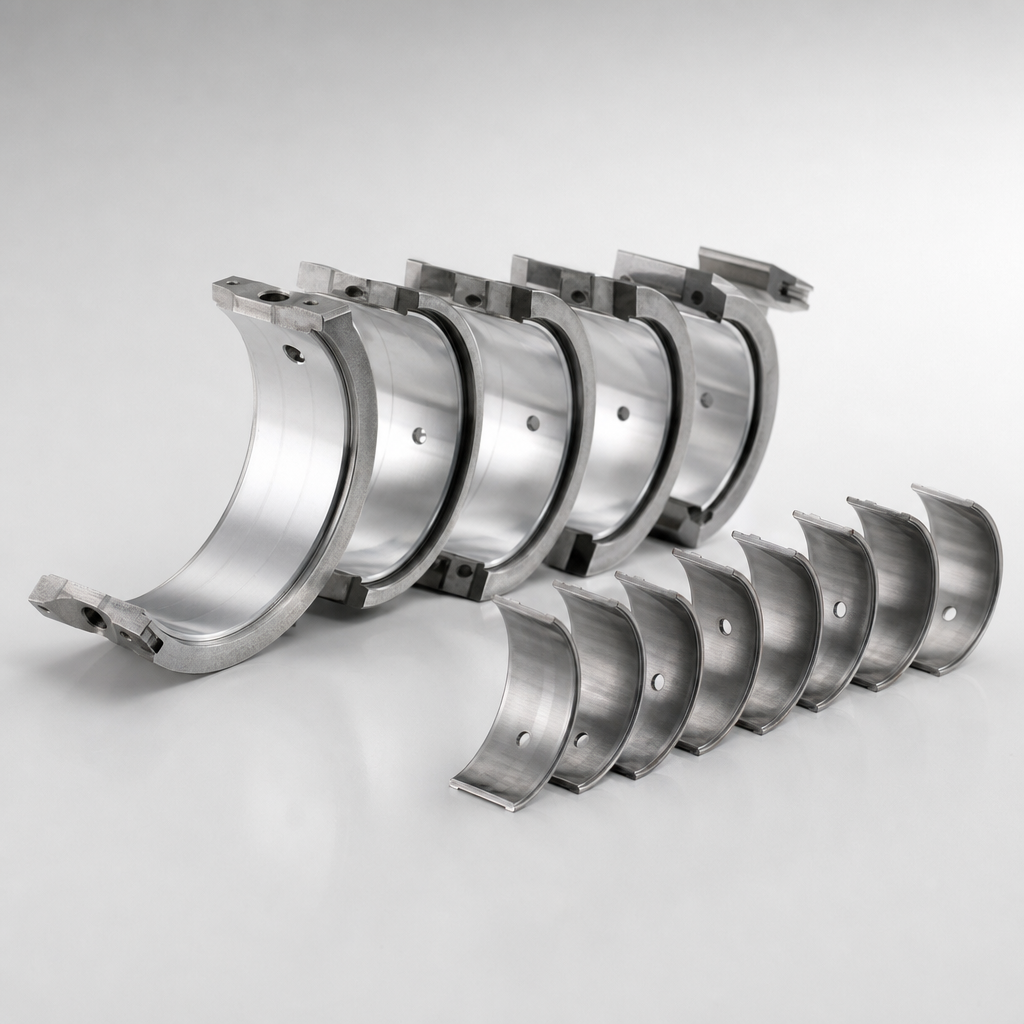
Application coverage: main bearings, con-rod bearings and thrust washers for the relevant petrol and diesel engine families
Dimensional control: wall thickness, eccentricity, spread, crush relief and tang position
Material system: steel backing plus the correct aluminium or copper-lead construction, with overlay matched to duty
Compliance discipline: lot traceability, raw-material certificates and chemical compliance declarations for REACH (EC) No 1907/2006 where required
System maturity: documented processes aligned with IATF 16949:2016 and ISO 9001:2015
The important point is not whether a supplier mentions these items. It is whether it can describe them with numbers and routines.
A credible engine bearing Opel supplier should be able to explain its control flow plainly: incoming strip inspection, in-process dimensional checks, surface inspection, final sampling and packing verification. If that explanation stays abstract, risk is already visible.
For a first qualification pass, buyers often ask for a short measurable summary such as:
incoming steel or bimetal strip thickness check on every coil lot, with certificate review and 3 to 5 point measurements across edge and center
wall-thickness checks during forming and after finish sizing, often every 30 to 60 minutes per line or every 300 to 500 pairs depending on output speed
eccentricity confirmation at defined clock positions such as 0°, 90° and 180° using approved fixtures or CMM support
visual standards for burrs, dents, contamination, edge damage and overlay defects under controlled lighting
final lot sampling to an agreed AQL or customer-defined release plan
One distinction matters more than many buyers expect: are quoted tolerances normal production capability, or special-control capability? A supplier may offer wall-thickness tolerance of ±0.005 mm to ±0.010 mm, but only on stable programs with locked tooling and approved strip source. That affects both cost and lead time immediately.
The spec deep-dive: which bearing parameters deserve real scrutiny
This is where generic sourcing conversations usually break down. Engine bearings are not interchangeable just because nominal journal size looks close. Fitment mapping is only the starting point.
Critical parameters to request
Parameter
Why it matters
Typical buyer check
Wall thickness tolerance
Directly affects oil clearance
Supplier provides measured batch data and gauge method
Housing crush / spread
Maintains shell retention in service
Checked against drawing and assembly specification
Eccentricity profile
Supports oil film formation under load
Verified at defined clock positions
Overlay thickness
Influences seizure resistance and embedability
Supplier states target range and test method
Surface finish
Affects run-in behaviour and debris handling
Final inspection standard documented
Backing hardness
Impacts forming stability and seating
Material certificate linked to lot number
</tr></thead><tbody> </tbody></table>If the buyer already works from a known cross-reference, include it in the RFQ package, for example OE 06A107065 where relevant to the internal dataset. That reduces interpretation mistakes during quotation, tooling review and sample approval.
When comparing factories, ask each one to state gauge capability, sampling frequency and non-conforming batch procedure. A supplier that can quantify control is easier to trust than one that repeats marketing language.
The most useful request is usually a one-page technical sheet per part family with actual control ranges. Typical items include:
Wall thickness: often controlled within ±0.005 mm to ±0.012 mm depending on size and material stack
Bearing spread / free crush condition: reported against drawing nominal, often around 0.15 mm to 0.35 mm for many light-vehicle shells, but always part-specific
Eccentricity: defined as a profile difference from crown to parting line, typically measured by dedicated fixtures rather than casual spot checks
Overlay thickness: many aftermarket programs quote roughly 0.010 mm to 0.020 mm for thin overlay systems, while aluminium-based structures differ and should not be treated as equivalent
Surface roughness: commonly around Ra 0.2 to 0.8 µm depending on layer and finishing route
Backing hardness: tied to material grade, lot certificate and periodic incoming confirmation
Buyers should also ask a harder question: how is oil clearance protected in daily production? The real answer should involve strip stability, die wear limits, sizing control, wall-thickness compensation and gauge R&R discipline. If the supplier cannot connect those process steps to final clearance consistency, the quote is incomplete.
For higher-load or mixed-market programs, confirm the full layer construction instead of asking only for "copper" or "aluminium" bearings. Two shells with the same fitment may behave very differently in fatigue resistance, seizure resistance and embedability.
The commercial trade-off: low MOQ versus stable production
Low MOQ sounds attractive. It is not always a buying advantage.
For bearings, very small runs can mean more tool changes, more fragmented scheduling and less process stability. The better question is usually: what MOQ still allows the factory to run the part under repeatable conditions?
Typical buying points include:
MOQ by item: driven by shell size, tooling setup and packaging format
Lead time: affected by strip availability, plating queue, inspection capacity and artwork approval
Private label support: inner box, master carton, barcode and pallet mark requirements
Mixed container planning: ability to consolidate bearings with other engine parts from our catalog
Service-parts continuity: ability to keep repeat performance across rolling forecast orders
A supplier with a broader engine-components program can also reduce coordination load. If the sourcing range includes pistons, rings, gaskets and pumps alongside bearings, reviewing /products/engine-components.html may simplify purchasing and inbound freight planning.
Commercially, buyers often encounter structures such as:
MOQ per SKU: around 300 to 1,000 sets for standard aftermarket references, with lower levels sometimes possible for stock items and higher levels for special coatings or slow movers
MOQ per order value: often a factory minimum such as USD 3,000 to USD 10,000, especially on export orders with custom packaging
Private-label packaging MOQ: commonly 1,000 to 3,000 boxes per artwork unless labels replace printed cartons
Repeat-order lead time: typically 30 to 45 days after deposit, artwork approval and order confirmation
First-order or tooling lead time: often 45 to 75 days because sampling, proofing and approvals add extra steps
Ask the engine bearing Opel supplier to quote at least three price levels:
ex-works price at sample MOQ
ex-works price at standard production MOQ
ex-works price at annual volume commitment or blanket-order release quantity
That reveals whether the price break comes from real production efficiency, packaging scale or simply thinner service coverage.
For import planning, insist on practical packing data: sets per inner box, boxes per master carton, net and gross weight, cartons per pallet and pallet height limit. Those figures shape freight cost and warehouse efficiency more than many early RFQs acknowledge.
The failure-mode audit: what a factory visit should actually uncover
A polished presentation tells you very little. A useful audit looks for failure points.
Audit areas worth checking
Calibration status of bore gauges, micrometers and thickness-measurement equipment
Traceability from raw strip or coil to finished packing lot
Control plan, PFMEA and reaction plan availability for key characteristics
Segregation of conforming and non-conforming stock
Operator training records for forming, machining and final inspection stations
Packaging validation for rust prevention and transport protection
For export buyers, complaint containment matters almost as much as production control. A workable 8D process, retained samples and lot-based recall capability can sharply reduce downstream exposure.
At Driventus, buyers can review our quality system during qualification. For projects requiring special shell geometry, packaging format or application-specific development, custom manufacturing is available for B2B programs. Driventus is an independent aftermarket manufacturer; brand names are referenced for fitment only.
A serious audit should also verify the control chain in detail:
whether gauges and fixtures carry unique IDs and current calibration labels
whether MSA or gauge R&R studies exist for wall thickness, spread and other critical checks
whether tool-wear limits are documented before maintenance or regrind is required
whether first-off, in-process and last-off inspections use the same lot reference that appears on shipping labels
whether non-conforming material is physically locked and dispositioned through records rather than handled informally
Timing on the shop floor matters too. Ask how long parts wait between forming, overlay or plating, inspection and packing. Uncontrolled inter-process storage, open-bin handling and long waiting time can create corrosion, contamination or lot-mixing risk even when the final report looks clean.
For sea-freight export, packaging details are not secondary. Check VCI paper or sealed bags, desiccant where needed, carton burst strength, pallet wrapping method and whether the factory has already validated packaging for 20 to 45 days in transit.
The comparison framework: how to avoid false quote comparisons
Many sourcing mistakes begin in the spreadsheet. One supplier quotes a bare shell. Another includes branded packaging, inspection reports and palletization. The lower unit price then looks better than it really is.
Use a structured RFQ sheet that captures at least:
If the program serves regulated markets, confirm whether any extra declarations or records are needed at import stage. Bearings are not emissions devices, but document discipline still matters in the wider aftermarket supply chain.
The best supplier is often the one whose technical answers and commercial answers show the same level of precision. Misalignment between sales claims and factory records usually appears early when the RFQ is detailed enough.
To make quote comparison usable, require each engine bearing Opel supplier to answer in a fixed table rather than free text. Include columns for:
quoted unit price by Incoterm and by volume break
tooling charge, sample charge and artwork charge where applicable
standard tolerance commitment and any surcharge for tighter sorting
scrap or replacement policy for non-conforming goods
standard payment term, such as 30% deposit / 70% before shipment or another agreed structure
monthly production capacity for the quoted family, preferably in sets or pairs
emergency replenishment option and realistic expedited lead time, such as 15 to 25 days only for existing tools and approved packaging
It is also worth normalizing landed cost. A lower ex-works figure may lose its advantage once inner boxes, export cartons, palletization, third-party inspection, bank charges and poorer carton density are included. On mature programs, even USD 0.03 to USD 0.08 per set can be outweighed by better fill rate, lower claim rate or fewer stockouts.
Where demand is uncertain, ask for forecast logic instead of forcing an unrealistic promise. Many factories can support a rolling 3-month forecast with one month firm and two months tentative. That often gives better lead-time reliability than a low MOQ with no visibility.
The release decision: when sample approval is enough to place volume orders
Sample approval is not the finish line. It is only evidence that the supplier can make a part correctly once.
Before releasing a volume order, buyers should confirm:
approved sample status is tied to a fixed production route
packaging artwork and labels are frozen
ERP and customs master data are correct
batch coding format is agreed
warranty and claim-handling process is documented
If your team is sourcing an engine bearing Opel supplier for wholesale, import or private-label business, the real objective is repeatable performance over time, not one acceptable sample set.
To review application coverage, packaging options and related engine components, see our catalog. If you want to discuss your RFQ, forecast volume or audit requirements, you can request a quote.
A practical approval flow usually works best in gates:
1. Drawing and cross-reference review: confirm OE mapping, shell construction, set content and market-specific label needs 2. Pilot sample stage: request samples from intended production tooling, not hand-finished bench samples 3. Dimensional report: require measured values for wall thickness, spread, width, tang position and visual criteria against drawing limits 4. Fitment and clearance verification: check housing fit and journal clearance on actual or validated reference components 5. First production lot approval: release a controlled order and review the first shipping lot report before unrestricted repeat ordering
For many buyers, the first production order should not be the full annual volume. A controlled batch is safer—often one standard MOQ or one mixed-order release—because it tests process stability under real shipping conditions.
Before first shipment, define the claim window and containment rule. Agree how shortages, packaging issues and dimensional claims are reported, and whether settlement will be by replacement, credit or debit note. That discipline is part of supplier qualification, not an afterthought.
Frequently asked questions
Typical documents include the commercial invoice, packing list, certificate of origin where required, batch traceability records, inspection report and relevant compliance declarations such as REACH (EC) No 1907/2006 when requested by the buyer. For repeat export programs, buyers often also request material certificates by lot, carton and pallet packing details, barcode label format, and a copy of the approved artwork or packaging specification to prevent shipping mismatches.
Not necessarily. A very low MOQ can increase setup frequency and reduce process stability. Buyers should evaluate MOQ together with repeatability, lead time, packaging efficiency and total landed cost. In practice, many buyers find that a stable MOQ in the 300 to 1,000 set range for standard references delivers better pricing, scheduling and consistency than forcing very small custom runs.
Do not rely on visual checks alone. Confirm dimensional data, material specification, fitment verification, batch coding and that approved samples are tied to the same production route used for future mass orders. Ask for a dimensional report with actual measured values, confirm whether samples came from production tooling, and release volume only after a controlled first lot demonstrates repeatability.
If you are qualifying new supply for engine bearings and related powertrain parts, Driventus can review your RFQ and audit criteria with a practical B2B focus. Contact our team to discuss the project at /contact.html