Engine Bearing Material: Specs, Trade-offs, and Sourcing
Engine bearing material is a sourcing decision, not just a metallurgy note on a drawing. For plain bearings, the alloy stack, overlay chemistry, and backing construction affect fatigue life, seizure resistance, conformability, and lead tolerance under real load. Buyers should compare the complete bearing system: shell material, overlay thickness, hardness, surface finish, oil compatibility, and dimensional control. This matters whether the part is for passenger car repair supply, remanufacturing, or OE-equivalent replacement. Driventus is an independent aftermarket manufacturer; brand names are referenced for fitment only. Our production and inspection flow follows IATF 16949:2016 and ISO 9001:2015, with REACH (EC) No 1907/2006 compliance support where required. For category sourcing, see [our catalog](/products.html), [our quality system](/quality.html), and [custom manufacturing](/oem-services.html).
What the material has to do inside the bearing
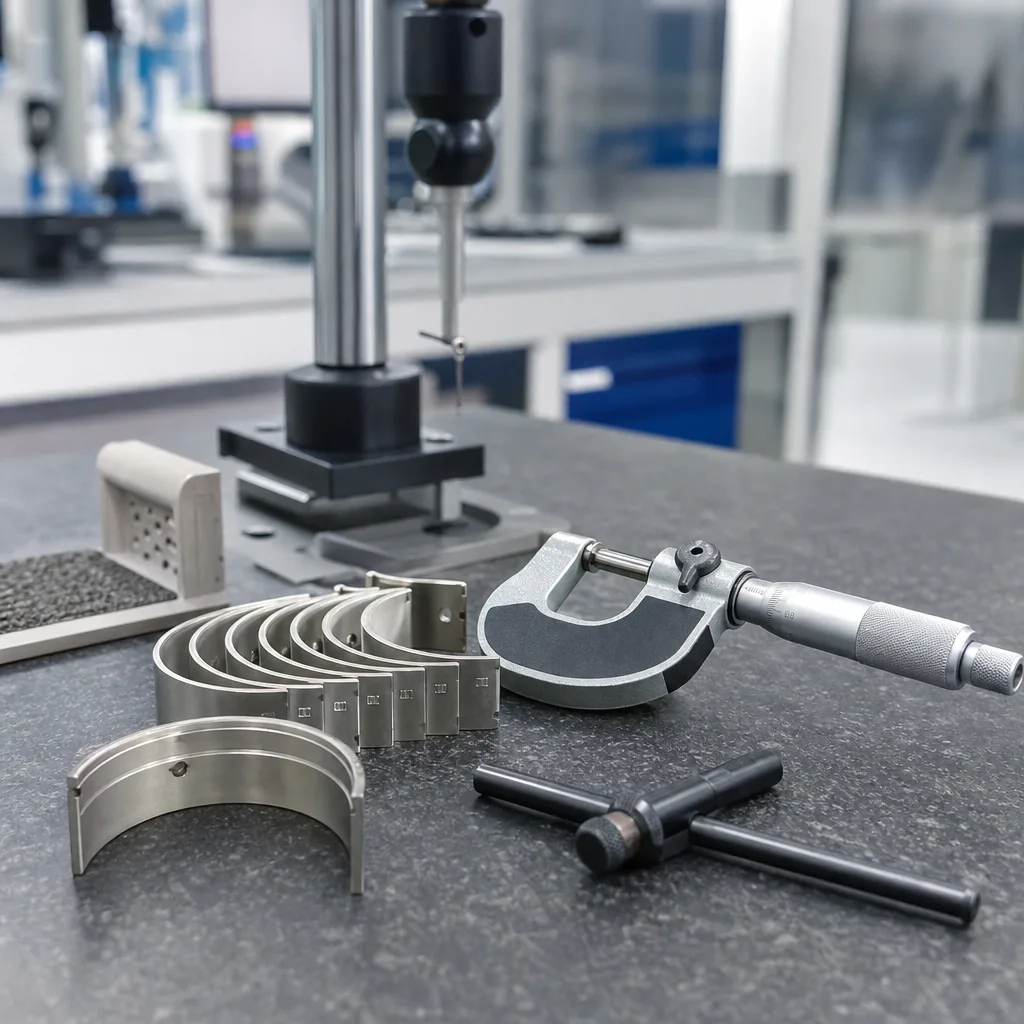
A bearing shell must do four jobs at once: carry load, retain oil, survive contamination, and protect the crankshaft during boundary lubrication. That is why engine bearing material is usually a layered system rather than a single metal.
Typical functions by layer:
- Steel backing: provides stiffness and crush retention in the housing.
- Intermediate layer: carries fatigue load and supports the overlay.
- Overlay: improves embeddability and reduces scuff risk during start-stop operation.
- Optional surface treatment: helps control friction and wear during break-in.
For procurement teams, the practical question is not only what alloy is used, but how that alloy is processed. Casting quality, bonding integrity, and layer thickness consistency matter as much as nominal composition. If you are evaluating fitment across multiple engine families, cross-check the bearing shell against the crank journal size, housing bore, lubrication route, and surface finish specification.
Common material systems and where they fit
The most common bearing constructions in light-duty engines are tri-metal and bi-metal shells. The right choice depends on load, speed, and cost target.
| Material system | Typical structure | Strengths | Trade-offs |
|---|---|---|---|
| Bi-metal | Steel backing + aluminium-based layer | Cost-effective, good corrosion resistance, suitable for many passenger car engines | Lower fatigue margin than high-end tri-metal systems |
| Tri-metal | Steel backing + copper-lead or copper-based intermediate + soft overlay | High load capacity, strong fatigue resistance, good for turbocharged and higher-output applications | Higher cost, tighter process control required |
| Lead-free variants | Steel backing + lead-free intermediate and overlay | Supports REACH-driven material planning and market restrictions | Must be validated carefully for seizure and wear behaviour |
| Decision factor | Lower-cost option | Higher-spec option |
|---|---|---|
| Fatigue life margin | Adequate for moderate loads | Better for turbocharged, high-load, or fleet duty |
| Seizure resistance | Depends heavily on oil quality and clearance control | More tolerant of transient lubrication loss |
| Embeddability | Usually acceptable | Better for engines with contamination risk |
| Dimensional consistency | Variable by supplier | Tighter process control and better lot repeatability |
| Compliance planning | May be limited by material availability | Easier to align with REACH and customer specs |