Engine Bearing Buick Manufacturer China: Sourcing Guide
Buyers searching for engine bearing Buick manufacturer China usually need a supplier that can hold dimensional control, support repeatable export supply, and document every lot clearly. Driventus makes engine bearings from Taizhou, Zhejiang, with IATF 16949:2016 and ISO 9001:2015 systems in place. Driventus is an independent aftermarket manufacturer; brand names are referenced for fitment only. For procurement teams, the main checks are shell geometry, material stack, surface finish, packing method, and the document set behind each shipment. This article explains what to verify before you place a trial order, how custom options affect cost and lead time, and which audit points matter when you compare suppliers across the EU, UK, US, Canada, Australia, or Brazil.
What procurement teams should verify first
Engine bearing sourcing starts with the engine family, journal diameter, housing bore, and the target oil clearance at assembly. If a buyer sends only a vehicle name, there is too much risk of mixing main bearings, rod bearings, and thrust washers. For Buick programmes, ask for the OE reference, engine code, and whether the requirement is a service replacement or a production line pack. Our catalog and engine components pages help narrow the family, but the RFQ should still define:
- shell type and position
- material stack
- groove and oil hole layout
- chamfer direction
- pack quantity and label language
- lot traceability and carton marking
That level of detail reduces rework when the buyer audits samples or compares the first lot against drawing data.
Material stack and dimensional control
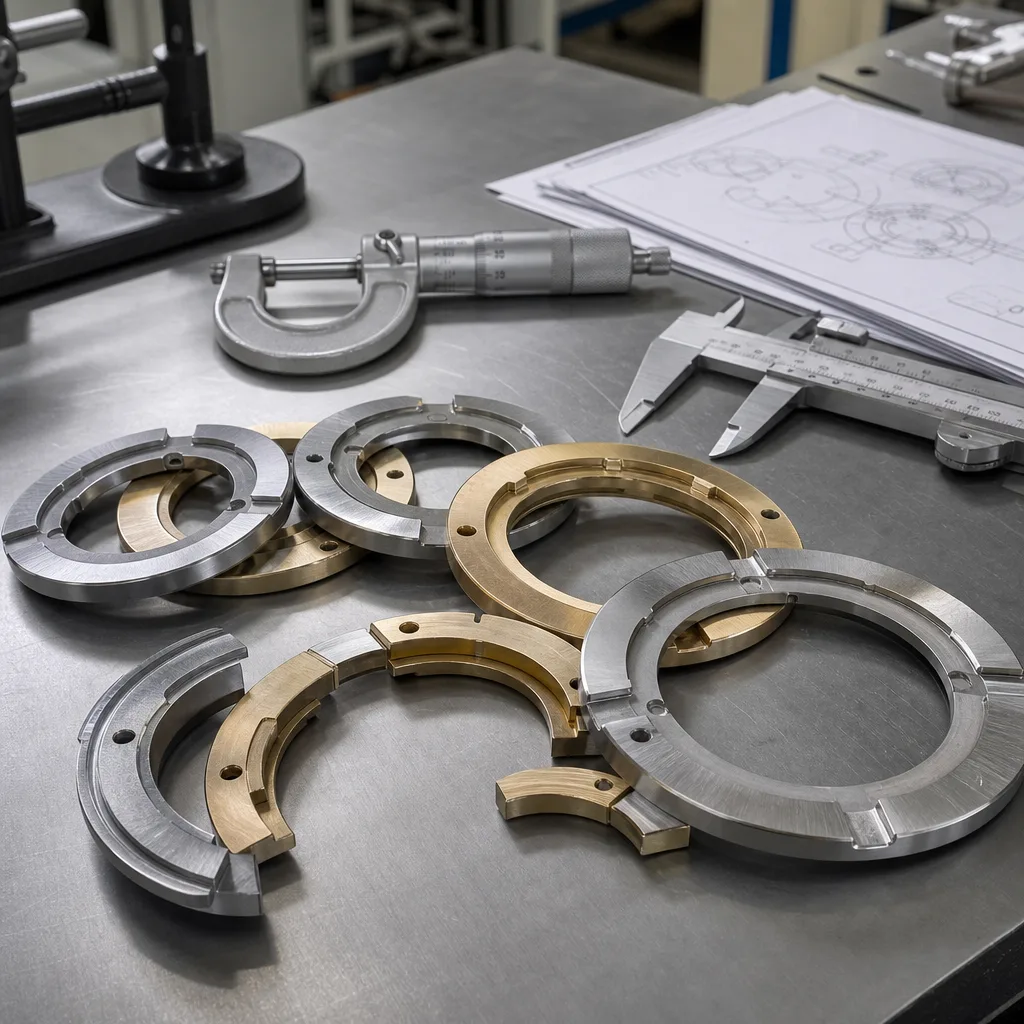
Most engine bearings for export programmes use a steel-backed structure with a bearing layer selected for load, corrosion resistance, and running-in behaviour. We specify the stack only after the drawing and duty cycle are clear, because a light-duty replacement and a high-load fleet programme do not need the same overlay. Dimensional control matters more than claims. Buyers should ask for wall thickness, eccentricity, crush, and tang at the drawing stage, then verify the first article against that drawing.
Driventus operates under IATF 16949:2016 and ISO 9001:2015 control, and material declarations can be aligned with REACH (EC) No 1907/2006 when required for the destination market. That is the right framework for suppliers that ship into the EU, UK, US, Canada, Australia, and Brazil. It is also the right way to keep rebuild kits consistent across reorder cycles.
Standard, coated, and custom options
Not every buyer needs a fully custom shell. The right choice depends on volume, lead time, and how much variation your workshops can tolerate.
| Option | When it fits | Procurement benefit | Main trade-off |
|---|---|---|---|
| Standard OE-match shell | High-volume replacement SKUs | Lowest sourcing complexity and easiest reordering | Limited tuning for special clearances |
| Coated shell | Start-stop duty, higher load, or contamination risk | Better scuff resistance during initial run-in | Higher unit cost and extra validation |
| Custom shell | Non-standard dimensions, fleet builds, or private label programmes | Exact fit to your drawing and packing spec | Higher MOQ and longer lead time |