EGR Valve Opel Wholesale: Sourcing Guide
For procurement teams searching for egr valve Opel wholesale suppliers, the hard part is not finding a part that looks close enough. The real risk is fitment drift: the wrong OE reference, actuator logic, connector layout, mounting pattern, or response curve can turn a low-cost buy into fault codes, returns, and warranty claims.
Driventus supplies EGR valves as an independent aftermarket manufacturer for distributors, repair chains, OEM programmes, and Tier-1 buyers. Brand names and vehicle names are used here for fitment identification only. We manufacture in Taizhou, Zhejiang, under IATF 16949:2016 and ISO 9001:2015 management systems, with export experience in more than 60 countries. This guide focuses on the decisions wholesale buyers need to make before volume commitment: how to match the right Opel reference, what evidence to request from a supplier, where claims usually start, and how to plan lead time without overbuying.
Start with the OE reference, not the badge
For Opel sourcing, the vehicle name is only the starting point. One model can carry several engine families, emissions variants, and regional specifications, so a generic “Opel EGR valve” search often produces parts that are close in appearance but wrong in detail. The safest route is to anchor the RFQ around the OE number, engine code, connector style, and mounting geometry.
Use this checklist before asking for price:
- OE cross-reference: match the OE number, engine code, and production range.
- Connector and actuator type: confirm pin count, plug orientation, lock tab position, and whether the unit is vacuum or electronically controlled.
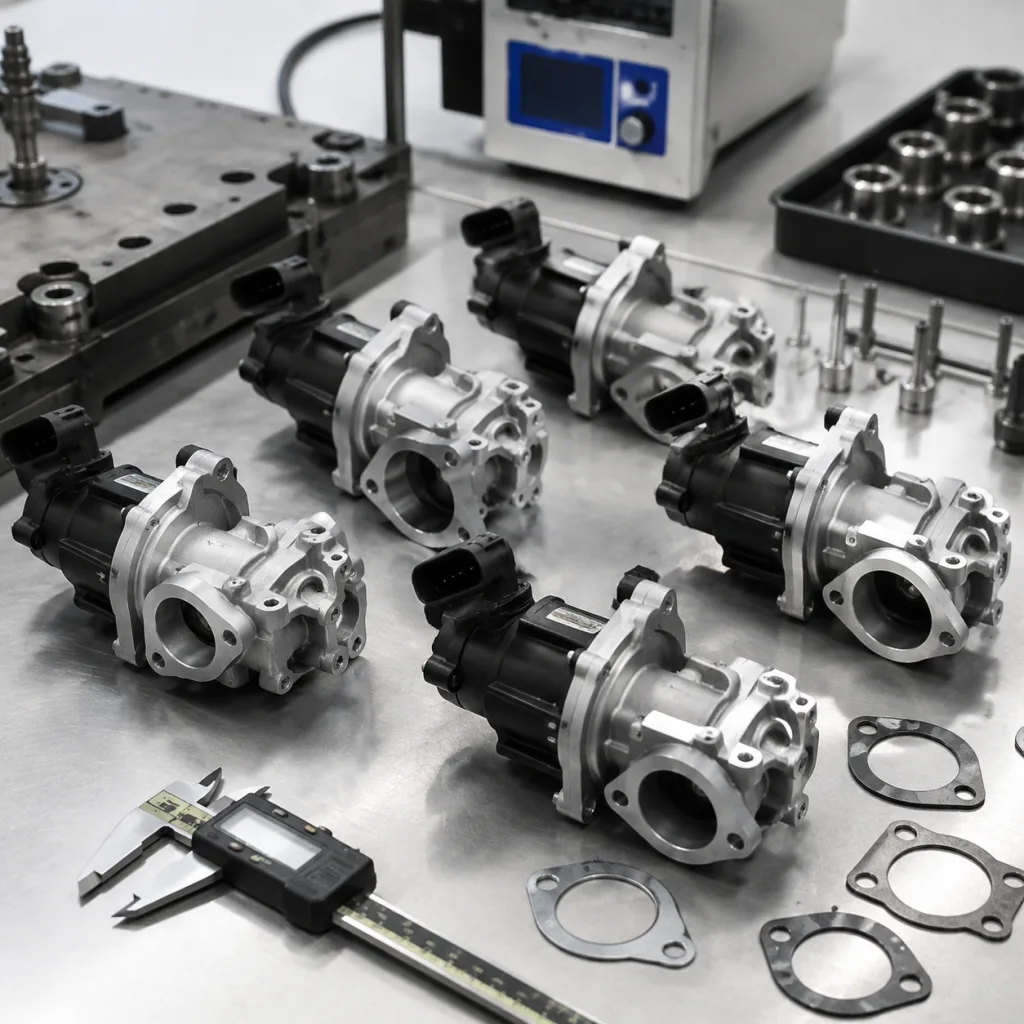
- Mounting interface: verify bolt spacing, bore diameter, gasket face, and overall height.
- Functional range: request flow, travel, or leakage data when drivability or emissions sensitivity is high.
- Shipment content: confirm whether the quote includes gaskets, seals, fasteners, or only the valve assembly.
- Labeling: define part-number format, batch code, barcode, carton strength, and origin marking.
A usable approval package usually includes the OE number, engine code, connector photo, mounting photo, gasket outline, and a confirmed sample or dimensional drawing. For electronic EGR valves, ask for pinout confirmation, coil resistance, and commanded travel range. For vacuum versions, ask for diaphragm hold data and vacuum response under a defined test window. If you are building a broader programme, review the engine components range or start from our catalog.
Failure modes that create returns
EGR valves operate in one of the harshest zones on the engine. Heat, soot, vibration, condensate, and repeated actuation all punish weak design and loose process control. Most wholesale complaints do not start with a dramatic defect; they start with a small mismatch that turns into a warehouse return or a workshop comeback.
The common failure patterns are predictable:
- Sticking from carbon buildup or poor clearances.
- Leakage at the seat, flange, or gasket interface.
- Actuator wear that slows response or prevents full travel.
- Connector corrosion or pin-fit problems.
- Dimensional drift that makes installation awkward or impossible.
Buyers can cut claims by setting measurable controls instead of vague quality language. Practical targets may include bolt-hole positional tolerance within ±0.20 mm, gasket-face flatness within 0.15 mm, connector position within ±0.30 mm, and overall height within ±0.50 mm unless the OE drawing is tighter. For functional checks, require leak screening on the finished lot and cycle testing on a defined sample before release.
Typical buyer-controlled tests include seat leakage checks, full-stroke verification, return-spring response, connector retention, and 30 to 50 cycle pre-shipment actuation on sample units for new programmes. For long-running programmes, some buyers also request salt-spray evidence on terminals or housings where humidity and winter road salt have been recurring issues.
A golden sample or approved drawing helps both sides judge future batches consistently. For higher-volume orders, pre-shipment inspection photos, dimensional reports, and functional summaries tied to the production lot are worth asking for. Where the programme needs tighter control, Driventus can support custom manufacturing with application-specific drawings, validation samples, and agreed inspection plans.
Compare suppliers on proof, not promises
A strong quotation is useful only if the supplier can prove how the product is made and checked. In B2B procurement, certificates are the baseline, not the finish line. What matters is whether the supplier can connect the certificate scope to the exact part family and shipment you intend to buy.
Ask for current evidence in three layers: management system, production control, and shipment traceability. Relevant references include IATF 16949:2016, ISO 9001:2015, and REACH-related declarations where applicable. For regulated programmes, buyers may also request emissions-related test context aligned to the application, such as ECE R-83 context, but they should always confirm the actual method, sample size, and acceptance criteria rather than relying on a generic statement.
Documents worth requesting:
- valid certificate copies with scope and expiry dates
- incoming and final inspection records
- PPAP-style documentation when the programme requires it
- control plan and PFMEA excerpts for OEM-style work
- lot traceability by batch, work order, and production date
- corrective-action workflow for nonconformity cases
- packaging approval records for private-label programmes
Check that the company name, factory address, product scope, and part family all align. If the paperwork refers to one site and the shipment comes from another, slow down and verify. For capability review before RFQ submission, use the quality system page as the starting point.
For a stronger approval process, ask what records ship automatically, what records are held for request, and what records are available only for new programmes. That answer tells you a lot about how the factory handles control and traceability.
Lead time and MOQ: build the plan before the order
Wholesale EGR sourcing works best when the buyer treats demand as planned inventory, not as an emergency purchase. Lead time depends on stock position, machining queue, component availability, testing scope, packaging requirements, and whether the order is for an existing catalogue reference or a new drawing.
A practical planning model usually falls into three bands:
- Stocked catalogue items: often 7 to 15 days after order confirmation.
- Standard made-to-order runs: commonly 25 to 35 days after deposit and artwork approval.
- New references or custom packaging: often 45 to 60 days when samples, validation, or label approval are included.
MOQ is rarely a fixed number in isolation. It depends on packaging format, number of references in the programme, and whether the buyer wants mixed-reference cartons. Ask directly whether low-volume references can be combined, whether the supplier can reserve capacity for seasonal demand, and whether pilot lots are handled under the same specification as mass production.
Good RFQs include these planning points:
- target OE references and estimated annual volume
- destination and preferred Incoterms
- packaging and label requirements
- forecast pattern by quarter
- urgency level for samples, pilot lots, and launch stock
Price comparisons can be misleading if one quote includes gaskets, testing, and export packing while another does not. A slightly higher unit price can still lower total landed cost if it reduces claims, avoids split shipments, and shortens warehouse handling. For buyers managing branch networks or export inventory, stable replenishment often matters more than the lowest headline number.
If you want cleaner quotations, ask suppliers to separate MOQ pricing, 1,000-piece pricing, and annual-contract pricing, and to state the lead time and validity period beside each one.
How Driventus handles Opel programmes
Driventus manufactures engine and powertrain components in Taizhou, Zhejiang, with integrated production and export experience across Europe, North America, South America, and Oceania. For EGR valve programmes, that matters because buyers need repeatable batches, clear technical communication, and accountable support when fitment questions arise.
Our B2B support model includes:
- OE-number-based fitment review for Opel and other applications
- sample confirmation before mass production
- drawing-versus-sample comparison where validation is tighter
- batch traceability and inspection records
- export packing for distributor, warehouse, and private-label use
- claims analysis and corrective-action support
We work with aftermarket distributors, OEM and Tier-1 buyers, and multi-location repair chains. If your team is building a multi-reference line, replacing an existing source, or launching private label, send the OE list, annual volume, sample needs, and packaging standard with your enquiry. We can align the commercial offer to the real release pattern, including MOQ, monthly call-off, forecast horizon, and destination terms, so the purchase order matches the stocking plan rather than a one-off spot buy.
You can request a quote for a current egr valve Opel wholesale programme or a new sourcing project.
Frequently asked questions
Yes. We normally work from OE numbers, engine codes, connector details, and dimensional data to confirm fitment. Brand names are used for reference only, and final approval should follow your application review and sample confirmation process. For a clean approval path, send the OE number, engine code, connector photo, mounting photo, and target annual volume together so the correct reference can be matched before pricing is finalised.
We can share certificate copies, inspection records, traceability details, and application-specific production information. For OEM-style programmes, sample approval documents and PPAP-style records can be arranged according to the agreed project scope. Buyers may also request dimensional reports with stated tolerances, material declarations, test summaries, and packing approval records if the programme requires them.
Yes. We support distributor packaging, barcode labelling, carton specifications, and programme-specific packing requirements. Custom manufacturing is available when the application needs a dedicated drawing, validation sample, or special packing standard. If needed, we can also align pack quantity, carton master dimensions, pallet pattern, and label content to your warehouse and retail requirements.
For sourcing, samples, or programme planning, send your OE list, annual demand, and packaging requirements to our team. Start the conversation at /contact.html.
Request a Quote