EGR Valve Mini OEM Supplier: Sourcing Guide for Buyers
Buying an EGR valve for a compact passenger car platform or light-duty Asian application is rarely a simple replacement search. For procurement teams, it is a sourcing decision built around stable fitment, repeatable lead times, and documented quality control across batch after batch. The right supplier must support OE cross-references, validate leakage and flow behaviour, manage electrical or vacuum-actuated variants, and keep packaging consistent for downstream distribution. Driventus supplies EGR valve assemblies and related engine components from Taizhou, Zhejiang for aftermarket distributors, OEM and Tier-1 programmes, and repair networks. We operate under IATF 16949:2016 and ISO 9001:2015 systems and export to more than 60 countries. Driventus is an independent aftermarket manufacturer; brand names are referenced for fitment only. If you are sourcing an egr valve mini oem supplier, the practical questions are not brochure claims. They are MOQ, test data, material specification, OE fitment evidence, and audit readiness.
What buyers expect from a mini EGR valve supplier
For procurement teams, “mini” usually refers to a compact EGR valve used on smaller-displacement engines. These applications often have tight engine-bay packaging, limited access around the intake manifold, and highly specific connector or vacuum-port layouts. The supplier has to match the OE mounting pattern, port geometry, electrical interface, actuator envelope, gasket interface, and flow behaviour closely enough for direct installation without field modification.
A mini EGR valve is not just a smaller casting. It can require tighter control of flange flatness, bore concentricity, pintle travel, spring preload, and connector orientation. A small geometry change may cause leakage, poor idle behaviour, installation interference, or diagnostic trouble codes such as insufficient EGR flow or position-sensor deviation. For buyers serving repair chains, importers, or private-label programmes, repeatability matters just as much as first-sample appearance.
Typical buyer requirements include:
OE cross-reference control using verified part-number mapping, such as OE 06A107065 where applicable
Dimensional consistency on flange, bore, mounting holes, gasket surfaces, port profile, and actuator envelope
Leak control at the valve seat and flange interface under defined pressure or vacuum test conditions
Stable electrical performance for electronically controlled valves, including connector fit, coil resistance or motor current, sensor output, and actuator response
Traceable materials for body, pintle, shaft, spring, seal, gasket, and electronic interfaces
Packaging that protects the valve body, plug, gasket surface, and actuator during export handling
When the valve goes into a repair chain or distributor network, one fitment error can become expensive quickly. The buyer may face returns, catalogue corrections, warranty labour claims, and a loss of installer confidence. That is why inspection records, sample approval data, fitment notes, and packaging controls should be reviewed before a production order is placed.
Commercial points to confirm before RFQ award
A supplier discussion should cover commercial terms and factory capability, not just unit price. For recurring programmes, the important variables are MOQ, tooling status, sample lead time, production lead time, payment terms, export packing, and the factory’s ability to support staggered shipments or mixed-SKU consolidation. A low unit price only helps when the supplier can hold specification, ship on schedule, and support claims with clear records.
Procurement item
What to confirm
Why it matters
MOQ
Per part number, per shipment, and per packaging style
Controls inventory exposure
Lead time
Sample, pilot run, and mass production release
Prevents stock-outs and launch delays
Tooling status
Existing tooling, insert modification, fixture change, or new development
Defines cost, timing, and feasibility
Packaging
Bulk, tray, foam protection, individual box, master carton, or pallet
Reduces transit damage and connector breakage
Warranty terms
Defect handling, claim evidence, return sample rules, and response time
Limits after-sales disputes
Documentation
Test report, COA, material declaration, traceability, and inspection record
Supports import, audit, and customer approval files
Fitment data
OE cross-reference list, application notes, engine codes, and exclusions
Reduces catalogue errors
Shipment plan
Full-container, LCL, air sample, or staggered release
Helps align stock with market demand
</tr></thead><tbody> </tbody></table>For buyers serving multiple markets, it is also worth confirming whether the supplier can keep the same bill of materials across batches. This matters when the customer expects repeated fitment against a single OE number and does not want unannounced changes to the connector supplier, gasket material, spring specification, sensor supplier, casting source, or surface treatment.
Before RFQ award, buyers should clarify whether the quoted price includes gaskets, screws, individual boxes, barcodes, private-label artwork, export cartons, desiccant or anti-rust protection, and palletisation. These details can change landed cost and customer experience even when the valve itself is correctly manufactured.
Quality checks that matter for EGR valves
A credible sourcing decision depends on verifiable testing. For EGR valves, the most relevant controls are dimensional inspection, leakage testing, actuator response, cycle durability, surface cleanliness, and corrosion resistance where the application requires it. Because the part controls exhaust gas recirculation, small defects can affect idle stability, emissions performance, fault-code frequency, and long-term sealing.
Driventus works within an IATF 16949:2016 and ISO 9001:2015 quality framework. Buyers may also request evidence aligned with REACH (EC) No 1907/2006 for material compliance where applicable, plus application-level validation methods such as thermal cycling, vibration exposure, salt-spray review, condensate exposure, or soot-contamination testing. The right validation package depends on programme risk, target market, order volume, and the customer approval process.
Common factory controls include:
Incoming inspection for castings, machined bodies, seals, springs, shafts, gears, sensors, coils, motors, and electronic subcomponents
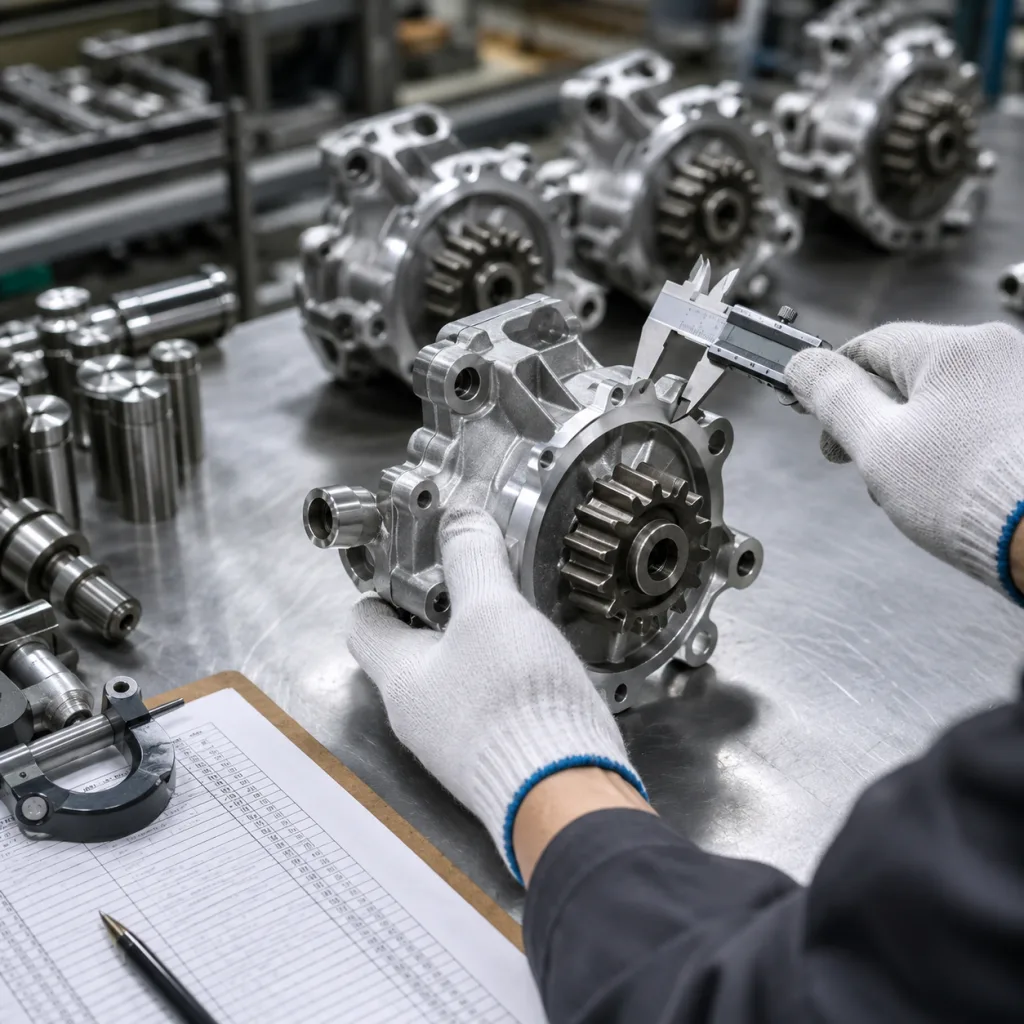
In-process dimensional checks on critical sealing faces, mounting holes, flange thickness, port profile, pintle seat, and actuator alignment
Final functional test for opening response, return behaviour, travel range, signal stability, and commanded-position response where applicable
Leakage testing at defined pressure or vacuum conditions to confirm valve-seat and flange sealing performance
Visual inspection for carbon contamination, machining burrs, thread damage, cracked housings, gasket defects, bent pins, and connector fit
Surface and corrosion checks for parts exposed to moisture, road salt, condensate, or long storage periods
Traceability marking by batch, lot, production date, operator, inspection record, or packing list reference
If you are qualifying a new source, ask for the control plan, sample inspection report, and test method used for leakage and actuation. These documents carry more weight than broad durability claims because they show what is checked, how often it is checked, and which limits are used for release. For higher-volume programmes, a buyer may also request retained samples, PPAP-style documentation, initial sample inspection reports, and periodic revalidation to confirm that later shipments match the approved sample.
Why fitment control is more important than catalogue breadth
Many buyers compare suppliers by the number of part numbers they list. That can be misleading. EGR valve sourcing is sensitive to engine family, emission calibration, connector style, vacuum routing, manifold geometry, gasket design, and ECU strategy. Two parts that look similar may still differ in stroke, spring rate, feedback signal, port diameter, cooling provision, or electrical calibration. Those differences can create installation or performance problems only after the part reaches the workshop.
A disciplined supplier should be able to confirm:
1. Vehicle and engine application coverage 2. OE cross-reference status and any known supersession notes 3. Connector type, pin count, plug orientation, terminal shape, and mounting direction 4. Port shape, flange pattern, gasket profile, bolt-hole location, and bolt size 5. Seal material compatibility with exhaust gas exposure, condensate, and operating temperature 6. Whether the unit is a direct replacement or requires adaptation, gasket change, or ECU procedure 7. Known exclusions, market-specific variants, or calibration-sensitive applications
Fitment review checklist
Compare OE number, application notes, engine code, and production year range
Verify flange pattern, port alignment, valve body height, and actuator clearance
Check harness reach, plug shape, pin layout, terminal retention, and latch position
Confirm gasket thickness, seal profile, fastener requirements, and included accessories
Review actuator type, valve travel, return behaviour, and position-feedback method
Check whether the application uses vacuum control, electronic control, stepper motor drive, or integrated sensor feedback
Review any known ECU relearn, adaptation, clearing, or diagnostic steps after installation
This approach reduces return rates and helps prevent catalogue mislabelling. It is especially important in compact engine bays, where small geometry changes can block proper installation or create contact with nearby hoses, brackets, covers, heat shields, or wiring. For distributors, strong fitment control also protects catalogue data, marketplace listings, and customer-service teams from repeated clarification requests.
How Driventus supports sourcing programmes
Driventus manufactures engine and powertrain components in Taizhou and supports B2B buyers with catalogue supply, OEM development, and custom manufacturing. For EGR valve programmes, our team can assist with drawing review, OE cross-reference review, sample development, batch planning, quality documentation, and export packaging requirements for distribution channels.
A typical sourcing programme can start with an OE reference, sample photo, technical drawing, failed-part sample, or application list. Driventus can then review feasibility, confirm whether existing tooling is available, identify any missing fitment or test information, and prepare a sample or quotation based on the required volume and target market. For private-label or distributor supply, the same process can cover box format, carton quantity, barcode rules, language requirements, pallet label format, and protection for connectors or gasket surfaces.
Explore our catalog for related engine parts, and review our quality system for certification and inspection practices. If your project needs a non-standard configuration, custom manufacturing is available for defined technical targets and volume commitments.
We also supply related engine components through our engine components section, which can simplify multi-line purchasing for importers, wholesalers, and repair network buyers. Combining compatible product lines can reduce supplier management work, improve shipment efficiency, and create more consistent documentation across the purchase file.
Because Driventus is an independent aftermarket manufacturer and brand names are referenced for fitment only, we focus on dimensional accuracy, documented process control, and repeatable supply instead of brand ownership claims. For buyers evaluating an egr valve mini oem supplier, this keeps the discussion centred on application data, quality evidence, lead time, and long-term supply stability.
When to request samples, and what to include in the brief
Sample requests are most useful when the buyer sends a clear technical brief. The brief should include the OE number, engine code if available, target annual volume, destination market, and any packaging or labelling rules. With that information, the supplier can check the correct variant, avoid unnecessary back-and-forth, and prepare the right inspection or test information with the sample.
A practical sample brief should include:
OE reference and known cross-references
Vehicle model, production year range, engine family, fuel type, and emission standard where known
Photos of the old unit, connector, flange, gasket surface, port opening, vacuum nipple, and any visible markings
Required label language, barcode format, carton quantity, private-label needs, and pallet marking rules
Any test standard, inspection format, PPAP requirement, or customer approval document required
Target launch date, first-order quantity, monthly forecast, and destination market
Any known field issue, return reason, DTC pattern, or competitor sample that needs to be matched or improved
For a procurement manager, a good sample is more than a physical part. It is the basis for catalogue creation, internal approval, customer presentation, and downstream warranty control. Sample approval should therefore be tied to dimensional records, leakage results, and functional test notes, not only visual comparison.
After sample approval, buyers should agree how the approved configuration will be controlled during production. This may include a retained golden sample, batch traceability, packaging sign-off, first-article inspection, and confirmation that changes to material, tooling, electronics, gasket supply, surface treatment, or sub-supplier require buyer approval before shipment.
Frequently asked questions
Yes. We work from OE part numbers and application data where available, including cross-reference mapping for catalogue use. Brand names are referenced for fitment only.
We can provide inspection records, functional test data, traceability information, and quality system details under IATF 16949:2016 and ISO 9001:2015.
Yes. Packaging format, barcode needs, carton quantity, and customer label content can be defined during RFQ or sample approval, subject to order volume.
If you are comparing suppliers or building a private-label programme, send your OE reference, volume target, and packaging requirements through /contact.html for a prompt review.