EGR Valve Lexus Supplier: Sourcing and QA Criteria
Choosing an egr valve lexus supplier is not a catalog-matching exercise. The part may look correct and still fail through casting porosity, poor seat sealing, slow actuation, connector mismatch, sensor drift, weak packaging, or missing lot records. For distributors, wholesalers, and repair-chain buyers, the buying decision also has to cover MOQ by SKU, sample timing, tooling responsibility, private-label artwork approval, part-number cross-reference support, and supply stability during demand peaks. Driventus manufactures engine and powertrain components in Taizhou, Zhejiang, and exports to more than 60 countries. Our EGR valve programmes are built for independent aftermarket distribution and selected custom projects, with process controls aligned to IATF 16949:2016 and ISO 9001:2015. Driventus is an independent aftermarket manufacturer; brand names are referenced for fitment only.
Start With the Buying Decision, Not the Part Photo
Lexus-fitment EGR valve demand is usually tied to ageing petrol platforms, hybrid service volume, and emissions-related workshop diagnostics. The first question is not “can you quote this shape?” It is “which version are we sourcing, and how will we prove it works?”
Define the scope before comparing price. A complete valve assembly, electrically actuated valve, vacuum-actuated valve, or valve with an integrated position sensor will each need a different test plan, tooling review, MOQ, and cost model.
Driventus supports B2B sourcing for aftermarket distributors, wholesalers, OEM/Tier-1 purchasing teams, and multi-location repair chains. Buyers can review related engine parts through our catalog and discuss EGR valve projects through custom manufacturing when dimensions, connectors, brackets, or packaging differ from standard aftermarket references.
Use this decision framework for the first RFQ:
Application certainty: model year, engine code, market region, and left-hand-drive/right-hand-drive split where relevant
Reference control: buyer item number and OE cross-reference format, such as OE 25620… or OE 25800…, where available
Demand profile: annual forecast, first-order quantity, reorder frequency, and required safety stock in weeks of sales
Approval file: documents needed for customs, onboarding, marketplace listing, or customer approval
For a first RFQ, send at least 3 clear photos, connector close-ups, key dimensions in millimetres, and the expected first order quantity. If no drawing exists, Driventus can work from a physical sample. Build that into the schedule: sample receipt, reverse measurement, fitment confirmation, and buyer approval must happen before tooling or pilot production.
A supplier should not claim vehicle manufacturer approval unless a formal programme exists. Driventus does not make that claim for independent aftermarket parts.
Where EGR Valve Supply Fails in Real Programmes
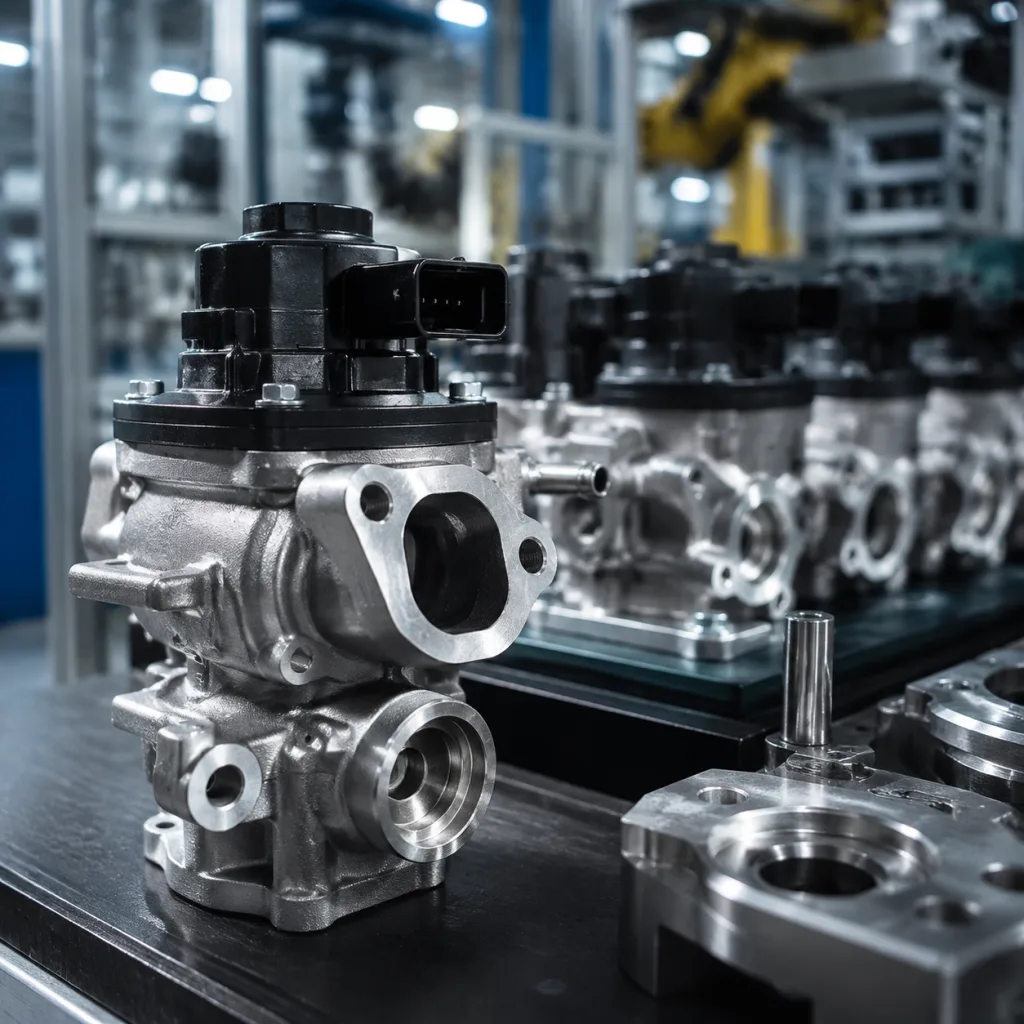
EGR valves work in heat, carbon deposits, vibration, pressure pulsation, and under-bonnet moisture. A low quote can become expensive quickly if leakage, sticking, sensor drift, coil resistance, or connector retention is not controlled.
Do not audit only the finished sample. Audit the process that will repeat the sample. Driventus operates under an automotive quality system aligned with IATF 16949:2016 and ISO 9001:2015. For EGR valve projects, buyers commonly request evidence of incoming material inspection, machining capability, assembly torque control, end-of-line functional testing, nonconforming-product handling, and traceability by production lot.
Failure mode
What to verify
Practical target or record
Procurement risk reduced
Corrosion or heat distortion
Casting alloy, stainless shaft or pintle specification, seal material records
Heat and corrosion grade recorded by lot
Leakage, sticking, premature return
Poor gasket sealing
Flange flatness, bore diameter, valve seat finish
Flatness commonly controlled within 0.05–0.10 mm where design requires
Exhaust leakage and flow inconsistency
Electrical fault codes
Coil resistance, connector retention, sensor output range
Resistance checked against approved sample window; terminal pull test recorded
Diagnostic trouble codes and early failure
Idle instability or emissions fault
Opening response, closing force, leakage at defined pressure
100% end-of-line actuation and leakage screening for agreed SKUs
Sticking, poor closure, unstable operation
Slow warranty containment
Batch code, inspection record, packaging lot
Lot code links carton, test record, and production date
Faster isolation of affected production
</tr></thead><tbody> </tbody></table>The supplier’s reaction to an out-of-tolerance value matters as much as the value itself. The minimum acceptable process is segregation, root-cause review, corrective action, and re-inspection before release. For higher-volume SKUs, request Cpk or trend data for critical machining and electrical parameters rather than a single pass/fail report.
For EU and UK importers, material declarations may also be required under REACH (EC) No 1907/2006. In markets where emissions compliance is sensitive, buyers should validate the EGR valve as an emissions-control component within the intended regulatory framework. ECE R-83 relates to light-duty vehicle emissions type approval, although aftermarket component obligations vary by jurisdiction.
MOQ, Samples, and Lead Time: How the Deal Should Be Built
The right commercial structure depends on the project shape. One fast-moving reference can be validated differently from a 12-SKU Lexus-fitment range. Driventus normally separates sample orders, pilot batches, and mass-production orders so inspection feedback is reviewed before the buyer commits to larger volume.
A typical sourcing path looks like this:
1. RFQ review, 1–3 working days: application list, drawings or samples where available, annual volume, packaging requirements, target market, and target landed-cost range. 2. Cross-reference confirmation, 2–5 working days: buyer-supplied OE references, aftermarket references, connector photos, and physical sample comparison when needed. 3. Sample production or stock sample dispatch, commonly 7–20 working days: dimensional checks, connector verification, leakage check, and bench actuation test. 4. Pilot order, commonly 50–300 pieces per SKU: controlled batch for distributor validation, repair-chain field feedback, or warehouse receiving test. 5. Mass production, commonly 30–60 days after deposit and artwork approval: scheduled output with agreed inspection records, labelling, and export packing.
Commercial parameters vary by SKU complexity, tooling condition, order mix, and packaging specification. For established references, a practical MOQ may start from 100–300 pieces per SKU when parts or semi-finished inventory are available. For slow-moving or custom references, MOQ may move to 300–1,000 pieces per SKU because castings, solenoids, connectors, seals, and cartons must be purchased in economic batches. Mixed-SKU shipments can reduce total inventory risk, but MOQ still has to be confirmed by item, not only by total order value.
Price should be compared on equal terms. A higher unit price may include 100% functional testing, reinforced private-label packaging, low-volume machining, special connector sourcing, or reserved production capacity. A lower unit price may exclude branded packaging, special declarations, tooling amortisation, or batch-level test reports.
Ask every egr valve lexus supplier to confirm these points in writing:
MOQ by part number, shipment, and packaging type
Sample charge, refund conditions after mass order, and sample lead time
Production lead time after deposit, sample approval, and artwork approval
Tooling cost for any custom housing, connector, bracket, fixture, gauge, or test adapter
Incoterms, carton dimensions, palletisation, gross weight, net weight, and HS code support
Payment schedule, forecast window, and whether safety stock can be held after repeat orders
Warranty handling process, claim evidence required, and expected response time for 8D or corrective action
Forecast discipline keeps the programme stable. A six-month rolling forecast helps the factory plan castings, solenoids, connectors, seals, machining capacity, and inspection resources without forcing excessive inventory onto the buyer.
Spec Deep-Dive: What OE-Equivalence Must Prove
OE-equivalence is not visual similarity. A valve can match the casting outline and still fail through incorrect pintle travel, excess seat leakage, poor connector fit, or a sensor curve that the ECU does not accept.
For Lexus-fitment EGR valve programmes, Driventus can support validation around these checkpoints:
Flange bolt-hole position and port alignment checked with gauges or CMM where required, with critical dimensions recorded in millimetres
Mating surface flatness controlled to reduce gasket leakage risk, typically reviewed against a 0.05–0.10 mm project-specific target
Connector geometry, pin orientation, terminal plating, and terminal retention verified against the supplied reference
Coil resistance and insulation resistance tested during assembly against the approved master-sample window
Valve opening and closing response checked under controlled voltage and pressure conditions, with abnormal noise or sticking rejected
Pintle stroke, spring return, and seat contact reviewed where the construction allows measurement
Seat leakage measured at defined pressure to confirm sealing consistency and prevent idle instability complaints
Salt spray or corrosion screening agreed where the target market uses road de-icing salts or humid coastal storage
Thermal cycling reviewed for programmes exposed to high exhaust-temperature swings
Installation fit checked with gasket, fasteners, bracket clearance, and harness reach before mass release
Documentation Package
Set the acceptance criteria before the sample is built. Define drawing revision, number of pieces measured, measurement points, leakage pressure, electrical limits, and whether photos or video of functional testing are required.
A procurement-ready file may include dimensional reports, material declarations, sample inspection reports, production control plans, packaging specifications, and batch traceability records. During mass production, the most useful records are lot-based rather than generic: incoming material records, in-process machining checks, 100% end-of-line actuation results where agreed, leakage-test summary, packing list, carton label proof, and batch-code map.
If a field issue occurs, those records allow the supplier to isolate production date, operator station, material lot, and shipment batch. For regulated markets, buyers should define the exact declaration format before mass production. A supplier can provide component test evidence, but the importer remains responsible for confirming local aftermarket emissions, installation, and labelling obligations.
Scenario: The Part Arrives Good, Then Fails in Distribution
Many EGR valve problems do not start on the engine. They start in the carton. Aftermarket valves often pass through import handling, warehouse storage, branch transfer, courier movement, and workshop shelves before installation. A heavy valve body with a protruding connector can be damaged long before the technician opens the box.
Driventus can supply neutral packaging or buyer-specified packaging after artwork approval. Import managers should confirm whether the destination market requires country-of-origin marking, barcode format, batch-code placement, and language-specific safety or installation notes. For mixed containers, carton labels should support warehouse receiving by part number, application group, and quantity.
A practical packaging specification should define inner box structure, insert material, corrosion protection, master-carton strength, pallet height, and barcode position. For dense metal components, avoid loose packing and require connector protection. A common export approach is one valve per inner box, shaped pulp or foam support around the connector and flange, moisture-resistant bag where required, then master cartons sized to remain liftable by warehouse staff. Carton gross weight should normally stay within the buyer warehouse limit, often 15–25 kg depending on local handling rules.
A practical label data set includes:
Buyer item number and internal Driventus production reference
OE cross-reference family, such as OE 25620… where supplied by the buyer
Quantity, gross weight, net weight, and carton dimensions in metric units
Batch or lot number for traceability, tied to the production and test record
Country of origin and any importer-required marking
Barcode or QR code if required by the distributor warehouse system
Packaging revision or artwork approval date for private-label programmes
Freeze private-label work before mass production. Approve dieline, print colour, barcode readability, warning text, installation insert, carton mark, and pallet label before deposit-triggered production. Artwork changes after packing has started usually create rework cost and lead-time delay.
Repair-chain buyers may also need fitment files, interchange tables, installation notes, and failure-mode guidance for branch training. These materials should be factual, service-oriented, and free from language that implies approval by the vehicle brand. Driventus is an independent aftermarket manufacturer; brand names are referenced for fitment only.
Supplier Shortlist Q&A for Procurement Teams
Q: What should eliminate a supplier early?
A supplier that quotes quickly but cannot explain tolerance targets, test conditions, batch records, or packaging protection should be treated as high risk. Low price does not offset weak repeatability.
Q: Which evidence matters most?
Compare suppliers against both factory capability and export execution. The shortlist should cover certification, application support, testing depth, packaging design, compliance support, commercial fit, and communication speed.
Criterion
Minimum expectation
Stronger evidence
Buyer action
Certification
ISO 9001:2015 quality management
IATF 16949:2016 automotive process controls
Request current certificate and scope
Application support
Cross-reference table
Sample-based dimensional confirmation
Send OE number, photos, and sample if available
Testing
Basic electrical and leakage checks
End-of-line functional data by batch
Ask for the actual test parameters used
Packaging
Export carton
Drop-tested or reinforced SKU-specific insert
Approve inner protection before pilot order
Compliance
Material declaration on request
REACH (EC) No 1907/2006 support and controlled substance review
Confirm declaration format before mass production
Commercial support
MOQ and lead time stated
Forecast-based production planning and safety stock discussion
Compare MOQ, lead time, payment, and warranty on one sheet
</tr></thead><tbody> </tbody></table>Q: Is a remote audit enough?
Often, yes for an initial shortlist. For China-based options, a remote or on-site factory audit should review incoming inspection records, machining equipment, assembly fixtures, test benches, nonconforming-product control, calibration labels, operator work instructions, and corrective-action records. Ask for a recent production-lot report rather than a generic sample report.
Q: How should we score suppliers?
A practical scoring model can weight quality system 25%, technical validation 25%, commercial fit 20%, packaging/export execution 15%, and communication speed 15%. Adjust the weighting if the project is custom, highly regulated, or urgent.
Q: What should we send to Driventus to speed up review?
If your team is building a Lexus-fitment EGR valve range, combine the RFQ with target SKUs, annual volume, forecast by quarter, packaging requirements, target price level, required test documents, and any buyer-supplied samples. This helps Driventus assess whether the programme can use existing production capability or requires custom development.
Frequently asked questions
Send the application list, buyer item numbers, OE cross-reference families such as OE 25620… where available, annual forecast, first-order quantity, target market, packaging requirements, and any physical sample or drawing. Connector photos, pin count, flange measurements, port spacing, gasket interface, and expected MOQ help reduce confirmation time.
Yes. Driventus can support neutral or buyer-specified packaging after artwork approval. Label content, barcode format, carton strength, country-of-origin marking, batch traceability, inner protection, and packaging revision should be agreed before mass production to avoid receiving delays.
No. Driventus is an independent aftermarket manufacturer; brand names are referenced for fitment only. We can support dimensional, functional, material, packaging, and batch documentation for procurement review, but we do not claim approval or endorsement by a vehicle manufacturer.
For SKU review, MOQ confirmation, sample timing, lead-time planning, or audit documentation, contact Driventus with your target applications, forecast, packaging requirement, and any reference sample. You can [request a quote](/contact.html) or send the project file through /contact.html.