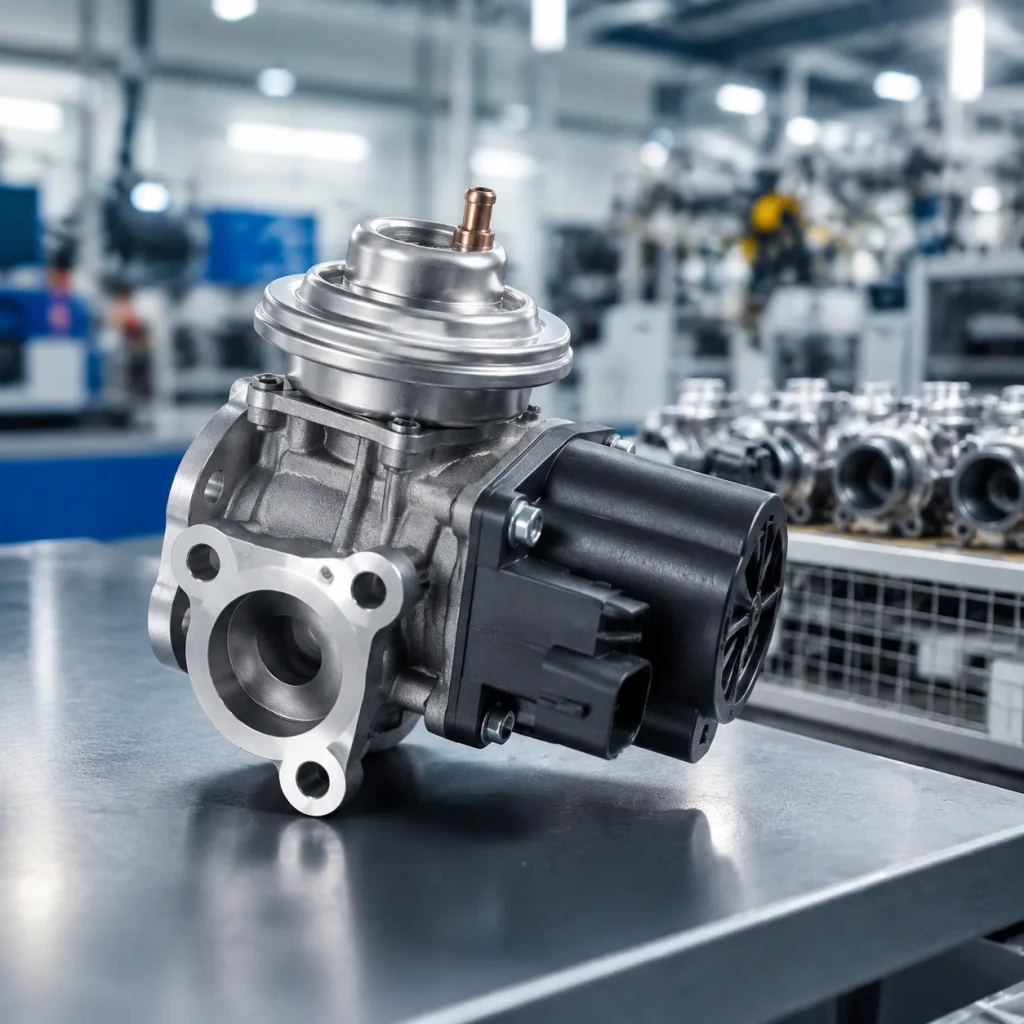
Chevrolet-fit EGR valves are bought by distributors, Tier-1 sourcing teams, repair chains, and private-label brands that need dependable emissions-repair coverage across petrol and diesel applications. The real risk is rarely price alone. Buyers also need to verify casting integrity, actuator response, sealing stability, connector compatibility, packaging strength, traceability, and audit-ready documentation before adding a supplier to the range.
Driventus manufactures EGR valves and related engine components in Taizhou, Zhejiang, and supports export programmes for North America, Europe, the UK, Australia, Brazil, and other aftermarket markets. This guide frames the decision around fitment, validation, and commercial control so buyers can evaluate an `egr valve chevrolet oem supplier` without implying vehicle manufacturer approval. It covers application data, MOQ planning, lead time, quality evidence, validation checks, documentation, and factory audit points. Driventus is an independent aftermarket manufacturer; brand names are referenced only to identify fitment compatibility.
How to Define the Buying Scope
An EGR valve routes exhaust gas back into the intake stream to lower combustion temperature and reduce nitrogen oxide formation. Chevrolet-fit coverage may include vacuum-operated valves, electric stepper valves, and DC motor-driven valves depending on engine family, emissions generation, production market, and service-channel demand.
The fastest way to avoid bad quotes is to define the application cleanly before asking for price. A sourcing file should state market, engine displacement, model year range, fuel type, connector style, pin count, mounting pattern, gasket interface, valve travel, actuator type, and packaging requirement. Where OE part-number cross-references are used, keep them generic and fitment-based, for example OE 06A… or OE 11251…, and rely on the buyer’s own interchange data rather than unsupported brand claims.
Useful sourcing links:
Review engine and emissions product lines in our catalog.
Confirm process controls through the Driventus quality system.
Discuss private-label tooling, revised brackets, or connector changes through custom manufacturing.
Driventus supplies independent aftermarket components only. Nothing in this article states or implies approval, endorsement, dealership supply, or original equipment supply status with any vehicle manufacturer.
What the Quotation Should Actually Contain
A useful EGR valve quotation should show more than the unit price. Import managers and category buyers need clear assumptions for order volume, tooling responsibility, packing method, logistics route, documentation, and after-sales support.
Sourcing item
What to request
Procurement reason
MOQ
Trial order and production MOQ by part number, plus any step-up pricing by tier
Confirms cash exposure, launch feasibility, and whether a 200–500 pc pilot can move to 1,000+ pc replenishment without reset charges
Lead time
Sample, pilot, first-order, and repeat-order timing in calendar days
Supports launch planning and seasonal stock builds; request separate numbers for stock items versus custom tooling
Incoterms
EXW, FOB Ningbo/Shanghai, CIF, or agreed terms
Makes landed-cost comparison consistent and avoids hidden inland freight assumptions
Reduces warehouse rework, relabelling, and carton damage; specify inner pack qty, master carton qty, and drop-test target if needed
Traceability
Date code, batch code, inspection record link, shipment lot
Enables containment if a claim occurs and helps match returns to production window
Documentation
Drawing, inspection report, material statement, functional test summary
Supports distributor onboarding, customer audits, and claim review
Claim handling
Response time, evidence required, replacement or credit process
Clarifies warranty exposure before launch and defines escalation timing
</tr></thead><tbody> </tbody></table>For a new EGR valve programme, buyers often reduce risk by separating fast-moving references from long-tail applications. That keeps early inventory focused on SKUs with proven demand while return-rate data, catalogue accuracy, and technician feedback are still being reviewed. The quotation should also state whether gaskets, bolts, labels, instruction sheets, QR codes, and barcode formats are included.
If the project requires a new casting, connector revision, bracket change, or modified calibration profile, the RFQ should identify whether tooling is buyer-owned, supplier-owned, or amortised into the piece price. Apply the same rule to dedicated packaging artwork, carton dies, market-specific compliance labels, and inspection fixtures needed for repeat production. Buyers should also request price breaks by quantity band, such as pilot, 1,000+ pcs, 3,000+ pcs, and 5,000+ pcs, because the real commercial decision usually depends on landed cost at the first replenishment point, not the headline sample price.
Where Suppliers Usually Fail Quality Audits
An `egr valve chevrolet oem supplier` should be assessed through documented manufacturing controls rather than sales language alone. Driventus operates under IATF 16949:2016 and ISO 9001:2015 quality management frameworks. For buyers, the most useful evidence is how those systems are applied to incoming materials, machining, assembly, testing, release, and claim containment.
Key audit points include:
Incoming inspection for aluminium castings, stainless shafts, springs, seals, gears, motors, coils, terminals, and connectors, with acceptance criteria tied to dimensional and visual standards.
Machining control for flange flatness, bore diameter, shaft alignment, seat geometry, and threaded features, typically checked to drawing limits and recorded in the inspection log.
Assembly torque control for covers, brackets, fasteners, motor housings, and electrical terminals, with torque windows defined by fastener size and thread condition.
Functional testing for valve opening position, leakage, response time, actuator current draw, and return stability, ideally using end-of-line fixtures that capture numeric values rather than pass/fail only.
Lot traceability linking production date, operator station, inspection result, end-of-line test record, and shipment batch, so any warranty issue can be narrowed to a single run.
Nonconforming material handling with segregation, root-cause analysis, corrective action, and effectiveness review, including defined re-test requirements after rework.
Gauge calibration records for leak testers, dimensional gauges, torque tools, and electrical test fixtures, with calibration intervals stated in months and out-of-tolerance actions documented.
For export programmes, procurement teams may also request material declarations related to REACH (EC) No 1907/2006 when products are placed into the EU market. Electrical and electromechanical EGR valves should be reviewed for connector resin, terminal plating, insulation stability, heat resistance, vibration durability, and corrosion resistance under the buyer’s target climate and warranty assumptions.
A remote audit can screen supplier capability, especially when supported by live video, calibration records, and recent inspection sheets. A physical audit gives stronger evidence of fixture condition, operator training, workstation discipline, storage practice, and end-of-line test control. Ask for current records and sample documents, not only certificate copies. Buyers should also check whether the factory can show a corrective-action closure time target, such as 8D response within 5–10 working days, because that often predicts real claim-handling discipline better than certificate wording alone.
How to Validate Fitment Before Release
EGR valve validation should cover dimensional match, sealing performance, actuator behaviour, electrical compatibility, and durability. A visually similar valve can still create fitment or diagnostic issues if pintle seat geometry, gasket compression, motor response, connector keying, or rest-position control differs from the target application.
Typical validation checks for Chevrolet-fit EGR valves include:
Mounting hole position, port alignment, and flange flatness measured against drawing limits, with critical-to-fit dimensions held to the buyer’s agreed tolerance band.
Connector keying, pin count, terminal retention, housing heat resistance, and harness engagement checked against the mating connector and harness pull-out requirement.
Valve stroke, rest position, and return behaviour verified with controlled test fixtures, often using a repeatability target such as three cycles with no drift outside the set band.
Leakage testing at pressure and temperature conditions agreed with the buyer, for example room temperature screening plus a hot-state hold test where the acceptance limit is no visible leakage or an agreed cc/min threshold.
Electrical load, actuator current draw, coil resistance, and response-time checks to confirm the valve reaches commanded position without over-current or slow recovery.
Thermal cycling to check body distortion, seal stability, and actuator consistency, especially where the part sees engine-bay heat soak.
Salt spray or corrosion exposure where the valve is mounted in high-splash or high-humidity zones, with duration aligned to the market environment and warranty period.
Vibration testing for bracket security, fastener retention, and electrical continuity, particularly on diesel and commercial-duty applications.
Published standards can support the validation framework, but no single universal standard covers every EGR valve characteristic. Buyers may reference ISO 9001:2015 for process control and IATF 16949:2016 for automotive quality management expectations. Vehicle emissions rules such as ECE R-83 define emissions requirements at vehicle level; they should not be presented as direct approval for an individual aftermarket valve.
For repair chains, fitment accuracy reduces bay-time losses, repeat visits, and technician frustration. For distributors, it lowers catalogue disputes, warranty returns, and negative service feedback. The strongest sourcing package combines samples, drawings, application data, agreed inspection criteria, and clear release conditions before mass production. Where possible, require a buyer-approved golden sample, a signed dimensional report, and a first-article check against the actual mating flange and harness before release to repeat production.
A Practical Launch Sequence for MOQ and Private Label
EGR valve sourcing works best when validation timing is separated from replenishment timing. Samples may be available faster than a full commercial order, but sample approval does not replace production release checks, batch traceability, packaging approval, or agreed inspection records.
A typical project sequence is:
1. Buyer sends target references, annual volume estimate, application market, packaging requirement, and compliance request. 2. Supplier confirms existing coverage, tooling status, sample availability, technical limitations, and preliminary quotation. 3. Buyer validates samples for fitment, electrical response, leakage, sealing, durability, and packaging. 4. Supplier prepares pilot production with inspection reports, functional test data, and batch traceability. 5. Buyer reviews pilot parts, confirms carton artwork and labels, then releases repeat orders based on MOQ, forecast, and shipping schedule.
For private-label programmes, allow extra time for artwork review, carton compression checks, label approval, barcode verification, instruction-sheet language, and pallet layout. Mixed-SKU palletisation should be specified early because small cartons, gaskets, hardware bags, and protective inserts affect packing density and freight cost. As a practical rule, buyers should build 2–4 weeks for artwork and label approvals, 1–2 weeks for sample revision if packaging changes, and a further buffer if the destination market requires translated instructions or regulated markings.
When assessing a prospective `egr valve chevrolet oem supplier`, ask whether the factory can hold safety stock for contracted references, combine EGR valves with other engine components, and provide export documents consistently. Driventus can support consolidated engine-component orders, including EGR valves, gaskets, water pumps, pistons, crankshafts, and turbocharger-related parts, subject to confirmed application data, compliance requirements, and MOQ. Buyers planning steady replenishment should also ask for a release logic such as 30% deposit with 70% before shipment, or an agreed rolling forecast with monthly call-off, because that directly affects stock reservation and production priority.
RFQ Questions That Force Comparable Quotes
A complete RFQ reduces back-and-forth, prevents hidden assumptions, and helps suppliers quote the same scope. It also makes factory comparison more objective because each offer can be reviewed against the same fitment, packaging, documentation, and logistics requirements.
Include the following items in your sourcing file:
Target application list by market, engine, year range, fuel type, and emissions generation where known.
Buyer interchange numbers and any approved OE cross-reference format, such as OE 06A… where applicable.
Required valve type: vacuum-operated, electric stepper, or motor-driven.
Procurement teams should avoid choosing an EGR valve supplier only on the first quoted price. A low unit cost can be offset by poor catalogue data, weak packaging, inconsistent connector quality, missing documents, or slow claim response. A stronger evaluation weighs total landed cost, defect containment, documentation quality, private-label execution, and the supplier’s ability to maintain coverage over multiple buying seasons.
Driventus is an independent aftermarket manufacturer; brand names are referenced for fitment only. To make quotations directly comparable, buyers should ask each supplier to state assumed carton qty, pallet qty, sample charge, tooling charge if any, production lead time, and warranty term on the same RFQ sheet, rather than leaving those terms implicit.
Frequently asked questions
Yes. Driventus can discuss neutral packaging, private-label cartons, barcode formats, carton artwork, and mixed-SKU export packing after confirming application data, MOQ, artwork files, and compliance requirements.
Request IATF 16949:2016 and ISO 9001:2015 certificate copies, dimensional reports, functional test results, material declarations where required, packaging specifications, calibration evidence, and batch traceability samples.
No. Chevrolet-fit refers to application compatibility based on catalogue and interchange data. Driventus is an independent aftermarket manufacturer; brand names are referenced only for fitment identification.
For EGR valve sourcing, sample review, or private-label planning, share your application list, annual forecast, target market, and packaging requirements with Driventus. Start a technical RFQ at /contact.html