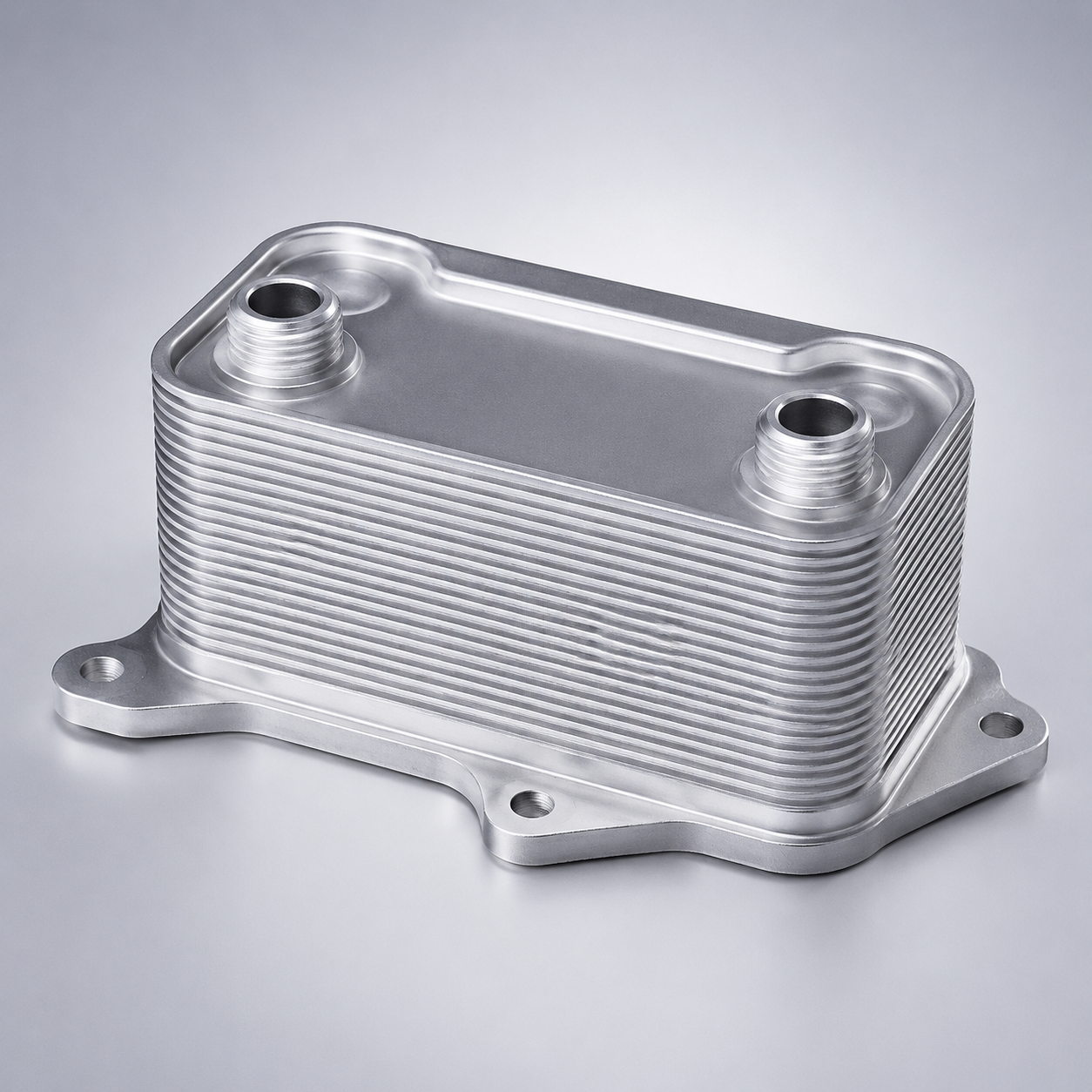
EGR cooler · 2026-06-29

EGR Cooler Mitsubishi Wholesale: A Smarter B2B Buying Framework

Buying on price first is how many import programmes create avoidable warranty cost later. In **egr cooler mitsubishi wholesale** sourcing, the real question is not simply whether the part fits. It is whether the supplier can keep flange geometry, weld integrity, leak performance, and packaging consistency stable from sample stage to repeat orders.

That is why experienced procurement teams look past the opening quote. They check traceability, test discipline, drawing control, and how the factory handles mixed-SKU orders, peak-season lead times, and packaging variation. A small production drift—flatness off by 0.20 mm, a bracket slightly out of position, inconsistent braze penetration, weak carton protection—can turn a low-cost purchase into claims, air freight, and stock disruption.

This guide takes a more practical angle: how to qualify risk before you scale volume. It covers the checkpoints that matter most to distributors, importers, OEM-adjacent buyers, and repair-chain procurement teams sourcing Mitsubishi-compatible EGR coolers from export manufacturers. Driventus is an independent aftermarket manufacturer; brand names are referenced for fitment only.

Start with the go/no-go decision, not the quotation

For this product, fitment is only the entry point. An EGR cooler has to survive heat cycling, coolant pressure, exhaust exposure, vibration, and workshop installation stress. So the first decision is simple: is this supplier controlled enough to quote seriously?

Before comparing prices, verify whether the factory can hold the basics across batches.

Key go/no-go checks:

  • Application coverage: Confirm engine family, model years, OE cross-references, and market-specific variants before RFQ release. Mitsubishi applications often differ by region, emissions standard, and mounting detail.
  • Material specification: Verify tube, core, shell, flange, and braze or weld materials. Stainless consistency directly affects corrosion resistance, heat tolerance, and fatigue life. Buyers commonly ask whether hot-gas and wetted sections use grades such as SUS304 or SUS316, with flange thickness often in the 4.0-8.0 mm range depending on design.
  • Dimensional control: Ask how the supplier controls flange flatness, port alignment, mounting-hole position, bracket location, and joint geometry. Typical critical limits include flange flatness of ≤0.15 mm, mounting-hole positional tolerance of ±0.20 mm, and overall assembly dimensions within ±0.50 mm, unless the drawing states otherwise.
  • Pressure and leak testing: Require documented parameters, not a verbal assurance. A practical export standard is 100% air-under-water or dry-air decay testing at about 2.0-3.0 bar coolant-side pressure with a 20-60 second hold.
  • Thermal cycle validation: Ask for evidence, especially for fleet or higher-duty applications. Buyers often look for summaries covering 300-1,000 cycles rather than a generic “tested OK” claim.
  • Documentation discipline: Confirm export packaging spec, traceability method, conformance records, and carton labelling rules.
  • Supply terms: Lock down MOQ, pilot-order quantity, sample timing, standard lead time, and peak-season lead time in writing.

A fast way to expose weak quoting is to request three quantity breaks on the same SKU—say 100 pcs / 300 pcs / 1,000 pcs. Serious manufacturers usually explain the price movement through setup cost, material usage, packaging, and line efficiency. Traders often cannot.

Also ask for separate pricing on neutral packing versus private-label colour box. Packaging changes can add USD 0.30-1.50+ per unit, sometimes more if inserts or printed cartons are complex.

If your programme spans several hard-part categories, it may also be worth checking whether the supplier can support adjacent items through our catalog. Consolidation can simplify inspection, freight planning, and replenishment.

Where EGR cooler programmes usually fail in the field

Most warranty issues in this category come from a short list of repeat problems. Good suppliers know them in detail. Better suppliers can show how they prevent them.

Common failure modes

  • Core cracking from thermal fatigue: Repeated expansion and contraction can open micro-cracks in weak welds, poorly supported areas, or uneven wall sections.
  • Coolant-to-exhaust leakage: Internal leakage may cause coolant loss, white smoke, intake contamination, and repeat workshop returns.
  • External weld seepage: Weak joint preparation, unstable welding parameters, or poor process control can create slow leaks that appear only after installation.
  • Flange distortion: Flatness outside tolerance leads to sealing problems, installation stress, and early gasket failure.
  • Soot blockage: Internal geometry and surface finish affect deposit build-up over service life.
  • Bracket or mounting stress: If bracket position drifts, installation load can transfer into the cooler body and shorten life.

What a credible supplier should be ready to show

For egr cooler mitsubishi wholesale supply, ask for:

  • Core construction details
  • Material certificates by heat or batch where applicable
  • Leak-test method and acceptance limits
  • Thermal cycling or endurance test summary
  • Dimensional inspection points tied to drawings
  • PPAP-style documentation if the programme requires it
  • Corrective action records for previous non-conformities

One revealing question: where are defects most often caught—welding, assembly, pressure test, or final pack? If the supplier has no clear answer, the process is probably not under control.

It also helps to understand the actual production route. A typical stainless EGR cooler flow is: tube/core cutting → forming → fixture assembly → TIG/MIG welding or controlled brazing → de-burring/cleaning → pressure or leak testing → dimensional inspection → passivation/anti-rust protection if specified → marking → packaging.

The danger points are usually after welding and before packing. If those handoffs are not recorded, defect containment becomes guesswork.

For welded assemblies, practical audit questions include:

  • Are dedicated fixtures used?
  • Are weld current and shielding gas controlled by SOP?
  • How often are fixtures checked?
  • Are key dimensions checked only at first-off, or during the shift as well?

That last point matters. If bracket position is checked only once, drift can show up later from fixture heat expansion or operator changeover. Many buyers prefer in-process checks every 30-50 pcs or every 2 hours on critical dimensions.

For regulated markets, material compliance declarations may also be needed, especially around REACH (EC) No 1907/2006 and customer-specific restricted substance rules.

How to compare two similar suppliers when both look acceptable

This is where many sourcing decisions are won or lost. Two factories may quote similar prices and both claim export experience. The difference shows up in lead-time control, traceability, and how they behave once the programme is live.

Use a comparison framework like this:

</tr></thead><tbody> </tbody></table>During supplier comparison, practical audit questions tell you more than polished presentations:

  • Is leak testing 100% or sampled?
  • What pressure and hold time are used?
  • How is weld consistency checked across shifts?
  • What is the control plan for flange flatness, mounting geometry, and bracket position?
  • Are non-conforming parts physically segregated and digitally logged?
  • How are engineering changes communicated?
  • Can the factory support private label or custom manufacturing?

Commercial clarity matters too. In many aftermarket programmes, realistic starting points look like this:

  • Sample MOQ: 1-3 pcs if tooling and drawing are already approved
  • Pilot order MOQ: often 30-100 pcs per SKU
  • Mass-order MOQ: often 100-300 pcs per SKU, or a mixed order that reaches a carton or pallet minimum
  • Sample lead time: usually 7-20 days for existing drawings, 20-35 days if fixture adjustment or packaging approval is needed
  • Mass production lead time: commonly 25-45 days after deposit and packaging confirmation, longer in peak season

Ask every supplier for the same six commercial data points:

1. EXW or FOB price by quantity break 2. Separate tooling or fixture charge if any 3. Private-label packaging surcharge 4. Palletisation or export-carton specification 5. Peak-season lead-time policy 6. Claim-handling and replacement terms

For egr cooler mitsubishi wholesale sourcing, the better supplier is usually not the one with the lowest first quote. It is the one that can explain its process, show records quickly, and give numbers that still look believable after follow-up questions.

Which documents actually matter before you place the order

Certificates help, but they are only a filter. What protects the buyer is the underlying record system.

An EGR cooler supplier serving export aftermarket or OE-adjacent business should be able to work within a documented process framework. Relevant references often include:

  • IATF 16949:2016 for automotive quality management requirements
  • ISO 9001:2015 for documented process control
  • REACH (EC) No 1907/2006 for EU chemical compliance
  • Customer-specific rules for labelling, packaging, and traceability

When reviewing the supplier’s quality system, ask for:

  • Certificate copies with validity dates
  • Incoming material inspection records
  • In-process inspection plan
  • Final inspection checklist
  • Pressure or leak-test record format
  • Non-conformance and corrective action workflow
  • Packaging specification and drop-resistance approach
  • Batch coding logic for cartons and units

The bigger issue is repeatability. Buyers should confirm how the supplier locks an approved sample into routine production, controls drawing revisions, prevents material substitution, and ensures replacement stock matches the approved specification.

In practice, useful traceability records include:

  • Material heat or batch number linked to production date
  • Operator or line ID for welding or assembly
  • Leak-test result by unit or lot
  • Final inspection status by carton or pallet
  • Revision status of drawing, work instruction, and packaging artwork

For higher-control programmes, some buyers ask for a simple PPAP-style file even in the aftermarket. That often includes the drawing, ballooned inspection report, material certs, test summary, packaging approval, and signed sample confirmation. It is not bureaucracy for its own sake. It reduces argument six months later when the reorder arrives.

Packaging documentation matters more than many teams expect. A solid export pack for cooler assemblies may include individual bagging, partitions or molded supports for flanges and tubes, desiccant for long sea freight, and a master carton suitable for stacking. Buyers often ask about carton burst or compression suitability and pallet patterns that avoid overhang.

Even a technically acceptable part can become a commercial problem if transit damage runs above 1-2%. In egr cooler mitsubishi wholesale programmes, that can affect multiple distributors or workshops at the same time.

Build the RFQ so suppliers cannot quote on assumptions

A weak RFQ creates messy quotations. A strong RFQ shortens validation time and makes supplier comparison fair.

For Mitsubishi-compatible EGR cooler procurement, include the technical and commercial detail up front instead of clarifying it after the quote arrives.

Recommended RFQ content:

  • Vehicle application, engine code, and target markets
  • OE cross-reference if already used in your catalogue format
  • Annual demand by SKU and forecast split by quarter
  • Required testing or validation level
  • Packaging requirements: neutral, private label, barcode, pallet pattern
  • Incoterm and destination port
  • Sample quantity and approval deadline
  • Required documents: compliance declaration, inspection report, packing photos
  • Any special marking, carton language, or importer label requirement

A small technical matrix inside the RFQ is especially useful. It forces all suppliers to quote against the same assumptions. Typical line items:

  • Leak test requirement: for example, 100% test at a specified pressure and hold time
  • Critical dimensions: flange flatness, hole location, port orientation, bracket position
  • Surface requirement: no sharp burrs, no weld spatter in sealing zones
  • Marking: batch code, supplier code, or buyer-specific label
  • Packaging count: units per inner and per master carton
  • Inspection submission: whether first-article photos and dimension report are required before shipment

If the programme includes related hard parts, supplier consolidation may improve freight efficiency. In that case, buyers sometimes review our catalog or /products/engine-components.html during RFQ planning.

For first orders, a practical release sequence is:

1. Sample approval 2. Pilot batch with inspection review 3. Mass order after field or warehouse validation

That structure controls launch risk without slowing the whole programme down.

Also request quantity-break pricing from the start. Instead of asking for one number, ask for 100 / 300 / 1,000 pcs pricing, plus sample cost, tooling cost if any, standard lead time, peak-season lead time, and quotation validity. If demand is spread across several Mitsubishi references, ask whether the factory supports a mixed MOQ based on total order value or production hours rather than a rigid MOQ on every SKU.

For egr cooler mitsubishi wholesale enquiries, a detailed RFQ is one of the easiest ways to reduce sourcing noise and make supplier evaluation more accurate.

When a China-based source is the right move—and when to test cautiously

A Chinese manufacturer is often a practical fit when the buyer needs flexibility across SKUs, reasonable cost at container-building volumes, and faster commercial response than a fragmented supply base can offer.

The best fit is not about geography alone. It is about repeatability, communication, and shipment discipline.

A China-based source often makes sense when the programme involves:

  • Mixed-container or multi-SKU planning
  • Stable replenishment for distributor stock programmes
  • Sample development for catalogue expansion
  • Private-label packaging support
  • Technical communication on fitment and inspection criteria
  • Cost control across a broader engine-component sourcing plan

Driventus manufactures engine and powertrain components for B2B customers in multiple export markets. In egr cooler mitsubishi wholesale projects, buyers usually start with application coverage, documentation requirements, quality checkpoints, and realistic supply timing.

The stronger suppliers are the ones that answer detailed questions directly, provide controlled records, and define achievable lead times rather than optimistic ones.

Commercially, a Chinese manufacturer is often the right fit when the buyer values:

  • Flexible MOQ structure across multiple SKUs
  • Competitive FOB pricing at practical order volumes
  • Fast sample turnaround for catalogue expansion
  • Private-label and export-carton control in one supply base
  • Consolidated shipment planning with other engine components

That said, the first order should still be controlled. A common low-risk path is sample approval → 50-100 pcs pilot → 300+ pcs replenishment once inspection and early market feedback are stable. This gives the buyer enough volume to validate packaging, leak-test consistency, and carton traceability without taking unnecessary stock risk.

Driventus is an independent aftermarket manufacturer; brand names are referenced for fitment only. If you want to review applications, documentation, or project requirements, use the request a quote page.

Frequently asked questions

MOQ depends on SKU complexity, packaging format, tooling status, and whether the order is for stock supply or custom branding. In many export aftermarket programmes, buyers may see sample quantities of 1-3 pcs, pilot orders of 30-100 pcs per SKU, and mass-order MOQ levels around 100-300 pcs per SKU, sometimes with mixed-SKU flexibility. Confirm MOQ by part number rather than assuming one rule applies across the full range.

At minimum, request quality certificates, inspection records, leak-test information, packing specifications, and material or compliance declarations where required. For EU supply, REACH-related declarations may also be relevant. Batch traceability records, carton markings, conformance documentation, and, if needed, a PPAP-style sample file are also useful for warranty control, return analysis, and change management.

Use an RFQ with detailed application data, dimensional checkpoints, packaging requirements, and validation criteria. Approve samples against drawings and fitment checks, then place a pilot order before mass release. Audit leak testing, weld control, flange flatness controls, bracket-position tolerances, and traceability procedures before scaling volume. It also helps to define acceptance criteria in advance, such as 100% leak testing and key-dimensional tolerances on the drawing or inspection plan.

If you are reviewing suppliers for Mitsubishi-compatible EGR cooler programmes, we can discuss application coverage, documentation, MOQ, testing standards, lead time, and production terms. Send your RFQ or audit checklist via /contact.html

Request a Quote
Sourcing factor What to verify Typical buyer concern
MOQOpening order quantity by SKU and mixed-SKU optionsAvoid overstock on slow-moving references
Sample lead timeTime for first article or approval samplesSpeed of validation before programme launch
Production lead timeStandard and peak-season lead timesSupply continuity for container planning
CapacityMonthly output by line or cellAbility to support tender wins
TraceabilityBatch coding, carton ID, inspection record linkageRoot-cause containment if returns occur
Quality certificationIATF 16949:2016 and ISO 9001:2015 statusConfidence in process control and audit readiness
PackagingCorrosion protection, inner supports, master carton strengthReduced transit damage and claim rate
Engineering supportDrawing review, sample feedback, change controlFewer fitment disputes