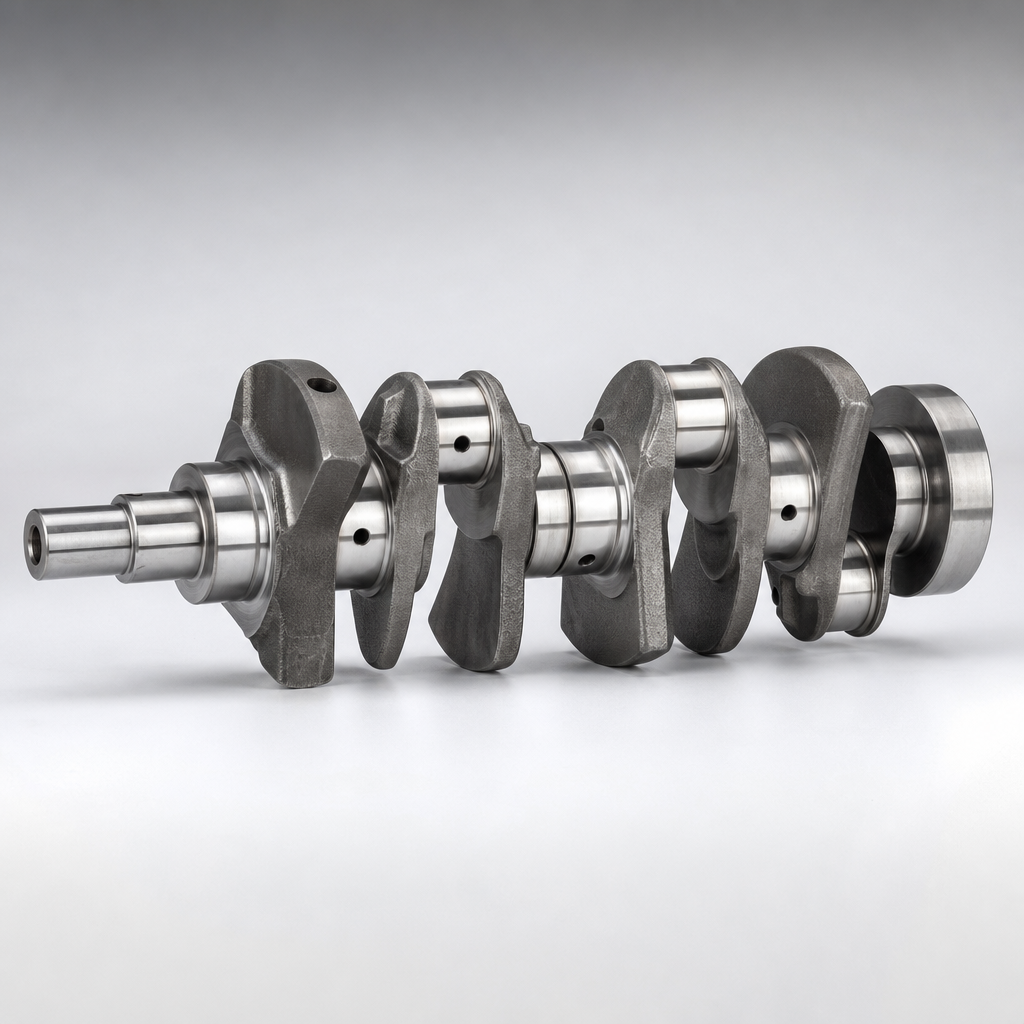
dual mass flywheel · 2026-06-04

Dual Mass Flywheel Manufacturer China: Sourcing Guide

For buyers searching for a dual mass flywheel manufacturer china, the real sourcing question is not whether a supplier can quote the part. It is whether they can hold the interface dimensions, control torsional damping behaviour, support OE cross-references, and ship repeatable assemblies at commercial volume. For aftermarket distribution, repair networks, and OEM supply, confidence comes from measurable process control rather than brochure language. A dual mass flywheel is far from a simple stamped component. It brings together primary and secondary rotating masses, arc springs, friction or hysteresis elements, bearing or bushing support, clutch friction faces, starter ring gear engagement, and dynamic balance requirements. Each one can affect idle rattle, launch judder, shift feel, starter noise, and gearbox durability. Even a small mismatch in crank register diameter, pilot bore, bolt circle PCD, axial height, ring gear position, or damping angle can lead to vibration, difficult installation, abnormal noise, or early return claims. Driventus is an independent aftermarket manufacturer; brand names are referenced for fitment only. We manufacture engine and powertrain components in Taizhou, Zhejiang, and export to 60+ countries with IATF 16949:2016 and ISO 9001:2015 systems in place. This guide outlines what procurement teams should verify before placing a trial order, including technical checks, audit points, validation expectations, and commercial terms that reduce sourcing risk when building a China-based dual mass flywheel programme.

What buyers should verify before sourcing

A dual mass flywheel is usually purchased against an OE reference, but the OE number alone rarely gives enough control for sourcing. Buyers should confirm the exact vehicle application, engine code, transmission code, clutch kit pairing, crankshaft fixing method, starter ring gear specification, and regional production differences before requesting a quotation. In many aftermarket programmes, two flywheels can look similar in overall diameter and bolt pattern while differing in axial stack height, crankshaft register depth, secondary mass offset, damping travel, or ring gear tooth count. Those details decide whether the part installs cleanly and whether the vehicle drives without judder, idle rattle, starter clash, or gearbox noise.

For procurement teams, the supplier file should include:

  • OE cross-reference format, for example OE 06A105266 or the buyer's verified reference where applicable
  • Vehicle application list by model year, engine code, fuel type, transmission code, and clutch kit reference
  • Assembly mass, nominal inertia where available, overall diameter, friction face diameter, and axial height
  • Crankshaft bolt pattern, PCD, hole diameter, pilot bore, register diameter, and mounting face offset
  • Ring gear tooth count, outside diameter, tooth form, chamfer direction, hardness range, and starter engagement position
  • Primary and secondary mass construction, spring pack configuration, damping angle, stop position, and rotational free play limits
  • Radial runout, face runout, dynamic balance grade or residual unbalance limit, axial clearance, and parallelism targets
  • Friction face flatness, roughness, machining pattern, and clutch contact diameter
  • Friction surface material, heat-treatment condition, and hardness range where specified
  • Fastener specification, bolt seating face, torque-angle notes, and whether new bolts are required
  • Packaging method, VCI or oil-based corrosion protection, drop-test expectation, and traceability label format

The strongest supplier discussions start with a drawing, a verified OE sample, an approved aftermarket sample, or a complete OE reference package. When those are not available, buyers should at least request dimensional confirmation against the target application before approving samples. A responsible dual mass flywheel manufacturer in China should be able to explain which characteristics are checked on every unit, which are checked by batch, which are verified at first-article approval, and which need application-specific validation.

If the supplier cannot provide controlled inspection data, the risk is not limited to premature wear. Gearbox rattle, clutch judder, starter noise, hard installation, bolt interference, and customer returns can all follow. For aftermarket supply, dimensional match matters as much as material grade because the part has to work with existing clutch, crankshaft, starter, bellhousing, and transmission interfaces. For reference, Driventus publishes product coverage in our catalog and engine-related families in engine components.

Manufacturing controls that matter

A reliable sourcing programme depends on process control at every stage, not just end-of-line inspection. For a dual mass flywheel, the main control points are incoming material verification, casting or forging quality where applicable, CNC turning and drilling accuracy, heat treatment, ring gear assembly, spring and internal damping component assembly, grease application, friction surface finishing, dynamic balancing, corrosion protection, and traceability. Each stage affects the next. A machining error can increase residual unbalance; inconsistent heat treatment can affect friction face wear and thermal checking; uncontrolled spring selection can change torque response from unit to unit.

Typical control items

</tr></thead><tbody> </tbody></table>Buyers should also examine how the manufacturer controls changeovers between part numbers. Dual mass flywheels are often produced across many SKUs with similar appearance, so fixture identification, poka-yoke where practical, first-piece approval, tool life monitoring, separated WIP locations, and barcode or batch control help prevent mixed parts. A factory that can show first-article inspection records, in-process inspection frequency, gauge calibration status, nonconformance handling, rework limits, and final audit results is usually easier to manage across repeat orders.

Published quality frameworks such as IATF 16949:2016 and ISO 9001:2015 belong in the supplier discussion, but certificates should be treated as the starting point, not the full audit. Buyers should connect each certificate to real production records: APQP or equivalent launch files where required, control plans, inspection standards, calibration logs, MSA or gauge R&R for critical gauges, corrective action reports, and traceable batch documentation. Driventus details its quality system for buyers who need audit-ready documentation and a clearer view of how manufacturing controls are applied in export supply.

Commercial terms for export buyers

For distributors and import managers, the commercial model should be clear before sampling starts. A manufacturer in China should state MOQ, sample cost, production lead time, payment terms, packing method, export carton configuration, and shipment options in writing. Dual mass flywheels are heavy, precision assemblies, so planning has to cover more than unit price. Landed cost, handling damage, and warehouse traceability all matter. Packaging strength, pallet density, corrosion protection, desiccant or VCI use, and carton labelling can directly affect damage rate, stock rotation, and resale quality.

For dual mass flywheel programmes, buyers usually evaluate:

  • MOQ by part number, by engine family, by mixed-SKU shipment, or by consolidated order value
  • Sample lead time, pilot order lead time, mass production lead time, and capacity during peak season
  • Whether tooling, fixture, gauge, validation, or development charges apply for new references
  • Unit price validity period and steel, casting, bearing, or spring component price adjustment mechanism
  • Standard export packing, foam or molded pulp support, VCI bag or anti-rust oil, carton strength, and palletisation
  • Carton drop-test, stacking strength, vibration, humidity, and long-distance sea freight requirements
  • Labelling for batch traceability, private label, barcode, QR code, country of origin, and market-specific content
  • Incoterms such as EXW, FOB Ningbo or Shanghai, CIF, DAP, or DDP where supported and legally practical
  • Port options, consolidation options, HS code review, mixed-SKU loading plan, and pallet dimensions
  • Payment terms, pre-shipment inspection timing, and document requirements such as invoice, packing list, BL, COO, and test records
  • Replacement, credit, sorting, quarantine, or containment policy for confirmed defects

Lead time should be quoted separately for sample, pilot, and bulk orders. A sample can often be prepared faster than a repeatable production batch because it may use existing components, extra inspection, or manual preparation. Buyers should therefore ask how long it takes to produce the first commercial batch under normal process conditions, not only how quickly one sample can be sent. For recurring orders, it is also important to understand whether the supplier keeps finished stock, semi-finished machined blanks, shared ring gears and spring packs, or only produces to order.

If a supplier claims short lead times but cannot show capacity, incoming quality control and final balancing may become bottlenecks. For multi-SKU programmes, it is useful to group related parts under one sourcing plan so logistics, inventory, carton design, label control, and documentation are easier to manage. Importers should also define how claims are handled: what evidence is required, whether torque marks or installation records are needed, how returned or field-failed parts are reviewed, and how corrective actions are communicated. Driventus supports custom manufacturing for catalog adaptation, export packaging, private label requirements, and application-specific programmes where the technical data and commercial volume are clearly defined.

Validation tests before release

Before moving from sample to bulk supply, procurement teams should require validation testing against the application profile. For a dual mass flywheel, release work usually starts with dimensional inspection, balance verification, runout checks, and functional torsion checks. The scope can then expand depending on order size, vehicle platform risk, and market exposure. The aim is to confirm that the product is not only dimensionally similar to the reference part, but also stable under rotational, thermal, axial, and torsional load conditions.

Suggested validation checklist

1. Confirm OE fitment against the vehicle application, engine code, clutch kit, transmission code, starter type, and crankshaft fixing method. 2. Measure key dimensions against the agreed drawing, OE sample, or approved reference sample using defined datums. 3. Check crankshaft mounting face, bolt PCD, pilot bore, register diameter, axial height, friction face offset, and ring gear position. 4. Verify assembly balance, radial runout, face runout, parallelism, and axial clearance at defined datum points. 5. Confirm damping travel, rotational free play, spring behaviour, return performance, and end-stop function. 6. Review friction surface finish, hardness, flatness, contact diameter, and clutch bedding surface condition. 7. Inspect ring gear tooth count, tooth profile, hardness, chamfer direction, and starter engagement orientation. 8. Check noise, looseness, grease leakage, excessive backlash, or abnormal movement during manual and fixture testing. 9. Review corrosion protection and packaging after transit simulation or real shipment trial. 10. Approve inspection records and retain a signed golden sample or boundary sample for future batch comparison.

For higher-risk programmes, buyers may request additional bench testing such as torsional characteristic curve measurement, cyclic torsional fatigue, thermal cycling, burst or overspeed evaluation, endurance running, hot-spot resistance checks, and comparison testing against an original sample. These tests should be selected according to the actual vehicle platform and purchasing specification. A small aftermarket trial order may not need the same test scope as an OEM or Tier-1 programme, but every programme should have defined acceptance criteria before bulk shipment.

Where relevant, buyers may also ask whether the product programme has been assessed for market-specific compliance considerations such as REACH (EC) No 1907/2006 for restricted substances in materials, coatings, grease, and packaging. For environmental and corrosion discussions, buyers may specify neutral salt spray or humidity exposure according to their own aftermarket standard; for durability, the more useful requirement is usually a defined torsional load cycle, speed range, temperature profile, and acceptance limit rather than a vague statement that the part is 'tested'. Standards should be cited accurately and only where they apply to the purchasing specification. The practical point is simple: validation belongs in the release plan, with pass/fail criteria agreed before a claim appears in the field.

How Driventus supports procurement teams

Procurement professionals usually need three things from a dual mass flywheel supplier: consistent product, clear technical communication, and export discipline. Driventus manufactures in Taizhou with integration across engine and powertrain parts, helping connect machining flow, incoming material checks, process inspection, assembly control, balancing, corrosion protection, and packing standards. For buyers comparing a dual mass flywheel manufacturer in China, this structure makes the review process more concrete because technical, quality, and commercial questions can be linked to production records and batch-level controls.

What buyers can request:

  • Application review for OE cross-reference matching and regional fitment risk
  • Confirmation against engine code, transmission type, clutch system, starter position, and crankshaft interface where data is available
  • Sample submission with dimensional report, runout data, balance confirmation, and visual inspection record
  • Batch traceability, production lot code, carton label, and retained inspection records
  • Dynamic balance, radial runout, face runout, and key dimension confirmation according to agreed scope
  • Ring gear, friction face, spring pack, and mounting interface checks for critical applications
  • Export packaging adapted to distributor, private label, or OEM requirements
  • Carton label, barcode, pallet, document, and mixed-SKU shipment support for import workflows
  • Programme support for catalogue expansion, OE reference mapping, and regional fitment development
  • Technical communication for claim review, containment, root-cause analysis, and corrective action follow-up

Driventus serves aftermarket distributors, OEM and Tier-1 suppliers, and repair networks across 60+ countries. That experience does not replace a buyer's own audit, sample testing, or release process, but it does mean the supplier side can be structured for technical review, factory verification, and repeat order planning. A strong sourcing conversation usually starts with a target application list, annual volume estimate, required packaging format, OE or sample references, and any known market-specific requirements. From there, Driventus can review feasibility, confirm available references, identify where new development or validation may be needed, and prepare a quotation path. Start with request a quote once your target application list is confirmed.

Frequently asked questions

Yes, when the application data is complete. Buyers should provide OE references, engine code, transmission type, clutch system details, starter/ring gear information, and any dimensional sample or drawing so fitment can be confirmed before quotation.

Ask for material traceability, key dimension reports, balance data, runout records, packaging details, batch labels, and quality certificates. IATF 16949:2016 and ISO 9001:2015 are common system references, but buyers should also review control plans, calibration records, and real batch inspection data.

Yes. Driventus offers custom manufacturing for packaging, labelling, application coverage, inspection scope, and application-specific requirements where the technical data is defined and the programme is commercially viable.

If you are comparing suppliers, send your application list, OE references, packaging needs, target volume, and any inspection requirements for a technical review and quotation. [request a quote](/contact.html)

Request a Quote
Control item What buyers should ask for Why it matters
Material traceabilityHeat number, batch record, supplier source, and material certificateSupports containment if cracking, hardness drift, or wear defects appear
Incoming inspectionCertificate review, hardness spot check, blank dimensions, and casting or forging visual criteriaPrevents nonconforming blanks entering machining and assembly
Machining tolerancesBore, register, bolt circle PCD, mounting face, friction face, height, and datum schemeProtects concentricity, clutch alignment, axial position, and installation fit
Ring gear controlTooth count, tooth profile, runout, hardness, chamfer orientation, and press-fit or shrink-fit recordSupports correct starter engagement and reduces tooth wear or starter noise
Dynamic balanceBalance report per unit or batch, correction method, speed, and residual unbalance limitReduces driveline vibration, bearing load, and gearbox noise
Runout checkRadial and axial runout measured at agreed datum points with calibrated gaugesHelps prevent clutch judder, pedal pulsation, and rotating imbalance
Spring pack inspectionFree length, wire diameter, load curve, travel, damping angle, end-stop position, and grease conditionConfirms torsional damping performance and protects against rattle or harsh engagement
Friction surface finishRoughness, flatness, parallelism, machining pattern, and visual conditionAffects clutch bedding, engagement feel, heat transfer, and wear
Surface hardnessHeat-treatment record, test method, test location, and acceptance rangeAffects wear life and resistance to hot spots under cyclic load
TraceabilityLot code on product, carton, pallet, and inspection recordMakes field feedback, quarantine, and corrective action practical