cylinder sleeve · 2026-06-18

Cylinder Sleeve Nissan Wholesale Sourcing Guide

A cylinder sleeve Nissan wholesale programme fails when the buyer treats sleeves as a catalogue commodity. The real risk is not one bad part. It is a full batch that installs inconsistently, wears rings early, rusts in transit, or cannot be traced when a repair chain reports warranty noise.

Use this guide as a sourcing decision tool. It separates what must be fixed before quotation, what should be validated before mass supply, and where suppliers often hide cost or quality risk. Driventus manufactures engine and powertrain components in Taizhou, Zhejiang, and exports to more than 60 countries. We supply aftermarket distributors, OEM and Tier-1 customers, and multi-location repair chains under IATF 16949:2016 and ISO 9001:2015 management systems. Driventus is an independent aftermarket manufacturer; brand names are referenced for fitment only.

Start With the Buying Decision, Not the Part Name

Before asking for price, decide what problem the order must solve: fast-moving stock replenishment, a repair-chain rebuild programme, a private-label launch, or a replacement for an unstable supplier. Each route changes the specification, MOQ logic and documentation level.

Nissan-fit applications may cover passenger cars, light commercial vehicles and industrial engine rebuild demand. One purchasing list can include high-volume references, occasional specialist sleeves and different bore oversizes. Treating all of them the same usually creates either excess stock or weak supplier control.

For early sourcing review, buyers can compare standard engine component lines in our catalog and align special drawings through custom manufacturing. When an OE cross-reference is required, use the format provided in the enquiry, such as OE 11251… or OE 06A… only where relevant to the requested application. Driventus does not claim vehicle manufacturer approval or endorsement.

A workable purchase specification should answer these questions:

  • Which engine family, engine code, nominal bore and oversize are required, such as +0.25 mm, +0.50 mm or +1.00 mm?
  • Is the sleeve dry, wet, flanged or straight, and are flange diameter and flange thickness confirmed?
  • Will the sleeve ship rough-machined, semi-finished with allowance, or finished bore ready for installation or honing?
  • Which dimensions are critical: OD, ID, total length, flange OD, flange thickness, chamfer, wall thickness, step or groove position?
  • Is the order a sample run, trial batch, replenishment batch or safety-stock build?
  • What packaging is required: individual VCI or anti-rust wrap, inner box, export carton, pallet, barcode label or private-label neutral pack?
  • Which export documents are needed: commercial invoice, packing list, certificate of origin where applicable and restricted substances review under REACH (EC) No 1907/2006?

Then rank references by movement. A-moving sleeves can support larger batches, dedicated safety stock and better unit economics. C-moving references may need mixed-reference pallets, longer replenishment cycles or higher unit pricing because casting yield, setup time and inspection labour are spread across fewer pieces.

Spec Deep-Dive: The Controls That Decide Sleeve Performance

Cylinder sleeve performance depends on cast iron structure, hardness control, wall-thickness stability and machining accuracy. A cheap sleeve can look acceptable on arrival and still fail in use if graphite distribution, concentricity or hardness variation is uncontrolled.

Confirm each specification against the buyer drawing, physical sample or agreed reference part. Catalogue wording is not enough, especially for semi-finished or finished-bore sleeves.

</tr></thead><tbody> </tbody></table>Inspection should cover outside diameter, inside diameter, flange diameter, flange thickness, total length, chamfer position, perpendicularity where specified and wall-thickness variation. For high-volume programmes, request a control plan, inspection fixture list and sample measurement report before approving mass production.

Tight tolerances need a temperature basis. Cast iron dimensions move with temperature, so critical measurements should normally reference 20°C or a documented shop-floor method. For press-fit dry sleeves, also confirm the interference range with the rebuilder. A sleeve that is correct for one block preparation method may be wrong for another.

Failure Modes a Supplier Must Prove They Can Contain

Final inspection alone is too late. A wholesale supplier needs process control that prevents repeat defects and isolates suspect batches fast when a field issue appears. Driventus operates under IATF 16949:2016 and ISO 9001:2015 frameworks, with incoming material checks, in-process machining inspection and final dimensional review. Buyers can review our quality system before arranging a factory audit or supplier qualification.

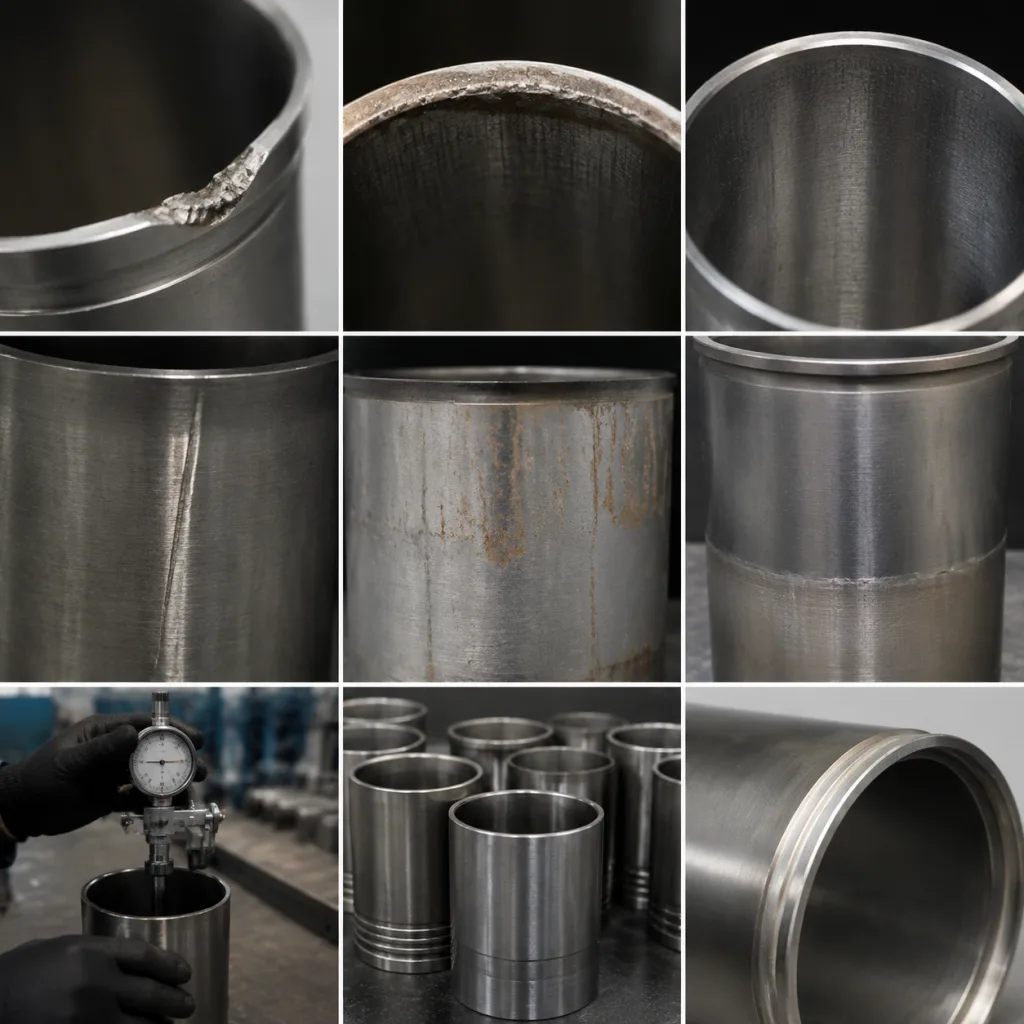
The most expensive sleeve problems are predictable:

  • Hardness variation across one shipment, causing uneven wear and inconsistent machining behaviour
  • OD or roundness drift, creating loose installation, excessive interference or block distortion
  • Flange thickness variation, affecting seating height and rebuild consistency
  • Rust or poor surface protection after sea freight, especially on long transit routes
  • Mixed rough, semi-finished and finished parts packed under one reference
  • Missing batch identity, making claim containment slow and expensive

Ask for documents that prove these risks are controlled, not just inspected at the end:

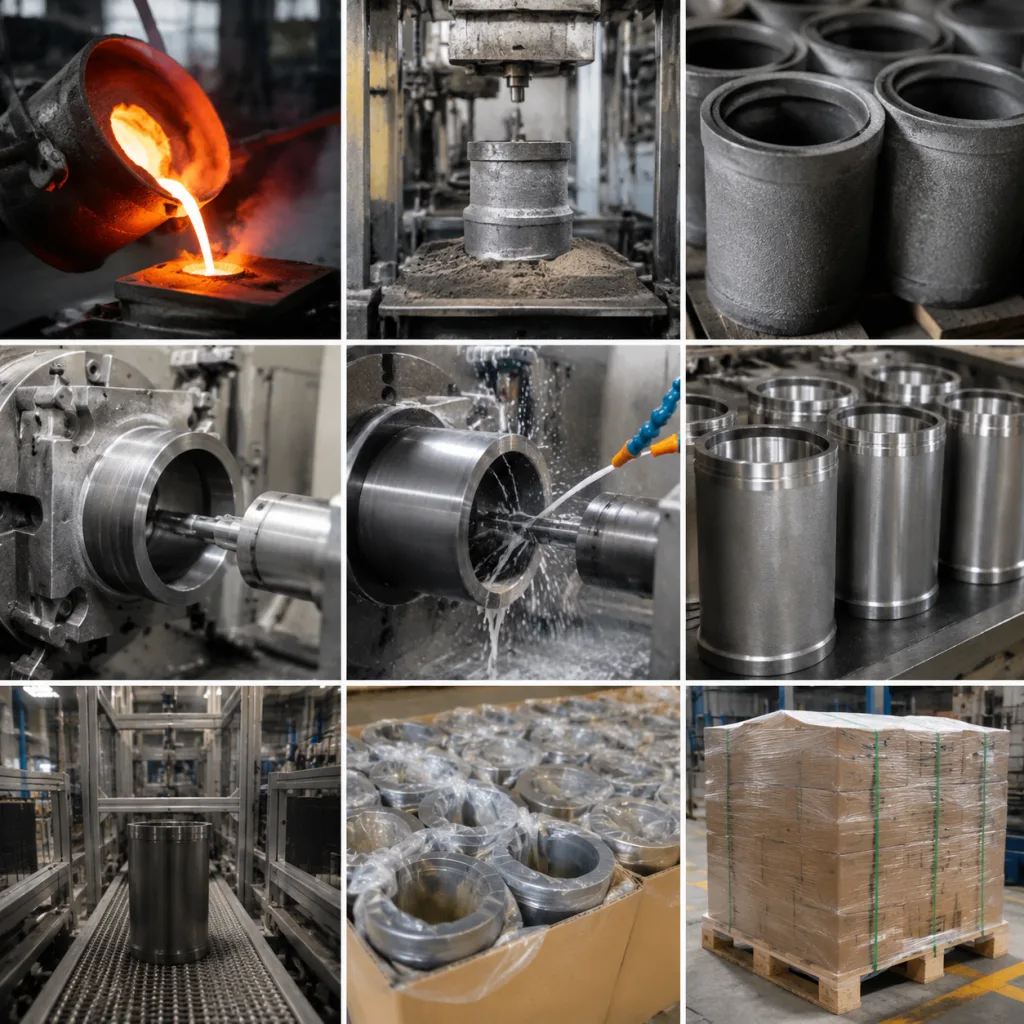
  • Process flow chart covering casting, optional stress relief or heat treatment, rough machining, finish machining, cleaning, anti-rust treatment and packing
  • Control plan identifying critical dimensions, inspection method, gauge type, sample size, inspection frequency and reaction plan
  • Material certificate with actual chemical composition, hardness range and heat or batch number
  • First article inspection report for every new reference, drawing revision, tooling change or machining process change
  • Batch inspection report with actual measured values for OD, ID, flange dimensions, length and visual inspection, not only pass/fail status
  • Gauge calibration list covering bore gauges, micrometers, height gauges, plug gauges, CMM or roundness equipment where used
  • Non-conformance and corrective-action procedure aligned with ISO 9001:2015 principles, including containment timing and 8D response where required

For a new cylinder sleeve nissan wholesale programme, validate in stages. Approve drawing or sample data first. Run 5-20 sample pieces for dimensional and installation review. Then approve a pilot lot of 100-300 pieces before releasing the full MOQ. For critical references, request Cpk review on OD, flange thickness or finished bore once the process is stable and the measurement method is agreed.

For regulated destination markets, also check packaging material requirements, restricted substance declarations under REACH (EC) No 1907/2006 and customer-specific documentation. Cylinder sleeves are not brake friction parts, emissions control devices or lighting components, so standards such as SAE J2527 or ECE R-83 are not normally the governing product standards for this component. Sleeve-specific drawings, material specifications and inspection controls should remain the primary acceptance criteria.

Failure Modes a Supplier Must Prove They Can Contain

Compare Ordering Models Before Negotiating Unit Price

Wholesale purchasing works best when references are grouped by engine family, casting route and machining setup. Grouping compatible items reduces changeover time, improves batch consistency and helps the supplier reserve capacity. For cylinder sleeve nissan wholesale enquiries, separate fast-moving references from low-volume rebuild items because MOQ, tooling needs and production timing may differ.

Use the table as a commercial planning baseline, then adjust by material, geometry and inspection level.

Specification item Typical wholesale control point Procurement note
MaterialCentrifugal cast grey iron or alloy cast iron; commonly HT250/HT300 or buyer-specified equivalentConfirm grade by drawing, sample or approved material specification
Chemical controlCarbon, silicon, manganese, phosphorus and sulfur checked by heat or batchRequire actual composition values, not only material name
HardnessCommonly HB 180-240, application dependentRequire batch hardness report and test location; avoid mixed hardness across one shipment
Graphite / structureFlake graphite and pearlitic matrix where specifiedRequest metallographic report for new or high-risk programmes
Bore conditionRough, semi-finished or finishedState machining allowance; semi-finished ID often keeps 0.30-0.80 mm for final boring/honing depending on application
OD toleranceDrawing-controlled; critical outside diameters often held within 0.01-0.03 mm where specifiedMatch tolerance to press-fit requirement and block machining method
ID toleranceRough or semi-finished by allowance; finished bore by drawingDo not accept verbal bore claims; define gauge method and temperature basis
Roundness / cylindricityUsually drawing-defined for finished or precision semi-finished sleevesAsk whether measured by roundness tester, bore gauge sweep or fixture method
Surface roughnessBore finish and OD finish defined separatelyHoned finished bores may require Ra/Rz targets; rough sleeves should not be judged by finished-bore criteria
Visual conditionNo cracks, heavy porosity, dents, burrs, rust or flange damageInclude AQL level and defect definitions in the purchase order
TraceabilityHeat, batch or production lot numberRequired for claim containment, stock isolation and replacement planning

</tr></thead><tbody> </tbody></table>Unit price is only one line in the cost model. Sleeve cost is shaped by casting weight, material grade, machining hours, scrap allowance, tolerance level, surface finish, inspection frequency, anti-rust protection, carton specification, pallet loading and Incoterms. A finished-bore sleeve with tight OD tolerance, individual boxing and 100% dimensional inspection should not be compared with a rough sleeve shipped in bulk cartons.

A practical model is to place a trial batch for the top 3-5 references, then move validated fast movers to a blanket PO with 60- or 90-day rolling forecasts. If demand is uncertain, split delivery into scheduled releases, for example 40% first shipment, 30% after 45 days and 30% after 90 days, if production and storage terms are agreed in advance.

Choose the model by buyer type. A multi-region distributor may prefer neutral packaging and consolidated mixed-reference pallets. A repair-chain buyer may value stable replenishment dates, barcoded cartons and clear batch identity more than the lowest unit quote. An OEM or Tier-1 programme may require PPAP-style documentation if specified by the customer; submission level, sample quantity and approval timing should be agreed before quotation.

Audit Scenario: Walk One Sleeve From Casting to Pallet

A useful audit does not start in the meeting room. Pick one sleeve reference, then follow it from casting receipt to final pallet. The goal is to see whether the supplier can repeat the same geometry across batches and protect the goods through export handling.

Use these questions during the walk-through:

  • Does the supplier control casting source, melt record, chemical composition and hardness by batch?
  • Are incoming castings checked for cracks, porosity, flange defects, excessive ovality and visible rust before machining?
  • Are critical dimensions measured with calibrated bore gauges, micrometers, height gauges, plug gauges, CMM or roundness equipment where required?
  • Is gauge calibration traceable, current and recorded, with overdue gauges blocked from use?
  • Are OD, ID, flange thickness, total length and chamfer dimensions checked at first piece, during production and final inspection?
  • Are rough-machined, semi-finished and finished sleeves physically separated to avoid packing or shipment errors?
  • How are rust prevention, VCI paper or bag use, desiccant quantity, carton strength and pallet moisture protection validated?
  • Can the supplier isolate raw material, work-in-progress, finished goods and shipped stock by batch number after a field claim?
  • What is the normal containment time and corrective-action response time for dimensional or material claims?

Look closely at fixture condition, tool-change records, first-piece approval, rejected-part segregation, anti-rust dip or spray concentration, carton drop resistance and pallet wrapping. Traceability should be simple at warehouse level: the carton label should connect to production batch, inspection record and material certificate without manual guesswork.

Commercial audit points also matter. Confirm Incoterms, payment terms, port of loading, HS code review, private-label rules, spare carton labels, document cut-off times and pre-shipment inspection options. Driventus exports from China to customers in the EU, UK, US, Canada, Australia, Brazil and other markets, so destination-specific document formats can be agreed during order confirmation.

Audit Scenario: Walk One Sleeve From Casting to Pallet

RFQ Checklist: What to Send for a Fast, Usable Quote

A strong RFQ gives the supplier enough information to quote the sleeve you actually need. If no drawing is available, provide a physical sample or full dimensional report. Photos alone are not enough; they cannot confirm bore size, flange geometry, wall thickness or surface finish.

Include the following with your enquiry:

  • Application description, engine code, fuel type and market region where available
  • OE cross-reference if already used in your internal system, such as OE 11251…, for cross-reference only
  • Sleeve type and required dimensions: outside diameter, inside diameter, flange diameter, flange thickness, total length, chamfer size and wall thickness
  • Required machining state: rough, semi-finished or finished, including bore allowance or final bore tolerance if known
  • Material grade, hardness range, surface finish requirement and any metallography requirement
  • Annual volume, first order quantity, target MOQ, preferred shipment split and required delivery window
  • Packaging requirements, label format, barcode data, carton weight limit, pallet dimensions and pallet height limit
  • Destination country, preferred Incoterms, port of discharge and any certificate of origin requirement
  • Required inspection documents, AQL level, first article format and any customer-specific forms
  • Target price level or previous purchase benchmark if available, so the quotation can separate cost reduction options from specification changes

For faster comparison, send a simple RFQ table with one row per reference and separate columns for drawing number, engine code, OD, ID, flange OD, flange thickness, length, machining condition, quantity and packing. If the sleeve is replacing an existing supplier part, include 3-5 sample pieces from different batches where possible. This helps identify tolerance spread instead of copying one worn or damaged sample.

For custom bore sizes, special alloy requirements or private-label wholesale packaging, use custom manufacturing. For standard engine lines and related components, review our catalog, including engine components. When the RFQ is ready, procurement teams can request a quote with drawings, samples or dimensional data.

Frequently asked questions

Provide the engine application, dimensions, sleeve type, machining condition, quantity, destination country and required documents. A drawing or measured sample is preferred. If you use an internal OE-style reference such as OE 11251…, include it for cross-reference only.

Yes. Packaging can be neutral or buyer-specified, subject to carton artwork, label data, pallet configuration and order quantity. Anti-rust protection and export carton strength should be confirmed before mass shipment.

No. Driventus is an independent aftermarket manufacturer; brand names are referenced for fitment only. We manufacture to agreed drawings, samples and quality requirements, without claiming approval or endorsement by a vehicle manufacturer.

For pricing, samples or supplier qualification documents, send your drawings, forecast and destination details. Our team will review the RFQ and respond with practical sourcing options at /contact.html

Request a Quote
Ordering item Typical range Notes for buyers
Sample quantity5-20 pieces per referenceUsed for dimensional review, installation trial and finish confirmation
Trial order100-300 pieces per referenceSuitable for market validation before full stocking commitment
Standard MOQ300-1,000 pieces per referenceDepends on casting batch, machining setup, sleeve weight and packaging type
Mixed-reference MOQNegotiable by engine family or casting routeWorks best when OD, material and machining setup are similar
New tooling lead time25-45 days before samplingApplies to new casting pattern, special flange or non-standard sleeve geometry
Sample lead time15-35 days where tooling existsConfirm whether finished bore, honing, phosphating or special marking is required
Production lead time30-60 days after sample or drawing approvalLonger for new tooling, non-standard alloy, inspection hold points or peak-season capacity
Export packingInner protection plus carton and palletSea freight requires VCI, desiccant or sealed moisture control when transit is long
Supply modelSpot order, blanket PO or scheduled releaseForecast improves casting planning, replenishment reliability and price stability