cylinder sleeve · 2026-06-04

Cylinder Sleeve Hyundai OEM Supplier: Sourcing Guide

For procurement teams sourcing a cylinder sleeve Hyundai OEM supplier, the decision should rest on engineering evidence, not catalogue language. Fitment, metallurgy, dimensional stability, traceability, and supply continuity determine whether a sleeve will assemble correctly, maintain compression, transfer heat into the block, and reach the intended service interval. Even small deviations in outside diameter, wall thickness, roundness, taper, flange height, or plateau-honed finish can affect press-fit load, liner seating, oil retention, ring break-in, and long-term engine reliability.

Driventus supplies engine and powertrain components from Taizhou, Zhejiang, with IATF 16949:2016 and ISO 9001:2015 certified production systems. We support aftermarket distributors, OEM and Tier-1 programmes, and repair-chain buyers that need repeatable specifications, documented inspection records, controlled lot identification, and packaging suitable for export distribution. Driventus is an independent aftermarket manufacturer; Hyundai and other brand names are referenced for fitment only.

For buyers comparing suppliers across Europe, the UK, North America, Australia, and Brazil, the practical focus should be on drawing-controlled sample approval, lot-to-lot consistency, corrosion-protected packaging, and lead-time reliability. The sections below outline what to verify before placing volume orders and how to align technical and commercial requirements with a supplier that can support repeat business.

What procurement teams should verify first

A cylinder sleeve purchase should begin with application data, not catalogue wording. For Hyundai engine programmes, buyers should confirm the engine code, displacement, sleeve type, installation method, and whether the part is intended for dry liner, wet liner, or repair oversize use. A repair sleeve for a worn or oversize bore is not interchangeable with a new-build component unless the drawing explicitly defines the oversize, interference range, flange geometry, and final-bore machining allowance.

Where the programme uses OE cross-reference data, treat the reference as a fitment aid rather than a substitute for dimensional verification. Lock the application definition before quoting so the supplier can build to the correct geometry, material, finish, and inspection plan. For dry sleeves, confirm the required press-fit or shrink-fit condition against the block bore. For wet sleeves, confirm seal groove geometry, flange protrusion, coolant-side finish, and cavitation-resistance expectations.

Minimum buyer checklist

  • Engine code, displacement, model year range, and fuel type where relevant
  • Sleeve type: dry, wet, semi-finished, finished, or repair oversize
  • Nominal bore, outside diameter, wall thickness, and machining allowance
  • Overall length, flange diameter, flange thickness, step height, and chamfer details
  • Required interference fit, liner protrusion, or seating depth if specified by the rebuild standard
  • Block material, installation method, and final honing process
  • Material specification, casting route, and heat-treatment condition
  • Bore finish requirement, such as Ra/Rz target, cross-hatch angle, and plateau-honing requirement when applicable
  • Packaging and labelling needs for export cartons, pallets, and warehouse scanning
  • Country-specific chemical compliance, including REACH (EC) No 1907/2006 where applicable
  • Required documentation level, including first article approval, dimensional reports, and lot traceability

If your sourcing file is incomplete, request a dimensional drawing, a physical sample, and clarification on the intended block application before you commit to production. That is the fastest way to prevent insufficient press fit, sleeve movement, coolant seal leakage, deck mismatch, and returns after installation.

Dimensional control and material requirements

A serious supplier should be able to state the sleeve material, hardness range, machining route, and inspection method used at each stage of production. For engine repair and remanufacturing programmes, the key issue is not whether one sample meets the drawing. It is whether every production lot can reproduce the same geometry, surface condition, and material stability within the agreed tolerance band.

The material choice must support the thermal and mechanical loads of the engine family. Buyers should ask for the sleeve body material, casting or centrifugal-casting details where relevant, alloying elements, heat-treatment state, and post-machining tolerance bands. Many cast-iron sleeves are specified around pearlitic grey cast iron or alloyed cast iron with controlled graphite structure; the exact grade should be stated on the drawing or purchase specification. Surface condition matters as much as bulk material because the bore finish controls piston-ring seating, oil film retention, lubrication, and break-in performance.

</tr></thead><tbody> </tbody></table>Where customers request documentation, we can support PPAP-style submission packs, dimensional reports, material traceability, and lot-code records. For engineered programmes, see our custom manufacturing capability page. If a customer needs a specific finish or machining allowance, the drawing should define the requirement before tooling or sample approval begins; that avoids ambiguity during mass production and reduces the risk of rejecting usable parts against non-standard expectations.

How Driventus supports OEM and aftermarket supply

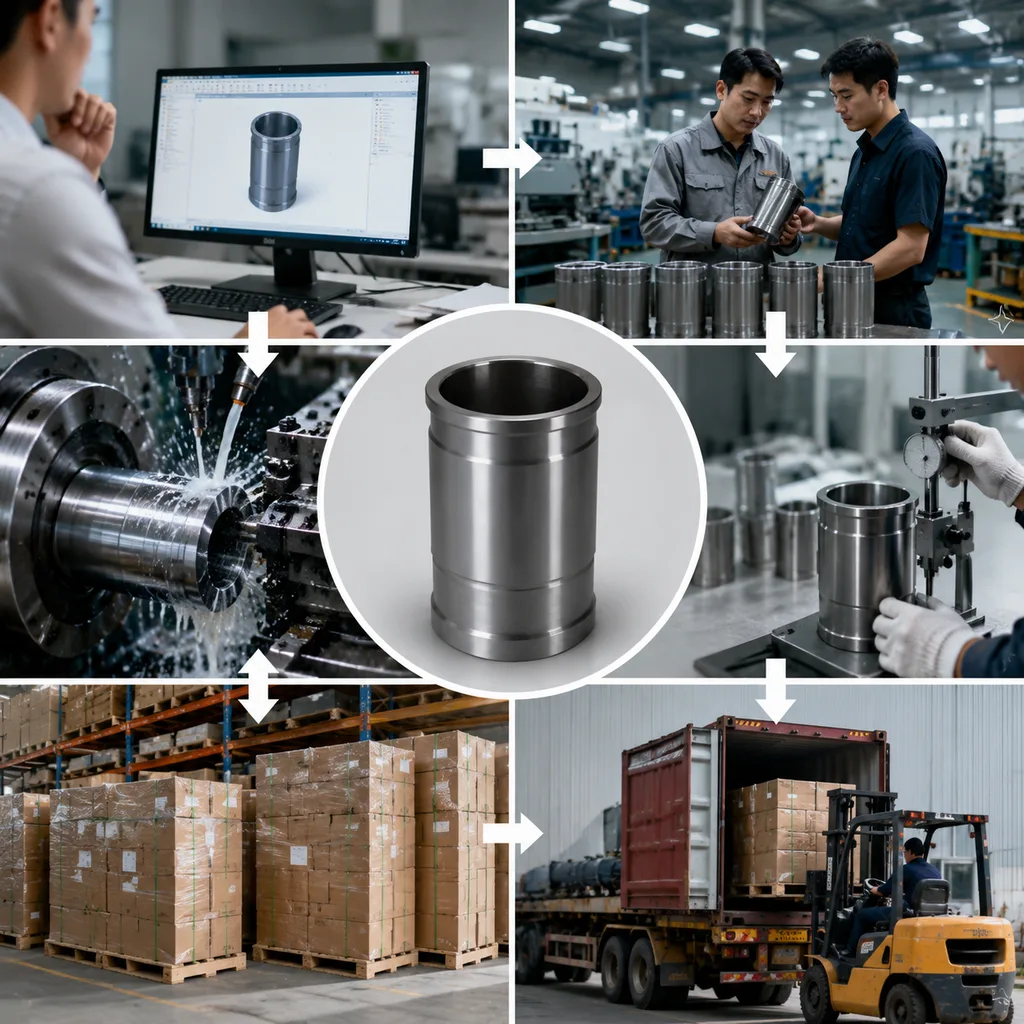
Driventus operates as a vertically integrated manufacturer, which helps control the process steps that matter most in sleeve production: material sourcing, casting or blank preparation, rough machining, heat treatment where specified, finish machining, honing, inspection, corrosion protection, and packing. That structure reduces dependency on external subcontractors and gives procurement teams a clearer line of sight from incoming material to shipped carton. It also improves the ability to hold the same specification across repeat orders.

Our supply model is structured for B2B buyers with different operating priorities:

  • Aftermarket distributors and wholesalers: stable SKU supply, neutral or private-label carton labelling, export packing, and replenishment planning
  • OEM / Tier-1 suppliers: controlled technical change management, drawing revision control, documentation packs, and lot traceability
  • Multi-location repair chains: repeatable fitment, predictable lead times, and manageable MOQ planning
  • Regional importers: consolidated shipping, transparent carton marks, pallet planning, and packaging that supports warehouse handling

For buyers building a broader engine line, our catalog and engine components overview can be used to align sleeves with pistons, rings, gaskets, crankshafts, bearings, and related parts. In practice, the main commercial questions are MOQ, sample lead time, annual volume flexibility, inspection scope, and whether a programme can be held open with scheduled releases rather than one large order. These are handled case by case because sleeve dimensions, tooling status, packaging, and test requirements vary by application and customer standard. A good supplier should be able to explain where it can flex and where it needs a fixed specification to maintain quality.

Quality system, inspection, and compliance documents

A cylinder sleeve Hyundai OEM supplier should be able to show how parts are controlled from incoming material to final shipment. Our production is managed under IATF 16949:2016 and ISO 9001:2015 systems, with inspection records available by batch. For procurement teams, that matters because it shows a repeatable process, calibrated measurement discipline, and traceable production records, not just a one-time approved sample.

The strongest approval packages normally include both technical evidence and production controls. A drawing alone is not enough if the supplier cannot show how it verifies dimensions, tracks lots, handles nonconforming material, and controls drawing revisions. Buyers auditing remotely should ask for the same evidence they would expect from a domestic source: control plan, inspection frequency, gauge calibration status, sample approval records, and corrective-action workflow.

Common documents procurement teams request

  • Material certificate with heat number or batch traceability
  • Dimensional inspection report covering OD, ID, length, flange dimensions, roundness, taper, and critical features
  • Surface finish, hardness, or microstructure data where specified
  • First article samples and signed sample approval record
  • Control plan, inspection standard, or special-characteristic list for controlled programmes
  • Packaging specification, anti-rust method, carton count, gross weight, and pallet layout confirmation
  • Lot identification, production date, and packing list linked to shipment records
  • Declaration of conformity for regulated markets when applicable
  • Corrective-action response history for recurring issues, if available under NDA

For buyers auditing a factory remotely, the question is not whether a supplier says it has a quality system. The question is whether that system appears in records, control plans, calibration status, in-process checks, and corrective-action handling. Our quality system page outlines the controls used for export programmes and repeat orders. If your organisation requires a specific approval workflow, define the required submission pack up front so there is no gap between sample sign-off and production release.

Commercial points that affect landed cost

Cylinder sleeve pricing is affected by material grade, blank weight, casting route, machining time, honing requirement, inspection level, packing method, freight density, and the degree of application-specific control required. For procurement managers, landed cost should include far more than the unit price on the quotation. A low headline quote can become expensive if it carries poor dimensional consistency, weak anti-rust protection, higher rejection rates, carton damage, or slow responses to drawing changes.

Before comparing quotations, buyers should normalize the commercial terms so they are comparing like for like. The same part can have very different total cost depending on whether it is quoted EXW, FOB, CIF, DAP, palletised, private-label packed, or with third-party inspection included.

Consider these variables before comparing quotations:

1. MOQ and mixed-SKU flexibility 2. Tooling status and sample approval time 3. Production lead time after deposit, PO, or drawing release 4. Carton configuration, anti-rust method, and pallet utilisation 5. Inspection scope, including AQL level or third-party inspection if required 6. Incoterms, destination compliance paperwork, and customs documentation 7. Packaging strength for sea freight, export transit, and warehouse handling 8. Currency exposure, raw-material fluctuation, and quotation validity window

When the programme is stable, the most efficient sourcing model is usually to lock the drawing version, acceptance criteria, carton format, label content, and release schedule before production starts. That reduces claims later, protects margin, and makes replenishment more predictable. For many buyers, cost control improves more from reducing avoidable variation, rework, and freight damage than from squeezing another percentage point off the unit price.

When to request custom manufacturing

Standard catalogue parts are efficient when the engine family is established, the repair route is well known, and the target market is broad. Custom manufacturing becomes the better option when the application has a special flange profile, a non-standard length, an unusual interference requirement, a customer-specific material grade, or a defined bore-finish specification. It is also the right route when the buyer needs a sleeve that adapts an older engine block to a rebuild standard used in a particular region.

Custom sourcing is usually justified when one or more of the following apply:

  • The original sleeve is obsolete or no longer supplied
  • The repair dimension must match a local rebuild standard
  • The engine block requires an oversize or undersize adaptation
  • The flange, step, chamfer, seal groove, or liner protrusion differs from the catalogue part
  • The buyer needs private-label packaging, regional barcoding, or customer-specific carton marks
  • The programme requires additional inspection, testing, PPAP-style records, or customer sign-off
  • The customer wants a controlled change from an existing reference part
  • The application involves a smaller batch where exact fit matters more than catalogue availability

If your team is comparing suppliers across several engine families, a short technical brief usually defines the correct route: off-the-shelf, adapted, or fully custom. That brief should include the engine code, sample photos, drawing references, target dimensions, interference or protrusion targets, finish requirements, annual demand, and packaging needs. The clearer the brief, the faster the supplier can confirm feasibility, quote accurately, and avoid sampling parts that cannot be validated against the final application. For teams that manage multiple programmes, that upfront discipline saves time and prevents misalignment between engineering and purchasing.

Frequently asked questions

Yes, provided the buyer supplies the engine code, dimensions, and the relevant OE cross-reference format already used in the programme. We do not claim manufacturer endorsement. Fitment is verified by drawing, sample, and dimensional review, and final acceptance should always be based on the buyer's application standard.

Typical documents include dimensional inspection reports, material traceability, lot identification, and packaging specifications. For controlled programmes, we can also support PPAP-style submissions, sample approval records, surface finish or hardness data where specified, and other documentation requested by the buyer's quality team.

Yes. MOQ depends on sleeve size, tooling status, inspection scope, and packaging format. We regularly support export cartons, palletised shipments, mixed-SKU replenishment, anti-rust protection, and private-label packaging for distributors and repair networks.

If you are qualifying a new source or comparing prices for a Hyundai programme, send your drawing, sample request, target tolerance, packaging requirement, or estimated annual volume and we will review it with you. Request a quote: /contact.html

Request a Quote
Parameter Typical procurement check Why it matters
Outer diameterMeasure at top, middle, and bottom in at least two clock positionsControls press fit, heat transfer, and retention
Inner diameterCheck semi-finished and finished bore conditionDefines piston-to-wall clearance and honing allowance
Wall thicknessCross-check at thrust and non-thrust zonesInfluences strength, distortion, and heat transfer
Length and flange heightFirst article audit plus routine lot checksPrevents deck mismatch, liner protrusion errors, and seating problems
Roundness and taperReported on first article and control samplesReduces blow-by, oil consumption, and ring wear
Surface finishVerify after boring/honing; specify Ra/Rz or plateau parameters where requiredSupports oil film stability and ring break-in
Concentricity/runoutMeasure on critical applications and custom lotsHelps avoid localized wear, piston noise, and uneven loading
HardnessConfirm by batch when specified by programmeSupports wear resistance and machining stability