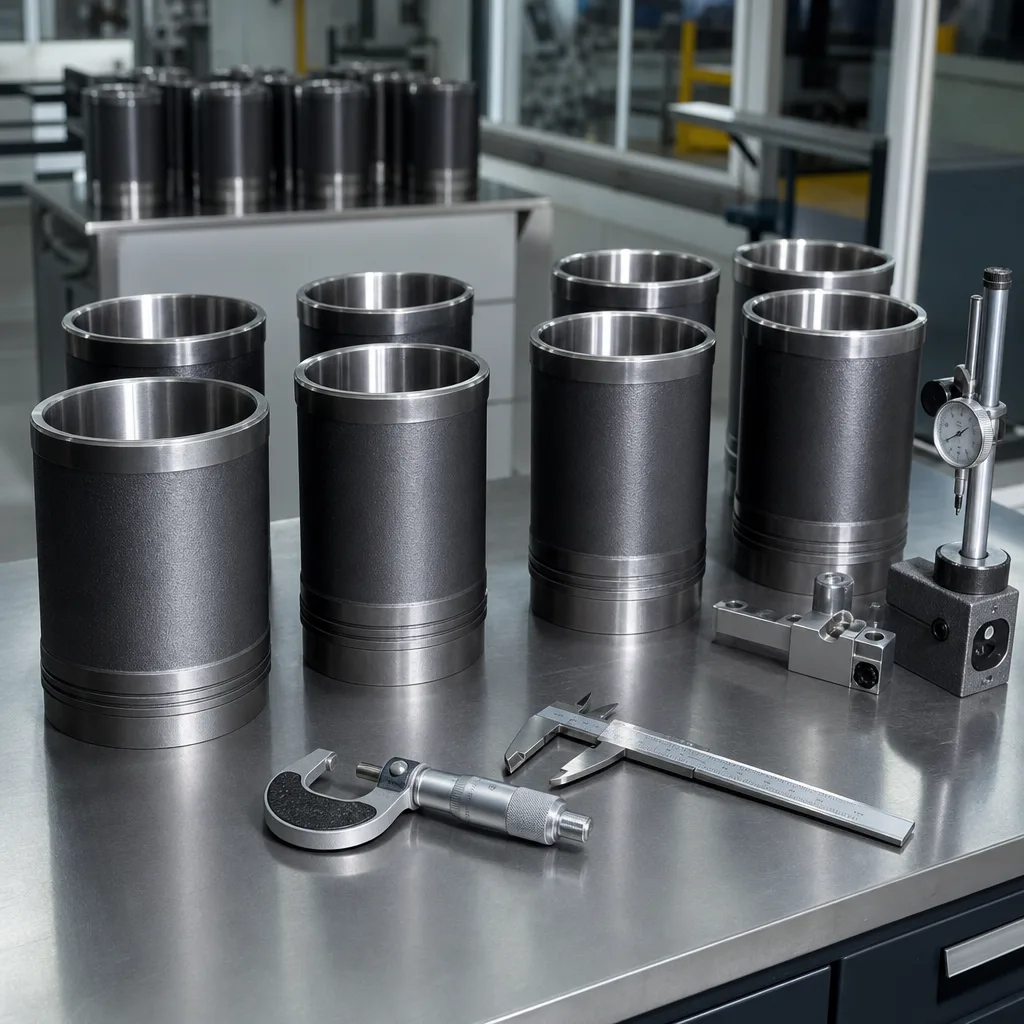
Cylinder Sleeve BMW Manufacturer China for Aftermarket Supply
Procurement teams buying cylinder sleeves for BMW applications usually need three things at once: correct bore geometry, stable supply, and documentation that holds up in audit. That means more than a finished part. It means controlled material, traceable inspection, and a supplier that can work from drawings, samples, and volume forecasts. Driventus is an independent aftermarket manufacturer; brand names are referenced for fitment only. For buyers in the EU, UK, US, Canada, Australia, and Brazil, the practical question is whether the supplier can repeat the same sleeve specification across pilot and production lots without drifting on wall thickness, hardness, or interference fit. The right answer depends on the block design, the repair strategy, and the end-market compliance package. This article sets out the sourcing criteria we use for engine sleeves, and where our catalog, quality system, and custom manufacturing support fit into that process.
When a BMW application needs a cylinder sleeve
A sleeve is usually specified when the original bore is worn, scored, cracked, or no longer within the machining allowance for the block. In procurement terms, the sleeve is not just a replacement part; it is a controlled repair component that must work with the block material, the final bore finish, and the piston set selected by the remanufacturer.
For BMW-related rebuild work, the buying decision normally starts with the block drawing or a measured sample. The supplier should confirm:
- Base material and casting route
- Bore size before and after machining
- Sleeve interference fit in the parent block
- Final honing allowance and surface finish
- Packaging to prevent corrosion during export
If the repair strategy is not defined early, a buyer can end up with a sleeve that fits the drawing but not the actual block condition. That is why the sourcing pack should include photos, dimensional data, and the intended machining sequence. If you also source pistons, gaskets, and water pumps, it is worth aligning the sleeve order with the rest of the engine bill of materials through our catalog and engine components.
Materials, machining, and tolerance controls
For engine sleeves, the material choice is driven by wear resistance, thermal stability, and machinability. Cast iron remains common because it is stable under heat, hones predictably, and is familiar to machine shops that rebuild passenger-car and light-duty engines. For some programs, alloyed or ductile iron variants are specified to improve strength or crack resistance.
Typical controls buyers should ask for are:
- Outer diameter tolerance for press fit
- Inner diameter allowance for final hone
- Wall thickness control
- Concentricity and roundness
- Hardness range after heat treatment
- Surface finish after honing, often specified as Ra rather than a broad visual standard
A supplier should also define the sequence between rough machining, heat treatment, finish machining, and protective oiling. If the process is not fixed, dimensional drift often appears at the final bore stage rather than at incoming inspection. For repeat orders, request a control plan that lists the measurable points and the sampling method. That is the only way to compare production lots across months, not just individual samples.
Replacement, repair, and custom sleeve options
Not every sourcing case needs the same sleeve type. Buyers normally face three options, each with a different cost and validation burden.
| Option | Best use case | Procurement impact |
|---|---|---|
| Standard replacement sleeve | High-volume aftermarket and common rebuilds | Lower tooling cost, faster repeat supply |
| Oversize repair sleeve | Worn or damaged blocks that need extra machining allowance | Requires block measurement and tighter workshop control |
| Custom sleeve to drawing | OEM, Tier-1, or platform-specific repair programs | Higher validation effort, but better fit to the block and piston set |