Cylinder Liner Opel Manufacturer China: Supplier Guide
Buyers searching for a cylinder liner Opel manufacturer China usually need three things at once: dimensional consistency, stable supply, and documentation that stands up to a factory audit. For engine remanufacturing, aftermarket distribution, and private-label programmes, the liner is not a generic cast part. It has to match bore geometry, interference fit, surface finish, and thermal behaviour across repeat orders. Driventus is an independent aftermarket manufacturer; brand names are referenced for fitment only. Our role is to supply engine components with controlled machining, traceable inspection records, and packaging that survives export handling. This matters for Opel applications because customers often buy against engine family, platform, or OE cross-reference rather than a simple visual sample. The procurement decision should therefore be based on materials, tolerances, process control, and lead-time discipline, not just unit price.
What procurement teams should verify first
For a cylinder liner, the first pass is not price. It is fitment control, production repeatability, and the supplier's ability to document what was made.
Key checks for an Opel programme:
Engine family and application scope, including whether the liner is for a dry or wet design
Finished bore diameter, outer diameter, flange geometry, and installed height
Required interference fit with the block and any honing allowance
Surface finish target after machining and plateau honing
Material grade, heat treatment route, and hardness range
Inspection method for concentricity, roundness, and wall thickness
Packaging method to prevent corrosion and edge damage in transit
If the source is a China factory, ask for the same evidence you would request from a local supplier: material certificates, in-process inspection records, and final dimensional reports. A lower purchase price is not useful if the liner requires rework at assembly.
Material and machining control
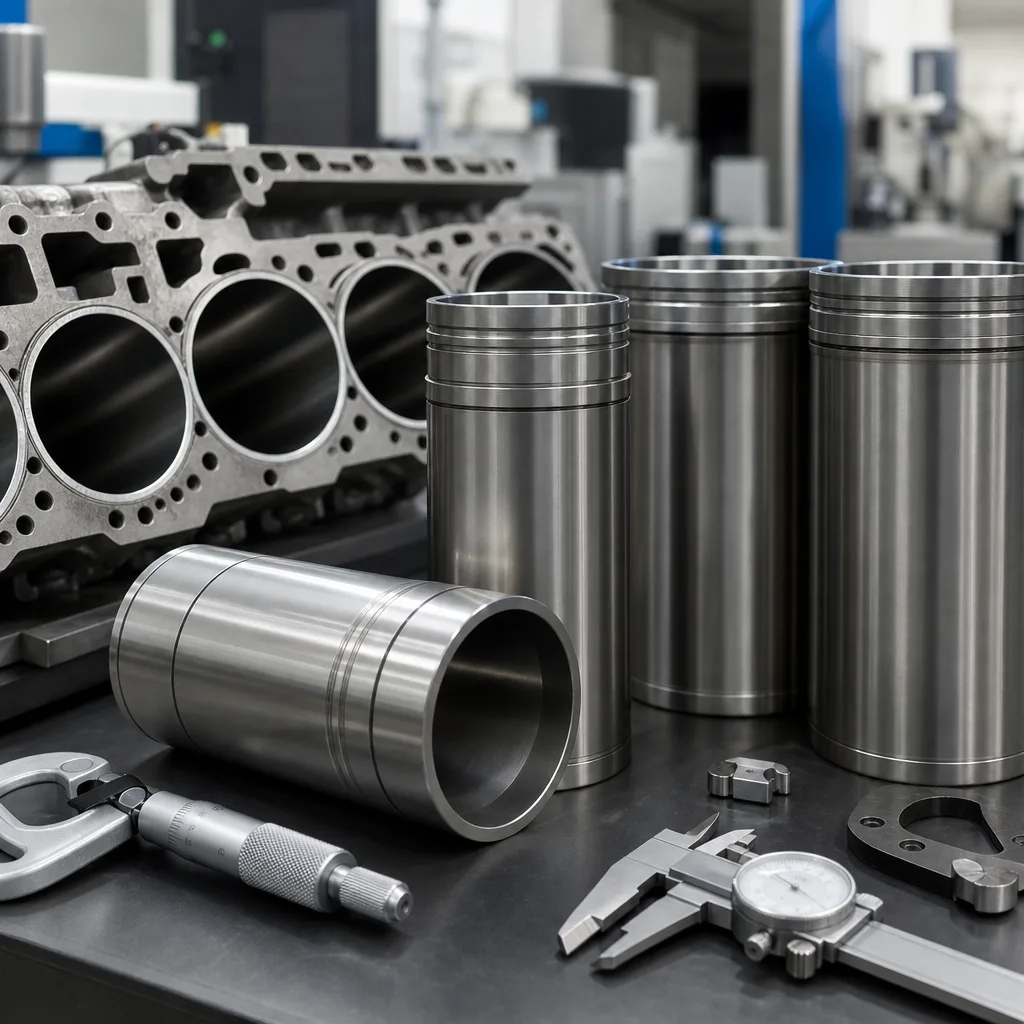
Most engine cylinder liners for passenger car and light commercial applications are made from high-strength cast iron, then machined to controlled tolerances. The exact route depends on engine design and service requirements.
A practical supplier specification set should include:
Item
What to request
Why it matters
Base material
Cast iron grade and melt traceability
Controls wear resistance and thermal stability
Heat treatment
Process route and hardness target
Affects machinability and service life
Bore machining
Final bore size and roundness data
Impacts piston clearance and oil control
Outer diameter
OD tolerance and surface condition
Determines interference fit in the block
Honing
Surface finish and cross-hatch requirement
Influences ring seating and oil retention
Flange / seat
Height, flatness, and squareness
Prevents head gasket and seating issues
</tr></thead><tbody> </tbody></table>For buyers comparing multiple sources, the important point is consistency, not broad claims. Two samples can match visually while diverging in OD stability after heat cycling. That is why dimensional control at every step matters more than a one-off inspection certificate.
Quality documentation and standards
A serious supply programme should be built around documented control points, not informal promises. For procurement teams in the EU, UK, US, Canada, Australia, and Brazil, the baseline expectation is an auditable system.
Our quality framework is aligned to IATF 16949:2016 and ISO 9001:2015, with export compliance support where relevant to the destination market. For material and chemical controls, customers may request evidence aligned to REACH (EC) No 1907/2006. For programmes that need additional validation, we can support part inspection reports, process flow records, and dimensional studies.
Use our quality system when you need to review the controls behind the part, not just the finished sample.
Typical documents available on request:
Material certificate
First article or sample inspection report
Dimensional inspection record
Packaging specification
Export carton and pallet details
Product photo set for pre-shipment approval
If the application is tied to an engine rebuild channel, buyers should also define what is acceptable for batch-to-batch variation. A liner that is technically in tolerance but inconsistent from lot to lot creates avoidable assembly risk.
Commercial terms for a stable supply chain
The best sourcing outcomes come from aligning technical data with commercial terms before the order is placed. That reduces surprises during sampling and mass production.
Points to settle early:
MOQ by part number or engine family
Sample lead-time versus mass-production lead-time
Tooling ownership if a custom profile is required
Carton quantity, palletisation, and corrosion protection
Incoterms and destination-country import requirements
Labelling rules for distributor inventory systems
For standard catalogue items, start with our catalog. For programmes that need application grouping by engine system, engine components is the more efficient entry point.
When the request is tied to a specific Opel engine family, do not assume all liners within the same displacement are interchangeable. Bore, deck height, flange form, and block material all affect the final specification. A sourcing team should treat the drawing or sample as the controlling document.
Custom manufacturing for OE-equivalent fitment
Not every buyer needs a fully new design, but many need a part that follows a known fitment while meeting their own commercial and packaging requirements. That is where custom manufacturing is relevant.
Common customisation requests include:
Adjusted OD or wall thickness for block refurbishment work
Non-standard flange height
Packaging sets for workshops or distributors
Laser marking or label control for internal traceability
Export-ready rust protection and moisture barriers
The right approach is to start from measured data, not a verbal description of the old part. If the target is OE-equivalent fitment, the supplier should confirm the critical dimensions against a validated reference sample and then lock the process window before volume production.
For buyers managing several repair channels, this reduces the risk of mixed stock and returns. It also makes re-ordering predictable when you are sourcing across multiple countries or warehouse locations.
How Driventus supports buyers
Driventus supplies cylinder liners and related engine components from Taizhou, Zhejiang, with export experience across more than 60 countries. The value for procurement teams is not only production capacity. It is the combination of repeatable machining, documented inspection, and straightforward communication around lead-time and specification control.
Use this as a working checklist when you evaluate a cylinder liner Opel manufacturer China:
Confirm engine application and dimensional requirements
Request material and inspection documentation
Verify packaging for long-distance freight
Align MOQ, lead-time, and forecast volume
Approve samples before placing repeat orders
If you need a broader sourcing review across pistons, gaskets, water pumps, or turbocharger-related components, we can align the cylinder liner programme with the rest of the engine parts basket. Start with request a quote and send the application data, sample photos, or drawing if available.
Frequently asked questions
No. We supply by application and specification. Opel fitment can be supported where the engine data, dimensions, and sample reference are provided.
Material certificates, inspection reports, sample dimensions, packaging details, and export photos are commonly requested. Additional process records can be shared for audit review.
Yes. Through our OEM service workflow, we can review drawings or samples, confirm the critical dimensions, and define packaging for distributor or workshop supply.
If you are comparing suppliers or preparing a new RFQ, send your engine data, target volume, and packaging requirements via /contact.html and we will review the specification against production capability.