Cylinder Head Wholesale: How to Screen Suppliers Before the First Order
In cylinder head wholesale, the real question is not who can quote fastest. It is who can keep castings stable, machining repeatable, fitment accurate, and claims containable after launch.
That changes how buyers should read an RFQ. Minimum order quantity matters, but so do batch traceability, pressure-test coverage, deck flatness control, export packaging, and the supplier's ability to explain exactly what happens when a lot fails incoming inspection. A serious wholesale partner should answer those points with numbers, records, and process rules, not broad assurances.
This article breaks supplier evaluation into practical buying angles: early screening, side-by-side comparison, factory failure modes, landed-cost trade-offs, fitment-document checks, and the support questions buyers should raise before nomination. Driventus is an independent aftermarket manufacturer; brand names are referenced for fitment only.
The first-pass screen: five questions that eliminate weak suppliers early
A cylinder head is not a simple catalogue item. It combines foundry quality, heat treatment, machining precision, sealing integrity, and valve train interface control. That is why a cheap quote can become an expensive programme once rejection rates, delayed launches, stock write-downs, or warranty exposure are added back in.
Before approving samples, start with five gatekeeping questions:
Is the quoted plant actually certified? Verify current IATF 16949:2016 and ISO 9001:2015 certificates, including scope, site, issuer, and expiry date. Some suppliers present a group certificate even when the quoted factory is outside scope.
What is made in-house and what is outsourced? Confirm whether the supplier provides bare heads, loaded heads, cam caps, valve guides, valve seats, pressure-tested assemblies, and related our catalog items from internal production or external partners.
How deep is batch traceability? Ask how heat number, casting batch, machining lot, assembly lot, and final inspection data are linked. Many buyers expect records to be retained for 3 to 7 years.
Can the export process prevent avoidable damage? Review rust prevention, labelling, carton strength, pallet standard, and material declaration support where needed under REACH (EC) No 1907/2006.
What happens when something goes wrong? Confirm containment timing, sort procedure, 8D reporting, and replacement or credit policy. A practical benchmark is 24 to 48 hours for containment feedback and 5 to 10 working days for root-cause closure.
If these answers are vague at RFQ stage, later qualification usually becomes slower and riskier. In cylinder head wholesale, weak early discipline is often the clearest warning sign.
A better comparison model than unit price alone
Strong buyers compare cylinder head wholesale suppliers with one matrix that blends commercial, technical, and quality criteria. Unit price stays in the picture, but it stops dominating the decision.
Evaluation point
What to ask for
Why it matters
MOQ
Standard MOQ by part number, mixed-container options, and minimum shipment value
Shapes launch cash flow, SKU coverage, and stock turns
Price logic
Unit price at 50, 100, 300, and 500 pieces; tooling amortisation; private-label packaging cost
Shows whether the offer scales or only looks good at one opening quantity
Lead time
Tooling, sample, pilot run, and repeat-order timing in calendar days
Sets the replenishment model
Casting route
Gravity casting or other route, alloy grade, heat treatment method, and scrap-rate target
Affects crack resistance and dimensional stability
</tr></thead><tbody> </tbody></table>For most programmes, sample data matters more than polished sales language. A capable supplier should be ready to share dimensional records, pressure-test results, hardness or material confirmation, and agreed visual standards for the quoted part family.
A useful rule of thumb: if two sources are within 3% to 5% on price, the better decision usually comes from lead-time stability, test coverage, and MOQ flexibility, not the last small ex-works saving.
Where cylinder heads usually fail inside the factory
Cylinder heads do not fail randomly. The common failure modes are familiar: porosity leakage, deck distortion, valve seat movement, guide wear, thread weakness, and cracking around high-temperature zones. The evaluation question is simple: does the supplier control these risks systematically, or just inspect after the fact?
Foundry and material control
Buyers should check whether the supplier can explain and document:
Aluminium alloy selection matched to thermal loading, casting stability, and machinability, often with controlled Si and Cu content where required
Melt control, impurity monitoring, degassing practice, and spectrometer verification by heat
Heat-treatment parameters with batch traceability, including furnace load ID, time, temperature, and quench control where applicable
Porosity control through process design, X-ray or section-validation practice where needed, plus clear rejection criteria
Seat and guide interference-fit control after thermal cycling, with nominal ranges in mm rather than vague pass/fail language
Machining and final inspection
The most important machining checks usually include:
Deck flatness after finish machining; many buyers work within a maximum deviation of 0.05 mm to 0.10 mm depending on head length and platform
Valve guide bore size and alignment, often controlled within hundredths of a millimetre
Valve seat runout and concentricity, commonly targeted at ≤0.03 mm to protect sealing and valve life
Cam bore or cam cap alignment where OHC designs are sensitive to journal distortion
Thread gauging for spark plug, injector, and manifold interfaces with defined GO/NO-GO control
100% or agreed-sampling pressure testing before packing, for example 3 to 5 bar air-under-water or an equivalent method with minimum hold time defined
These checks should sit inside a documented quality system with control plans, gauge calibration, nonconformance segregation, and reaction plans. For private-label and OE-service work, buyers may also ask for process flow charts, gauge lists, MSA evidence, and capability data for critical dimensions.
The key test is not whether the supplier knows the target tolerance. It is whether the supplier can explain how often the feature is checked, what Cpk level is accepted, and what action starts before bad parts move downstream.
The landed-cost questions that change the sourcing decision
A technically acceptable supplier is not always a practical one. In cylinder head wholesale, landed cost is shaped by MOQ, replenishment speed, pack logic, and claim exposure just as much as by ex-works price.
Ask for clear figures on:
MOQ per SKU: many aftermarket programmes begin at 50 to 200 units per reference, while slower-moving or loaded-head programmes may sit closer to 20 to 50 pieces if components are shared across a family; ask what actually drives the MOQ
Price break structure: request realistic pricing at 50, 100, 300, and 500 units, plus surcharges for assembled heads, upgraded valves, branded cartons, or low-volume mixed loads
Sampling lead time: often 20 to 45 days for existing references, longer for new tooling, new valve train content, or fresh PPAP requirements
Production lead time: commonly 30 to 60 days from deposit, drawing confirmation, and packaging approval to ex-works date; monthly capacity in units matters too
Container consolidation: whether multiple references can ship together without surcharge, and what minimum carton count per SKU applies
Packaging options: neutral box, customer label, moisture protection level, pallet height, and units per pallet so warehouse planning is not guesswork
Warranty reserve expectations: whether claims are credited, replaced, or netted against future orders, and whether labour is excluded or capped
This is also where factory-audit questions matter. Check maintenance discipline, gauge calibration intervals, operator training, incoming material control, FIFO practice, and subcontractor management. If the supplier offers custom manufacturing, verify tooling ownership, engineering-change approval, pilot-batch separation, and the piece-price effect if annual volume drops below forecast.
For many EU, UK, and North American importers, repeat-order consistency is worth more than a small opening discount. A supplier with 45-day repeat delivery, 100-piece MOQ, and mixed-SKU loading often beats a cheaper source that needs 300 pieces per SKU and 75-day replenishment.
Fitment mistakes are expensive: the document pack buyers should demand
One of the most avoidable losses in cylinder head wholesale is fitment error. Machining quality may be acceptable, yet the stock is still unsaleable because the accessory interfaces, valve configuration, or emissions-related features are wrong for the intended market.
Request a fitment pack that includes:
Application list by engine code and model-year range where available
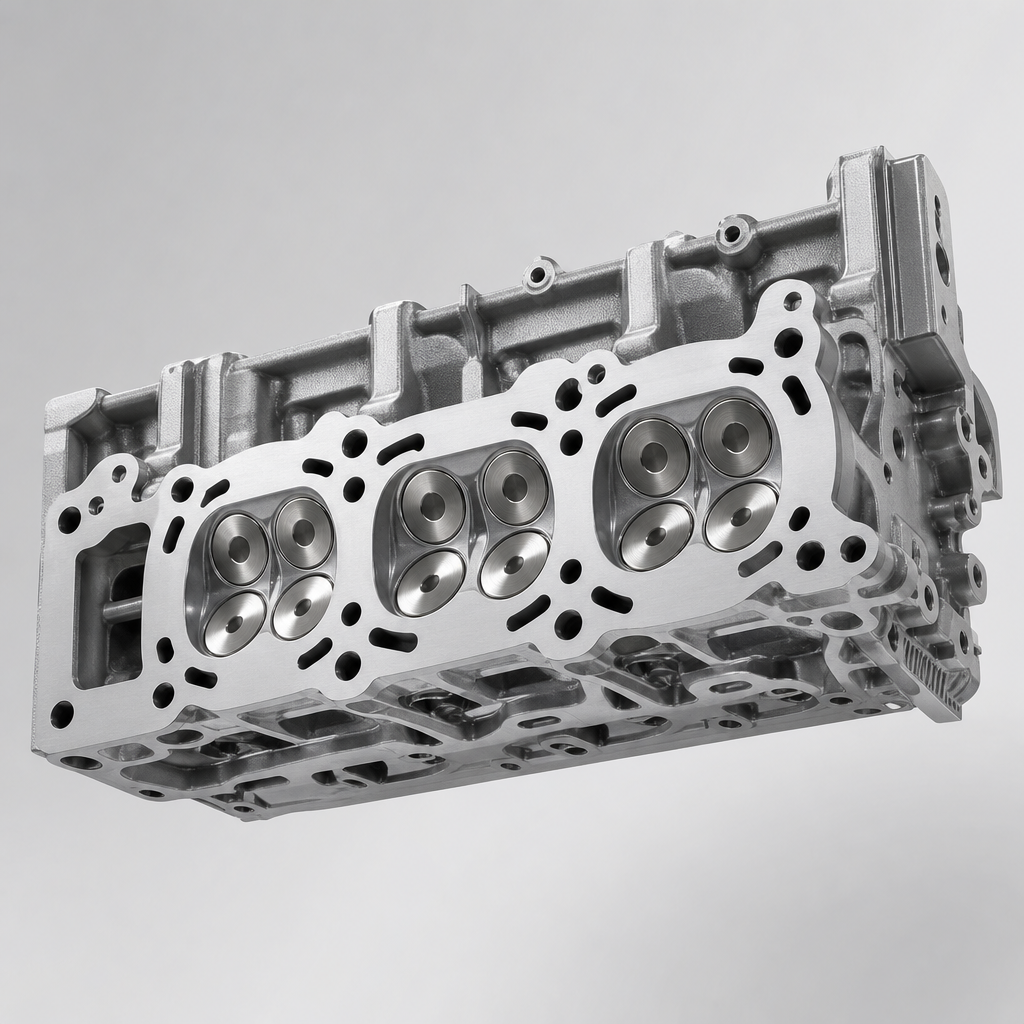
Casting photo set and key interface images from multiple angles, including manifold face, cam side, and sensor-port detail
Bare-head or loaded-head specification, with valve, spring, seal, seat, and guide content identified
Valve count, combustion chamber type, injector or glow plug arrangement where relevant, and camshaft layout
Deck height and principal mounting dimensions, with tolerance references where available
Any available cross-reference format such as OE 06A103351 when supplied by the customer or already linked to the quoted reference
A list of exclusions, especially where variants differ by secondary air, EGR, injector seat, or emissions-sensor layout
Do not rely on spreadsheet matching alone. Approved samples still need dimensional verification, especially when regional variants differ by sensor port, EGR layout, injector seat detail, manifold pattern, or ancillary mounting features.
Good buyers also ask the supplier to freeze the approved configuration by photo, marked drawing, sample tag, or master specification sheet. Without that control point, production can drift into a similar-looking but commercially wrong version.
Where emissions-related compatibility matters, the supplied configuration should not compromise the vehicle's certified system performance. Requirements vary by market, but associated engine components may be reviewed against recognised frameworks such as ECE R-83 where relevant. For larger accounts, it also makes sense to approve the carton label sample, barcode format, and packing-list-to-part-number check before first shipment; warehouse misidentification is a commercial failure too.
How Driventus fits into a cylinder head wholesale programme
Driventus supplies engine and powertrain components for international B2B customers, including aftermarket distributors, OEM-focused buyers, and repair networks. In cylinder head wholesale projects, the usual priorities are controlled machining, export-ready packaging, responsive communication, and clear technical alignment before the first production order.
Support can include:
RFQ review based on drawing, sample, or application data, with focus on fitment risk, batch size, and commercial feasibility
Bare and assembled head options depending on service-market requirements and target price band
Inspection reporting for agreed critical dimensions such as deck flatness, valve seat concentricity, guide size, and pressure-test status
Neutral or customer-specific packaging for wholesale channels, including carton marking and pallet-planning requirements
Driventus is an independent aftermarket manufacturer; brand names are referenced for fitment only.
The best supplier comparison is not price per unit in isolation. It is the full operating package: process control, fitment accuracy, lead-time discipline, traceability, after-sales handling, and the ability to quote MOQ and pricing in a way buyers can actually plan around. That is what keeps a cylinder head programme stable after the first order.
Frequently asked questions
MOQ depends on whether the part is an existing catalogue reference or a custom programme. For standard references, buyers often see 50 to 200 units per SKU. Loaded heads or slower-moving items may start lower if multiple SKUs can be consolidated, while new or specialised references may require higher opening quantities to absorb setup cost. In cylinder head wholesale, the important follow-up question is what drives the MOQ: casting economics, machining setup time, or packaging constraints.
Yes. In most cylinder head wholesale programmes, buyers should define pressure-test coverage and acceptance criteria before production starts. Coverage may be 100% or agreed sampling, but the method, test pressure, hold time, leak limit, retest rule, and record-retention period should all be documented. If the supplier cannot state those points clearly, the inspection standard is still too loose for routine wholesale supply.
For most B2B buyers, **IATF 16949:2016** and **ISO 9001:2015** are the main quality-management references. Buyers should confirm that the certificate scope matches the actual manufacturing site and process being quoted, not just a related company. In cylinder head wholesale, certificates are only the starting point; material records, process controls, tolerance data, pressure integrity, and batch traceability matter just as much.
If you are comparing cylinder head wholesale sources for distribution or private-label supply, we can help review fitment, MOQ, tolerances, pressure-test coverage, and production terms. Use this form to [request a quote](/contact.html).