Cylinder Head Toyota Supplier: Sourcing Guide
Choosing a cylinder head Toyota supplier takes more than comparing unit prices. Procurement teams need a head that matches the exact engine family, casting revision, valve-train layout, emissions variant, and machining scope. It has to hold gasket-face geometry, seal coolant and oil circuits during leak testing, arrive clean enough for engine assembly, and include documents that support receiving inspection and claim handling. For export buyers, the practical questions are lead time, MOQ by casting or assembly level, pallet strength, corrosion and impact protection, lot traceability, and whether the supplier can keep quality stable across repeat orders instead of simply passing one sample review. Driventus is an independent aftermarket manufacturer; brand names are referenced for fitment only. We supply cylinder head programmes for distributors, wholesalers, repair networks, and OEM or Tier-1 sourcing teams that need controlled production in China with export support. Before the first purchase order moves ahead, the right supplier should be able to confirm the casting route, heat-treatment or ageing status where applicable, CNC machining scope, pressure-test parameters, critical-dimension reporting, packaging bill of materials, and engineering change-control process.
What buyers should verify first
For a Toyota cylinder head programme, begin with the details that decide fit, sealing, installation time, and rebuild life. A low quotation has little value if the part number is unclear, the casting revision is wrong, or the machining scope does not match the buyer's repair process.
Key points to confirm at the first inquiry stage include:
- Engine code, displacement, fuel type, aspiration, and market variant
- OE reference, casting number, aftermarket cross-reference, or buyer drawing revision
- Bare, machined bare, semi-assembled, or fully assembled supply scope
- Valve count, cam layout, combustion-chamber type, and hydraulic or mechanical lifter arrangement
- Sensor bosses, plug locations, injector interfaces, EGR ports, and accessory mounting points
- Gasket-face flatness target, surface roughness requirement, and sealing-area protection
- Seat, guide, valve, cam journal, tappet bore, and spring-seat machining requirements
- Coolant, oil, breather, and drain-back passage configuration against the reference sample or drawing
- Pressure-test method, test medium, pressure range, holding time, and rejection criteria
- Thread specification, blind-hole depth, dowel locations, and helicoil or repair policy
- Cleanliness standard for chips, blasting media, oil residue, and passage obstruction
- Packaging design for sea freight, mixed pallets, warehouse handling, and drop risk
- Labelling, carton marks, pallet marks, serial or lot codes, and traceability information
Ask the supplier to confirm these points in writing before sample approval. For gasket-face control, buyers often set a flatness and Ra surface-finish target based on the gasket supplier's requirement; the approved value belongs in the drawing, control plan, or inspection sheet, not in loose wording such as "smooth surface." For leak testing, the quotation should state whether the head is tested by air-under-water, dry air pressure decay, or another validated method, including the pressure and hold time used for coolant and oil passages.
That shared technical baseline keeps the order from becoming a visual comparison. If the supplier cannot clearly define engine application, machining level, inspection method, and packing standard, receiving risk rises because your team has no reliable benchmark for acceptance.
For a broader view of part families, see our catalog. For process controls and inspection discipline, review our quality system.
Fitment control for Toyota applications
Toyota fitment is usually determined by engine family, head casting revision, emissions package, and accessory machining, not by the vehicle badge alone. Two cylinder heads can look similar on a catalogue page yet differ in water-jacket layout, oil-feed drilling, sensor location, cam configuration, manifold alignment, or timing-cover interface. For a cylinder head Toyota supplier, accurate fitment control means checking the functional details that decide whether the head can be installed without rework.
Buyers should confirm:
1. Engine code, displacement, fuel type, aspiration, and production-market variant 2. Number of valves, camshaft configuration, cam sensor position, and VVT-related interfaces where applicable 3. Casting number, buyer-approved cross-reference, and drawing or sample revision 4. EGR, coolant, oil gallery, breather, drain-back, and heater-port machining 5. Injector, spark plug, glow plug, sensor, thermostat, and temperature-switch interfaces where applicable 6. Head gasket match, fire-ring position, dowel location, oil restrictor holes, and bolt pattern 7. Intake and exhaust manifold port shape, bolt pitch, stud pattern, and alignment face height 8. Timing cover, chain or belt housing, engine bracket, lifting point, and accessory mounting points 9. Valve-cover sealing layout, half-moon areas, PCV provisions, and related fastener locations 10. Market-specific emissions, coolant routing, accessory, or right-hand/left-hand-drive service differences
A capable supplier should map these points against the buyer's drawing, sample, OE reference data, or existing aftermarket part number. On first-time projects, a physical sample, marked drawing, or 3D scan comparison is often the quickest way to remove ambiguity. For repeat programmes, the supplier should maintain controlled fitment records with revision history, approved photos, measurement points, and cross-reference notes so the same application is not reinterpreted with every order.
That is the difference between a usable cross-reference and a part that looks correct but fails during assembly. Driventus is an independent aftermarket manufacturer; brand names are referenced for fitment only.
Specification checklist for purchasing
Use a structured checklist before approving samples or placing volume orders. The point is to define exactly what the buyer is purchasing: a raw casting, a machined bare head, a semi-assembled head with guides and seats, or a fully assembled unit ready for the repair channel. Each build level changes cost, incoming inspection, warranty exposure, and the amount of final machining or assembly the buyer still needs to control.
| Check item | What to confirm | Why it matters |
|---|---|---|
| Casting route | Aluminium or cast iron programme, gravity/permanent-mould/sand process where relevant | Affects weight, thermal behaviour, porosity risk, machining strategy, and freight planning |
| Material and condition | Alloy grade or iron specification, heat treatment or ageing status where applicable | Supports strength, machinability, thermal stability, and repeatability between batches |
| Casting condition | Visual defects, porosity control, X-ray or section checks where specified, and weld/repair policy | Reduces risk of leaks, weak areas, or unacceptable cosmetic quality |
| Machining scope | Raw casting, machined bare, semi-assembled, or fully assembled | Changes labour content, receiving inspection, and repair-shop readiness |
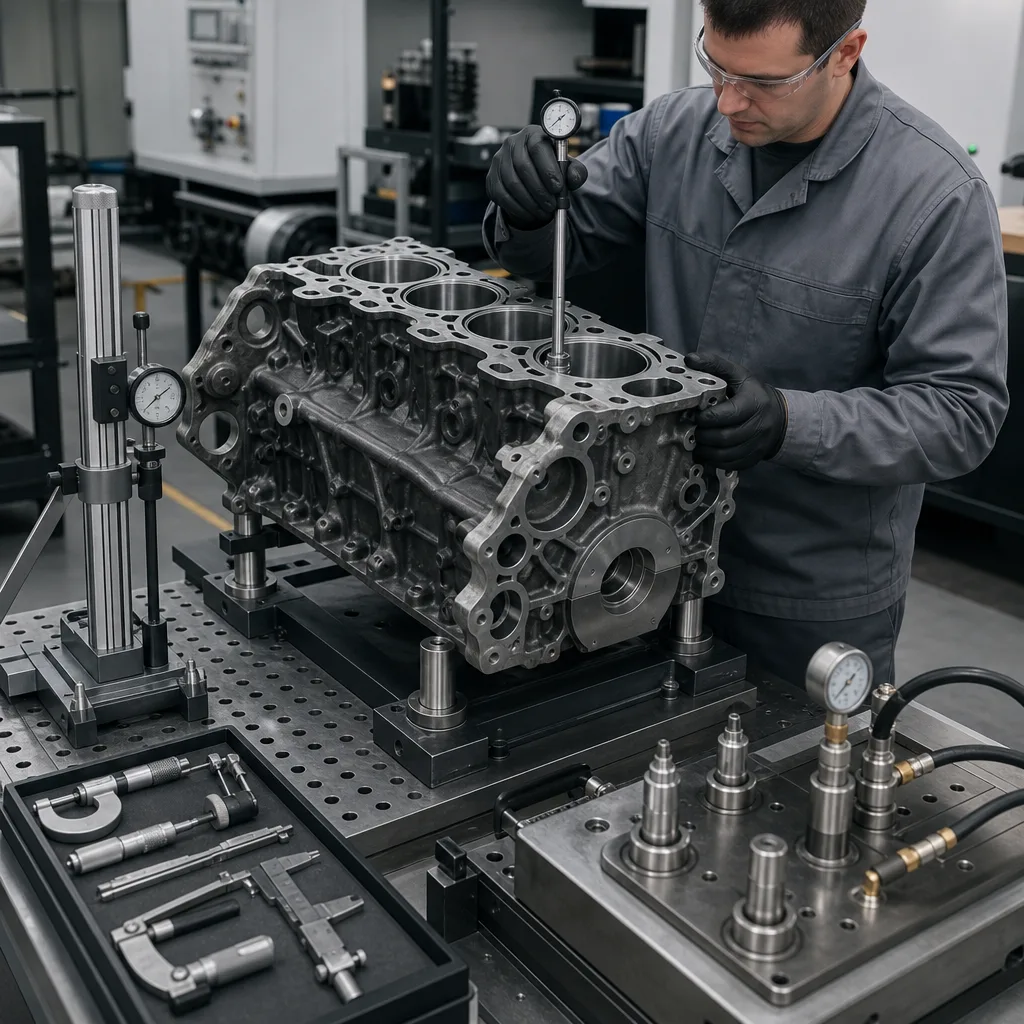
| Critical geometry | Deck flatness, cam tunnel alignment, valve-seat concentricity, guide bore size, and dowel position | Controls gasket sealing, valve sealing, cam rotation, and bolt-on fitment |
| Pressure test | Coolant and oil circuits tested with defined medium, pressure, hold time, and pass/fail limit | Reduces field failures from porosity, cracks, or gallery defects |
| Dimensional report | Critical dimensions recorded against drawing, approved sample, or control plan | Supports audit, receiving checks, PPAP-style review, and dispute resolution |
| Surface condition | Gasket-face Ra, port finish, sealing areas, thread quality, and deburring standard | Impacts head gasket retention, assembly quality, fluid sealing, and installation time |
| Valve train parts | Guides, seats, valves, springs, retainers, seals, cam caps, and tappet components where included | Determines rebuild readiness and final cost comparison |
| Threaded holes | Thread type, bolt-hole location, thread depth, cleanliness, and repair insert policy | Prevents installation delays, torque loss, and fastener damage |
| Cleanliness | Chips, abrasive residue, washing process, dry-out method, and passage obstruction check | Protects the engine after installation and reduces rework at the buyer's warehouse |
| Traceability | Heat, batch, lot, cavity, machining shift, or production-date traceability where specified | Helps with claims management, containment, and repeat-order control |
| Packaging | VCI or bagging, machined-face protection, foam or molded supports, carton strength, palletisation, and moisture control | Prevents corrosion and impact damage during export handling and warehouse storage |