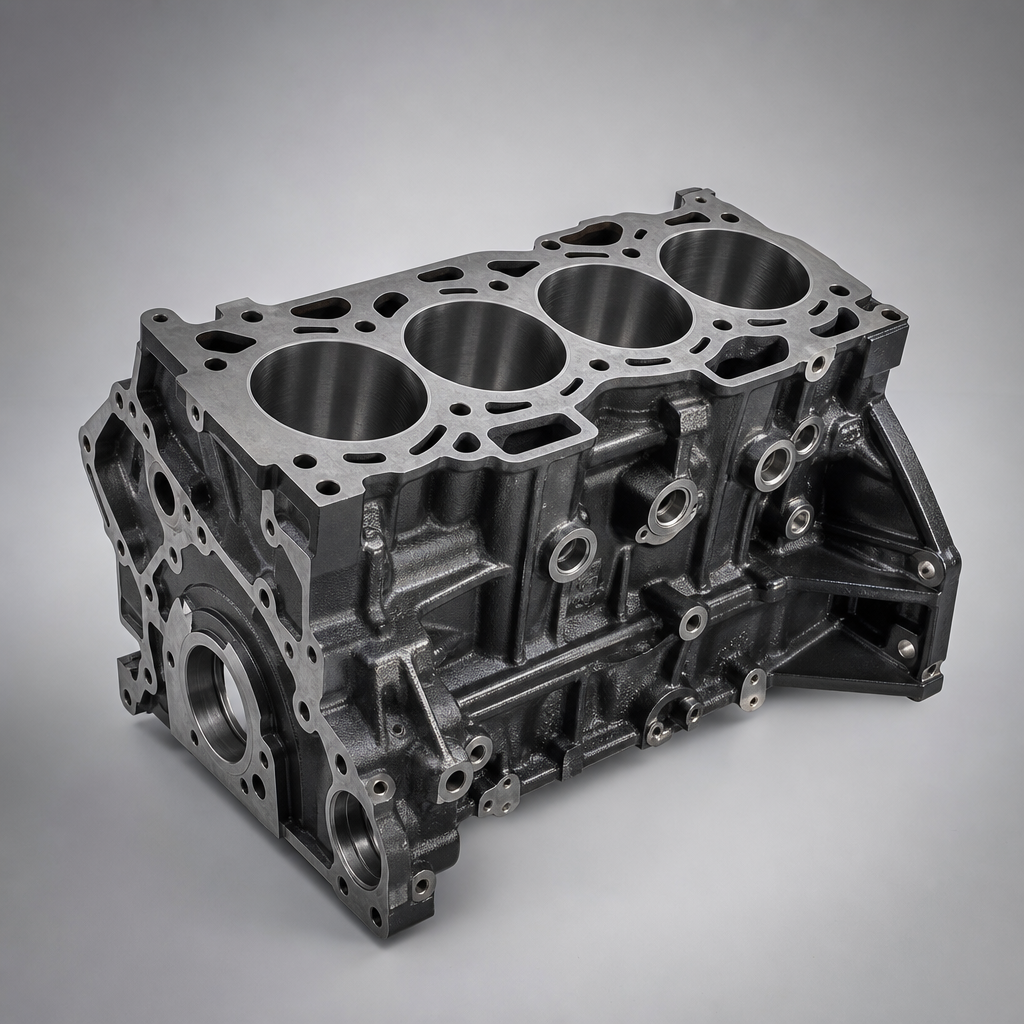
Cylinder Head Toyota Manufacturer China: Sourcing Guide
A cylinder head Toyota manufacturer China search can go wrong for reasons that are not visible in a quotation. The price may look competitive while the real risk sits in porosity, weak datum control, cam-bore mismatch, rough gasket faces, missing plugs, poor leak-test discipline or cartons that allow a machined deck to hit the floor during transit.
Toyota-fit cylinder heads cover very different petrol and diesel applications: aluminium DOHC heads, cam-carrier designs, line-bored cam tunnels, diesel heads with high sealing loads, and market-specific variants. The buyer’s job is to separate a supplier that can repeat the process from one that can only copy the shape.
For most aluminium aftermarket heads, useful expectations include controlled heat treatment, full leak testing, batch-level dimensional records, deck flatness commonly around 0.03-0.05 mm over the gasket face where the design allows, and Ra values matched to the intended MLS or composite gasket. Visual inspection alone is not enough.
Driventus manufactures independent aftermarket engine components in Taizhou, Zhejiang, using IATF 16949:2016 and ISO 9001:2015 certified processes. We supply B2B distributors, repair-chain procurement teams and OEM/Tier-1 sourcing projects across more than 60 countries. Driventus is an independent aftermarket manufacturer; Toyota and other brand names are referenced for fitment identification only.
This guide is written as a buyer’s working framework: what to define before RFQ, where cylinder head programs fail, how to compare commercial terms, what to audit, and which records to demand before sample approval.
Start With the Application, Not the Casting Photo
Many sourcing mistakes begin with a photograph and a part-number guess. For Toyota-fit cylinder heads, that is too thin. Before asking for price, define the engine code, displacement, fuel type, model years, destination market, gasket pattern, valve train layout and whether the head must match a specific OE-style casting or emissions-market variant.
The buying channel also matters. A repair-chain program may prioritise complete heads and fast replacement. A remanufacturing business may prefer bare machined heads. A distributor building a private-label range may need consistent packaging, barcode logic and fitment notes across several applications.
Common supply scopes include:
Bare cylinder head casting, fully machined and pressure-tested
Semi-assembled head with valve guides and valve seats installed
Complete head with valves, springs, retainers and camshaft-related hardware where applicable
Neutral or private-label packaging for distributor programs
Batch production against buyer sample, technical drawing or OE part-number cross-reference, such as an 11101-series reference when supplied by the buyer
Do not leave small parts ambiguous. The RFQ should state whether the price includes core plugs, oil-gallery plugs, valve stem seals, dowel pins, manifold studs, spark-plug tube seals, injector sleeves, cam caps, cam carrier, valve cover gasket, head gasket set or bolt kit. These items can move landed cost by 5-20%, and they often become the reason for distributor complaints when the buyer assumed they were included.
A useful RFQ asks for more than availability. Request machining datum references, combustion chamber layout, cam bore or cam carrier configuration, valve seat angles, guide material, deck surface finish target and pressure-test method. For example, clarify whether the design uses 30°/45°/60° valve seat geometry where applicable, cast iron or powder-metal bronze guides, controlled guide press fit, defined cam-bore tolerances, and spark-plug or sensor threads checked with gauges.
Our standard engine-component range can be reviewed through our catalog, including related parts under engine components.
For clarity, Driventus does not claim approval, authorisation or endorsement by Toyota or any vehicle manufacturer. Brand names and engine families are used only to identify fitment and application scope.
Compare Offers on the Same Build, Freight and Risk Basis
A low cylinder head quote can be real. It can also be incomplete. The comparison only becomes meaningful when every supplier is quoting the same supplied condition, Incoterm, inspection package, packing method and annual volume.
Use the quotation stage to lock down the commercial variables:
Sourcing item
What to verify before comparing prices
MOQ
Existing catalogue item often starts from 20-50 pcs for a trial order; stable repeat orders are usually planned at 50-200 pcs per part number; new casting development may require 100-300 pcs or a tooling agreement
Price logic
Bare machined heads are priced from casting weight, alloy grade, machining time, scrap allowance and pressure testing; semi-assembled or complete heads add valves, seats, guides, springs, seals, plugs, hardware, assembly labour and torque/height checks
Sample lead time
Existing item: commonly 15-30 days after technical confirmation and deposit; new tooling: often 60-120 days including pattern, casting trial, machining setup and first-article approval
Mass production lead time
For approved existing items, commonly 30-60 days depending on queue and quantity; confirm from approved sample date, not from RFQ date
Payment terms
Align with tooling ownership, sample approval, production milestones and inspection release; common structures include tooling deposit, sample charge, and balance before shipment or against inspection release
Packaging
Export carton, foam protection, VCI bag, deck-face protection or wooden pallet based on head weight; confirm gross weight, carton compression strength and pallet height limits
Spares support
Confirm availability of valves, guides, seats, gaskets, plugs, dowels and bolt kits where needed
</tr></thead><tbody> </tbody></table>The hidden-cost pattern is predictable. Supplier A quotes a bare head without dowels, studs, plugs or leak-test records. Supplier B quotes FOB Ningbo/Shanghai with seaworthy cartons, pallets, labels and pre-shipment photos. Supplier A looks cheaper until the buyer adds kitting labour, repacking, claim exposure and local sourcing for missing hardware.
Packaging deserves the same attention as machining. Cylinder heads have deck faces, threaded ports, cam tunnels, manifold faces and sealing surfaces that are easy to damage and expensive to dispute after arrival. A practical packing specification should define individual polybag or VCI bag, fitted foam or EPE corner blocks, hard deck-face board, desiccant where required, double-wall export carton, strap direction, pallet size, maximum pallet gross weight and handling marks such as “keep dry,” “do not drop” and “machined face.”
For long-distance sea freight to the EU, UK, US, Canada, Australia, Brazil and other markets, ask for drop-resistance details, pallet stacking limits, moisture protection, carton marking rules and handling instructions. Many buyers use carton drop resistance from 60-80 cm for single cartons depending on gross weight, pallet stacking not exceeding two pallets unless tested, and humidity protection for 30-45 days in ocean transit.
If private-label supply is required, Driventus can discuss carton artwork, neutral packing, barcode labels and batch traceability as part of custom manufacturing.
Where Cylinder Head Programs Usually Fail in Production
A factory audit should look for failure modes, not showroom capacity. Cylinder heads combine foundry quality, heat treatment, CNC machining, leak-tightness, cleanliness, assembly and packing. A weakness at any one stage can create oil leakage, coolant contamination, compression loss, overheating, noisy operation or premature valve wear.
The audit should follow the part through the plant:
Incoming aluminium alloy or cast iron material verification, including spectrometer or material certificate review
Casting inspection for shrinkage, porosity, inclusions, sand residue and core shift
Heat treatment control where applicable, including furnace temperature record, soak time and hardness check
Shot blasting, riser removal and pre-machining visual inspection before CNC loading
CNC machining datum control, fixture locating-point verification and tool-life monitoring
Valve guide and valve seat installation method, including bore preparation, interference target and press force monitoring
Seat concentricity, runout and contact pattern inspection
Cam bore alignment checks for overhead-cam designs, especially where cam caps are line bored as a matched set
Thread inspection for spark plug, injector, manifold, sensor and accessory ports using go/no-go gauges
Deck flatness and surface roughness measurement
Pressure testing of coolant passages and oil galleries
Washing and final cleaning to remove swarf, abrasive media and casting residue
Final visual inspection for dents, scratches, burrs and packaging damage risk
Ask for actual control plans and records for the part family. Certificates on the wall do not prove that a leaking casting is quarantined, that rework limits are written, or that a cam cap cannot be mixed between heads. A strong process flow usually looks like this: alloy verification → casting → heat treatment → rough inspection → CNC datum machining → seat/guide bore machining → guide and seat installation → finish machining → cam-bore/manifold/thread operations → washing → pressure test → dimensional inspection → final cleaning → rust/moisture protection → packing.
Typical checkpoints that can be written into a buyer control plan include deck flatness at 0.03-0.05 mm full length where feasible for the design, surface roughness commonly around Ra 0.4-1.6 µm depending on gasket type, seat runout commonly targeted within 0.03-0.05 mm, valve stem-to-guide clearance after assembly, and cam-bore alignment checked with a mandrel, bore gauge or CMM. The final limits must follow the drawing, approved sample or agreed engineering specification. The key is repeatable measurement, not one good sample.
Calibration is another audit filter. Check CMMs, height gauges, bore gauges, thread gauges, surface roughness testers, pressure-test equipment, torque tools and hardness testers. Records should show tool ID, due date, acceptance result and traceability to an approved laboratory or internal master. Also review revision control, operator training, inspection frequency, reaction plans and non-conformance handling.
Driventus operates under IATF 16949:2016 and ISO 9001:2015. Buyers can review our quality system to understand how inspection, traceability and corrective actions are structured for export engine components.
Sample Approval: A Measurement Pack Beats a Nice-Looking Head
A sample can look clean and still fail in service. Approval should be based on measured data, installation logic and fitment confirmation. The dimensional report should identify the measuring equipment, drawing or reference source, acceptance criteria, actual measured values, inspector and date. “OK” marks are not enough for critical interfaces.
Use this approval checklist as a starting point:
Deck flatness measured across length, width and diagonal axes, with readings recorded in mm
Deck surface roughness matched to the intended gasket type, typically confirmed by Ra measurement at multiple locations
Combustion chamber volume consistency across cylinders where applicable, often checked in cc for petrol heads
Valve guide inside diameter, outside diameter control and installed height
Valve seat runout, contact width and seat angle verification
Valve stem-to-guide clearance after assembly where supplied complete
Cam bore diameter, straightness and alignment for overhead-cam designs
Manifold face flatness and bolt-hole position
Spark plug, injector, sensor and accessory thread gauge results
Oil and coolant gallery pressure-test record, including test pressure and duration
Hardness result and material certificate for the casting batch
Assembly torque records if the head is supplied complete
Visual confirmation of plugs, dowels, studs and ancillary hardware included in the agreed scope
Pressure testing needs a written method. State whether the supplier will use air-under-water, dry air decay or hydraulic testing; which circuits are tested; test pressure; hold time; temperature if relevant; and acceptance criteria. Common aftermarket practice is 100% leak testing of coolant passages, with test pressures often in the 0.3-0.6 MPa range and hold times around 30-120 seconds depending on fixture and method. Oil galleries may require separate fixtures.
For complete heads, add assembly checks: installed valve spring height, spring free length and load where specified, valve tip height, keeper and retainer seating, valve sealing check, stem seal installation, cam-cap location and torque sequence if cam-related parts are included. Where cam caps are machined as a matched set, they must stay with the same head and position. Mixing caps can cause cam seizure or oil-pressure problems.
Confirm the gasket and bolt strategy before approval. Some engines use torque-to-yield head bolts and specific multi-layer steel gasket requirements. If the cylinder head is supplied with a gasket set, verify material compliance for the destination market, including REACH (EC) No 1907/2006 where relevant to substances, coatings or packaging components in the EU.
For emissions-related engine repair, the replacement head must support correct combustion, sealing and thermal performance. It should not be presented as certifying vehicle-level compliance with regulations such as ECE R-83. Vehicle compliance depends on the complete engine, calibration, aftertreatment and emissions system.
Paperwork That Prevents Customs, Marketplace and Claim Problems
Documentation is not administrative decoration. It affects customs clearance, internal supplier approval, marketplace onboarding and warranty handling. Define the document pack before production starts, not when the shipment is already on the water.
Common export-program documents include:
Commercial invoice and packing list with part number, quantity, net weight, gross weight and carton/pallet count
Certificate of origin when required by the destination market
Material certificate for the casting alloy or iron grade, including chemical composition where applicable
Dimensional inspection report for approved samples and agreed critical characteristics
Pressure-test report by batch or agreed sampling plan, showing method, pressure, duration and result
IATF 16949:2016 and ISO 9001:2015 certificates for the manufacturing site
Packaging specification and pallet layout, including carton dimensions and pallet gross weight
Batch traceability format showing production lot, date code or inspection reference
Corrective action report format for non-conformance handling, commonly 8D or equivalent
Photos of final packing and carton or pallet markings before shipment when requested
For mass production, define which controls are 100% and which are sampled. Leak testing is often 100% because the field risk is high. Dimensional checks may follow an agreed AQL or control-plan frequency, provided critical characteristics are clearly identified. If third-party inspection is required, the purchase order should state inspection timing, access rules, sampling quantity, defect classification, acceptance limits and who pays for reinspection after a failed shipment.
Regulated markets may require REACH (EC) No 1907/2006 declarations for applicable materials, coatings, protective oils, labels and packaging components. These declarations should relate to the actual product scope. Importers may also need HS code alignment, country-of-origin marking, wood-pallet treatment documentation where applicable, and marketplace fitment data in the required format.
Private-label buyers should approve artwork, country-of-origin marking, barcode format, fitment notes and disclaimer language early. OE cross-references should be supplied or approved by the buyer and used only as interchange references, not as vehicle-manufacturer endorsement. Clean paperwork reduces relabeling, shipment disputes and slow technical responses when repair customers ask for proof.
Driventus Program Support: From RFQ to Repeat Orders
Driventus is based in Taizhou, Zhejiang, and manufactures engine and powertrain components for aftermarket distributors, OEM/Tier-1 supply projects and multi-location repair chains. For Toyota-fit cylinder heads, we support both standard catalog sourcing and custom manufacturing based on buyer samples, drawings, cross-reference data and target market requirements.
A typical cylinder head Toyota manufacturer China inquiry moves through these steps:
1. Application review using buyer-provided engine code, model year, market and OE-style reference data 2. Confirmation of supplied condition: bare, semi-assembled or complete 3. Feasibility check for casting, machining, assembly, hardware and packaging 4. Sample quotation with MOQ, tooling status, Incoterm and lead-time estimate 5. Dimensional inspection and pressure-test reporting for sample approval 6. Batch production with traceability, packaging control and export documentation 7. Follow-up support for repeat orders, private-label programs and corrective actions if required
For existing catalogue heads, Driventus can usually move from application confirmation to sample quotation once supplied condition, packaging and documentation are clear. For new development, plan a staged route: sample or drawing review, tooling feasibility, casting trial, machining fixture validation, first-article inspection, pressure-test confirmation, installation review where required, and then pilot batch. It takes longer than buying stock. It also avoids repeating one casting or machining mistake across hundreds of heads.
The most useful RFQ includes photographs of the original head, gasket face images, casting marks, valve train details, target annual volume, destination country, documentation requirements and packaging preference. If available, add key measurements from the old head, gasket part number, camshaft and valve information, plug/stud/dowel requirements, and known market variants.
If the project covers multiple Toyota-fit cylinder heads, a consolidated RFQ can reduce tooling review time, standardise inspection criteria and simplify distributor onboarding across the program.
MOQ depends on casting availability, machining setup, assembly level and packaging requirements. Existing items can often support lower trial quantities, commonly around 20-50 pcs for an approved catalogue item, while repeat orders may be planned at 50-200 pcs per part number. New development items usually require a casting and machining batch, often 100-300 pcs or a tooling agreement. Driventus confirms MOQ after reviewing the part reference, supplied condition and target annual volume.
Yes. Driventus can support neutral or private-label packaging, barcode labels, pallet layouts and batch traceability for distributor programs. Artwork, country-of-origin marking, fitment language, carton strength, pallet layout and label specifications should be approved before mass production.
No. Driventus is an independent aftermarket manufacturer; brand names are referenced for fitment only. We do not claim approval, endorsement, authorisation or sponsorship by Toyota or any vehicle manufacturer.
If you are qualifying a cylinder head supplier in China, send the target application, annual volume, supplied condition, target MOQ, destination market and required documentation. Driventus can review feasibility and respond with sourcing options at /contact.html