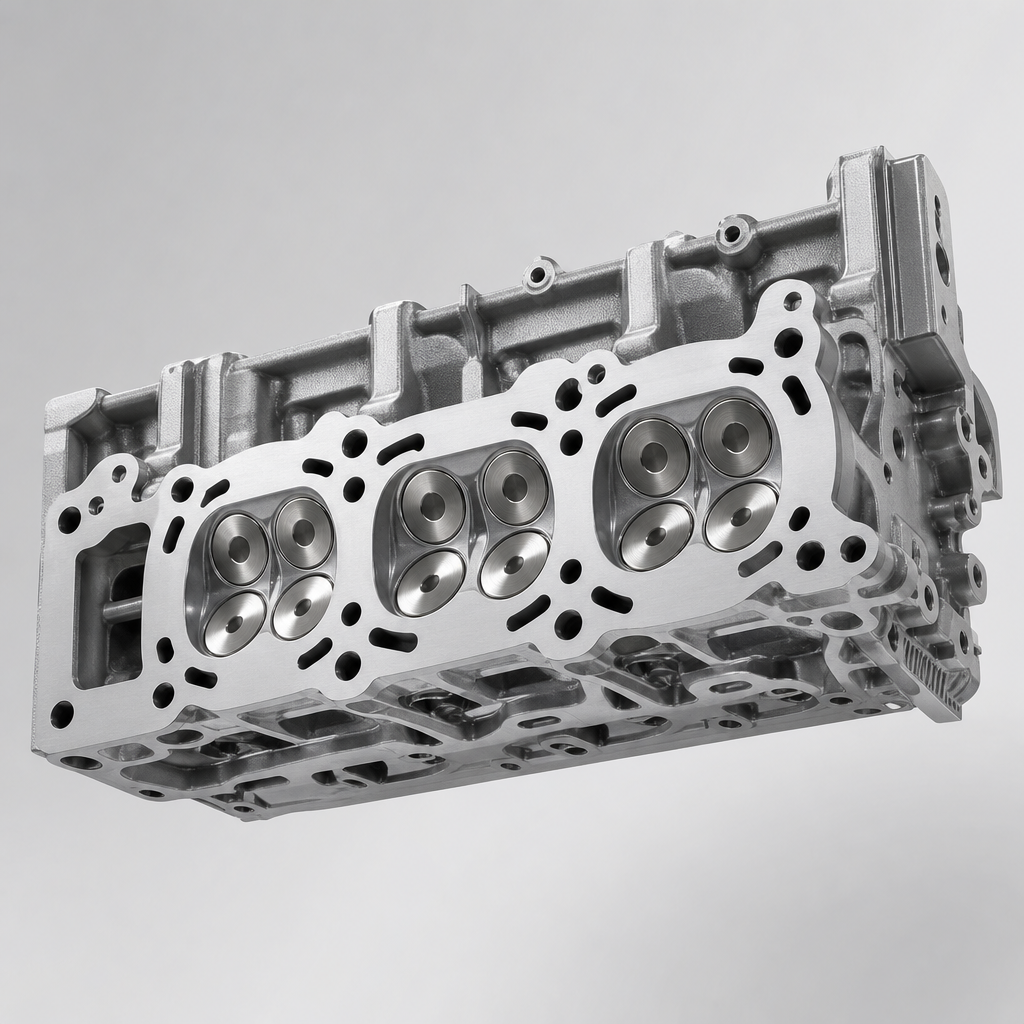
Cylinder Head Mercedes-Benz Supplier: B2B Sourcing Guide
Choosing a cylinder head Mercedes-Benz supplier is not mainly a catalogue exercise. It is a risk-screening exercise. Price matters, but repeatable casting quality, stable machining, documented inspection, and export reliability matter more once claims, downtime, and returns are counted. For distributors, repair networks, and private-label programmes, the real question is simple: can this source deliver the same part quality batch after batch, with traceability and fitment clarity that stand up under field pressure? That means looking past broad application lists and asking for process evidence: alloy grade and hardness range, flatness tolerance, seat concentricity, leak-test method, pilot-batch size, MOQ by SKU, and lead-time logic tied to casting, machining, assembly, and export. This guide breaks the evaluation into practical buying lenses: what good suppliers prove early, where failures usually start, how to audit the factory, how to compare offers beyond unit price, and what validation data should be on file before nomination. Driventus is an independent aftermarket manufacturer; brand names are referenced for fitment only.
Start with a decision framework, not the catalogue
A dependable cylinder head Mercedes-Benz supplier should be judged on three things at once: part conformity, process repeatability, and export execution. If one of those is weak, the programme is weak.
Use this as the first-pass filter:
Quality system maturity: current IATF 16949:2016 and ISO 9001:2015
Critical-dimension control: inspection plans for deck flatness, valve guide bore, cam bore alignment, and seat concentricity
Leak integrity: 100% pressure or air-decay testing where applicable
Material traceability: batch control for aluminium alloy castings, inserts, seats, and guides
OE reference discipline: clear cross-reference handling, including customer-supplied formats such as OE 06A107065 when used for verification or keyword context
Export packaging: corrosion protection, impact control, and pallet/carton validation
Document retention: dimensional reports, hardness data, leak-test records, and submission files on request
Catalogue width is useful. It is not the same as supply capability. A supplier may list hundreds of references and still struggle to hold tolerances on the part numbers that actually move.
Ask for numbers, not assurances. Typical control points often include deck flatness within 0.05 mm to 0.08 mm, valve seat concentricity within 0.03 mm to 0.05 mm TIR, guide bore tolerance within ±0.01 mm to ±0.02 mm, and gasket-face surface roughness in the Ra 1.6-3.2 um range where sealing performance requires it. For cam bores and carrier interfaces, suppliers should show CMM or fixture data, not only operator checks.
Good suppliers can also walk the route clearly: casting receipt, heat-number recording, incoming porosity review where used, rough machining, ageing or stress relief if applicable, finish machining, seat and guide installation, washing, pressure testing, final inspection, packing, and pallet coding. If assembled heads are offered, they should define exactly what is included and excluded.
One more sign of maturity: reaction control. A serious supplier can explain batch segregation, revision control, and the procedure followed after a quality alert. Record retention of 3 to 10 years is common depending on customer and market requirements.
Where cylinder head programmes fail: the audit points that expose risk
Most sourcing problems do not begin with the quote. They begin inside the process: unstable castings, drifting fixtures, weak cleaning, poor traceability, or packaging that looks acceptable until the first ocean shipment arrives.
A supplier audit should therefore focus on failure modes, not just equipment lists.
Recommended audit points
Audit area
What to verify
Why it matters
Casting source
In-house production or approved foundry list, alloy certificates, porosity controls
Casting defects can drive scrap, leakage, and warranty risk
CNC machining
Multi-axis capability, fixture repeatability, tool-life control
Stable machining affects bore alignment, surface finish, and sealing faces
Flatness inspection
CMM, granite table, straight-edge protocol, sampling plan
Deck distortion can contribute to head gasket failure
Valve seat machining
Concentricity and runout records
Poor seat geometry affects compression, durability, and emissions behaviour
Pressure testing
Test medium, pressure range, hold time, reject criteria
Confirms coolant and oil circuit integrity
Cleaning process
Deburring, washing, residual contamination checks
Residue can damage oil circuits and valvetrain components
Traceability
Heat number, batch code, process route, final inspector ID
Supports containment and root-cause analysis
Packaging
Unit protection, separators, pallet standard, drop resistance
Reduces transit damage and mixed-lot claims
</tr></thead><tbody> </tbody></table>A useful audit question is not “Do you inspect this?” It is “What happens when this goes out of tolerance?” Buyers should know whether production stops, suspect stock is isolated, affected batches are traced, and capability is reviewed—or whether the supplier simply sorts finished goods and ships the survivors.
Push past generic machine lists. Ask how many CNC stations are dedicated to cylinder heads, what fixture changeover time looks like, how often preventive maintenance is done, and what capability is achieved on critical dimensions. For mature references, many buyers want Cpk >= 1.33 on key characteristics, with Cp/Cpk studies from 25-50 consecutive pieces during launch or after major tooling change.
Pressure-test control deserves detail. Common buyer checkpoints are 100% testing at 2-5 bar air pressure or water-based equivalent, with a 30-120 second hold time depending on cavity volume and fixture design. Reject logic should be defined. So should false-reject tracking.
Cleaning is another quiet failure point. Machining chips left in oil galleries or water jackets can create immediate field issues. Verify multi-stage washing, air blow-off, and contamination checks such as residual particle limits or borescope confirmation where needed. If seats and guides are installed, confirm interference-fit control, heating/cooling method, and post-install machining.
Traceability should survive a live test. Pick one finished head and ask the supplier to retrieve its casting certificate, in-process inspection record, leak-test result, and shipment record within 15-30 minutes. If that cannot be done, traceability is weaker than it looks.
You can review our quality system for process and certification background.
How to plan MOQ and lead time without creating stock or service problems
MOQ and lead time are rarely one-number answers. They change by completion level, packaging model, and whether the reference is stocked, made to order, or built under private-label conditions.
At RFQ stage, buyers should separate these variables:
MOQ by reference
Pilot quantity for validation
Standard production lead time
Forecast horizon
Service model: ex-works stock, make-to-order, safety stock, or mixed
Engineering change notice rules
This matters because bare castings, machined heads, assembled heads, and custom-packed units do not move through the same route. A single generic MOQ can hide cost or delay later.
For uneven demand across many SKUs, buyers often need consolidation flexibility more than the lowest nominal unit price. A supplier that can combine several references in one shipment may support the programme better than one that forces high MOQ on each individual item.
As working benchmarks, aftermarket programmes often see:
20-50 pcs per reference for stocked standard heads
50-100 pcs for lower-run machined references
100-300 pcs for custom private-label packaging or non-standard machining routes
2-10 pcs for pilot approval
20-50 pcs for first controlled commercial release
Lead time should be broken into stages. A realistic structure may look like this:
2-4 weeks for raw casting availability if not already stocked
1-2 weeks for machining and insert operations
3-7 days for assembly where applicable
2-5 days for final inspection and packing
5-10 days for export documentation and consolidation
In normal conditions, repeat orders for stocked references may ship in 15-30 days. Custom-packed or made-to-order programmes more often run 30-45 days ex works. New drawing-based projects may need 45-90 days, especially when sample approval is included.
Also ask what happens when demand spikes. Can the supplier recover back orders? Are raw castings stocked? Are key references dependent on one fixture family? A quoted lead time that only works in quiet months is not a planning tool.
Pricing should be discussed together with MOQ and release pattern. A supplier may quote higher at 20 pcs and lower at 100 pcs or 300 pcs because setup, inspection cost, and pallet efficiency improve. For special variants, tooling or fixture charges may be amortised into the unit price above threshold volume or billed separately.
If you need non-standard specification, kitting, or packaging, Driventus supports custom manufacturing under controlled project review.
What to request before nomination: the minimum technical proof pack
Before nomination, buyers should have a data pack strong enough to answer one question: if this part fails in service, will we be surprised by something that should have been checked earlier?
The pre-nomination file should normally include:
Dimensional report on critical characteristics
Deck flatness result with inspection method stated
Valve guide bore and valve seat concentricity report
Cam bore alignment data where relevant
Pressure-test record with pass/fail criteria
Material declaration, including REACH (EC) No 1907/2006 where applicable
Surface finish or hardness data for specified features
Packing specification with unit and pallet photos
Sample approval record for first article or pilot batch
For assembled heads, request a complete assembly-content list. Buyers should know whether valves, springs, retainers, stem seals, cam caps, plugs, and similar items are included. This is a common source of disputes.
Do not accept “pass” without values. The report should show actual measurements and tolerance windows: deck flatness in mm, seat width, seat concentricity/TIR, guide ID/OD, cam bore diameter and alignment, gasket-face roughness Ra, and relevant thread gauge results. If hardness matters, ask for the specified range, test method, and sampling frequency.
Many sourcing teams use a reduced PPAP-style pack for pilot approval: ballooned drawing with results, material certificates, process flow, PFMEA/control-plan summary, gauge list, capability study for key dimensions, leak-test results, and signed sample identification. Practical sample quantities are often 3 pcs for initial fitment confirmation, 5 pcs for dimensional correlation, or 10-30 pcs when broader process evidence is required.
If private-label retail packing is part of the programme, include barcode verification, carton-dimension checks, and pallet-pattern approval in the same validation loop.
Where bare heads will be assembled locally, ask for the exact machining state. Are seats and guides installed? Are valve seats finish-cut? Are injector sleeves or glow-plug sleeves fitted where relevant? Are cam caps matched and line-bored with the head? Are sealing plugs already installed? Two suppliers may quote the same reference and still deliver very different completion levels.
For programmes linked to emissions-sensitive applications, fitment accuracy and sealing stability matter commercially. Component-level sourcing documents are not the same as full vehicle certification under regulations such as ECE R-83, so responsibilities should be stated clearly: what the supplier verifies, what an outside lab confirms, and what remains at vehicle level.
A practical supplier comparison model: beyond the cheapest EXW price
The cheapest ex-works number can become the most expensive programme. Returns, repacking, incoming inspection, leak failures, mixed lots, and emergency freight erase price gaps quickly.
A better comparison model scores each cylinder head Mercedes-Benz supplier across technical risk and operating cost—not only quoted price.
Comparison criteria for sourcing teams
Criteria
Supplier A question
Procurement impact
Certifications
Are IATF 16949:2016 and ISO 9001:2015 current?
Reduces audit and customer approval risk
PPM history
Can the supplier disclose internal reject and field claim trends?
Indicates process stability
Capacity
What is monthly output by reference family?
Supports demand spikes and launch planning
Tooling control
Who owns and maintains fixtures and gauges?
Affects repeatability over time
Change management
How are process changes notified and approved?
Protects fitment continuity
Warranty support
Is there an 8D process with containment timing?
Speeds issue resolution
Export execution
Can the supplier handle mixed-SKU pallets and destination documents?
Avoids shipping delays and warehouse errors
Technical response time
How quickly are drawing and deviation queries answered?
Important for launch and replenishment
</tr></thead><tbody> </tbody></table>A practical scorecard usually includes unit price, defect risk, lead-time reliability, documentation quality, and communication speed. For example, a head quoted at USD 145 with unstable packaging and inconsistent leak-test records may cost more in total than one quoted at USD 158 if the second source reduces claims and handling labour.
Challenge capacity claims with numbers. Ask for monthly installed capacity, normal utilisation, peak utilisation threshold, and the share already committed to current customers. “10,000 pcs/month” sounds strong until utilisation is already 85-90% and one fixture family supports most output.
Warranty support should be measurable too. Buyers can request timing such as 24-48 hours for first response, 72 hours for suspect-stock segregation, and 5-10 working days for formal 8D submission depending on issue complexity.
On export business, compare details that often get ignored until there is a delay: carton marking accuracy, HS-code support, country-of-origin paperwork, and ISPM 15 compliance where wood packaging is used.
One of the most reliable indicators is quotation-stage behaviour. Does the supplier clarify assumptions? Does it state exclusions? Does it flag where drawing confirmation is needed? Strong suppliers are usually precise early. Weak suppliers tend to be vague until the first issue appears.
That transparency prevents expensive mistakes: wrong completion level, mismatched OE reference, unrealistic MOQ, or a lead time that only worked for the sample batch.
Frequently asked questions
For automotive B2B sourcing, buyers commonly expect IATF 16949:2016 and ISO 9001:2015. These certifications do not guarantee part conformity on their own, but they do indicate a structured quality framework, traceability discipline, and controlled corrective-action process. Buyers should still request process-capability data, leak-test records, and dimensional reports for critical features such as deck flatness, seat concentricity, and guide bore tolerance.
MOQ depends on whether the part is a bare casting, machined head, or assembled unit. It is usually driven by setup cost, packaging format, assembly content, and SKU complexity. As a working aftermarket range, buyers often see about 20-50 pcs per stocked reference, 50-100 pcs for lower-volume machined heads, and 100-300 pcs for custom or private-label programmes. Pilot batches are commonly 2-10 pcs before full release.
Buyers should ask for critical-dimension reports, pressure-test records, material declarations, packing specifications, and sample approval documents. For regulated markets, compliance-related information such as REACH declarations may also be required depending on product scope and destination. The most useful approval pack includes measured values and tolerances, not only pass/fail status, plus a clear assembly content list for complete heads.
If you are qualifying a new supply source for cylinder heads, send your application list, annual volume forecast, target MOQ, packaging specification, and any required dimensional or leak-test standards to Driventus to **[request a quote](/contact.html)**.