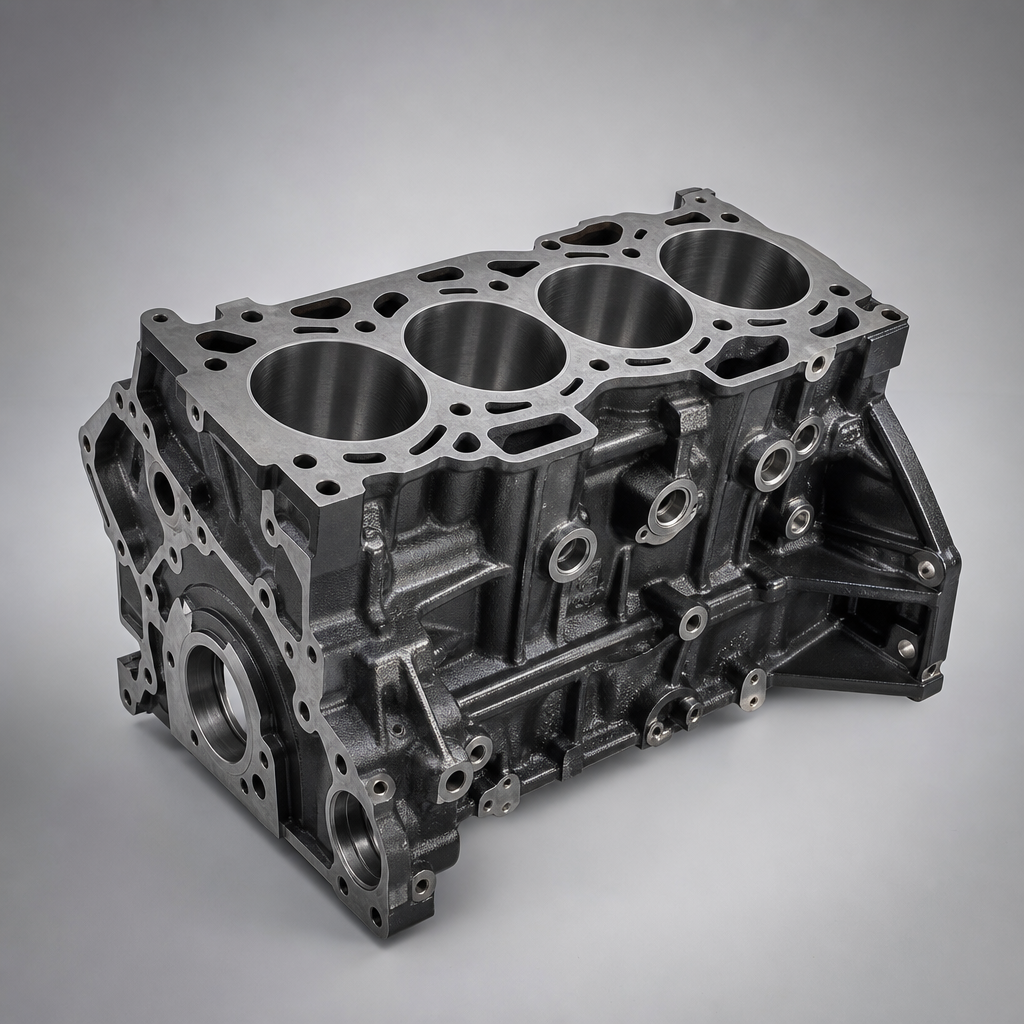
Cylinder Head Isuzu Manufacturer China: How Buyers Separate Capable Suppliers from Cheap Quotes
For importers and category buyers, sourcing a cylinder head from China is rarely a price-first exercise. The real question is whether the supplier can hold geometry, control casting risk, and ship repeat batches without creating warranty exposure. A cylinder head assembly depends on tight relationships between casting integrity, valve seat concentricity, guide-to-stem clearance, deck flatness, cam or rocker geometry, and pressure retention. In practical sourcing terms, buyer-critical values often include deck flatness within **0.03-0.08 mm** depending on application, valve seat concentricity around **0.02-0.04 mm TIR**, guide bore tolerance commonly in the **0.005-0.015 mm** range, and hydrostatic pressure testing at **0.3-0.5 MPa** with a **60-180 second** hold. Small errors here do not stay small once parts reach fleets, wholesalers, or repair-chain customers.
When reviewing a cylinder head Isuzu manufacturer China option, procurement teams should ask a more useful question than “Who is cheapest?” Ask instead: where can this programme fail, and does the factory control those points with records? That means checking foundry discipline, machining capability, inspection data, PPAP-style readiness where needed, and export documentation. It also means confirming whether the supplier offers bare castings, semi-finished heads, or complete assembled units with valves, guides, seats, springs, retainers, collets, and injector- or pre-combustion-related hardware where relevant. This guide is structured around how experienced buyers actually make the call: screen the supplier, verify the technical risks, compare supply models, audit the plant, sharpen the RFQ, and then decide whether the nominal unit price is telling the truth. Driventus is an independent aftermarket manufacturer; brand names are referenced for fitment only.
Start here: the five signals that tell you a quote is worth pursuing
Before discussing unit price, decide whether the factory is even comparable. Many quotations look competitive only because the technical and operational assumptions are still vague.
A cylinder head Isuzu manufacturer China candidate should show control in five areas:
- Quality management: certification to IATF 16949:2016 and ISO 9001:2015, plus evidence the system is used in production rather than kept for audits
- Material control: documented alloy grade, melt traceability, and incoming inspection for seats, guides, valves, springs, retainers, and seals where fitted
- Machining capability: CNC control for valve seat cutting, guide boring or reaming, deck milling, cam bore alignment, threaded feature inspection, and datum-to-datum positioning
- Validation discipline: pressure testing, hardness checks, dimensional reports, leak verification, and visual standards tied to written acceptance rules
- Export readiness: packaging stability, corrosion prevention, palletisation, HS code familiarity, and document support for international shipments
This first screen matters because price is easy to send; process evidence is harder. If a supplier cannot explain who controls casting, machining, assembly, and final test, the quote is not mature enough to compare.
One practical dividing line is manufacturing depth. Ask whether the factory controls the route from casting through machining and assembly, or whether major steps are subcontracted. Outsourcing is not automatically a disqualifier. It does, however, raise the burden of proof. You will need supplier audits, incoming acceptance limits, written ownership of non-conforming product, and clear traceability between subcontract batches and shipped lots.
At quoting stage, ask for hard process baselines rather than marketing claims:
- Casting alloy: aluminium heads are often based on Al-Si foundry alloys such as A356/AC4B-type equivalents
- Deck milling finish: gasket surfaces commonly controlled to Ra 1.6-3.2 μm depending on gasket design
- Valve seat interference fit: often around 0.05-0.12 mm, subject to drawing and material pairing
- Guide installation interference: often 0.02-0.06 mm, followed by finish sizing or honing
- Pressure test coverage: high-risk programmes may require 100% testing rather than batch sampling
If the supplier cannot state nominal tolerances, machine capability, or test parameters in numbers, stop there. The RFQ is still too loose. If you are reviewing scope across engine-component lines, see our catalog and the wider engine components range.
Where cylinder head programmes actually fail: the technical checkpoints that matter
A cylinder head can pass a visual check and still fail in service. That is why technical review should focus on failure modes, not cosmetic appearance.
Critical inspection items
- Casting soundness: porosity control in water jackets, valve bridge zones, and injector or glow-plug areas where relevant; some buyers allow visible pore limits such as ≤1.0 mm only in non-sealing cosmetic zones and zero acceptance in pressure-critical areas
- Deck flatness: measured after machining; common aftermarket diesel targets are often ≤0.05 mm across the gasket face, though the drawing governs
- Valve seat geometry: seat width, concentricity, contact pattern, and installed depth; contact width may sit around 1.2-2.0 mm depending on valve size and duty
- Guide bore and stem clearance: controlled by batch with offset or compensation records; operating clearances may be around 0.020-0.055 mm inlet and 0.030-0.065 mm exhaust depending on materials
- Cam tunnel or rocker geometry: bore alignment and finish where applicable; alignment is often checked with a master bar and finish controlled near Ra 0.8-1.6 μm
- Hydraulic test integrity: by 100% inspection or agreed sampling; typical conditions are 0.3-0.5 MPa, 60-180 s, with zero visible leakage
- Thread quality: injector, spark plug, manifold, and head-bolt threads checked with calibrated gauges under defined go/no-go rules
Why these points? Because cylinder heads live under thermal cycling, clamp load, coolant pressure, and combustion stress. A small drift in seat depth of 0.05-0.10 mm, a hidden porosity pocket, or an unstable threaded feature can become a warranty claim fast. In diesel applications, small movement in injector seat position or valve recession can affect sealing, noise, and service life.
Typical buyer document pack
| Document / Record | Why it matters | What to ask for | |
|---|---|---|---|
| Material certificate | Confirms alloy consistency | Heat number, alloy designation, and melt date | |
| Dimensional report | Confirms drawing compliance | Ballooned drawing with sample results and sample size | |
| Pressure test record | Reduces leakage risk | Test pressure, hold time, fixture type, and acceptance criteria | |
| Hardness report | Indicates heat-treatment stability | Test location, method, and range such as HB or HRB/HRC where relevant | |
| Process flow chart | Shows control points | Casting, heat treatment, machining, washing, assembly, final inspection | |
| Traceability format | Supports claims handling | Lot-code logic, carton label example, and date-code format |
| Supply model | Typical MOQ | Typical lead time | Notes |
|---|---|---|---|
| Existing aftermarket SKU | 50-200 pcs | 30-45 days | Usually workable when castings, seats, guides, and valves already sit in cycle stock |
| Private-label assembled head | 100-300 pcs | 45-60 days | Adds packaging approval, label or laser-mark control, and final assembly scheduling |
| New development / customised spec | 300-1,000 pcs | 60-120 days | Requires drawing review, samples, process validation, and sometimes new fixtures or tooling |
| RFQ item | Why it changes the quote | Example detail to request |
|---|---|---|
| Bare vs loaded head | Changes labour and bought-in content | List every included valve-train component |
| Pressure test method | Changes fixture and cycle time | 0.4 MPa / 120 s / 100% or agreed equivalent |
| Packaging level | Changes carton and pallet cost | Individual VCI bag, partition, pallet wrap |
| Branding | Adds setup and approval time | Laser mark, inkjet label, carton artwork |
| Sample requirement | Adds launch cost | 2-10 pcs for dimensional and trial-fit validation |