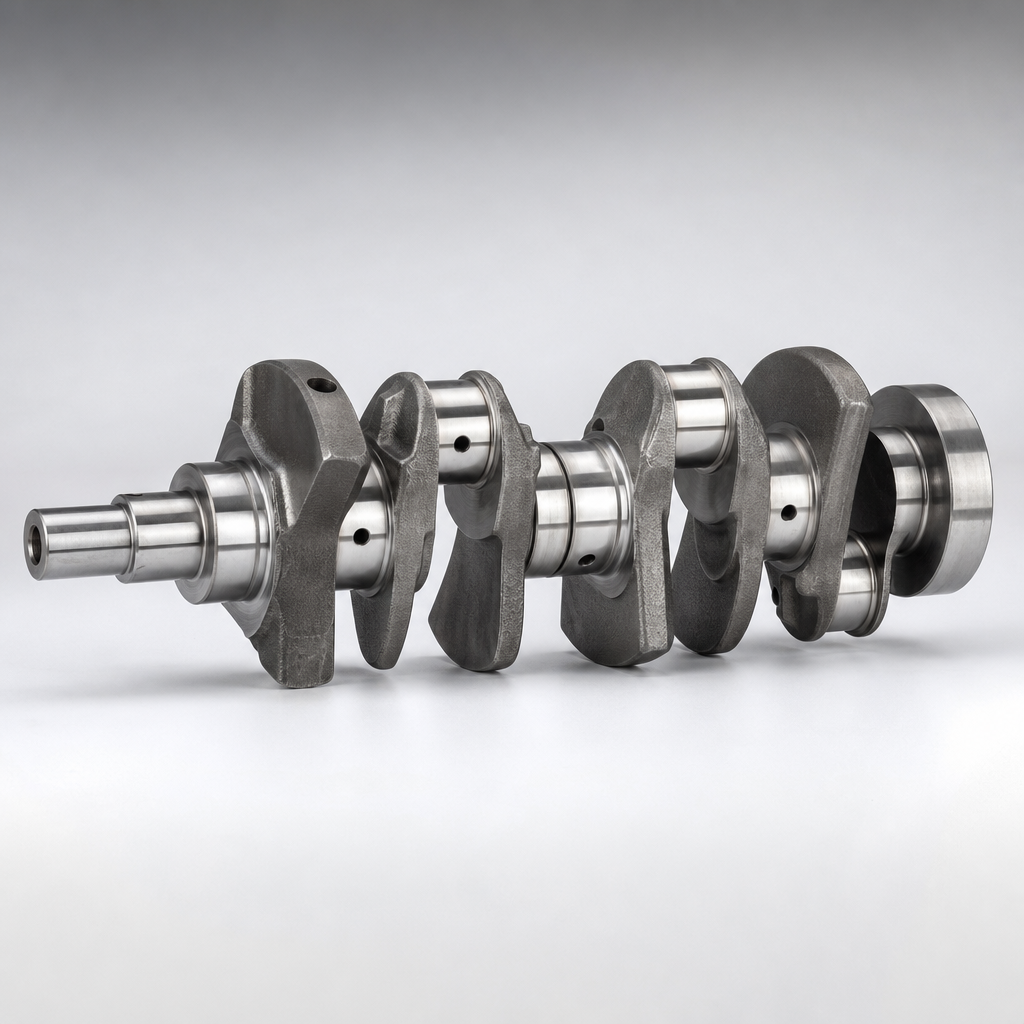
Crankshaft Ram OEM Supplier: How Buyers Separate Capability from Claims
When procurement teams evaluate a crankshaft ram oem supplier, the deciding factor is rarely the sales pitch. It is whether the factory can hold geometry, control metallurgy, trace every batch, and repeat that performance across real production volumes. Buyers need numbers, not adjectives: journal tolerance in mm, hardness window in HRC, runout limit, sample MOQ, production MOQ, tooling cost, and the true lead-time split across forging, machining, heat treatment, inspection, and export packing. Driventus manufactures crankshafts in Taizhou, Zhejiang for aftermarket, OEM, and Tier-1 programmes, with exports to more than 60 countries and certification to IATF 16949:2016 and ISO 9001:2015. We support sourcing teams that work from drawings, control plans, and shipment schedules—not assumptions. Driventus is an independent aftermarket manufacturer; any brand names mentioned are for fitment reference only. The sections below use a more practical lens: what to verify first, where suppliers usually fail, how lead times should really be compared, and which controls should be locked before an order is placed.
Start with the decision gate: can the supplier make this crankshaft to print?
The first screen is technical fit, not price. If the supplier cannot show control over the drawing, material route, and inspection method, the quote is only provisional.
What to verify up front:
Material specification: forged steel or ductile iron, matched to application; common routes include 42CrMo4 / AISI 4140 forgings and high-strength nodular iron to customer drawing
Heat treatment route: induction hardening, nitriding, or another defined process, with stated case depth and hardness range
Journal geometry: main and rod journal diameters, fillet radius, taper, and ovality, all tied to drawing tolerances
Dynamic balance: residual unbalance target set by drawing or customer specification, for example ≤15-30 g·mm per end for many passenger-vehicle applications
Surface finish: journal Ra and cleanliness requirements; typical journal finish may be Ra 0.2-0.4 μm after grinding and polishing
Traceability: heat code, batch code, and retention of inspection records by lot and shipment date
Ask for actual control values, not broad statements like "OEM quality" or "made to standard."
Item
Typical buyer target
Comment
Main/rod journal diameter tolerance
±0.005 to ±0.015 mm
Depends on engine family and bearing design
Journal taper
≤0.005 mm
Measured across full journal width
Journal ovality
≤0.003 to 0.008 mm
Ground journals usually tighter
Total runout
≤0.02 to 0.05 mm
Measured between centres or per drawing method
Fillet radius
As drawing, often ±0.10 mm
Critical for fatigue life
Surface hardness
52-62 HRC after induction hardening, if specified
Must be tied to depth and location
Case depth
1.5-4.0 mm typical
Effective depth depends on load case
</tr></thead><tbody> </tbody></table>If a programme references OE 06A107065 or another cross-reference, treat that as a starting point only. Final confirmation should be against the current drawing revision. For any crankshaft ram oem supplier, part-number matching without dimensional verification is a risk.
A strong first-pass RFQ package usually includes the drawing, engine code, target annual volume, required PPAP level if any, packaging format, and destination port. That is what allows the supplier to quote the right machining route, inspection scope, and freight basis.
Document test: what a capable supplier should produce before sampling
This is where weak suppliers often show themselves. A credible automotive factory should be able to produce controlled documents before the first sample is discussed in detail.
Item
What to request
Why it matters
Quality certification
IATF 16949:2016, ISO 9001:2015
Demonstrates process control and audit readiness
Material records
Mill certificate, chemistry report, heat number
Confirms alloy consistency
Dimensional reports
First article or PPAP-style report
Verifies critical dimensions
Testing records
Hardness, runout, balance, crack check
Supports incoming acceptance decisions
Compliance
REACH (EC) No 1907/2006 where applicable
Supports EU chemical compliance
</tr></thead><tbody> </tbody></table>For regulated channels, also ask how nonconforming product is handled, who approves rework, how deviations are released, and how long records are retained. A supplier’s quality system should be visible in the paperwork and workflow, not just on the wall.
The core document stack should include:
1. Drawing revision control: latest controlled drawing, customer approval date, and superseded revision history. 2. Process flow chart: forging or casting, rough machining, heat treatment, semi-finish machining, crack check, finish grinding, polishing, balancing, washing, rust prevention, packing. 3. Control plan: measurement frequency for critical dimensions, such as first-off, every 20-50 pcs, and final audit per lot. 4. FMEA or risk register: controls for distortion after heat treatment, grinding burn, burrs in oil holes, and wrong-marking risk. 5. Gauge calibration records: micrometers, roundness testers, hardness testers, balancing machines, MPI equipment, and runout fixtures. 6. Retention and traceability: many B2B buyers require 3-10 years depending on programme type; confirm the actual retention term in the supply agreement.
For OEM-style work, many buyers request PPAP-style content even where formal PPAP is not mandatory. A workable package usually includes a ballooned drawing, dimensional layout, material cert, hardness results, runout report, balance report, crack-detection record, process flow, control plan, and sample photos with marking.
If a crankshaft ram oem supplier cannot explain which documents are available at sample stage versus SOP stage, that is usually not an admin issue. It is a process-control issue.
Compare sourcing models properly: price, MOQ, and lead time are linked
Lead time for crankshafts is driven by the production route: forging availability, machining load, heat treatment queue, balancing, final inspection, and packing. That means two similar quotes can hide very different operational realities.
Key questions to ask:
1. Is the part produced from existing tooling or does it require new tooling? 2. What is the MOQ for samples, trial orders, and mass production? 3. Can the supplier hold safety stock for repeat programmes? 4. What is the documented lead time from purchase order to shipment? 5. How is packaging specified to protect journals and machined surfaces during transit?
For distributors and repair-chain buyers, supply stability often matters more than small short-term price changes. For OEM or Tier-1 programmes, the more important questions are whether the factory can manage APQP-style development, drawing revision control, and approval gates through custom manufacturing.
A practical comparison table:
Order type
Typical MOQ
Typical lead time
Pricing logic
Existing catalogue part, sample order
1-10 pcs
7-20 days if stock or semi-finished stock exists
Highest unit cost due to setup and packing overhead
Trial order from existing tooling
20-100 pcs
20-35 days
Lower price once machining setup is spread over batch
Repeat production order
200-1,000+ pcs
30-45 days
Best price stability with forecast and scheduled releases
New development with new tooling
Usually 100-500 pcs SOP MOQ after approval
45-90 days including tooling and sample approval
Tooling, sample machining, and approval costs must be amortised
</tr></thead><tbody> </tbody></table>When reviewing an RFQ, split the cost into two buckets: recurring and one-time.
Tooling or die cost: often charged once for new forgings or special fixtures
Sample cost: may be higher per piece because of setup, extra inspection, and expedited handling
PPAP or validation cost: sometimes quoted separately for OEM-style submissions
Freight term: EXW, FOB Ningbo/Shanghai, CFR, or DDP depending on buying model
The price curve usually follows a simple pattern. At very low volume, setup, balancing, and inspection dominate unit cost. At medium volume, tooling amortisation starts to spread. At stable monthly volume, steel purchasing and heat-treatment scheduling become more efficient. That is why a crankshaft that looks uncompetitive at 20 pcs may make sense at 300-500 pcs per release.
Also confirm the supplier’s lead-time start point. Some quote from drawing approval, some from deposit receipt, and some from final sample sign-off. If those definitions differ, the lead-time comparison is not real.
Failure-mode audit: where crankshaft programmes usually go wrong
Crankshaft problems are rarely random. Most field failures trace back to weak control in machining, heat treatment, cleaning, or final verification. A buyer audit should focus on those failure points directly.
Core inspection items
Main journal and rod journal diameter tolerance
Centerline runout
Thrust face width
Oil hole alignment and burr removal
Fillet radius consistency
Surface hardness profile after heat treatment
Magnetic particle inspection or equivalent crack detection
If the application is turbocharged or high-load, ask for evidence of fatigue validation and cleanliness control. Some buyers also request test methods aligned with SAE J2527 where corrosion or environmental exposure is relevant, and ECE R-83 where the programme is linked to emissions-related engine behaviour. The point is not to collect standards casually. The point is to confirm that every test claim is tied to a method, an acceptance limit, and an application requirement.
During audit, go beyond the final report and review the real process sequence:
1. Incoming blank verification: chemistry review, visual check, and random dimensional verification on forged or cast blanks. 2. Rough machining: datum creation, centre drilling, and stock allowance control before heat treatment. 3. Heat treatment control: furnace recipe, induction scan path, quench parameters, hardness mapping, and distortion monitoring. 4. Finish grinding and polishing: wheel specification, dressing frequency, burn prevention, and journal finish capability. 5. Oil-hole processing: chamfering, deburring, flushing, and borescope or visual confirmation where required. 6. Dynamic balancing: machine calibration, correction method, and residual unbalance record by part number. 7. Final cleaning and preservation: particle removal, anti-rust oil application, and capped or protected journals before packing.
Useful numeric checks on a sample lot:
Inspection point
Typical acceptance example
Why buyers ask
Runout
≤0.03 mm
Protects bearing life and vibration behaviour
Journal hardness
55-60 HRC
Confirms wear resistance after heat treatment
Hardness depth
≥2.0 mm effective depth where specified
Ensures load-bearing surface integrity
Surface finish
Ra ≤0.4 μm
Supports oil film formation
Residual unbalance
Per drawing, often ≤20 g·mm/end
Reduces NVH and field returns
MPI result
No linear indications in critical zones
Screens for cracks after processing
Cleanliness
No burrs, chips, or abrasive residue in oil holes
Prevents early engine damage
</tr></thead><tbody> </tbody></table>If a supplier says a dimension is "within standard," ask for the measured range and the method used. Example: measured with calibrated micrometer at 20°C, three positions per journal, 100% on finish-ground journals or SPC by batch. That is the level of specificity expected from a reliable crankshaft ram oem supplier.
What working with Driventus looks like after the inquiry
Driventus supplies crankshafts through both catalogue sales and programme-specific manufacturing. Buyers can review our catalog for standard coverage or visit engine components to see related powertrain parts that may be sourced together.
What procurement teams typically receive:
Drawing review and OE cross-reference check
Sample approval support with dimensional reports
Production traceability by batch and heat number
Export packing suitable for sea and air freight
Consistent communication for forecast-based orders
A useful supplier test is simple: request the same document set at the start of the discussion and again after order confirmation. A controlled factory should give the same answer both times. That consistency is often the clearest signal of an organised process.
A typical sourcing workflow is:
1. RFQ review: confirm drawing, OE reference, engine application, annual demand, and target Incoterm. 2. Technical feasibility: review forging availability, machining path, heat treatment route, gauges, and balancing requirement. 3. Commercial quotation: piece price by volume tier, tooling if needed, sample charge, packaging method, and estimated lead time. 4. Sampling: produce samples with dimensional report, material record, hardness data, and crack-check result. 5. Approval and SOP: lock revision, define marking and packing, then schedule production releases. 6. Repeat supply: support rolling forecasts, lot traceability, and claim feedback if field issues arise.
Buyer-side inputs that speed quotation:
2D drawing or approved sample
Required material grade and heat treatment
Critical-to-quality dimensions and tolerance list
Target MOQ or annual quantity, for example 300, 1,200, or 5,000 pcs/year
Required sample timing and SOP timing
Destination market and compliance needs
For logistics, crankshafts are usually packed with rust preventive, individual protection on machined surfaces, partitioned cartons or trays, and outer plywood cases for export. The packing design should account for part weight, centre of gravity, and prevention of journal-to-journal contact. Buyers shipping by sea should also confirm salt-air exposure protection and storage expectations, such as 3-6 months of corrosion protection under unopened packaging.
If you need pricing, capacity, or a technical review, request a quote.
PO-release checklist: the controls to lock before you buy
A sourcing checklist only helps if it becomes part of order release. Before placing a crankshaft order, confirm the technical file and the commercial file match exactly.
Use this checklist during supplier selection:
Confirm the exact engine application and revision
Match the OE cross-reference only after drawing verification
Review material, heat treatment, and balance requirements
Verify certification: IATF 16949:2016 and ISO 9001:2015
Request the dimensional report and inspection method
Confirm MOQ, lead time, and packaging specification
Check compliance requirements for the destination market
Record the escalation path for quality claims
This process suits aftermarket distributors, OEM buyers, and repair-chain procurement teams that need repeatable supply rather than one-off purchasing.
To make the checklist operational, add numeric sign-off items before PO release:
Checkpoint
Buyer should confirm
Example threshold
Drawing status
Latest approved revision on quote and PO
No mismatch between RFQ and order
Material
Grade and cert requirement
42CrMo4 / equivalent with heat number traceability
Journal tolerance
Critical dimensions listed on report
e.g. ±0.01 mm on finish journals
Runout
Final acceptance limit
e.g. ≤0.03 mm
Hardness
Range and test location
e.g. 55-60 HRC on specified journals
MOQ
Sample / trial / production MOQ
e.g. 5 pcs / 50 pcs / 300 pcs
Lead time
Start point and shipment basis
e.g. 35 days from deposit and drawing approval
Packaging
Unit pack and export pack standard
VCI + cap + carton + plywood case
Claim handling
Response time and replacement policy
24-72 hour initial response
</tr></thead><tbody> </tbody></table>Before issuing the order, ask the supplier to restate five points in the proforma invoice or order acknowledgement: part number and revision, quantity, unit price, lead time, packaging, and inspection documents shipped with the lot. That written confirmation prevents many avoidable disputes.
For any crankshaft ram oem supplier, disciplined order confirmation matters as much as machining capability. It is what connects the technical requirement to the commercial agreement.
Frequently asked questions
Yes. We supply standard catalogue parts and programme-specific crankshafts for B2B buyers. Brand names are referenced for fitment only, and every order should be confirmed against drawing and revision data. For OEM-style projects, buyers usually provide the drawing, annual volume, target PPAP level, and packaging specification so pricing and timing can be quoted accurately.
Typical documents include material records, dimensional inspection reports, hardness data, testing results, and traceability information. We also operate under IATF 16949:2016 and ISO 9001:2015 controls. Depending on the programme, buyers may also request a ballooned drawing, runout report, balance report, MPI or crack-check record, and sample marking photos.
Start with the engine code, drawing revision, and critical dimensions. OE cross-references such as OE 06A107065 can help narrow the match, but final approval should always be based on the technical file and sample verification. Key checks usually include main and rod journal sizes, stroke, flange details, oil-hole layout, reluctor or trigger features if applicable, and balancing specification.
Review the technical scope, compare options in our catalog, and send your requirements for a fast sourcing reply. Start here: /contact.html