Crankshaft pulley Vauxhall wholesale sourcing is a fitment, validation, and supply-control decision for importers and aftermarket distributors. A suitable pulley must match the target engine family’s belt profile, offset, bore, damping design, mounting geometry, and runout limits while also meeting commercial needs for MOQ, labelling, export packing, and shipment consolidation. Buyers need stable batches, dependable cross-reference data, and proof that the supplier can repeat tolerances across production runs, not just on a sample. Driventus manufactures engine and powertrain components in Taizhou, Zhejiang, and supplies B2B customers in more than 60 countries. For crankshaft pulleys, our work focuses on rubber-to-metal bonding control, CNC-machined interfaces, dynamic balance checks, corrosion-resistant finishes, and packaging designed for sea and air freight. Driventus is an independent aftermarket manufacturer; Vauxhall and other brand names are used only to identify fitment.
Wholesale Fitment Scope and Buyer Use Cases
For Vauxhall applications, crankshaft pulley demand usually comes from regional aftermarket distributors, repair-chain purchasing teams, and importers consolidating mixed engine-parts containers. These buyers need broad coverage, but coverage only works when the catalogue data is controlled and each reference is tied to a clear engine family.
A wholesale quotation should describe the application scope without implying vehicle manufacturer approval. Useful commercial fitment data includes:
Application family: passenger car and light commercial petrol or diesel platforms
Procurement teams can review related engine components in our catalog, including gasket sets, pistons, water pumps, and other rotating or sealing parts used in the same distribution channel. When crankshaft pulley demand is part of a wider sourcing programme, ordering by engine family is usually more efficient than treating each SKU as an isolated item.
Technical Requirements for Crankshaft Pulley Supply
A crankshaft pulley is not just a belt-drive wheel. On many engines it also works as a torsional vibration damper, helping control crankshaft oscillation and accessory-drive vibration. The rubber element, inertia ring, hub geometry, machining accuracy, and balance condition can affect belt life, accessory noise, front-end vibration, and long-term durability.
Key specification points for a wholesale crankshaft pulley programme include:
Specification item
Procurement check
Typical control method
Rib profile and groove count
Match belt system drawing or approved sample
Profile gauge and visual inspection
Bore and mounting face
Confirm datum, seating surface, and fit
CNC machining inspection
Axial offset
Control belt alignment across accessory drive
CMM or fixture gauge
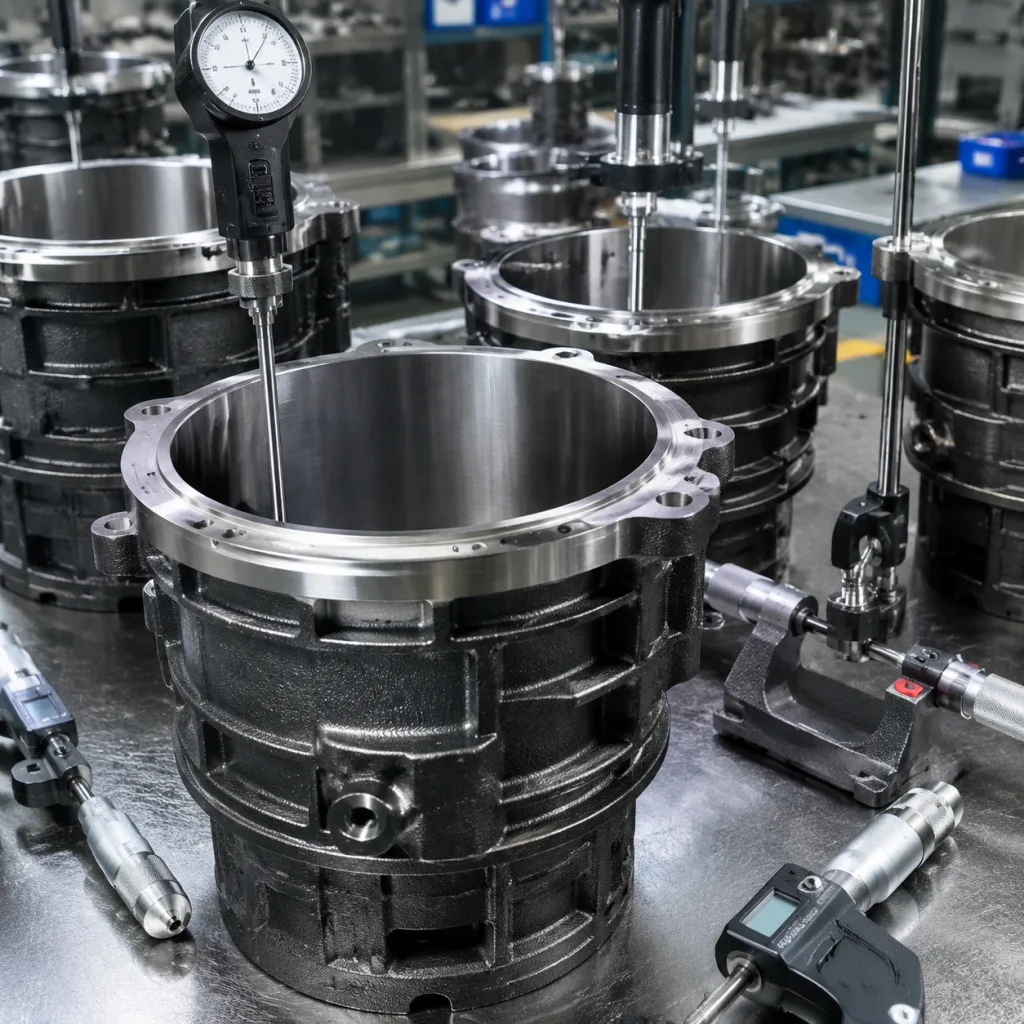
Radial and axial runout
Limit wobble and belt tracking problems
Dial indicator or runout station
Rubber-to-metal bond
Reduce separation risk under load and heat
Process control and batch testing
Dynamic balance
Reduce rotating vibration
Balance machine inspection
Surface finish
Resist corrosion during storage and transport
Coating thickness and salt exposure checks
</tr></thead><tbody> </tbody></table>Material choice depends on the pulley design and duty cycle. Common constructions include cast iron or steel hubs with bonded rubber damping elements, machined steel rings, and coated external surfaces. For rubber components, buyers should request the compound type, hardness range, bonding process, and ageing-control method. For metal parts, the supplier should be able to explain the casting or forging route, machining sequence, heat treatment where relevant, and coating specification.
Published management and compliance references that may support supplier qualification include IATF 16949:2016, ISO 9001:2015, and REACH (EC) No 1907/2006 for chemical substance controls affecting materials and coatings. These standards do not replace part-specific validation, but they help buyers judge whether the factory works within a controlled production system.
MOQ, Lead Time, and Packing Structure
Wholesale buyers should separate sample orders, first production orders, and repeat replenishment orders. A supplier that gives one lead time for every situation may not be allowing for tooling review, sample approval, packaging artwork, batch scheduling, or export consolidation.
A practical sourcing structure is:
Sample order: 5–20 pieces per SKU for dimensional inspection and fitment confirmation
Trial wholesale order: 100–300 pieces per moving SKU, depending on demand and carton volume
Repeat order: MOQ aligned to machining batch size, rubber bonding batch, coating process, and export carton plan
Lead time: commonly 30–60 days after deposit and confirmed packaging, depending on SKU mix and production load
Shipment mode: LCL, FCL, or air freight for urgent high-value replenishment
Documentation: commercial invoice, packing list, certificate of origin where required, and inspection summary
For crankshaft pulley Vauxhall wholesale orders, packing deserves early attention because pulleys are dense, machined parts with edges, rings, and coated surfaces that can be damaged in transit. Export cartons should prevent impact marks, ring deformation, corrosion, and barcode damage. A suitable packing plan normally includes an individual neutral or customer-branded box, internal restraint, moisture protection where required, master carton weight control, pallet wrapping, and pallet labels by SKU and batch.
Buyers should also confirm whether mixed-SKU cartons are allowed. They can reduce freight cost for slow-moving references, but they add receiving and put-away work at the warehouse. For high-volume references, single-SKU cartons with scannable labels are usually better for inventory control and claim traceability.
Supplier Audit Points for Importers
Factory audit preparation should focus on repeatability rather than presentation. A crankshaft pulley line needs control over incoming metal blanks, rubber compound handling, bonding, machining, balancing, surface treatment, final inspection, and packing. Buyers should ask for evidence that each process has defined parameters, measurable acceptance criteria, and records that can be traced to the shipped batch.
Useful audit questions include:
Is the plant certified to IATF 16949:2016 or ISO 9001:2015, and what product scope does the certificate cover?
Are incoming castings, forgings, steel parts, and rubber materials inspected by batch?
Are rubber mixing, storage, bonding temperature, pressure, and cure-time controls recorded for damped pulleys?
Are machining fixtures maintained and traceable to specific part families?
Is runout checked on every part or under a defined sampling plan?
Are balancing results recorded for references that require dynamic balance control?
Are nonconforming parts physically segregated from approved stock?
Can the supplier provide batch traceability from raw material to export carton?
Are packaging drop, humidity, or corrosion checks used for export markets?
Driventus operates under IATF 16949 and ISO 9001 certification. Buyers can review our quality system for information on process control, inspection methods, and quality documentation used for engine and powertrain components. Certification alone does not prove that a specific pulley is correct, so every new SKU should still pass dimensional review, sample approval, and first-batch inspection before routine shipment.
Cross-Reference Control and Custom Manufacturing
Cross-reference accuracy is one of the main sources of claims in pulley sourcing. The same vehicle model name can have different engines, accessory layouts, belt lengths, pulley diameters, and offsets depending on year, market, and trim. Buyers should not rely on a short application note when approving a crankshaft pulley Vauxhall wholesale programme.
For each SKU, a controlled sourcing file should include:
Customer part number and internal distributor code
OE-style reference supplied by the buyer, if available
Engine code or application family
Groove count and belt type
Pulley diameter and width
Bore, bolt pattern, and locating features
Mounting face offset and belt alignment datum
Damping construction type
Product photos from multiple angles
Sample inspection record and approved drawing revision
If the buyer has a sample, 2D drawing, 3D data, or an existing aftermarket reference, Driventus can review feasibility through custom manufacturing. This is useful when distributors need private-label coverage, regional application variants, or consolidation with other engine components from the same supplier base.
For new programmes, we recommend starting with the fastest-moving references, validating fitment and packaging locally, and then expanding into adjacent engine families. This approach reduces slow stock, improves forecast accuracy, and limits warranty exposure during the first purchasing cycle.
Quotation Data Buyers Should Provide
A complete RFQ reduces back-and-forth and improves pricing accuracy. For import managers and category buyers, the most useful input is not a long vehicle list; it is a controlled part file that combines technical, commercial, and logistics fields.
Minimum RFQ information should include:
Target SKU list and annual volume by reference
Required packing type: neutral, private label, or bulk
Destination port or delivery term, such as FOB Ningbo or CIF destination port
Required inspection documents and labelling format
Sample requirement and approval process
Target market compliance expectations, including REACH (EC) No 1907/2006 where applicable
Warranty handling method and claim evidence requirements
Supplied OE-style reference, drawing, 3D data, or approved sample where available
When a buyer requests pricing for engine-component bundles, related products can be reviewed through engine components. Bundling pulleys with timing covers, gaskets, water pumps, or other engine parts may reduce supplier-management workload and improve container planning, but each product family should still have its own inspection criteria.
Driventus is an independent aftermarket manufacturer; brand names are referenced for fitment only. We do not claim approval or endorsement by any vehicle manufacturer.
Frequently asked questions
MOQ depends on SKU, machining batch size, rubber bonding requirements, coating process, and packaging type. For new buyers, Driventus can discuss sample quantities first, followed by trial wholesale quantities for validated references.
Yes. Private-label supply is available for qualified B2B buyers. Packaging artwork, barcode format, carton marking, pallet labels, and inspection documentation should be confirmed before production scheduling.
Typical documents include quotation sheets, packing details, inspection summaries, certification information for IATF 16949:2016 and ISO 9001:2015, and batch traceability records where applicable. Part-specific validation records can be discussed during RFQ review.
If you are building a crankshaft pulley sourcing programme for Vauxhall applications, send your SKU list, target volumes, cross-reference data, and packing requirements to [request a quote](/contact.html).