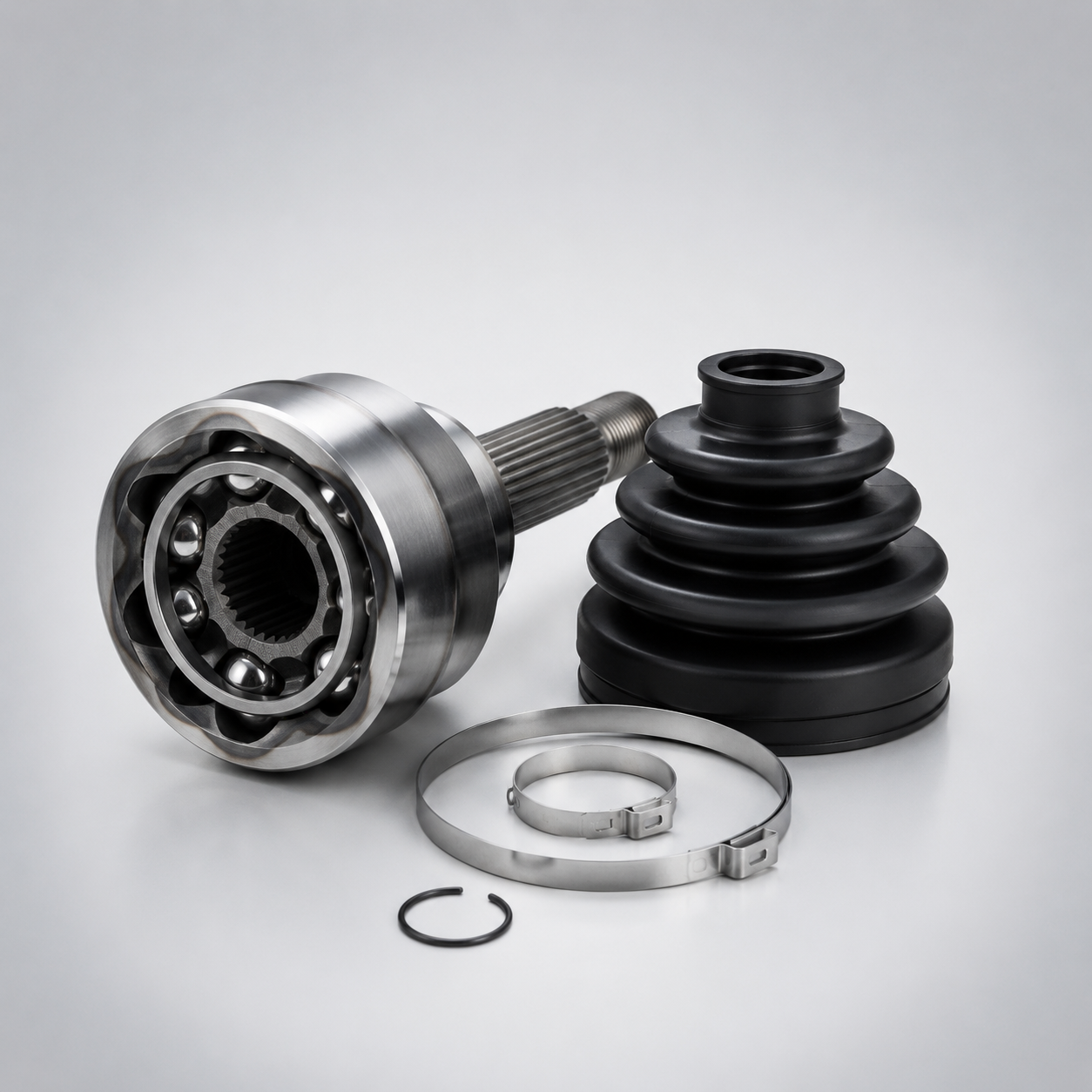
Crankshaft Pulley Renault Wholesale Sourcing Guide
For importers, wholesalers, and aftermarket distributors, sourcing a crankshaft pulley for Renault applications is not a simple unit-price exercise. The part has to match belt geometry, damping behavior, hub fit, and service-life expectations across different Renault engine families. If that control slips, the downstream problems are predictable: belt noise, belt walk, premature rubber separation, installation trouble, and expensive warranty returns.
This guide looks at crankshaft pulley Renault wholesale sourcing from the buyer’s side of the table. The focus is practical: how to compare suppliers, what technical data actually matters, where failures usually start, and how MOQ, documentation, production control, and logistics affect the real cost of supply. Driventus is an independent aftermarket manufacturer; any brand names mentioned are for fitment reference only.
For most buyers, the job is to reduce three risks at once: fitment mistakes, unstable landed cost, and avoidable claims. That means asking for specifics before RFQ comparison. At minimum, request actual outer diameter range, rib count, bore tolerance, runout limit, elastomer hardness window, coating type, sample MOQ, production MOQ, quoted EXW or FOB basis, standard lead time, and claim-response timing. A quote built on those fields is far easier to compare than a catalogue line with only an application note and a price.
Start with a go/no-go screen before you compare prices
A crankshaft pulley—often catalogued as a vibration damper or harmonic balancer—directly affects belt-drive stability and NVH. For Renault fitments, visible groove count and outside diameter are only the first layer. Serious buyers screen the technical control points first, then talk price.
Use this as an initial go/no-go checklist:
Bore and hub dimensions: interference-fit or slip-fit values must match OE requirements and the intended installation method. Ask for nominal bore size with tolerance, keyway or locating-feature detail, and hub-face perpendicularity data.
Axial and radial runout: poor control drives belt noise, tensioner movement, accessory wear, and complaints. Many buyers work with internal targets such as radial runout within 0.10-0.20 mm and axial runout within 0.10-0.15 mm, depending on design.
Elastomer specification: hardness, heat resistance, oil resistance, and bond quality determine damping and life. A common request is Shore A hardness with an allowed production window, such as nominal ±5 Shore A.
Groove profile: multi-rib geometry has to match the belt section. Request groove angle, pitch, crest/root profile, and gauge method instead of relying on photos.
Surface protection: coating type and coverage matter in sea transit and humid storage. Common finishes include black phosphate, electrophoretic coating, or paint systems with recorded thickness where applicable.
Dynamic balance: weak balance control can increase NVH and accessory loading. Ask whether the supplier uses 100% checking or sampling, and what residual unbalance limit applies.
Traceability: batch code, raw-material lot, and inspection records should link back to carton labels and production date.
A useful buyer habit is to force all suppliers to fill in one comparison sheet with the same numeric fields: nominal OD, rib count, belt profile, bore tolerance, key installation dimensions, runout result, hardness result, coating type, piece weight, carton quantity, and batch-code format. That quickly shows whether two similar quotations are based on the same control level.
If a supplier cannot provide controlled drawing checks, inspection data, and a clear fitment structure, a low unit price is not a serious advantage.
For buyers building a wider Renault range, it also helps to review how the supplier manages catalogue data and engine-family coverage. Where needed, buyers commonly review our catalog and related engine hard-part lines at /products/engine-components.html.
Compare suppliers by failure mode, not catalogue size
A supplier can list dozens of Renault references and still be a weak choice. The better comparison is simple: where is this supplier most likely to fail you—documentation, process control, MOQ rigidity, packaging, or complaint handling?
Evaluation point
What to request
Why it matters
Quality certification
IATF 16949:2016, ISO 9001:2015 certificates
Shows formal process control, document discipline, and corrective-action structure
PPAP-style documentation
Drawing check, material data, process flow, control plan where applicable
Helps confirm launch discipline and repeatability
MOQ
Per-item MOQ and mixed-order MOQ
Determines inventory exposure on fragmented Renault references
Lead time
Sample lead time, first-order lead time, repeat-order lead time
Affects replenishment and stock-cover planning
Test capability
Runout inspection, bond testing, coating checks, salt spray, durability checks
Shows whether the supplier verifies more than appearance
Packaging
Individual protection, label format, barcode support, carton-drop resistance
Reduces transit damage and warehouse errors
Compliance support
REACH (EC) No 1907/2006 declaration where relevant
Critical for distributors serving multiple markets
</tr></thead><tbody> </tbody></table>When comparing quotes, push for structure. Request at least three volume breaks per reference—such as 300 pcs, 1,000 pcs, and 3,000 pcs—plus any mixed-order policy. Without that, the cheapest quoted line may only be cheap at a volume you will never buy.
Cost also needs to be unpacked. Clarify:
whether tooling amortisation is included or separate
whether price changes track steel, rubber, or coating thresholds
whether neutral and private-label packaging are priced separately
whether sample cost is refundable against the first order
whether the quote is EXW, FOB, or CIF
In practice, trial-order pricing on low-volume Renault references often lands 8-20% above repeat-volume pricing. Custom packaging can add a small per-piece uplift plus carton-tooling cost. The exact figure matters less than the supplier’s ability to explain it clearly.
A factory with a documented quality system is usually easier to audit and onboard. If private-label packaging, market-specific coatings, or retailer barcode rules are part of the programme, define them early under custom manufacturing rather than after quotation.
Where pulley programmes usually fail in the field
Most field failures do not begin with a dramatic visible defect. They begin with a small control gap that passes incoming inspection and only shows up later as noise, tracking, vibration, or early separation. In any crankshaft pulley Renault wholesale programme, these are the weak points worth watching.
1. Concentricity drift
Poor hub concentricity can create belt flutter at idle, unstable tensioner behavior, and accessory-drive complaints. The part may install normally and still fail in service. Ask for the measurement method, fixture reference, and actual result in millimetres—not just pass/fail.
2. Elastomer instability
The bonded rubber element has to survive oil mist, ozone, contamination, and thermal cycling. Hardness drift and bond degradation reduce damping over time. Buyers often request initial Shore A hardness, post-ageing hardness change, and bond-condition review after thermal exposure such as 120-140°C cycle testing where relevant.
3. Groove inaccuracy
Incorrect rib profile, pitch, or surface finish can cause belt chirp and accelerated wear. Confirm whether the supplier checks groove geometry with dedicated gauges, profile projectors, or CMM at first-off stage.
4. Face misalignment
Small offset errors shift belt tracking and often show up as belt-edge wear or repeated tensioner movement. A practical RFQ field is permitted face runout or offset relative to the mounting face.
5. Corrosion before installation
Long sea transit and warehouse storage expose weak coatings quickly. Unprotected bores, edges, and sealing faces can oxidise before the part reaches the workshop. For export programmes with 30-60 days at sea and several months in stock, coating confirmation and salt-spray performance should be part of review.
6. Mass or damping inconsistency between batches
A sample that performs well once is not enough. Batch-to-batch change in mass distribution or damping construction can alter NVH behavior. Recording part weight within an agreed tolerance band is a simple way to catch drift.
Typical validation requests
dimensional report against a controlled drawing
radial and axial runout measurement
rubber hardness record
bond integrity or torsional durability summary
coating thickness or salt-spray result where specified
balance verification where design requires it
packaging specification and carton-label sample
Buyers often define sample quantity as well: 3-5 pcs per reference for bench inspection, then 10-30 pcs for a trial order, with a golden sample retained by both sides. For strategic references, a pilot batch may also include destructive bond checks on retained samples from the shipped lot.
The exact plan changes by market and customer risk. But the principle does not: technical review has to be tied to measurable data, not catalogue confidence.
Build the commercial plan around mixed-fitment reality
Renault application portfolios rarely move at one speed. A few references turn fast; many do not. That is why MOQ and lead-time planning matter as much as technical approval when buying crankshaft pulley Renault wholesale supply.
Typical points to confirm:
Sample MOQ: often 1-10 pcs per reference for validation and fitment checks
Trial-order MOQ: commonly lower for mixed fitments than for one high-volume item; for example 20-50 pcs per reference with a combined total of 200-500 pcs
Production MOQ: often driven by tooling use, bonding setup, machining efficiency, and packaging batch size; neutral packing may start around 100-300 pcs per reference, while private-label orders may rise to 300-1,000 pcs
Packaging lead time: new cartons, labels, inserts, and barcode approval can add 7-15 days
Forecast window: quarterly plans or rolling six-month forecasts help reserve capacity
Shipping mode: LCL for trial orders, FCL for replenishment, air freight only for urgent gaps
One useful question: does the supplier keep semi-finished stock for common pulley bodies, or does every order start from raw material? The answer can change repeat-order lead time materially.
Typical timing logic looks like this:
Samples from existing tooling: 7-15 days
First production order: 30-45 days after deposit, artwork approval, and sample confirmation
Repeat order: 20-35 days if material or semi-finished stock is available
New-tool or major modification projects: 45-75 days
From a logistics angle, verify:
carton quantity per reference
gross and net carton weight
pallet pattern and pallet height
HS code confirmation
moisture protection for export cartons
label content, including internal code, batch traceability, and country-of-origin format where needed
Also clarify whether mixed-reference pallets are acceptable, how shortages are reported before shipment, and whether pre-shipment photos or reference-by-reference packing lists are available.
For slower-moving Renault references, buyers often get better landed cost by grouping multiple part numbers into one monthly or bi-monthly shipment instead of chasing the lowest theoretical single-item price.
Audit the process like an operator, not a visitor
A useful factory audit is not about polished presentations. It is about whether the process can hold repeatability from incoming material to packed goods.
Focus the audit on these points:
incoming inspection for steel, cast components, coatings, and elastomer materials
tooling-maintenance records for machining and groove-forming operations
control of bonded assembly parameters where applicable
first-off and in-process inspection frequency
final inspection standards for runout, appearance, marking, and packing
segregation and disposition of non-conforming material
batch traceability from raw material to shipment
complaint handling, root cause analysis, and corrective-action flow
For EU and UK importers, compliance support may include material declarations linked to REACH (EC) No 1907/2006 where relevant. Packaging declarations, carton markings, and label consistency also matter, especially when goods move through multiple warehouses or under several labels.
Do not stop at “yes, we inspect that.” Ask how often. A supplier may check first-off dimensions at every setup, runout every 30-50 pcs, hardness by lot, coating thickness per batch, and visual condition at 100% before packing. The exact rule may vary by reference, but the factory should be able to explain it and show recent records.
Useful audit questions include:
What dimensions are critical, major, and minor?
What sampling plan is used for in-process and final inspection?
How is lot size defined for traceability and retained samples?
How long are records and retained samples kept?
What is the target response time for containment, 8D, and replacement?
Many distributors prefer initial containment feedback within 24-72 hours and a structured corrective-action report within 7-10 working days. That matters when stock is already spread across several warehouses.
If the programme involves customer-specific markings, retailer labels, bespoke kits, or controlled private-label formats, lock those details under custom manufacturing before SOP.
A step-by-step rollout plan for a stable Renault pulley programme
The most stable supply programmes are phased. Engineering, purchasing, quality, and warehouse teams all need to line up before volume release.
1. Screen the references Separate high-volume, strategic, and slow-moving fitments. Many buyers rank parts by annual demand, return risk, and competitive pressure before deciding what enters phase one.
2. Lock the technical standard Confirm critical dimensions, groove detail, damping construction, coating expectation, test items, golden-sample handling, and batch-marking rules.
3. Approve samples with data Check installation fit, runout, packaging suitability, and shelf presentation. Record measured values; do not rely on visual comments alone.
4. Run a pilot order Validate transit condition, receiving accuracy, and first market feedback. A pilot quantity of 20-100 pcs per reference is common, depending on demand profile.
5. Release volume with commercial controls Finalise forecast, packaging standard, label format, price tiers, and claims procedure.
If you are replacing an existing source, compare old and new parts directly for mass, groove geometry, visible bond quality, finish consistency, and marking logic before switching the market. That catches avoidable returns caused by unnoticed spec drift or packaging confusion.
Commercial thresholds should also be defined early. A buyer may accept higher pricing on references selling fewer than 200 pcs per year, while demanding annual rebate, fixed pricing, or raw-material review clauses on items above 1,000-3,000 pcs annually. That keeps slow movers from being overbought simply to hit an unrealistic MOQ.
If internal cross-reference notation is needed, use OE-format references only where available—for example OE 06A107065 style notation—and avoid loose catalogue substitutions that create confusion across systems.
Driventus supports B2B buyers with documented process control, export packaging options, and mixed product sourcing across engine and powertrain components. To discuss fitment coverage, MOQ, or a validation plan, use request a quote.
Frequently asked questions
MOQ depends on the reference, production method, packaging format, and whether the order is mixed across several Renault applications. In practice, sample MOQ is often 1-10 pcs, mixed trial orders may run around 20-50 pcs per reference with a combined total MOQ, and standard repeat production can start around 100-300 pcs per reference for neutral packing. Private-label packaging or slower-moving items may require higher MOQ because of carton printing, setup, and packing efficiency.
Buyers typically ask for IATF 16949:2016 and ISO 9001:2015 certificates, dimensional inspection reports, drawing checks, material or compliance declarations where relevant, packaging specifications, and a defined claims handling process. For bonded pulleys, it is also useful to request validation data related to radial and axial runout, hardness, bond performance, coating confirmation, and batch traceability format. If the project is commercially important, ask for quoted MOQ tiers, sample lead time, repeat lead time, and inspection frequency in writing as part of supplier approval.
Yes, usually subject to MOQ, artwork approval, and lead time for carton and label preparation. Buyers should confirm carton size, label format, barcode requirements, pallet standard, and any retailer-specific marking rules before the first production order. In many programmes, new private-label packaging adds about 7-15 days for artwork and print preparation, and carton MOQ may be higher than the part MOQ itself, so both cost and lead-time impact should be quoted separately.
If you are reviewing Renault pulley supply for distribution or private label, Driventus can provide technical and commercial details for evaluation. Contact our team to discuss fitment scope and order planning at /contact.html