Buying a crankshaft pulley for Peugeot applications is a sourcing task, not a catalogue search. The part must match the engine family, belt layout, offset, bore, and torsional damping requirement, then survive long-distance supply, incoming inspection, and field use. For procurement teams, the practical questions are lead time, minimum order quantity, dimensional consistency, corrosion protection, and documented quality control. Driventus is an independent aftermarket manufacturer; brand names are referenced for fitment only. For buyers comparing suppliers, the most useful evidence is a clear specification pack, lot traceability, and a stable process backed by IATF 16949:2016 and ISO 9001:2015. This article explains what to verify before placing a production order, how to compare supplier claims, and where custom manufacturing can reduce risk when an OE cross-reference is needed for a Peugeot programme.
What procurement teams should verify first
A Peugeot crankshaft pulley is usually purchased against a defined engine code, belt drive configuration, or OE reference, but the procurement decision should start with measurable requirements.
Item
What to confirm
Why it matters
Outer diameter
Match to belt path and accessory drive speed
A small change affects alternator and A/C load
Bore and keying
Crank nose fit and retention method
Controls concentricity and installation reliability
Offset and groove count
Alignment with the accessory drive
Prevents belt walk and abnormal wear
Damping design
Solid, decoupled, or elastomer bonded
Impacts vibration control and service life
Material and coating
Steel, cast iron, phosphate, e-coat, or zinc finish
Affects corrosion resistance and mass
</tr></thead><tbody> </tbody></table>If the part is sourced for Peugeot programme support, ask for a dimensional drawing, material declaration, and sample approval plan before release. For wider engine-family sourcing, see our catalog and the related engine components range.
Why supplier capability matters more than a part number
A crankshaft pulley can look simple while still carrying tight functional requirements. For B2B buyers, supplier capability is the difference between a part that fits on day one and a part that creates belt noise, vibration, or premature bearing load.
A serious supplier should be able to document:
CNC machining capability for bore, face, and concentric features
Dynamic balancing control where the design requires it
Incoming inspection for bar, casting, or forged blanks
Batch traceability from raw material to finished carton
Packaging that prevents flange damage and oil contamination
Stable lead times for repeat orders and programme replenishment
If you are comparing OEM supplier options, ask how the factory manages PPAP-style documentation, first article checks, and running change control. For buyers who need non-standard geometry or private-label packaging, custom manufacturing is usually the correct path rather than forcing a generic catalogue part into a constrained application.
Quality controls that reduce warranty risk
The best supplier evidence is not a sales statement. It is process control.
Driventus uses a documented quality system aligned with IATF 16949:2016 and ISO 9001:2015. For crankshaft pulleys, the controls that matter most are:
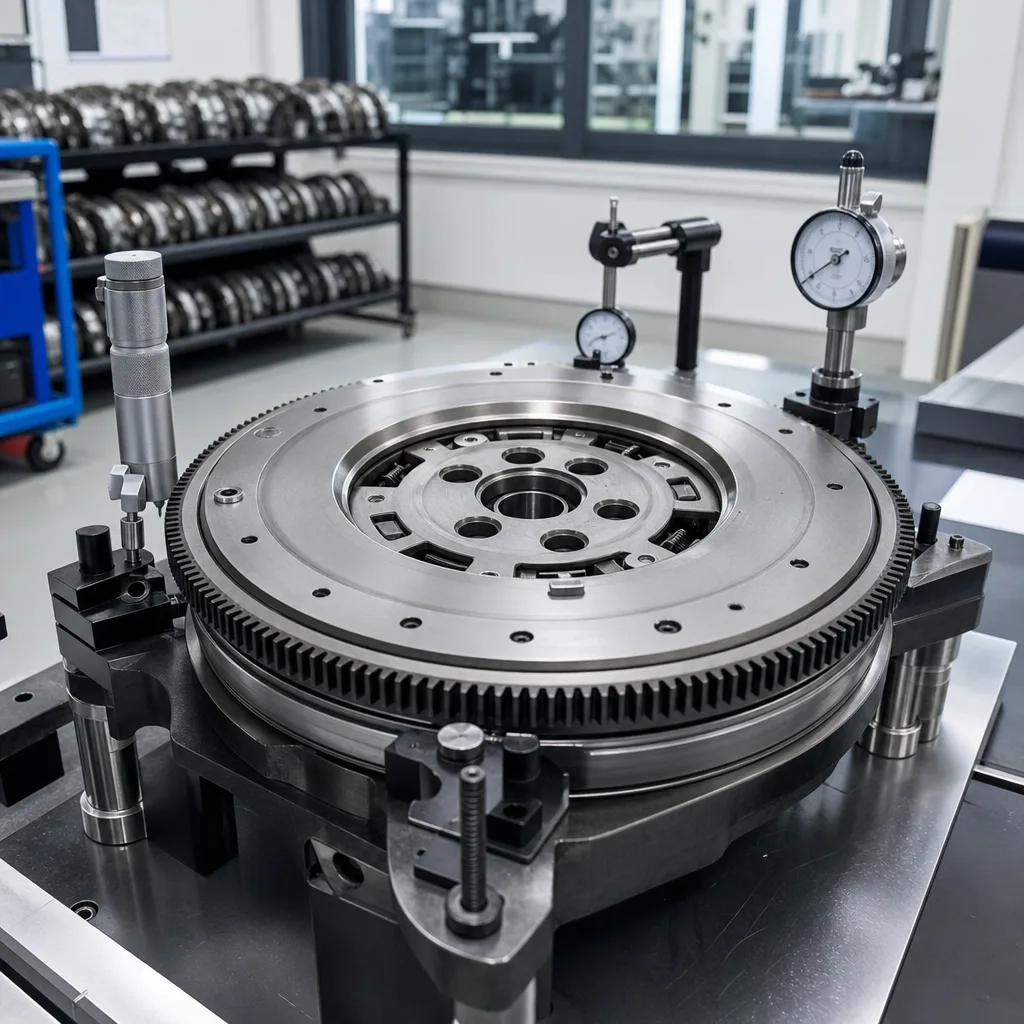
Concentricity and runout checks against the drawing
Bore diameter inspection and fit verification
Torque retention or fastening interface checks, where applicable
Balance verification for dynamically sensitive designs
Surface finish and coating thickness checks
Salt-spray or corrosion testing when specified by the buyer
For markets with emissions or durability-related compliance questions, purchasers may also ask whether the component fits programmes referenced under REACH (EC) No 1907/2006 and, where relevant to the vehicle system, ECE R-83 or SAE J2527 test plans. Those references do not replace buyer specification control, but they help align expectations between engineering, quality, and commercial teams.
A supplier should be able to provide inspection records by lot, not only a generic certificate.
Commercial terms that matter in international sourcing
For import managers, the technical fit is only half the decision. The commercial structure has to support repeat supply.
Typical points to lock down early:
MOQ by part number, not by product family
Standard lead time for sample, trial, and mass production
Incoterms and packing specification
Country-of-origin marking and carton labelling
Spare-parts availability window for mature programmes
Change-control notice period for tooling, material, or finish changes
If a Peugeot application is forecasted across several regions, separate the launch quantity from the steady-state replenishment plan. That makes it easier to protect service stock without overcommitting inventory. Buyers often reduce risk by requesting a pilot lot first, then moving to scheduled releases once dimensional stability is confirmed.
How to compare suppliers on a like-for-like basis
Use the same evaluation sheet for every quote. Otherwise, price comparisons are not meaningful.
A practical scorecard looks like this:
1. Drawing match: confirmed against the same revision level 2. Material declaration: available and consistent with the application 3. Dimensional report: supplied with sample or first batch 4. Process control: machining, balancing, coating, and packaging documented 5. Traceability: lot codes and retention records available 6. Logistics: lead time, palletisation, and export readiness 7. Commercial risk: warranty handling, claim response, and replacement policy
For larger programmes, ask the supplier to explain where standardisation is possible and where a custom setup is safer. The lowest unit price is not useful if the part requires rework, field replacement, or emergency air freight.
If you need a proposal for a Peugeot-linked programme, request a quote with the target engine family, annual volume, and the drawing or OE cross-reference you are working from.
Recommended specification pack before ordering
Before releasing purchase orders, ask for a complete pack that includes the following:
Engineering drawing with tolerances
Material and finish declaration
Dimensional inspection report
Balance or runout record, if applicable
Packaging specification
Traceability format and lot marking example
Sample approval or trial lot summary
This pack lets the buyer, receiving team, and downstream distributor check the same facts. It also reduces the chance that a visually similar pulley enters the wrong SKU bucket. For Peugeot programmes with multiple engine variants, the specification pack should be tied to the exact application and not just a broad vehicle platform description.
Frequently asked questions
Confirm the engine family, pulley diameter, bore, offset, groove count, and damping design. Ask for a drawing, material declaration, and dimensional report before PO release.
Yes. If your programme needs a non-standard finish, packaging, or geometry, [custom manufacturing](/oem-services.html) is the better route than a generic catalogue substitute.
At minimum, expect documented control aligned with IATF 16949:2016 and ISO 9001:2015, plus lot traceability and inspection records for each batch.
Send your target application, volume forecast, and drawing details, and we will review the best supply path for your programme. [Request a quote](/contact.html)